The US estimated damage from cryptocurrency fraud at $80.7 billion

cryptonews.ru2026-07-29 tarihinde yayınlandı2026-07-29 tarihinde güncellendi

Özet

According to a report by the Consumer Federation of America (CFA), U.S. citizens lost an estimated $80.7 billion to cryptocurrency fraud in 2025. This figure is derived from data reported to the FBI's Internet Crime Complaint Center (IC3), which received 181,565 crypto-related complaints with claimed losses of $11.37 billion—a 22% increase from 2024. The CFA applied a 7.1 multiplier to account for significant underreporting. Cryptocurrency fraud accounted for over half of all losses reported to IC3. The largest category of reported damage was investment fraud, totaling $8.6 billion (estimated $61.4 billion after the multiplier). The FBI specifically noted 61,559 crypto investment fraud complaints with losses of $7.23 billion. Individuals over 60 were disproportionately affected, reporting $4.43 billion in losses from 44,555 complaints. Overall, IC3 received over 1 million complaints across all internet crimes in 2025, with reported losses of $20.88 billion. The CFA estimates total losses at $148.2 billion, or $1,009 per U.S. household. For the first time, the FBI separately tracked AI-enabled crimes, logging 22,364 complaints with $893.3 million in reported losses (estimated $6.3 billion). The FBI also highlighted its "Operation Level Up" initiative, launched in 2024, which has prevented over $500 million in potential crypto fraud losses.

In 2025, US citizens lost $80.7 billion due to cryptocurrency fraud. These figures were cited by the Consumer Federation of America (CFA).

The calculation is based on data from the FBI's Internet Crime Complaint Center (IC3). Last year, IC3 recorded 181,565 reports with a cryptocurrency component. The reported damage amounted to $11.37 billion, which is 22% more than in 2024.

Cryptocurrencies accounted for more than half of all losses reported to IC3.

The CFA multiplied the center's reported damage figure by a factor of 7.1. The organization explained this is due to underreporting: according to 2017 data from the US Bureau of Justice Statistics, only about 14% of victims of financial fraud report the incident to the police.

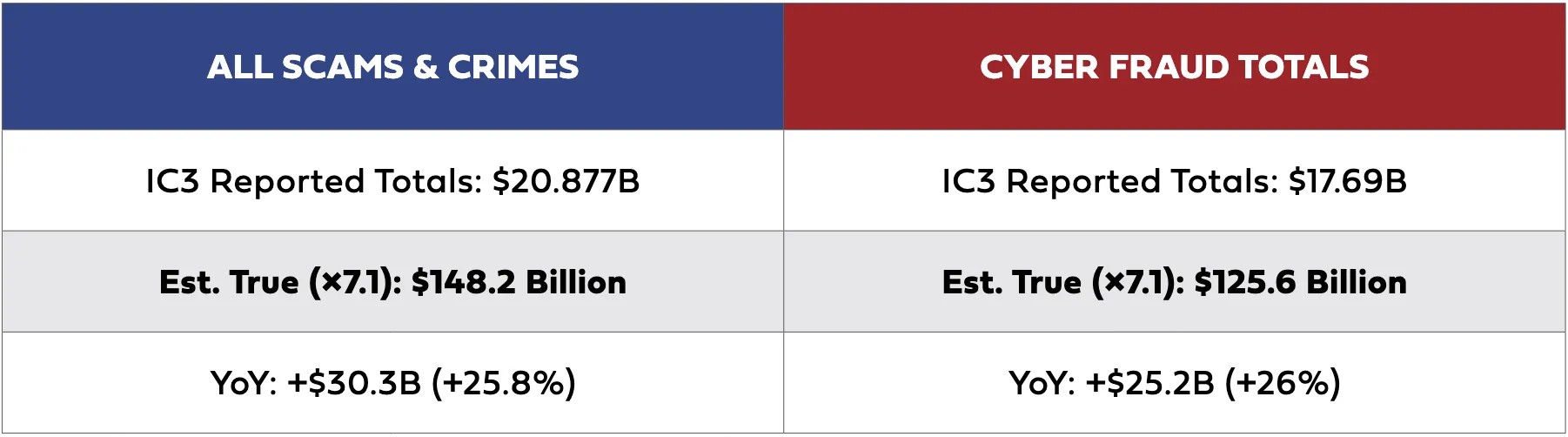
For all types of internet crimes, IC3 received 1,008,597 complaints. The reported damage amounted to $20.88 billion. The CFA estimated the total losses of Americans from online fraud and internet crimes at $148.2 billion, or $1,009 per household.
Source: Consumer Federation of America.

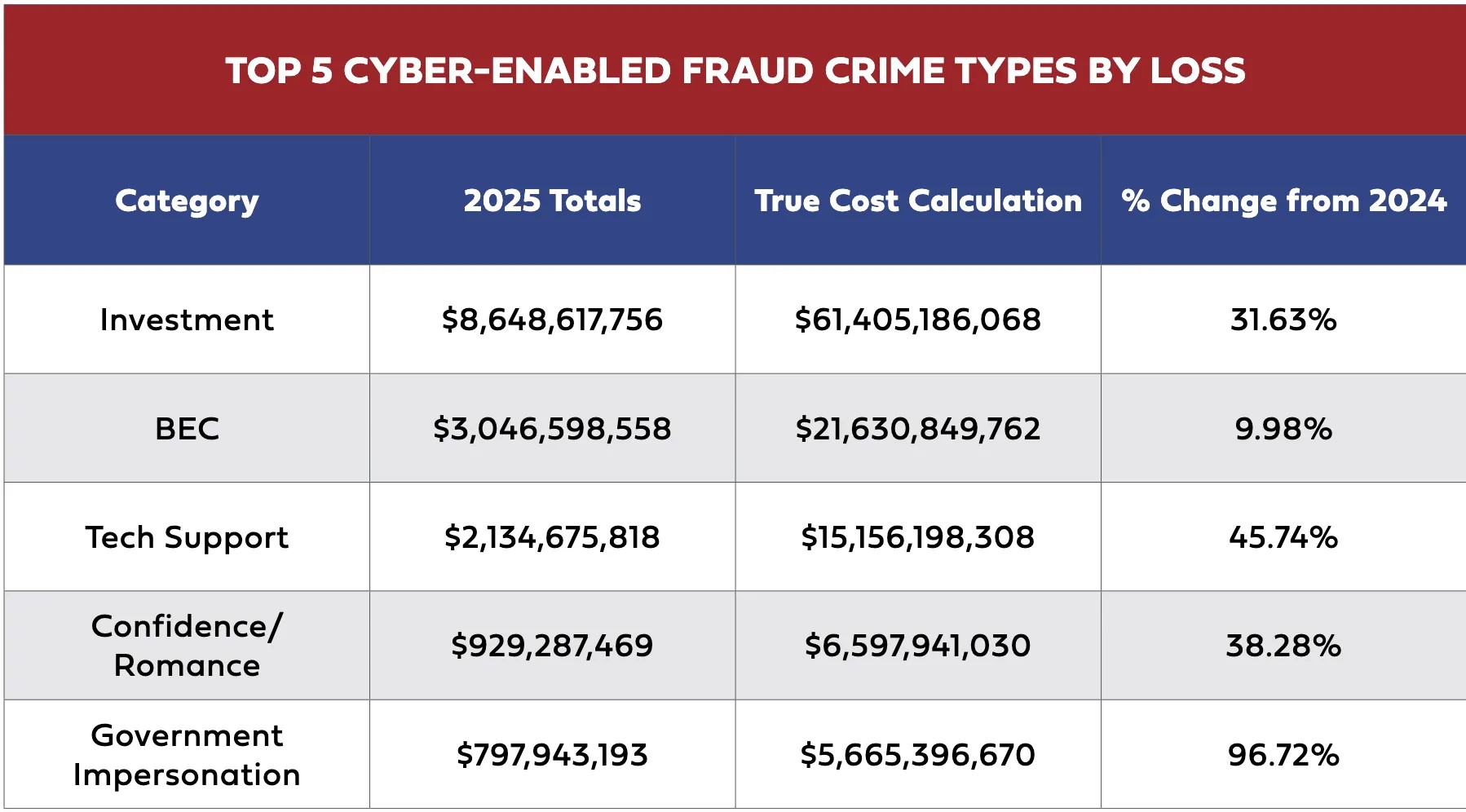
The largest category by reported damage in IC3 was investment fraud. In 2025, losses amounted to about $8.6 billion. The total figure was estimated at $61.4 billion after applying the coefficient of 7.1.
Source: Consumer Federation of America.

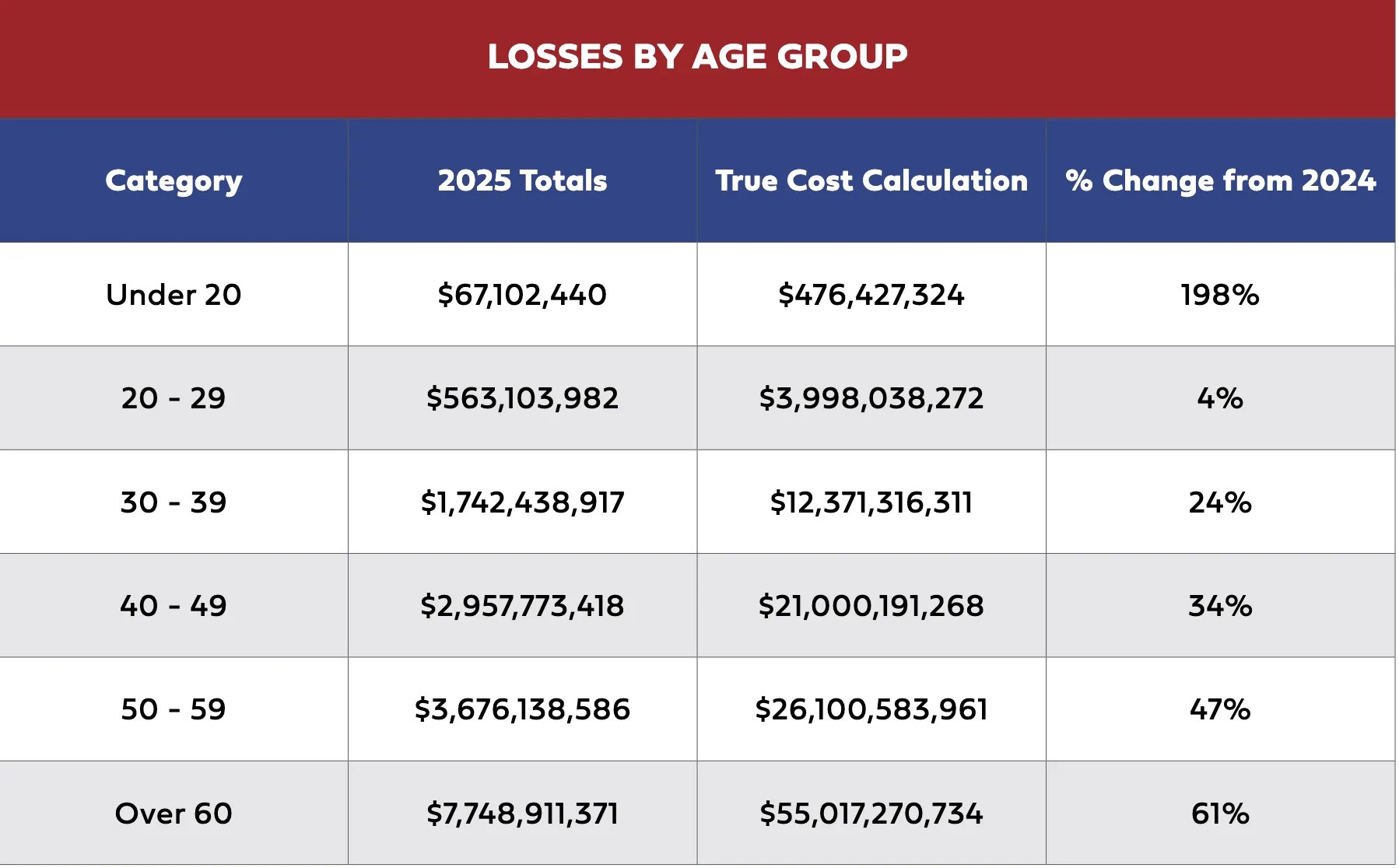
In a separate section on cryptocurrencies, the FBI listed 61,559 complaints about crypto investment fraud. The reported losses for them reached $7.23 billion. People over 60 years old filed 44,555 reports with a cryptocurrency component. Their reported losses are estimated at $4.43 billion, almost 39% of all crypto losses recorded by IC3.

For all types of internet crimes, this age group also suffered the largest damage — $7.75 billion. The average reported figure was $38,500 per complaint.
Source: Consumer Federation of America.

IC3 for the first time separately accounted for crimes involving the use of AI. In 2025, the FBI recorded 22,364 such complaints and $893.3 million in reported losses. The CFA recalculated this figure to $6.3 billion in estimated damage.

According to the FBI, criminals use artificial intelligence to create fake social media profiles, clone voices, forge documents and videos featuring public figures or victims' loved ones.

The IC3 report also described the FBI's initiative against crypto investment fraud, Operation Level Up, launched in early 2024. According to the bureau, since then, the operation has helped notify over 8,000 potential victims and prevent over $500 million in losses. In 2025, the figures were 3,780 people and $225.9 million in potential damage, respectively.

Digital Slavery in Myanmar: How a Network of Fraud Factories Operates in the Country

Recall that in May, the FBI announced the seizure of more than 127,000 BTC worth about $8 billion as part of an international operation, Operation Blackout, against scam centers and associated networks.


İlgili Sorular

QWhat was the estimated total loss due to cryptocurrency fraud for U.S. citizens in 2025 according to the Consumer Federation of America (CFA)?

AThe Consumer Federation of America (CFA) estimated the total loss for U.S. citizens due to cryptocurrency fraud in 2025 to be $80.7 billion.

QHow did the CFA calculate its estimate of $80.7 billion in crypto fraud losses from the FBI's IC3 reported figure of $11.37 billion?

AThe CFA calculated its estimate by applying a multiplier of 7.1 to the FBI's IC3 reported loss of $11.37 billion. This adjustment is based on a U.S. Bureau of Justice Statistics report indicating that only about 14% of financial fraud victims report the crime to the police.

QWhich demographic group suffered the largest reported financial loss from all types of internet crimes according to the FBI's IC3 data?

AAccording to the FBI's IC3 data, people aged 60 and older suffered the largest reported financial loss from all types of internet crimes, totaling $7.75 billion.

QWhat was the total estimated damage from AI-related crimes in 2025 after CFA's calculation?

AAfter applying the 7.1 multiplier, the CFA estimated the total damage from AI-related internet crimes in 2025 to be $6.3 billion, based on the FBI's IC3 reported figure of $893.3 million.

QWhat is Operation Level Up, and what was its reported impact in 2025 according to the FBI?

AOperation Level Up is an FBI initiative launched in early 2024 to combat crypto investment fraud. In 2025, the operation helped notify 3,780 potential victims and prevent an estimated $225.9 million in potential losses.

İlgili Okumalar

Stocks Fell Even More Violently Than Crypto, Where Did the Money Go?

From June to late July 2026, global stock markets, particularly technology and semiconductor stocks, experienced severe declines, with South Korea's KOSPI index facing historic circuit breakers and shedding 40% from its June peak. Key catalysts included SK Hynix's earnings miss despite record profits and competitive pressures from China's CXMT IPO. A global forced deleveraging event unfolded, devastating highly leveraged instruments like the 2x leveraged SK Hynix ETF, which lost over 80% of its value. Surprisingly, Bitcoin showed relative stability during this period, rising roughly 15% from its July low. The article clarifies this wasn't due to an inflow of equity flight capital but because Bitcoin had already undergone a significant correction in May and June, with U.S. spot Bitcoin ETFs seeing record outflows. True safe-haven flows went to gold, severing Bitcoin's short-term "digital gold" narrative. The sell-off is characterized not as an AI story collapse but a liquidity-driven清算 of crowded leveraged positions, potentially halfway through according to some analysts. For substantial capital to return to Bitcoin, the article cites necessary conditions: eased global liquidity pressure, a soft-landing Fed rate cut, and regulatory clarity from the stalled U.S. CLARITY Act. The conclusion is that Bitcoin is not a current safe haven but a pre-cleared asset. Its decoupling from tech stocks highlights its potential future role as a non-correlated asset for institutional portfolios, positioning it favorably for when global capital reallocates post-crisis.

marsbit1 saat önce

Stocks Fell Even More Violently Than Crypto, Where Did the Money Go?

marsbit1 saat önce

İşlemler

Spot
活动图片