Original | Odaily Planet Daily (@OdailyChina)
Author | Asher (@Asher_ 0210)

Crypto Market Sentiment Drops to Extreme Fear, While Prediction Markets Continue to Refresh Activity
If you only look at the market trends, there's nothing exciting about the crypto market right now.
After last week's major crypto crash, Bitcoin's rebound has been limited, altcoins remain generally sluggish, and capital risk appetite has clearly contracted. Changes in market sentiment confirm this: according to Alternative.me data, last month's Crypto Fear & Greed Index was still in the 25 (Fear) range, and yesterday it once fell to 7 (Extreme Fear). Even with a slight recovery today, the market is still in the "Extreme Fear" stage.
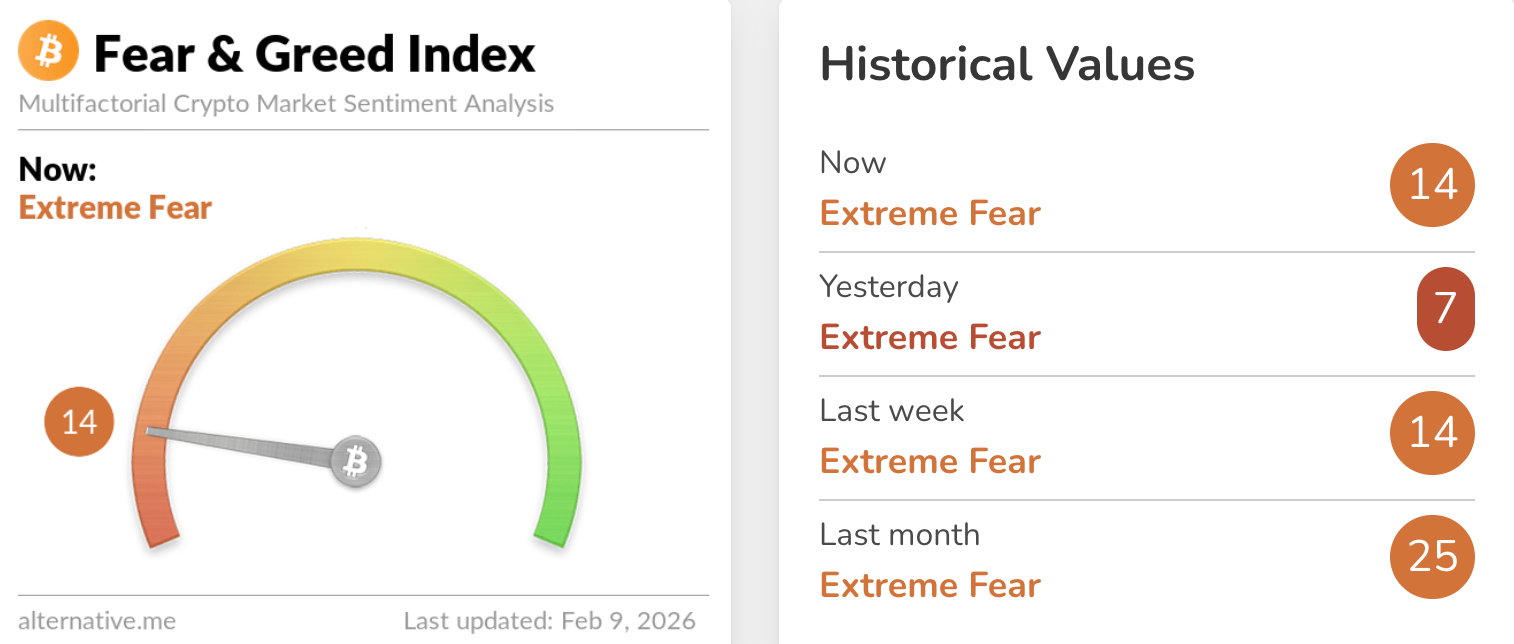
Crypto Fear & Greed Index
But against this backdrop, one vertical sector is showing a completely different trend—prediction markets are continuously heating up.
From on-chain data, the weekly nominal trading volume of prediction markets has significantly increased in recent weeks. Although it fell back last week, it remains consistently high in the historical range, indicating that user demand for prediction market trading has not significantly declined with the cooling market. Instead, it shows more stable activity.
The core reason behind this is that the trading drive of prediction markets does not rely on the price fluctuations of crypto assets, but on various ongoing events in the real world—from major sports events like basketball, football, American football, tennis, hockey, League of Legends, to changes in macro policies, Federal Reserve interest rate cuts, US government shutdowns, and even entertainment topics. New trading targets are generated almost every day. Because of this, compared to traditional crypto trading which relies on market cycles, the activity of prediction markets is more driven by "event flow", making it significantly less sensitive to market ups and downs, thus maintaining high participation and trading frequency even during market downturns.
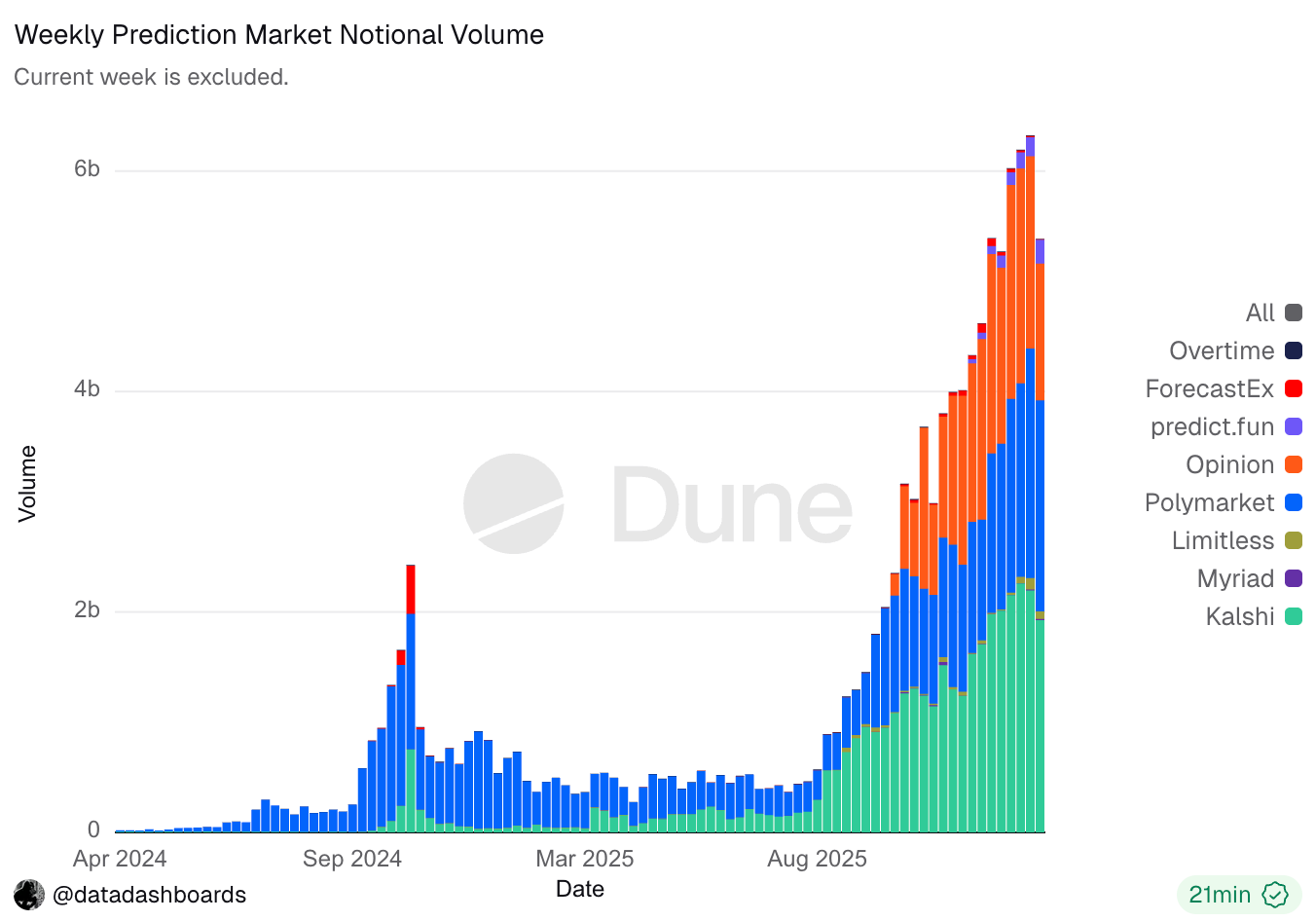
Prediction Market Weekly Trading Volume
The migration of user attention is also clearly visible. Nick Tomaino, founder of 1confirmation, recently stated that the monthly website traffic of Polymarket continues to climb, while the traffic of Robinhood and Coinbase shows a downward trend, indicating that some trading and speculative demand is shifting from traditional trading platforms to event-driven markets.
At the same time, Kalshi's growth is more concrete: its iOS app has currently jumped to second place on the US App Store's free app download chart, right after Coinbase. This performance is particularly rare during a phase when the overall crypto market trading sentiment remains low.
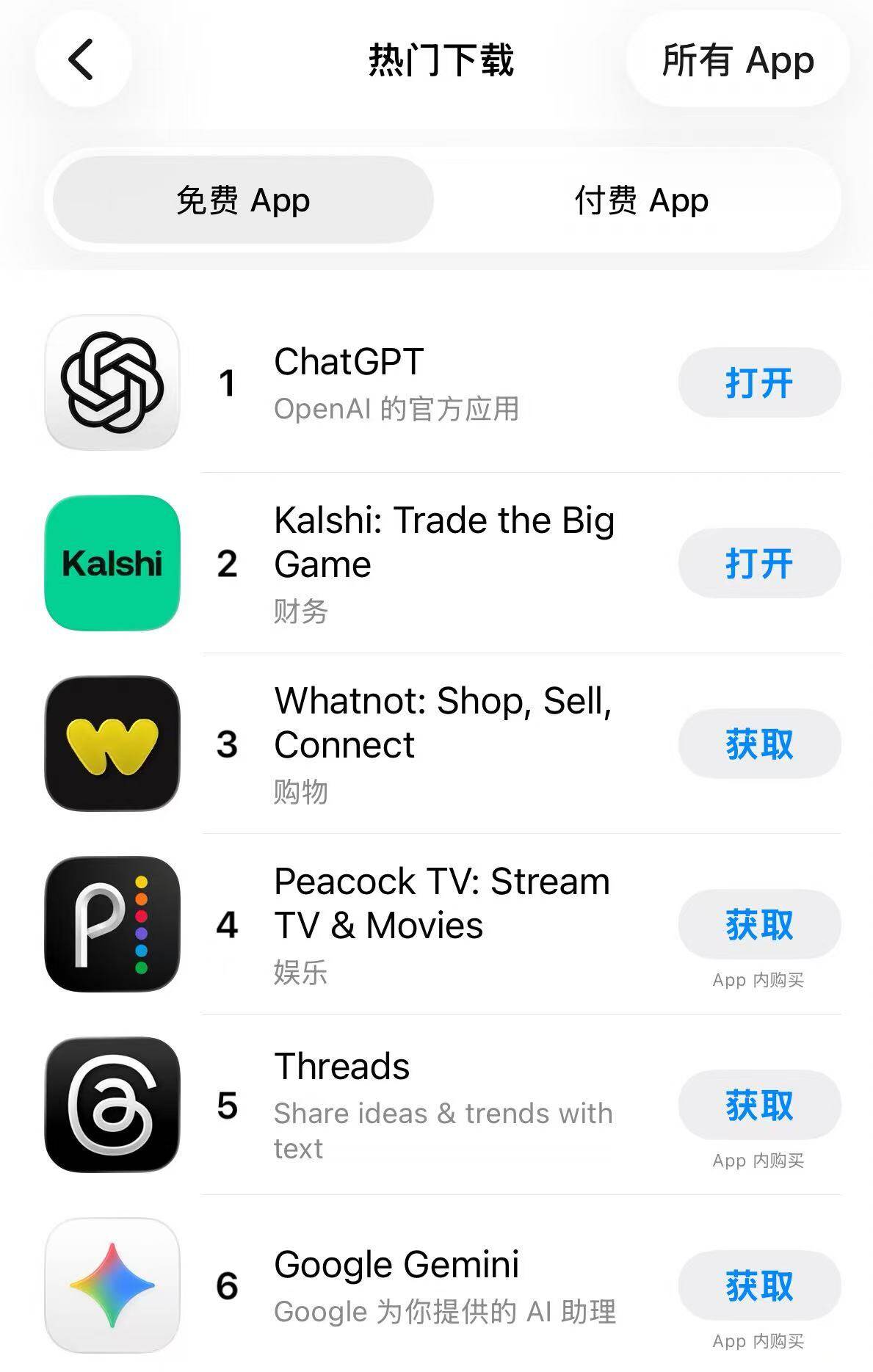
Apple APP Store Free APP Download Ranking
More importantly, prediction market projects are still on the eve of token launches
Many sectors in crypto often share a common problem: by the time most people start paying attention, the tokens have long been issued, and the profit stage truly belonging to early participants is basically over. But the current position of prediction markets is the opposite—user growth has already begun to appear, and the token cycle is just starting.
The most watched signal comes from Polymarket. Its parent company, Blockratize, recently filed a trademark application for "POLY", covering tokens and related financial service scenarios. It is reported that Polymarket management has confirmed that they will launch the native POLY token and conduct an airdrop in the future, though the specific timing has not been announced. This means that the large amount of trading and interaction currently generated around the platform is likely still in the early window of the potential airdrop cycle.
At the same time, Opinion, the most discussed prediction market on BNB Chain recently, on one hand, has already listed the OPN token airdrop task on the Binance Wallet Booster, which is widely seen by the market as a signal of an approaching TGE; on the other hand, Opinion recently announced the completion of a $20 million Series A funding round, with participation from institutions like Hack VC, Jump Crypto, Primitive Ventures, and Decasonic, also reflecting that investment institutions are positioning themselves early in this sector.
From a market expectation perspective, the community also maintains high attention on Opinion's TGE performance. Data from the Polymarket website shows that the probability of the betting event "Opinion's FDV exceeding $500 million on the first day of trading" is currently as high as 76%, with a trading volume of nearly $4 million. In the current environment where the overall altcoin market performance is sluggish, the maintenance of a high probability for related predictions also reflects the market's general expectation that the project may still receive strong price support in the initial listing phase.
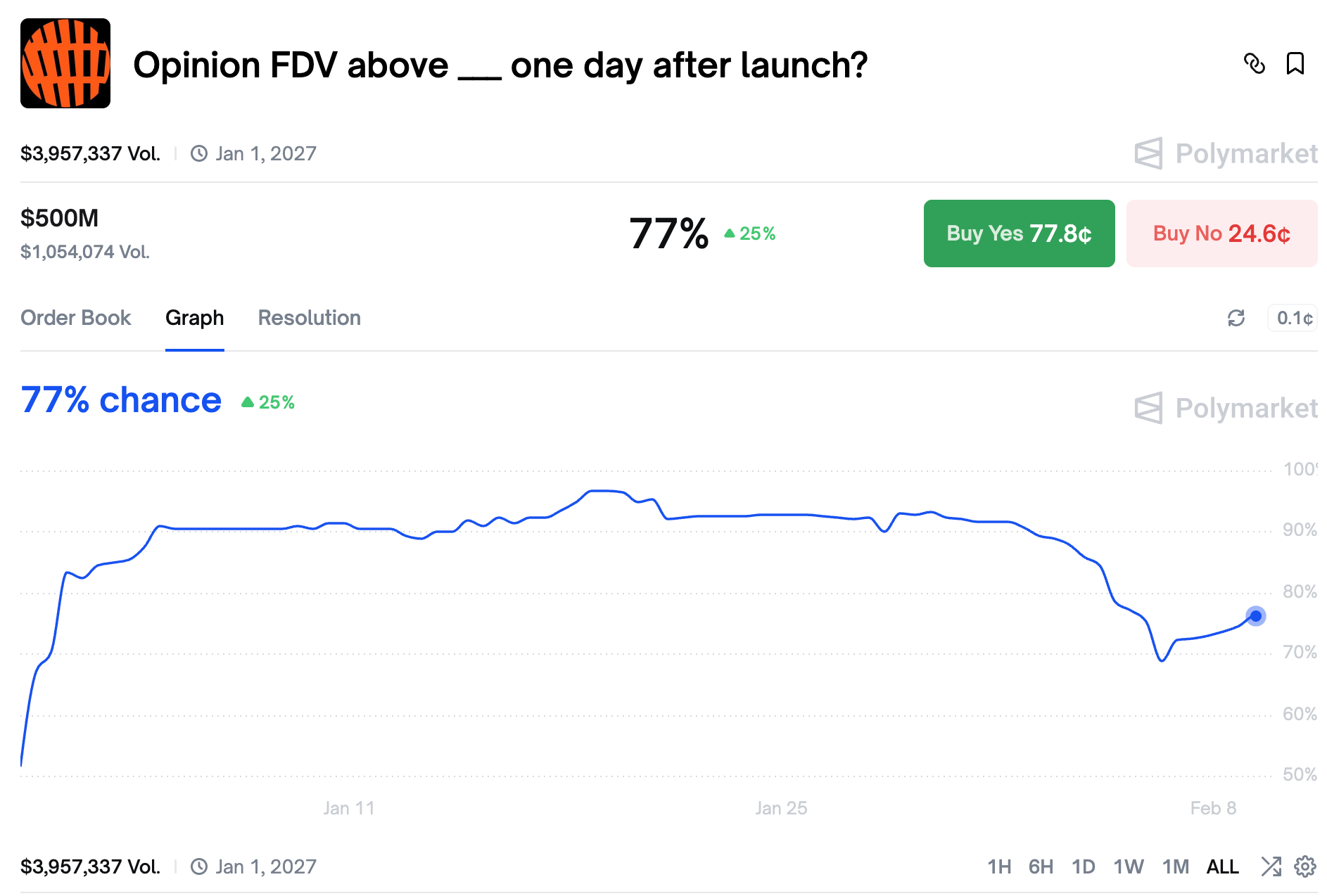
Betting event: "Opinion's FDV exceeding $500 million on the first day of trading"
Possibly driven by the expectation of Opinion's imminent TGE, predict.fun, another prediction market on BNB Chain with top weekly trading volume, has also seen a noticeable increase in community activity recently. It is worth noting that the project's founder, dingaling, recently stated in the official Discord community that "there are still many things being prepared" and hinted that new progress will be announced this month, further increasing market attention to its subsequent moves.

Screenshot of founder dingaling's reply in the official Discord
The period before the World Cup might be the real breakout phase for prediction markets
The US Super Bowl that started this morning has already provided a very直观的 reference. On Polymarket alone, the trading volume for prediction events related to the "US Super Bowl Champion" exceeded $700 million. The trading scale brought by a single event is already quite substantial.
But the Super Bowl is essentially a (US) domestic (most watched) event, while the World Cup is a catalyst of a completely different magnitude.
Compared to a single match, the World Cup lasts longer, has more matches, involves countries globally, and from the group stage to the knockout stage, new prediction market trading targets are generated almost daily: advancement probabilities, score ranges, knockout matchups, Golden Boot ownership, championship odds, etc., will continuously form new markets. This high-frequency event flow lasting for weeks can often bring more stable and longer-cycle trading activity, not just short-term traffic peaks.
Therefore, if the US Super Bowl has proven that major sporting events can bring huge trading volume to prediction markets in a short time, then the World Cup is more likely to be the key node determining whether the overall user scale and trading volume of the sector enter the next stage.
It is believed that around the World Cup, many prediction market platforms will conduct their TGEs. Perhaps now is the best time to埋伏. For me personally, with the market bleak, buying altcoins is not as good as "placing some bets" in prediction markets.
Related Content
Prediction Market Activity Hits Record High, Major Events Worth Paying Attention to in Top Projects Are Here
Hot Sector, New Interaction Opportunities: Three Prediction Markets Favored by YZi Labs
Step-by-Step Guide to Participating in predict.fun, Supported by CZ






