The Stock Market Is Hitting New Highs, So Why Are Consumers Growing More Pessimistic?

marsbit2026-05-28 tarihinde yayınlandı2026-05-28 tarihinde güncellendi

Özet

Title: Why Are Consumers More Pessimistic as U.S. Stocks Hit New Highs? Summary: The article explores the apparent contradiction between record-high U.S. stock markets and declining consumer confidence. It attributes this divergence to a "K-shaped" economic recovery, where asset owners benefit from rising prices while others suffer under inflation. The consumer confidence survey itself may be skewed due to sampling changes, now over-representing more pessimistic Democrats. However, a core issue is economic bifurcation: the top 10% of consumers now account for nearly half of all spending, masking weakening conditions for the majority. While low confidence can be a contrarian bullish signal for investors, the mechanisms driving asset gains also exacerbate pressures on the 40% of Americans without investments. The result is a deepening divide where market prosperity increasingly concentrates wealth and masks widespread financial strain.

Editor's Note: While the U.S. stock market continues to hit record highs, consumer confidence has plunged to low levels. These two seemingly contradictory data sets are presenting a classic structural divide in the U.S. economy.

This article does not attempt to explain whether the stock market is detached from fundamentals, but rather explores what the narrative of 'the U.S. consumer remains strong' is actually built upon, at a time when asset price appreciation and a sense of decline for ordinary households are happening simultaneously. The author points out that consumer confidence surveys themselves may have sampling bias, but the more critical issue is that the U.S. economy is becoming increasingly 'K-shaped': those who hold stocks, real estate, and financial assets continue to benefit from rising asset prices; those without investment assets are being left further behind under the pressure of inflation, and rising food and energy costs.

This also explains why aggregate consumption data still appears robust. The top 10% of U.S. consumers now contribute to nearly half of all consumer spending. The continued spending of asset holders, high-income earners, and affluent retirees masks the reality that most households are weakening. In other words, the U.S. economy is not without resilience, but this resilience is increasingly concentrated among a minority.

For investors, low consumer confidence might be a contrarian indicator; but for ordinary people without assets, a rising stock market does not necessarily mean an improved life. The real issue is that the same mechanisms driving asset prices higher may also continue to increase pressure on the asset-less group. This is the sharpest contradiction in the current U.S. economy: the more prosperous the market, the more pronounced the division may become.

The following is the original text:

To the Investors:

One of the most perplexing charts in financial markets is perhaps the one that overlays consumer confidence with the performance of the U.S. stock market. Over the past period, U.S. stocks have been hitting new all-time highs almost daily, yet consumer confidence has been consistently sliding, falling to some of the lowest levels on record.

How can both these things be true at the same time?

First, the quality of the University of Michigan Consumer Sentiment Survey has declined noticeably. Historically, respondents to the survey were roughly 50% Republican and 50% Democrat, but over the last three years this has changed. As the survey methodology has shifted online, the sample composition has also shifted: today's respondents are approximately two-thirds Democrat and one-third Republican.

Given that Democrats currently hold a significantly more pessimistic view of the economy, this over-sampling of one political bloc amplifies negative sentiment in the survey results more than it used to.

That said, I do personally believe a significant portion of Americans hold negative views about the economy and their own financial situations. They are bearing the brunt of currency debasement and the pressures of high inflation from the past few years. Grocery and gasoline bills keep adding up, while wage increases haven't kept pace with rising prices.

Second, people who own stocks feel good about the market rising; but people with no investment assets just feel left further behind as stock prices climb. Thankfully, about 60% of Americans own stocks directly or indirectly, so a decent chunk of the population does benefit from appreciating assets.
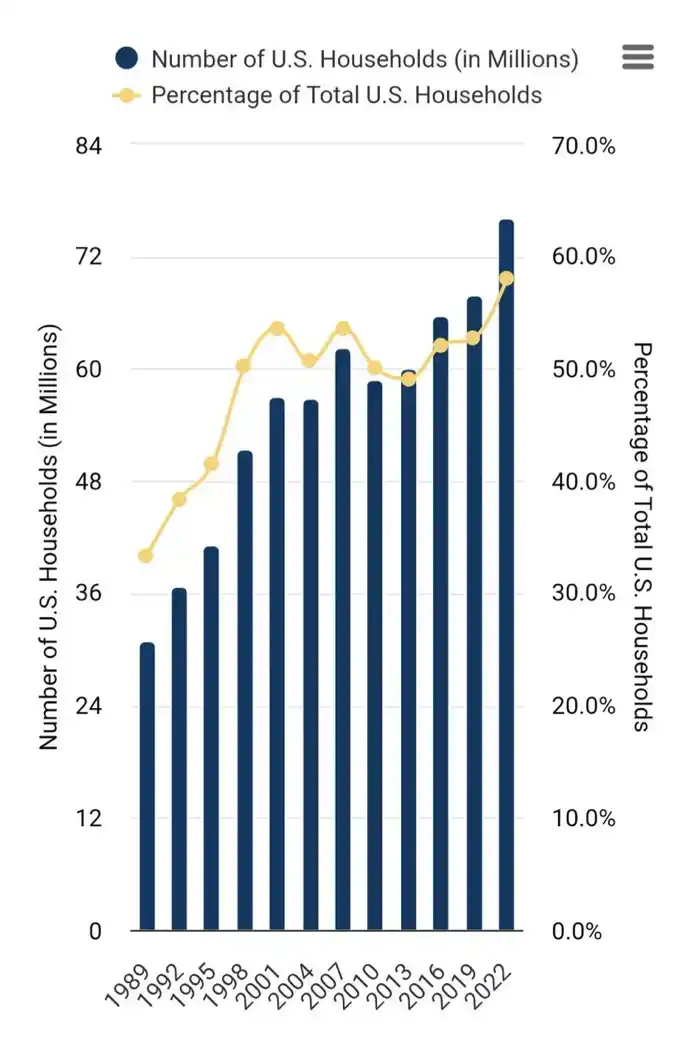
But 40% of Americans are not benefiting. These are typically people who do not appear on national television shows, do not post their views on X or Substack, and may not necessarily articulate the financial pain they are experiencing in the language familiar to economists or investors.

This is why the gap between stock market performance and consumer confidence is widening.

One could argue that consumers are saying one thing but their spending behavior shows another. There is some truth to this, as U.S. consumer spending is indeed still growing. But the detail is this: today, the top 10% of U.S. consumers now account for 50% of the nation's consumer spending.
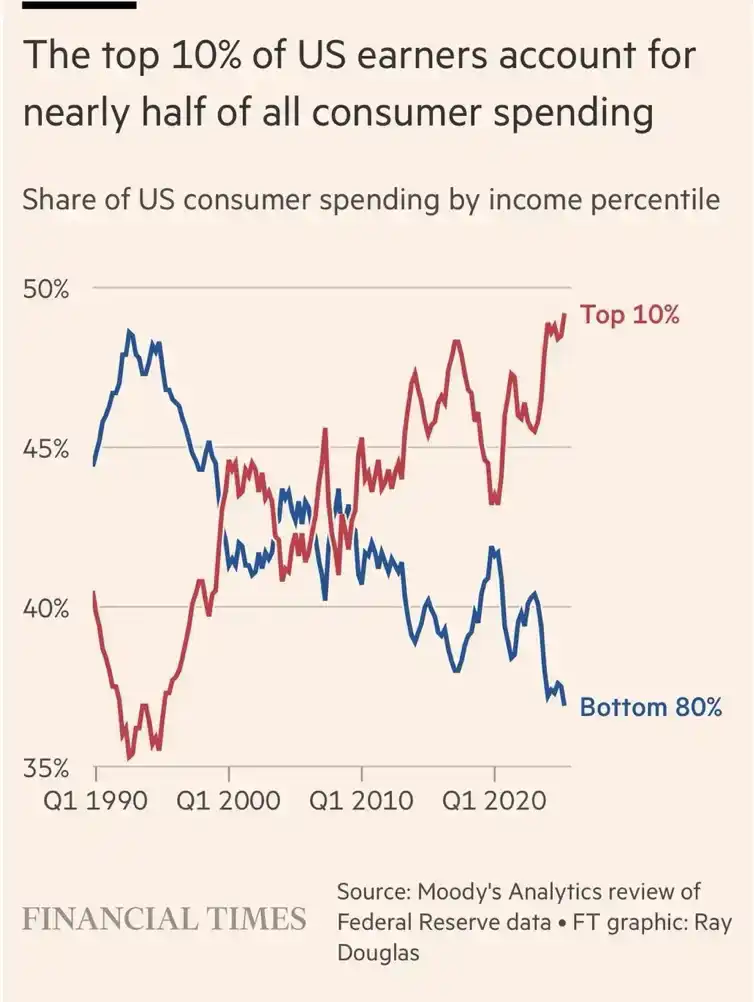
As my friend SightBringer wrote:

"The U.S. consumption economy is increasingly a demand engine driven by luxury goods and high-income earners, wrapped in a fragile mass-market shell. The cruelty of that chart is that it shows the consumption base being hollowed out. The top 10% now support nearly half of all consumer spending, while the share of the bottom 80% is declining.

This means that, looking at aggregate data, the U.S. consumer appears to be holding strong, but most households are actually weakening. Overall consumption is holding up because asset holders, high-income earners, and affluent retirees are still spending."

If you dig into the data, you'll see a 'K-shaped economy' emerging more and more clearly in consumer spending. This makes the situation complex and confusing, but it makes sense when linked to the slump in consumer confidence.

However, I also bring some good news for investors. Peter Mallouk, CEO of Creative Planning, points out that extremely low consumer sentiment readings tend to be a "very good contrary indicator." He says: "The worse people feel about the future, the better the stock market tends to perform afterwards."
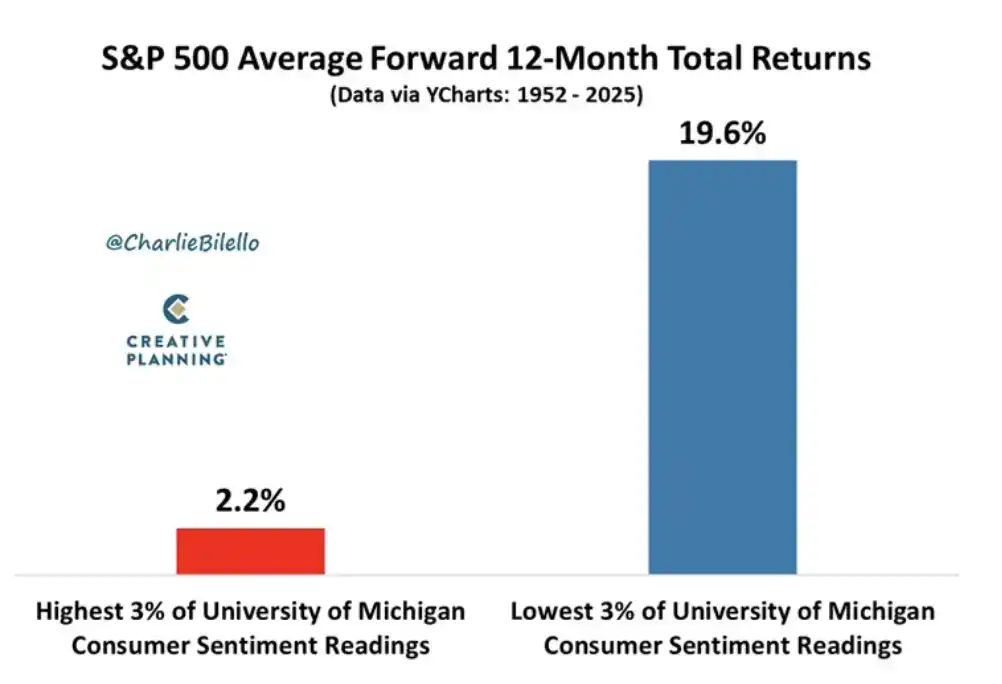
When the University of Michigan Consumer Sentiment Index has fallen into the lowest 3% of all its historical readings, the S&P 500 has delivered an average 12-month return of 19.6%. Given the stark divergence already present between the stock market and consumer confidence, this should offer investors some solace. But the continued strength of the U.S. economy may not truly help the bottom 40% of Americans—they own no investment assets and are still absorbing the impact of higher consumer prices.

This is the most profound binary split of our times.

The rich get richer, while everyone else falls further behind. The very forces driving asset prices higher are also punishing those who most need breathing room. If you want to know what the Federal Reserve, the Treasury, or Washington will ultimately decide, you need only look at which category the people making those decisions belong to.

The wealthy and powerful are navigating the situation with the tools at their disposal. They will try to show empathy. They will look at as much data as possible. I truly believe these people want to do the right thing and help as many people as possible.

The problem is they cannot serve two masters. So, wealthy asset holders will continue to win, and everyone else will continue to sink. All you can do is make sure you're on the right side. Because time is running out, asset prices are still moving higher, and inflation is claiming more victims.

Have a great day. We'll talk again soon.

İlgili Sorular

QWhy is there a divergence between the record-high U.S. stock market and low consumer confidence?

AThe divergence is due to a 'K-shaped' economic recovery. While asset owners benefit from rising stock and property prices, many households without significant investments suffer from inflation, higher food and energy costs, and stagnant wages. Additionally, consumer confidence surveys may be skewed towards more pessimistic Democratic respondents.

QWhat is the 'K-shaped' economic recovery described in the article?

AA 'K-shaped' recovery describes an economy where different groups recover at different rates. One arm of the 'K' represents asset holders and high-income individuals whose wealth and prospects improve with rising markets. The other arm represents lower and middle-income individuals without substantial assets, who face increasing financial pressures and falling behind.

QHow do the spending habits of the top 10% of consumers affect overall economic data?

AThe top 10% of consumers now account for nearly 50% of total consumer spending. Their continued strong spending on goods and services, often luxury items, masks the underlying weakness in spending by the bottom 80% of households, making aggregate consumption data appear resilient while most families are financially strained.

QAccording to the article, why might low consumer confidence be a positive signal for investors?

AHistorically, when the University of Michigan Consumer Sentiment Index falls into its lowest 3% readings, the S&P 500 has delivered an average return of 19.6% over the following 12 months. This suggests extreme consumer pessimism can act as a contrarian indicator, potentially signaling a buying opportunity for stocks.

QWhat is the core conflict or 'binary split' highlighted as the defining issue of our time in the article?

AThe core conflict is that the same monetary and economic policies that drive asset price inflation—benefiting the wealthy who own stocks and property—simultaneously increase the cost of living through general inflation, disproportionately punishing lower-income households without such assets. This deepens wealth and opportunity inequality.

İlgili Okumalar

After Marvell's 32% Surge, the Chinese Chip Family Behind It Emerges

The stock price of Marvell Technology surged 32.5% on June 2nd, driven by NVIDIA CEO Jensen Huang highlighting its custom ASICs and optical interconnects as core to AI data center architecture. This event brought attention to the Chinese semiconductor family behind Marvell: the Dai siblings. The story centers on three siblings, all UC Berkeley graduates, whose three-decade entrepreneurial journey aligns with major semiconductor industry shifts. In 1995, youngest sister Dai Wei Li co-founded Marvell with her husband Sehat Sutardja and his brother, focusing on storage controllers. Eldest brother Dai Wei Min founded EDA company Ultima, later sold to Cadence, and later founded VeriSilicon (芯原) in China, becoming a leading semiconductor IP provider. Second brother Dai Wei Jin co-founded EDA firm Silicon Perspective (sold to Cadence) and GPU IP company Vivante, later acquired by VeriSilicon. The combined "Dai-Sutardja" family network extends beyond Marvell. Their ventures and investments form a comprehensive ecosystem for the post-Moore's Law, chiplet era. Key holdings include: Dream Big Semiconductor (AI SuperNICs, acquired by Arm), Alphawave (high-speed SerDes IP, acquired by Qualcomm), and Silicon Box (a chiplet advanced packaging foundry). VeriSilicon itself thrives on the AI ASIC and IP boom in China. Collectively, the family's AI infrastructure-related portfolio is estimated at over $22 billion. Their strategy represents a distinct path: building critical components for open standards and key manufacturing capacity in the chiplet era, rather than pursuing standalone AI chip dominance. While this path may not create the next NVIDIA, it has enabled repeated successful exits and sustained influence within the global semiconductor industry.

marsbit49 dk önce

After Marvell's 32% Surge, the Chinese Chip Family Behind It Emerges

marsbit49 dk önce

Microsoft is Afraid of Being Marginalized by AI Giants

Microsoft, once the defining force of the PC era, now faces a familiar challenge in the AI age: the risk of being relegated to a profitable but invisible infrastructure provider. This anxiety was laid bare at Build 2026, where CEO Satya Nadella unveiled a major strategic pivot. The catalyst was a quiet April agreement that dissolved Microsoft's exclusive licensing and cloud-hosting deal with OpenAI, its once-vital partner. This erased Microsoft's key AI moat. With OpenAI and Anthropic defining AI applications and gaining enterprise traction—even within Microsoft's own ranks—Nadella had to answer: without exclusivity, what is Microsoft's role? The answer was a suite of seven in-house AI models, a developer-focused AI workstation (Surface RTX Spark Dev Box), and, most crucially, the Agent 365 platform for enterprise AI governance. The models, notably targeting Anthropic's strengths in coding and enterprise, signal a defensive move. However, the broader strategy is to make the models themselves less decisive. Financially, Microsoft's AI revenue is strong, driven largely by Azure running others' models. Yet its user-facing products like Copilot show weak penetration and engagement. Microsoft earns infrastructure money but lacks direct user mindshare. Nadella's core fear is being "hollowed out." As OpenAI and Anthropic prepare for IPOs and gain financial independence, they may build their own infrastructure, threatening Azure's lucrative AI revenue stream. Microsoft's window is to entrench itself deeper: not as the model creator, but as the indispensable platform for securely deploying, managing, and governing all AI models within the enterprise through Agent 365. Build 2026 revealed Microsoft's bet: in the AI era, the ultimate power lies not in any single model, but in the enterprise "operating system" that controls them. Nadella is determined to ensure Microsoft is the driver of this new era, not just a passenger.

marsbit1 saat önce

Microsoft is Afraid of Being Marginalized by AI Giants

marsbit1 saat önce

CPU, Quietly Returning to the Center of the AI Computing Power Stage

Over the past three years, AI computing power narratives have been dominated by GPUs. However, starting in 2026, this story began to shift. While training large models remains GPU-intensive, the rapid growth of inference and AI agent workloads, which require high levels of task orchestration, concurrency, and data flow management, has highlighted a renewed critical role for CPUs. These are tasks GPUs are not designed to handle. Intel's recent launch of the Xeon 6+ processor, built on its Intel 18A process and featuring up to 288 efficiency cores (E-cores), exemplifies this strategic pivot. It is positioned not as a mere companion to GPUs but as the essential "control plane" for AI infrastructure, optimized for high-density, energy-efficient, and high-throughput workloads characteristic of AI agents and inference. This "CPU resurgence" is not about CPUs outperforming GPUs in raw computation. It reflects a systemic bottleneck: as AI scales from training single models to deploying countless intelligent agents, the demand for coordination and data handling surges. Major cloud providers are also developing their own high-density ARM-based server CPUs for similar workloads. However, Intel's success with this strategy faces significant challenges. Competition includes NVIDIA's integrated CPU-GPU solutions, the expanding adoption of cloud vendors' in-house ARM CPUs, and the crucial market test of Intel's 18A manufacturing process against rivals like TSMC's N2. In conclusion, CPUs are indeed reclaiming a central, though redefined, role in AI compute—managing the complex orchestration that enables massive-scale AI deployment. While the trend is clear, which company will ultimately lead this CPU resurgence remains an open question to be decided in the data centers of 2027 and beyond.

marsbit1 saat önce

CPU, Quietly Returning to the Center of the AI Computing Power Stage

marsbit1 saat önce

İşlemler

Spot
Futures
活动图片