The Safest Middleman in the Chip Industry Is Taking the Most Dangerous Path

marsbit2026-03-25 tarihinde yayınlandı2026-03-25 tarihinde güncellendi

Özet

Arm, the semiconductor IP licensing giant, is embarking on a high-risk strategic shift by developing its own data center CPU, the Neoverse V3-based AGI CPU. This move, its first in-house chip in 35 years, aims to catapult the company's annual revenue from $4 billion to a targeted $15 billion for its chip business by 2031. This ambitious goal requires creating a new business line nearly the size of Intel's entire data center division. The core driver is the threat from its largest customers. Major cloud providers like AWS, Google, and Microsoft are increasingly designing and deploying their own powerful Arm-based server chips (Graviton, Axion, Cobalt), capturing the chip profits while Arm earns only licensing fees and royalties. This trend places a visible ceiling on Arm's traditional revenue growth from the data center sector. By building its own chip, Arm is now competing directly with its own licensees. While its first customer, Meta, lacks a mature in-house chip program, the strategy risks alienating key partners like Amazon and Google. Arm's bet is that the explosive growth of AI-driven data center demand, particularly for CPU-based AI inference tasks, is large enough to support both its new chip business and its ongoing IP licensing model. The success of this unprecedented dual-role strategy hinges on navigating this inherent conflict.

Between $4 billion and $15 billion lies not a growth curve, but a self-disruption of a business model.

On March 24, Arm unveiled the first self-developed data center CPU in its 35-year history in San Francisco. This chip, named the AGI CPU, features 136 Neoverse V3 cores, is built on TSMC's 3nm process, has a 300W TDP, with Meta as its first customer, and is set for large-scale deployment within the year. Simultaneously announced collaborations include OpenAI, Cerebras, Cloudflare, SAP, and SK Telecom.

At the launch event, Arm CEO Rene Haas presented a set of target figures, stating that the chip business aims to achieve $15 billion in annual revenue by 2031, with total company revenue reaching $25 billion and earnings per share of $9.

What do these numbers signify? Arm's total company revenue for FY2025 (ending March 2025) is $4.007 billion. According to Arm's annual report data, this includes $1.839 billion in licensing revenue and $2.168 billion in royalty revenue, with a gross margin of 97%. In other words, a company with $4 billion in annual revenue aims to build a new business nearly the size of Intel's entire data center division within five years. According to Intel's Q4 2024 earnings report, Intel's DCAI (Data Center and AI) division generated $12.8 billion in revenue for the full year 2024.
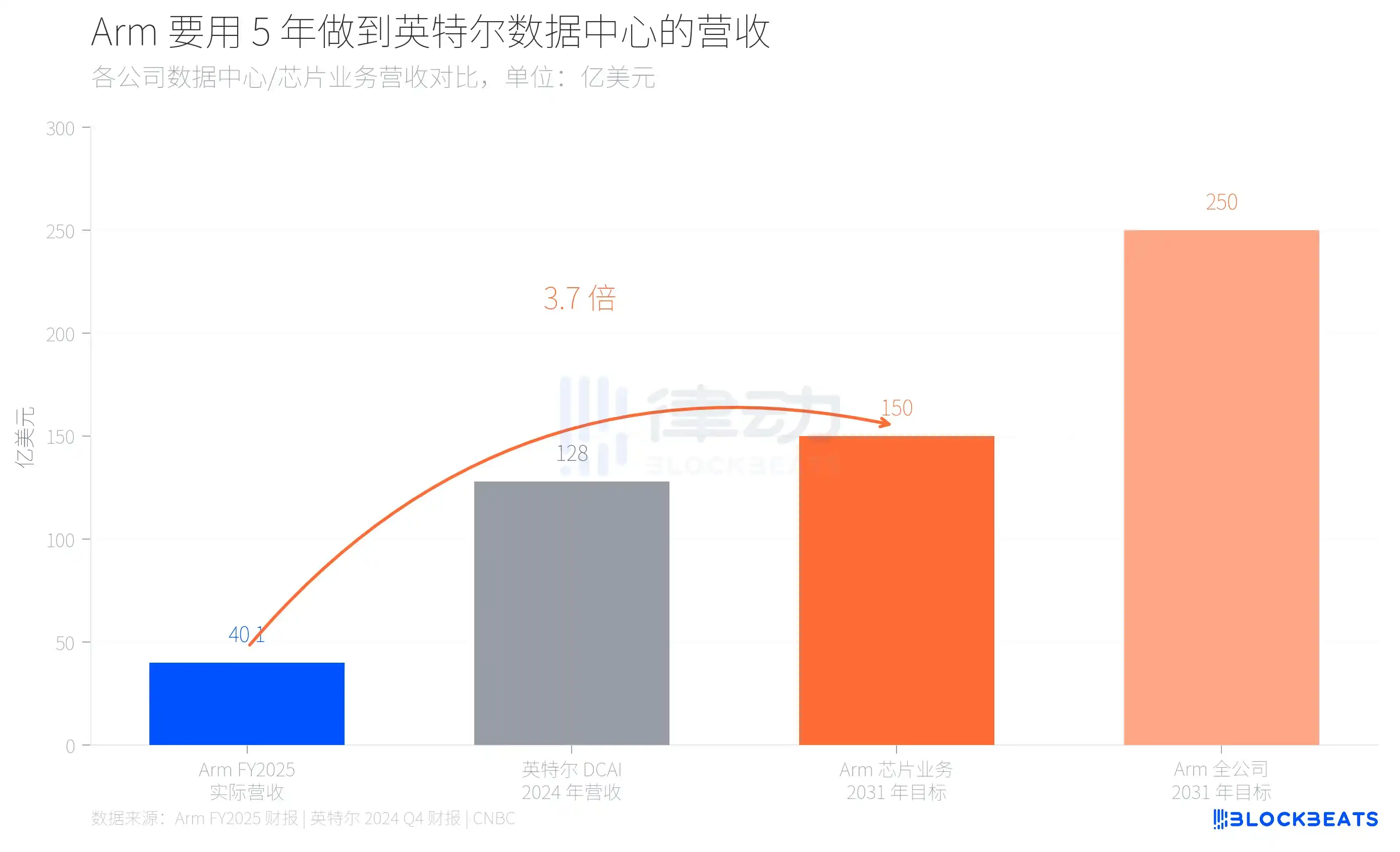
Behind the 3.7-fold leap from $4 billion to $15 billion is Arm's attempt to transform from a pure IP licensing company into a hybrid that sells both design blueprints and finished products. There is no precedent for this in the chip industry.

Why is Arm taking this risk? The answer lies in its customer list.

Over the past three years, Arm's largest data center customers have all been doing the same thing. According to AWS public data, Amazon has migrated over 50% of its EC2 computing power to its self-developed Graviton chips, with the latest Graviton5 reaching 192 cores. As disclosed by Google Cloud, Google's Axion chip has already facilitated the migration of over 30,000 internal applications, improving energy efficiency by 80%. Microsoft's Cobalt 200 is also based on the Arm Neoverse architecture, built on TSMC's 3nm process, with 132 cores.
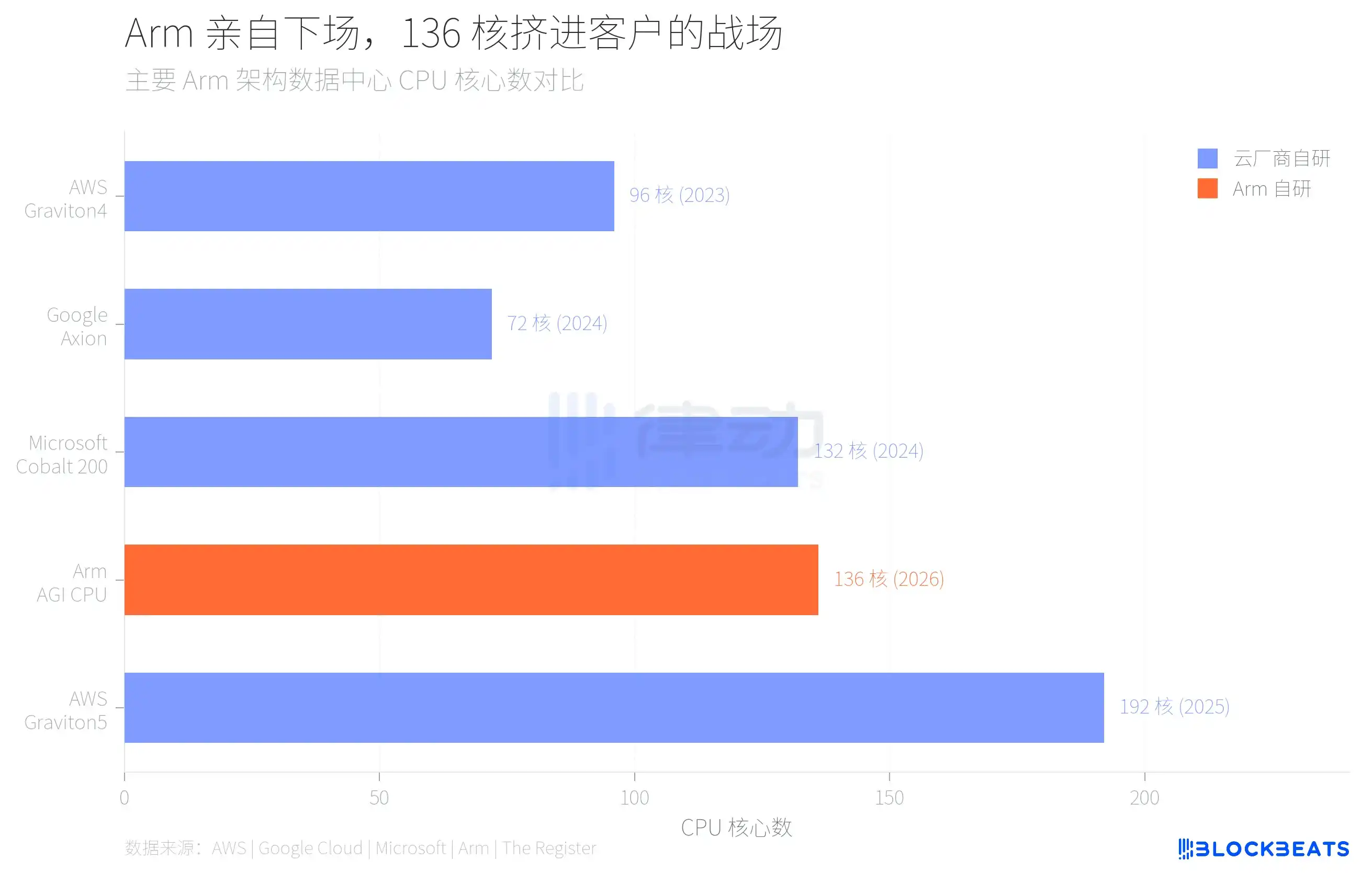
These cloud providers all use Arm's architectural license, but they design, tape out, and deploy the chips themselves. Arm earns licensing fees and royalties from this, not the profits from the chips. As more computing demands are absorbed by these self-developed chips, the revenue ceiling for Arm in the data center becomes increasingly clear.

Examining Arm's revenue structure over the past four years reveals this ceiling more concretely. According to Arm's financial reports from FY2022 to FY2025, total company revenue grew from $2.7 billion to $4.0 billion, with an average annual growth of about 14%. Within this, royalty revenue increased from $1.562 billion to $2.168 billion, while licensing revenue grew from $1.141 billion to $1.839 billion. Royalty growth has already slowed to around 20% in recent years, and much of this 20% growth comes from the upgrade cycle to the Armv9 architecture in mobile, not the data center.
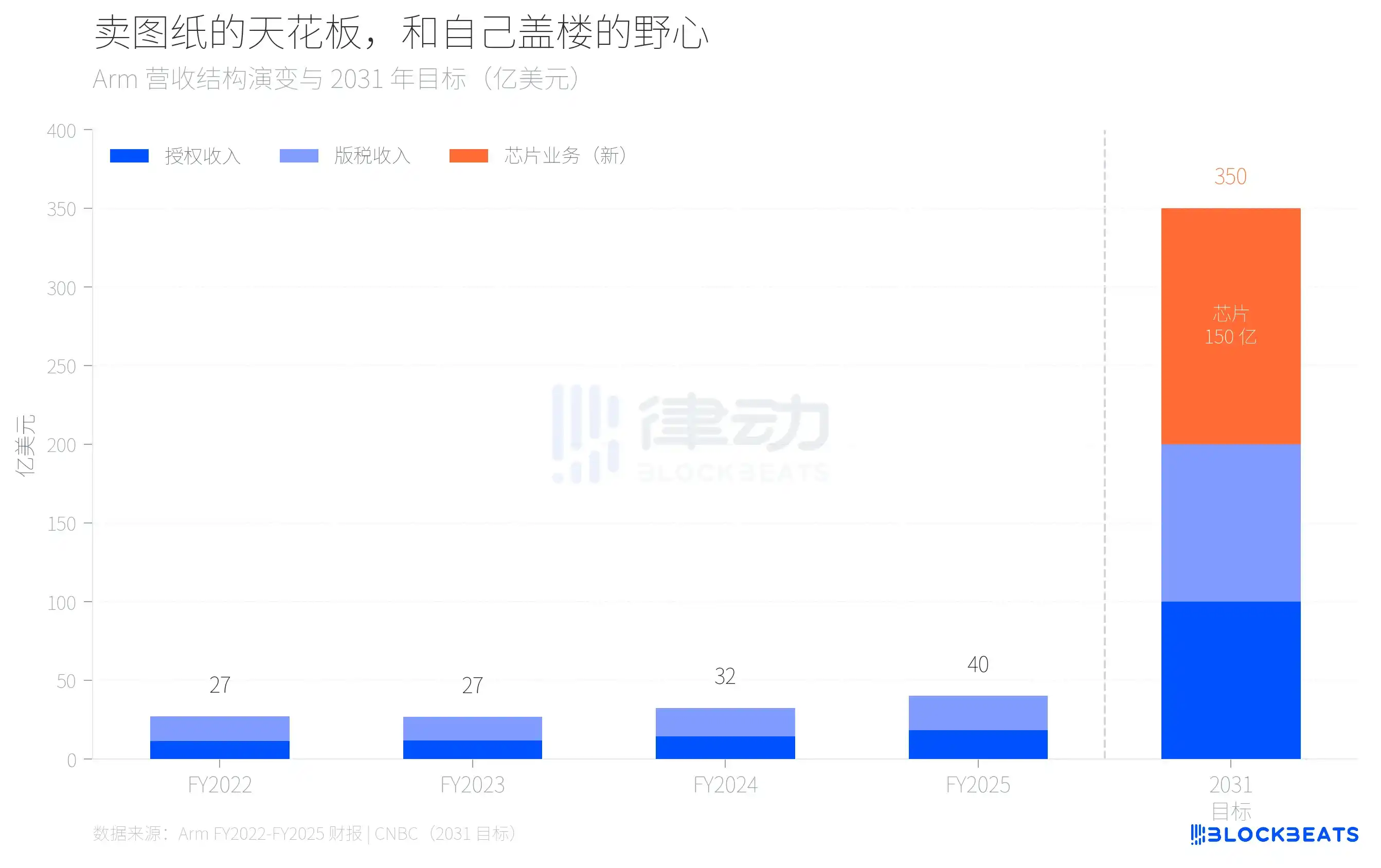
Extrapolating at this growth rate, even if both licensing and royalty revenues maintain around 20% annual growth, they would only reach approximately $10 billion by 2031. The remaining $5 billion to reach the $15 billion target must come from a business that does not exist today. This is the arithmetic logic behind Arm's decision to build its own chips.

By choosing to manufacture its own chips, Arm is essentially competing with its own customers. A company that sells architectural blueprints has started building houses itself, while its blueprint buyers have been building for several years.

This is the true backdrop of the 136-core AGI CPU. According to The Register, this chip has a base frequency of 3.2 GHz, boosting to 3.7 GHz, 12-channel DDR5 memory, 6 GB/s bandwidth per core, 96 PCIe 6.0 lanes, and supports CXL 3.0. Arm positions it as the "computing foundation for the agentic AI cloud era," specializing in CPU-side task scheduling and data flow management for AI inference, rather than directly competing with GPUs.

The pace of market share change is also telling. According to Omdia estimates, Arm architecture servers will account for about 21% of global shipments in 2025, with a growth rate of 70%. However, within hyperscale data centers, this proportion is already close to 50%. The 40-year monopoly of x86 is not collapsing; it's being replaced chip by chip.

The risk for Arm's self-developed chips lies not in technology, but in relationships. Meta's willingness to be the first customer is partly because Meta does not have a mature self-developed chip project like Amazon or Google. But how will Amazon, Google, and Microsoft view this? If a supplier starts competing for your business, would you still entrust it with your most critical architectural licenses?

Arm's bet is that the total data center market will grow faster than customer relationships deteriorate. Rene Haas evidently believes that the incremental demand for CPUs in the AI era is large enough for self-developed chips and architectural licensing to coexist. The $15 billion target is the price tag on this judgment.

After 35 years of selling blueprints, it's building its first house. The blueprints are still for sale, and the house is also being built. The question is whether there's enough room on the same plot of land for both.

İlgili Sorular

QWhat is the significance of Arm's first self-developed data center CPU, the AGI CPU, and who is its first major customer?

AThe AGI CPU is Arm's first self-developed data center CPU, marking a significant shift from its traditional IP licensing model to also manufacturing and selling finished chips. It is built on TSMC's 3nm process, features 136 Neoverse V3 cores, and has a 300W TDP. Meta is the first major customer and plans to deploy it at scale within the year.

QWhat are Arm's ambitious financial targets for its chip business by 2031, and how do they compare to its current revenue?

AArm aims for its chip business to achieve $15 billion in annual revenue by 2031, with total company revenue reaching $25 billion and earnings per share of $9. This is a massive increase from its FY2025 total revenue of approximately $4 billion, meaning the new chip business alone would need to grow to nearly the size of Intel's entire Data Center and AI division, which had $12.8 billion in revenue in 2024.

QWhy is Arm taking the risk of manufacturing its own chips, a strategy that puts it in competition with its own customers?

AArm is taking this risk because its largest data center customers, like Amazon (Graviton), Google (Axion), and Microsoft (Cobalt), are increasingly designing their own chips based on Arm's architecture licenses. While Arm earns licensing fees and royalties from these designs, it misses out on the larger profits from the actual chips. This trend places a clear ceiling on Arm's future revenue growth from its traditional business model, forcing it to seek new revenue streams by selling finished products.

QWhat is the potential conflict or risk for Arm in its new strategy of selling both IP licenses and finished chips?

AThe primary risk is damaging its relationships with its major architecture licensees, such as Amazon, Google, and Microsoft. By becoming a direct supplier of finished chips, Arm is now competing with its own customers. These companies may become reluctant to share their most critical architectural plans and designs with a supplier that is also a competitor, potentially jeopardizing Arm's core licensing business.

QHow does Arm justify its new strategy and what market trend is it betting on for success?

AArm is betting that the total market demand for data center CPUs, particularly driven by the agentic AI era, is growing fast enough to accommodate both its traditional licensing business and its new chip manufacturing venture. CEO Rene Haas believes the AI-driven demand for CPU-based tasks like AI inference scheduling and data flow management will be so substantial that the potential revenue from selling chips outweighs the risk of alienating some licensing customers.

İlgili Okumalar

The AI Agent Era Accelerates Its Arrival: Questflow Defines a New Paradigm of Financial Intelligence with On-Chain AI Brokerage

The AI Agent era is accelerating, with the CB Insights AI 100 list highlighting global investment confidence. The focus has shifted from whether AI works to its speed of deployment and ability to manage complex workflows, with autonomous AI Agents driving this transformation. At the forefront is Questflow, a Singapore-based startup redefining financial intelligence through its on-chain AI brokerage. Unlike tools that merely provide data dashboards, Questflow deploys AI Agents that proactively scan markets, form judgments, and execute trades via a conversational interface—operating 24/7 without requiring manual confirmation for each decision. This embodies the new AI paradigm of agents capable of executing multi-step workflows autonomously. Questflow's mission is to democratize institutional-grade trading intelligence. Historically reserved for the ultra-wealthy, this capability is now accessible starting from just $1 through Questflow's "AI Clone + Copy Trade" model. The platform charges only a 1% execution fee, aligning its incentives directly with users and eliminating traditional management or performance fees. The timing is opportune, aligning with key trends identified by CB Insights: the scalable deployment of AI Agents, accelerated AI adoption in financial services, and the maturation of on-chain infrastructure. With robust liquidity on platforms like Hyperliquid and Polymarket, alongside advancements in AI reasoning and non-custodial wallet security, Questflow is positioned to merge the roles of broker, fund, and exchange into a single, accessible platform for millions.

链捕手16 dk önce

The AI Agent Era Accelerates Its Arrival: Questflow Defines a New Paradigm of Financial Intelligence with On-Chain AI Brokerage

链捕手16 dk önce

Why Pricing Social Interactions is Doomed to Fail?

Titled "Why Putting a Price on Social Interaction Is Doomed to Fail," this article critiques attempts to monetize social networks directly through SocialFi models, arguing their inevitable failure stems from a fundamental misunderstanding of media dynamics. Using Marshall McLuhan's theory of "hot" and "cold" media, the author posits that social networks are inherently "cold" media. Their value isn't contained in individual posts but is co-created through user participation, interpretation, and fragmented, ongoing interaction (e.g., replies, shares). This ambiguity and need for user involvement are core to their function. The article asserts that SocialFi projects like Friend.tech failed because introducing real-time, tradable financial pricing (a definitive "hot" signal) into this "cold" environment doesn't add a layer—it replaces the medium's essence. The unambiguous price signal overshadows and nullifies the nuanced, participatory social signal. Users become traders, not participants, and when speculative profits vanish, the underlying social ecosystem—never genuinely cultivated—collapses entirely. This principle extends beyond crypto. The author argues platforms like Twitter have gradually "heated up" through metrics (likes, retweets counts, algorithmically defined value), shifting users from participants to performers and eroding organic engagement. The solution isn't to abandon capital but to manage its entry point. Successful models like Substack, Patreon, or Bandcamp allow capital to "condense" at specific, isolated nodes (e.g., subscriptions, one-time payments) without permeating and "heating" every social interaction. They preserve the core "cold," participatory medium while enabling monetization at designated boundaries. The NFT boom and bust serves as a stark parallel: the ancient "cold" medium of collecting (valued for story, community, gradual accumulation) was rapidly destroyed by platforms that introduced real-time floor prices, rarity scores, and trading dashboards, transforming collectors into speculators and vaporizing cultural value when prices fell. The core lesson: "Liquidity equals heat." Injecting high liquidity and definitive pricing into a "cold" participatory medium doesn't optimize it; it fundamentally alters and destroys its value-creating mechanism. The future lies not in pricing every social gesture but in finding precise, non-invasive points for capital to condense without overheating the entire ecosystem.

marsbit24 dk önce

Why Pricing Social Interactions is Doomed to Fail?

marsbit24 dk önce

Jensen Huang's CMU Speech: In the AI Era, Don't Just Watch, Build

Jensen Huang, CEO of NVIDIA and a first-generation immigrant, delivered the commencement address to Carnegie Mellon University's class of 2026. He shared his personal journey from a humble background to founding NVIDIA, emphasizing resilience, learning from failure, and the responsibility that comes with leadership. Huang framed the present moment as the dawn of the AI revolution, a shift he believes is more profound than previous computing waves. He described AI as fundamentally resetting computing—moving from human-written software to machines that understand, reason, and use tools. This will create a new industry for generating intelligence and transform every sector. While acknowledging AI's potential to automate tasks and displace some jobs, Huang distinguished between the *tasks* of a job and its core *purpose*. He argued AI will augment human capability, not replace humans. The real risk, he stated, is not AI itself, but people being left behind by those who effectively use AI. He presented AI as a generational opportunity for massive infrastructure investment—in chip factories, data centers, energy grids, and advanced manufacturing—that could re-industrialize nations like the U.S. and bridge the digital divide by making computing and intelligent tools accessible to all. Huang called for a balanced approach: advancing AI safely and responsibly, establishing prudent policies, ensuring broad access, and encouraging universal participation. He urged the graduates not to fear the future but to engage with optimism and ambition, reminding them of CMU's motto, "My heart is in the work." His core message was clear: this is their moment to actively build and shape the AI-powered future, not merely observe it.

marsbit1 saat önce

Jensen Huang's CMU Speech: In the AI Era, Don't Just Watch, Build

marsbit1 saat önce

İşlemler

Spot
Futures

Popüler Makaleler

4 Nasıl Satın Alınır

HTX.com’a hoş geldiniz! 4 (4) satın alma işlemlerini basit ve kullanışlı bir hâle getirdik. Adım adım açıkladığımız rehberimizi takip ederek kripto yolculuğunuza başlayın. 1. Adım: HTX Hesabınızı OluşturunHTX'te ücretsiz bir hesap açmak için e-posta adresinizi veya telefon numaranızı kullanın. Sorunsuzca kaydolun ve tüm özelliklerin kilidini açın. Hesabımı Aç2. Adım: Kripto Satın Al Bölümüne Gidin ve Ödeme Yönteminizi SeçinKredi/Banka Kartı: Visa veya Mastercard'ınızı kullanarak anında 4 (4) satın alın.Bakiye: Sorunsuz bir şekilde işlem yapmak için HTX hesap bakiyenizdeki fonları kullanın.Üçüncü Taraflar: Kullanımı kolaylaştırmak için Google Pay ve Apple Pay gibi popüler ödeme yöntemlerini ekledik.P2P: HTX'teki diğer kullanıcılarla doğrudan işlem yapın.Borsa Dışı (OTC): Yatırımcılar için kişiye özel hizmetler ve rekabetçi döviz kurları sunuyoruz.3. Adım: 4 (4) Varlıklarınızı Saklayın4 (4) satın aldıktan sonra HTX hesabınızda saklayın. Alternatif olarak, blok zinciri transferi yoluyla başka bir yere gönderebilir veya diğer kripto para birimlerini takas etmek için kullanabilirsiniz.4. Adım: 4 (4) Varlıklarınızla İşlem YapınHTX'in spot piyasasında 4 (4) ile kolayca işlemler yapın.Hesabınıza erişin, işlem çiftinizi seçin, işlemlerinizi gerçekleştirin ve gerçek zamanlı olarak izleyin. Hem yeni başlayanlar hem de deneyimli yatırımcılar için kullanıcı dostu bir deneyim sunuyoruz.

355 Toplam GörüntülenmeYayınlanma 2025.10.20Güncellenme 2025.10.20

4 Nasıl Satın Alınır

Tartışmalar

HTX Topluluğuna hoş geldiniz. Burada, en son platform gelişmeleri hakkında bilgi sahibi olabilir ve profesyonel piyasa görüşlerine erişebilirsiniz. Kullanıcıların 4 (4) fiyatı hakkındaki görüşleri aşağıda sunulmaktadır.

活动图片