The Real Cost of Being One Minute in Prediction Markets — A Study on the Golden Entry Windows for Different Events

marsbit2026-02-14 tarihinde yayınlandı2026-02-14 tarihinde güncellendi

Özet

In prediction markets, the cost of hesitation is measured in minutes. This analysis of 2,023 on-chain trades on Polymarket reveals that the "confirmation tax"—the price paid for waiting to verify news—can be devastatingly high. The core metric is "Remaining Alpha" (1 - current price). For events that resolve to "YES" ($1), buying at $0.20 offers $0.80 in potential profit, while buying at $0.90 leaves only $0.10. The research identifies three distinct event types with their own profit decay curves: 1. **Sudden & Certain Events** (e.g., "Maduro arrested"): The golden window is the first 60 seconds, with an average entry price of $0.56 (44% Alpha). Alpha's half-life is less than 2 minutes, evaporating entirely after ~10 minutes. Strategy: Prioritize position over 100% certainty. 2. **Negotiation & Correction Events** (e.g., "SVB acquisition"): The decay is step-like. A 6-hour observation window existed with prices stable at ~$0.65, followed by a sharp price correction. Strategy: Look for confirmation signals (e.g., large smart money buys) rather than racing to be first. 3. **Priced-In Events** (e.g., "TikTok ban"): The event is highly anticipated. By the official deadline (T0), the price is already efficient (~$0.84), offering near-zero Alpha. Strategy: Avoid entering at T0; it's the finish line, not the start. The key takeaway: Time is an exponential function of money in prediction markets. A one-minute delay can mean forfeiting the vast majority of profitable alpha, t...

Author: Hubble AI

For prediction market traders, the biggest pain point is often not "not knowing," but "being too late."

When we see breaking news, our instinctive reaction is usually to first verify:"Is this news reliable?" or "Is it a rumor?" This caution is a virtue in traditional investing, but in binary options markets like Polymarket, it can be an extremely expensive hidden cost.

We call this cost the "confirmation tax."

The PolyHub team reviewed 2,023 on-chain trade-by-trade data points from Polymarket, attempting to answer a quantitative question: How much Alpha (excess return) did you actually sacrifice to obtain 100% information certainty?

The data conclusion was more brutal than we anticipated: in the most liquid突发事件 (sudden events), the first 10 minutes absorbed 96% of the information advantage. This means that when you spend 1 minute confirming the authenticity of the news, you have actually handed over the vast majority of the profits to those opponents who are willing to take risks or have faster information sources.

This article does not instill anxiety; it only uses on-chain data from three typical markets to reconstruct the "golden entry window" for different types of news events.

The conclusion is brutal and simple: In prediction markets, time is an exponential function of money. The later you enter, the smaller the remaining profit space you can capture, and this decay rate often far exceeds most people's imagination.

I. Defining the Metric: What is "Remaining Profit Space"?

To quantify the cost of "entering late," we use a simple metric:

Remaining Profit Space (Alpha) = 1 - Current Buy Price

For a contract that最终结算 (settles) at $1 (YES):

  • Entering at $0.20, your remaining space is $0.80.

  • Entering at $0.90, your remaining space is only $0.10.

This is the money still left on the table for you. Our research found that as time passes, this money doesn't decrease linearly; it evaporates exponentially.

II. On-Chain Review: Three Different "Decay Curves"

1. Sudden & Certain Type: Only "Blind Rush," No "Confirmation"

  • Case: Maduro Arrested (Maduro out by Jan 31, 2026?)

  • Characteristics: Physical event + Instant official confirmation.

  • On-Chain Data Reconstruction:

0-1 minute (Golden Window): Within 60 seconds after the information shock, the average transaction price was only $0.56, meaning the remaining profit space was as high as 0.44 (44%).

1-5 minutes: Just a few minutes later, large amounts of capital rushed in, and the remaining space quickly dropped to 0.12.

After 10 minutes: The price stabilized at $0.97, Alpha exhausted.

Trading Insight: In this type of market, the half-life of Alpha is < 2 minutes. If you try to wait for "in-depth reports" from mainstream media to confirm the information, you are essentially providing exit liquidity for those who entered in the first minute. The strategy here is only one: Sacrifice certainty for entry position, under controllable risk.

2. Game Correction Type: Compete on "Signals," Not Speed

  • Case: Silicon Valley Bank Acquisition (Will SVB be acquired?)

  • Characteristics: No single breaking news; composed of weekend negotiations, rumors, and market expectation corrections.

On-Chain Data Reconstruction:

  • First 6 hours (Observation Period): Even though it was Monday morning, the price remained at 0.61-0.64, the market was hesitating.

  • 极狐

    6-12 hours (Confirmation Period): The price showed step-like jumps, rising from 0.64 to 0.94.

Trading Insight: The decay in this type of market is "step-like." The golden window lasts 0-6 hours. You don't need to compete on speed here; what you need to look for are "confirmation signals" that can change market consensus(e.g., rumors of谈判破裂 (negotiation breakdown), large buy orders from Smart Money).

3. Already Priced-In Type: Buying Means Catching the Falling Knife

  • Case: TikTok US Ban (TikTok banned in the US)

  • Characteristics: The event itself has been highly anticipated for a long time, with huge market liquidity.

On-Chain Data Reconstruction: In the 60 minutes before and after the official生效 (enforcement) of the ban (T0), the price stabilized around 0.84, with almost no Alpha generation visible.

Trading Insight: For highly anticipated institutional events, T0 is not the starting line, but the finish line. Entering at this point offers no information advantage, only the risk of "selling the news."

III. Practical Advice: Build Your "Entry Decision Tree"

Based on the above data, we advise traders, when seeing news, not to rush to place an order immediately, but to spend 5 seconds judging the event type, and then match the corresponding strategy:
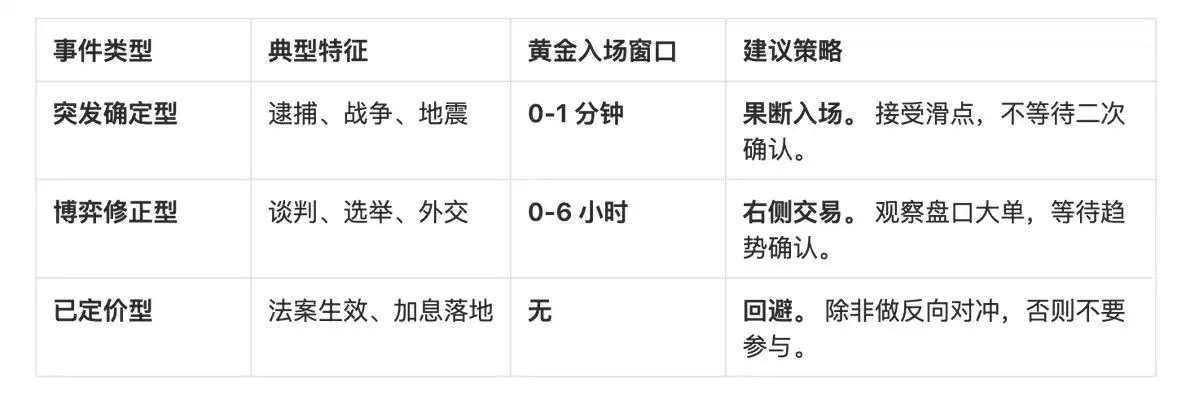
Conclusion

In prediction markets, 1 minute of hesitation corresponds not to the passage of time, but to a violent collapse of the profit-loss ratio.

Next time you face major news, ask yourself this question:

"Am I entering now as a hunter to capture Alpha, or as prey to provide liquidity?"

İlgili Sorular

QWhat is the 'confirmation tax' mentioned in the article, and why is it costly in prediction markets?

AThe 'confirmation tax' is the cost of sacrificing potential alpha (excess returns) by taking time to verify the authenticity of news before trading. In prediction markets like Polymarket, this is extremely expensive because the first few minutes after an event absorb the vast majority of the information advantage. Waiting even one minute to confirm news can mean forfeiting most of the profits to faster, risk-taking traders.

QAccording to the data, what percentage of the information advantage is absorbed within the first 10 minutes in high-liquidity突发事件 (sudden events)?

AAccording to the analysis of 2,023 on-chain trades, the first 10 minutes absorb 96% of the information advantage in high-liquidity sudden events.

QWhat are the three types of event decay curves identified in the research, and name one example for each.

AThe three types are: 1. Sudden Deterministic Events (e.g., 'Maduro out by Jan 31, 2026?'), 2. Game Theory Correction Events (e.g., 'Will SVB be acquired?'), and 3. Already Priced-In Events (e.g., 'TikTok banned in the US').

QFor a 'Sudden Deterministic' event, what is the approximate half-life of alpha, and what is the only viable strategy?

AFor a 'Sudden Deterministic' event, the half-life of alpha is less than 2 minutes. The only viable strategy is to sacrifice certainty in exchange for an entry position, acting on the news quickly within a risk-controllable framework.

QWhat is the key difference in strategy between a 'Sudden Deterministic' event and a 'Game Theory Correction' event?

AFor a 'Sudden Deterministic' event, the strategy requires extreme speed, acting within the first minute. For a 'Game Theory Correction' event, speed is less critical; the strategy focuses on identifying 'confirmation signals' that shift market consensus over a longer window (e.g., 0-6 hours), such as rumors of failed negotiations or large buys from smart money.

İlgili Okumalar

380,000 Apps Exposed, 2,000+ Apps Leaked Secrets: AI Programming Turns 'Intranet' into Public Internet

Israeli cybersecurity firm RedAccess uncovered a severe data exposure trend linked to "vibe coding" or AI-powered software development tools. Their research found approximately 38,000 publicly accessible web applications built with platforms like Lovable, Base44, Netlify, and Replit. Of these, an estimated 2,000 apps exposed sensitive corporate and personal data, including medical records, financial information, internal strategic documents, and customer chat logs. In some cases, access even granted administrative privileges. The core issue stems from default privacy settings that make applications public by default, combined with a lack of built-in security controls (like authentication) in the AI-generated code. This allows employees without security expertise—"citizen developers"—to easily create and deploy applications that bypass standard corporate security reviews. The exposed apps, often indexed by search engines, are trivially discoverable. While some platform providers (Replit, Lovable, Wix/Base44) argue that security configuration is the user's responsibility and question the validity of some findings, security researchers confirm the widespread reality of such exposures. This pattern, also noted in prior studies, highlights a critical security gap as AI democratizes app creation, potentially leading to massive, unintentional data leaks.

marsbit24 dk önce

380,000 Apps Exposed, 2,000+ Apps Leaked Secrets: AI Programming Turns 'Intranet' into Public Internet

marsbit24 dk önce

Attracting Global Capital, Asia's New 'Super Cycle' Is Unfolding

Investors are turning to Asia as the next frontier for global equity growth, with a new "super cycle" unfolding across the region. Driven by the AI revolution, Asian markets, particularly South Korea, have seen significant rallies. According to Morgan Stanley analysis, the underlying drivers of Asia's industrial cycle are shifting from traditional sectors like real estate and manufacturing to massive investments in AI infrastructure, energy security and transition, and supply chain resilience. Fixed asset investment in Asia is projected to grow from around $11 trillion in 2025 to $16 trillion by 2030, with a 7% annual growth rate from 2026-2030. The AI wave is a primary catalyst, driving immense capital expenditure for chips, servers, data centers, and power systems. Asia is central to this hardware supply chain. In China, AI investment is focused on building a full-system domestic capability, with the local AI chip market potentially reaching $86 billion by 2030. Beyond AI, China's export story is expanding from EVs and batteries to robotics. The country already captures about half of new global industrial robot demand and over 90% of humanoid robot shipments. This growth phase mirrors the early stages of China's EV export boom. Simultaneously, energy security investments, spurred by AI's massive power needs, are rising, with China benefiting from its leadership in solar, batteries, and EVs. Regional defense spending is also increasing structurally, supporting demand for advanced manufacturing. The main beneficiaries are China, South Korea, and Japan, positioned in core supply chain areas. However, risks remain, including potential overcapacity, profit margin pressures from competition, persistent technological restrictions, geopolitical friction, and workforce displacement due to AI-driven automation. Market volatility is also expected to increase as investor expectations diverge on the realization of these capital investment and export themes.

marsbit25 dk önce

Attracting Global Capital, Asia's New 'Super Cycle' Is Unfolding

marsbit25 dk önce

Funding Weekly Report | 14 Public Funding Events, Kalshi Completes $10B New Funding Round at $220B Valuation Led by Coatue Management

Weekly Funding Roundup: 14 Deals and $10.49B+ in Total Funding, Led by Kalshi's $1B Round Last week (5.4-5.10) saw 14 notable funding events in the global blockchain ecosystem, raising over $10.49 billion in total. Key highlights include Kalshi, a prediction market platform, securing a $1 billion round led by Coatue Management, reaching a $22 billion valuation. The platform now boasts ~2 million MAUs and $178B in annualized trading volume. In DeFi, regulated on-chain reinsurer OnRe raised $5 million in Series A funding, and Bitcoin-backed credit protocol Saturn Credit completed a $2 million seed round. For Infrastructure & Tools, OpenTrade raised $17 million to expand its stablecoin yield infrastructure, and RWA platform Balcony secured $12.7 million to deploy its property settlement service in the US. Centralized Finance saw one deal: AI-driven trading platform Stockcoin.ai completed a seed round led by Amber Group. In the prediction market sector alongside Kalshi, AI-powered platform Elastics raised $2 million. Other notable deals include SC Ventures' strategic investment in crypto market maker GSR and Centrifuge securing a "seven-figure" investment from Coinbase to become a core RWA partner for Base. On the investor side, Haun Ventures raised a new $1 billion fund targeting crypto and AI, and Multi Investment raised ~$616 million to focus on blockchain and Web3 investments.

marsbit1 saat önce

Funding Weekly Report | 14 Public Funding Events, Kalshi Completes $10B New Funding Round at $220B Valuation Led by Coatue Management

marsbit1 saat önce

İşlemler

Spot
Futures

Popüler Makaleler

ONE Nasıl Satın Alınır

HTX.com’a hoş geldiniz! Harmony (ONE) satın alma işlemlerini basit ve kullanışlı bir hâle getirdik. Adım adım açıkladığımız rehberimizi takip ederek kripto yolculuğunuza başlayın. 1. Adım: HTX Hesabınızı OluşturunHTX'te ücretsiz bir hesap açmak için e-posta adresinizi veya telefon numaranızı kullanın. Sorunsuzca kaydolun ve tüm özelliklerin kilidini açın. Hesabımı Aç2. Adım: Kripto Satın Al Bölümüne Gidin ve Ödeme Yönteminizi SeçinKredi/Banka Kartı: Visa veya Mastercard'ınızı kullanarak anında Harmony (ONE) satın alın.Bakiye: Sorunsuz bir şekilde işlem yapmak için HTX hesap bakiyenizdeki fonları kullanın.Üçüncü Taraflar: Kullanımı kolaylaştırmak için Google Pay ve Apple Pay gibi popüler ödeme yöntemlerini ekledik.P2P: HTX'teki diğer kullanıcılarla doğrudan işlem yapın.Borsa Dışı (OTC): Yatırımcılar için kişiye özel hizmetler ve rekabetçi döviz kurları sunuyoruz.3. Adım: Harmony (ONE) Varlıklarınızı SaklayınHarmony (ONE) satın aldıktan sonra HTX hesabınızda saklayın. Alternatif olarak, blok zinciri transferi yoluyla başka bir yere gönderebilir veya diğer kripto para birimlerini takas etmek için kullanabilirsiniz.4. Adım: Harmony (ONE) Varlıklarınızla İşlem YapınHTX'in spot piyasasında Harmony (ONE) ile kolayca işlemler yapın.Hesabınıza erişin, işlem çiftinizi seçin, işlemlerinizi gerçekleştirin ve gerçek zamanlı olarak izleyin. Hem yeni başlayanlar hem de deneyimli yatırımcılar için kullanıcı dostu bir deneyim sunuyoruz.

266 Toplam GörüntülenmeYayınlanma 2024.12.12Güncellenme 2025.03.21

ONE Nasıl Satın Alınır

Tartışmalar

HTX Topluluğuna hoş geldiniz. Burada, en son platform gelişmeleri hakkında bilgi sahibi olabilir ve profesyonel piyasa görüşlerine erişebilirsiniz. Kullanıcıların ONE (ONE) fiyatı hakkındaki görüşleri aşağıda sunulmaktadır.

活动图片













