The On-Chain Evolution of Private Credit: From Ledgers to Investable Products

深潮2025-12-18 tarihinde yayınlandı2025-12-18 tarihinde güncellendi

Özet

Private credit is undergoing a significant on-chain evolution, transitioning from a ledger-based operational upgrade to a distributable, investable product. While the total value of tokenized private credit has surged to around $24 billion, only 12% of the $19.3 billion in active loans tracked on RWA.xyz are held in transferable tokenized form. The market is split between "representative" tokenization—where blockchain serves as a transparent record-keeping system for off-chain loans—and "distributable" tokenization, where loans are natively issued and held as transferable tokens on-chain. The latter is growing rapidly, offering benefits like enhanced liquidity, faster settlement, and improved transparency. Figure dominates the market with a 73% share but uses blockchain only for record-keeping. In contrast, platforms like Maple are driving the shift toward fully distributable tokenized credit. This shift could standardize and scale private credit distribution by reducing intermediation, enabling programmable compliance, and improving portability—key advancements for an asset class that represents less than 2% of the $1.6 trillion global private credit market.

Author: Prathik Desai

Compiled by: Block Unicorn
Preface

On tokenized real-world asset (RWA) platforms, private credit is at a pivotal moment. Over the past year, tokenized private credit has been the fastest-growing category, surging from less than $50,000 to approximately $2.4 billion.

If stablecoins (whose payment channels cover all on-chain activities) are excluded, tokenized private credit ranks second only to on-chain commodities. Top tokenized commodities include Tether and Paxos's gold-backed currencies, as well as Justoken's tokens backed by cotton, soybean oil, and corn. This appears to be a serious category, with real borrowers, cash flows, underwriting mechanisms, and yields—and it is less dependent on market cycles compared to commodities.

But the story only becomes complex when you dig deeper.

This $2.4 billion in outstanding tokenized private credit represents only a small fraction of the total outstanding loans. This suggests that only a portion of these assets can truly be held and transferred on-chain in tokenized form.

In today's article, I will examine the reality behind the numbers of tokenized private credit and what these numbers mean for the future of this category.

Let's dive right in.

The Dual Nature of Tokenized Private Credit

The total active loans on the RWA.xyz platform are slightly over $19.3 billion. However, only about 12% of these assets can be held and transferred in tokenized form. This highlights the dual nature of tokenized private credit.

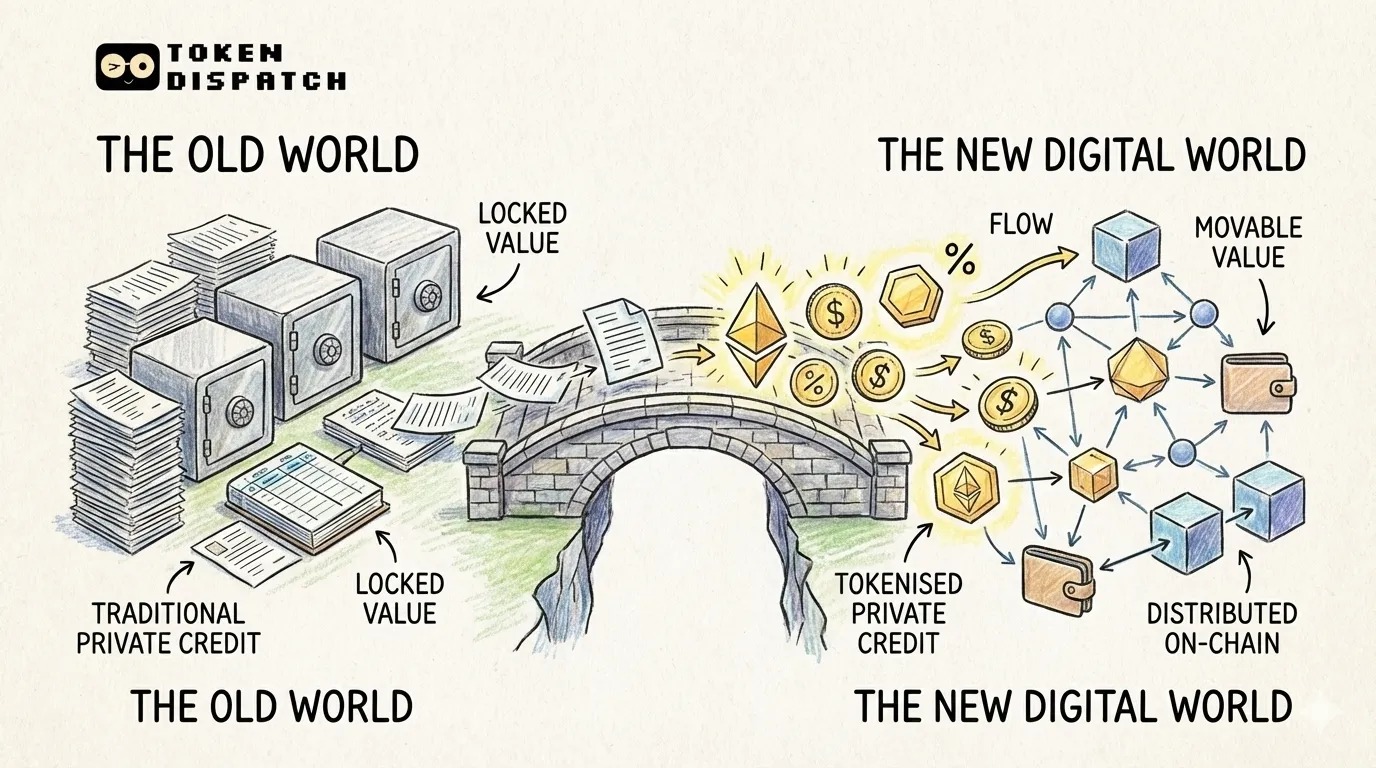
One aspect is "representative" tokenized private credit, where the blockchain merely provides operational upgrades by establishing an on-chain ledger of outstanding loans recorded from the traditional private credit market. The other aspect is the distribution upgrade, where blockchain-driven markets coexist with traditional (or off-chain) private credit markets.

The former is used solely for recording and reconciliation, documented on a public ledger. The latter, however, can be transferred to wallets for transactions.

Once you understand this classification system, you won't ask whether private credit is on-chain. Instead, you'll pose a sharper question: How much private credit originates from the blockchain? The answer to this question might offer some insights.
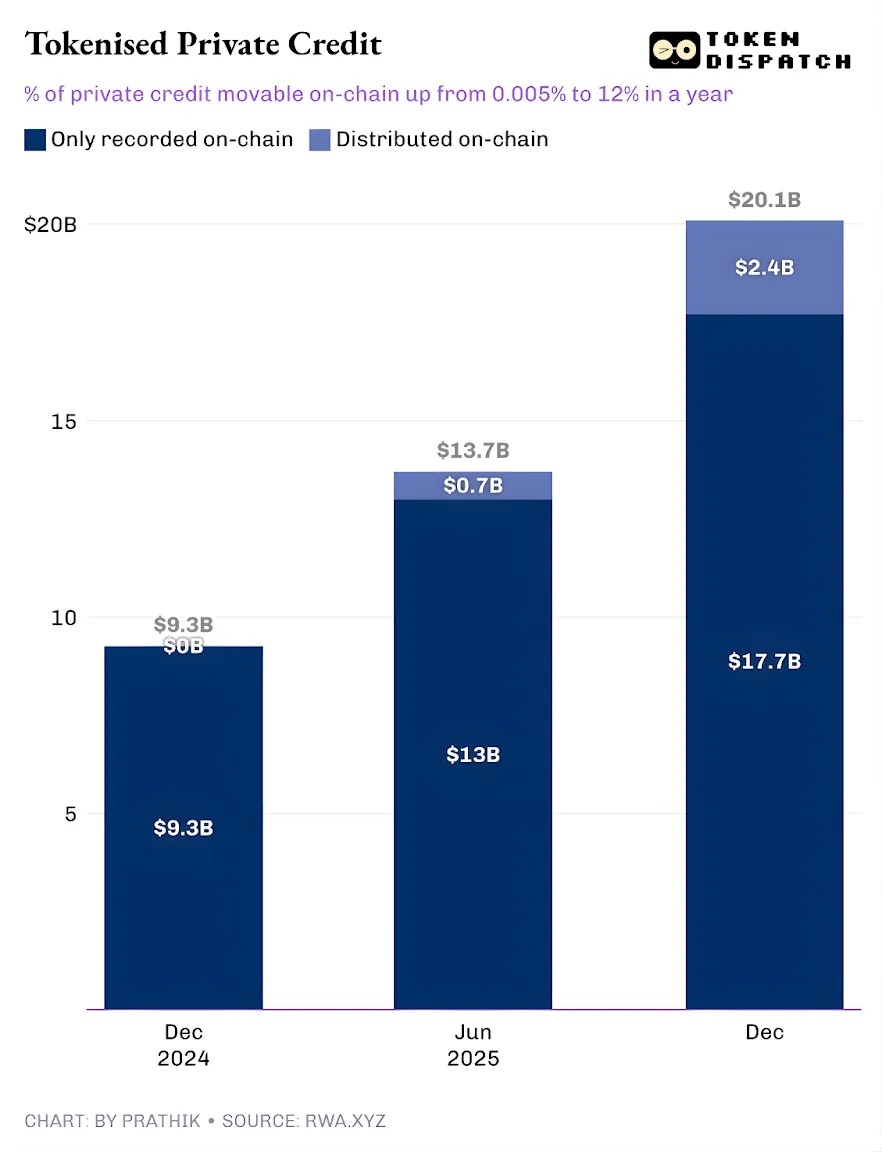
The trajectory of tokenized private credit is encouraging.

Until last year, almost all tokenized private credit was merely an operational upgrade. The loans already existed, borrowers made timely payments, platforms operated normally, and the blockchain simply recorded these activities. All tokenized private credit was only recorded on-chain and could not be transferred as tokens. Within a year, this share of on-chain transferable assets has climbed to 12% of the total trackable private credit.

It showcases the growth of tokenized private credit as a distributable on-chain product. This enables investors to hold fund shares, pool tokens, notes, or structured investment exposures in tokenized form.

If this distributed model continues to expand, private credit will no longer resemble a loan ledger but rather an investable on-chain asset class. This shift will change the benefits lenders derive from transactions. Beyond yields, lenders will gain a tool with greater operational transparency, faster settlement, and more flexible custody. Borrowers will access funding that isn't dependent on a single distribution channel, which could be highly beneficial in risk-averse environments.

But who will drive the growth of the distributable private credit market?

The Figure Effect

Currently, the majority of outstanding credit comes from a single platform, while the rest of the ecosystem forms a long tail.

Since October 2022, Figure has dominated the tokenized private credit market, but its market share has dropped from over 90% in February to 73% today.
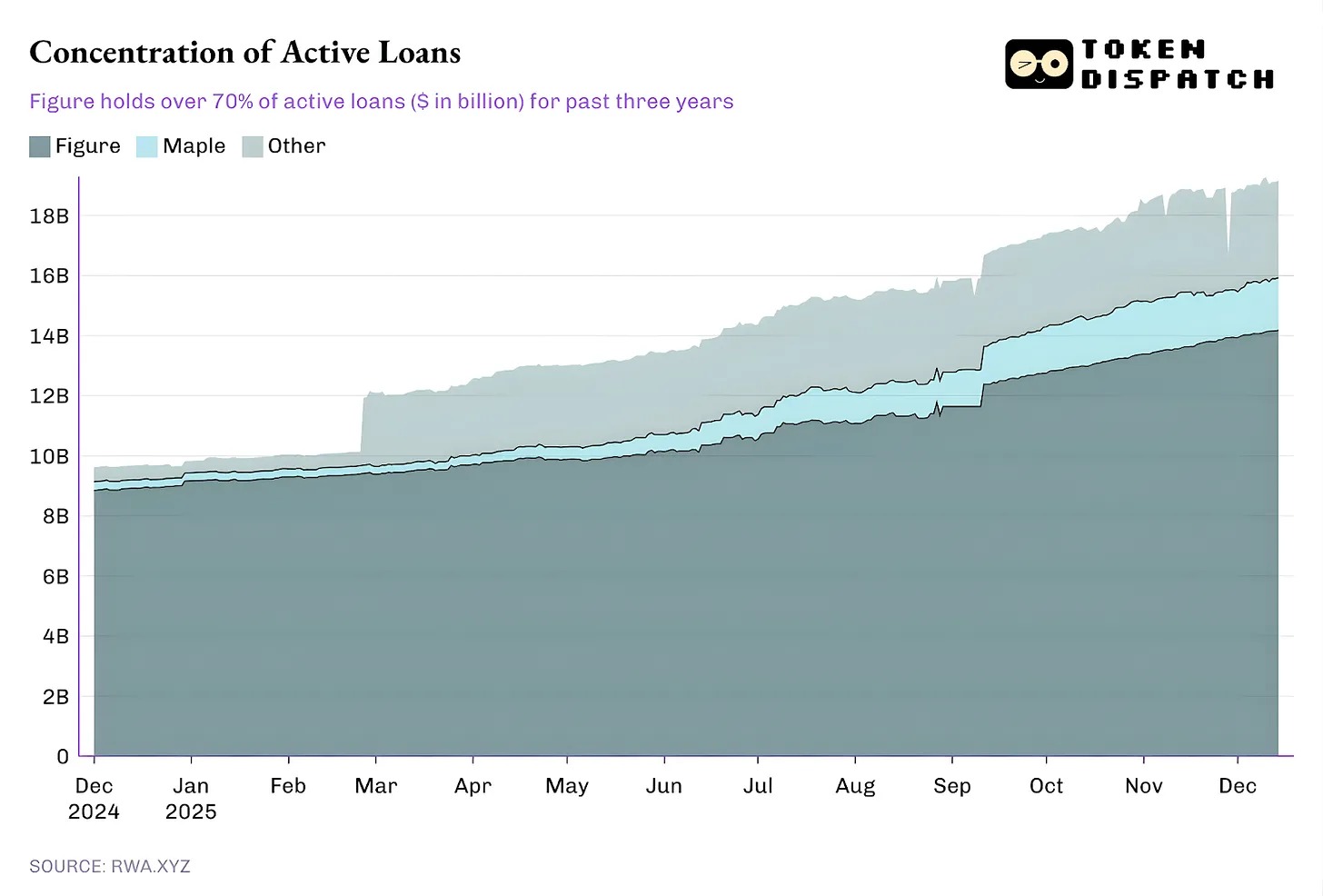
But what's more interesting is Figure's private credit model.

Although tokenized private credit now exceeds $14 billion, all the value of this industry leader is reflected in "representative" asset value, while the distributed value remains zero. This indicates that Figure's model is an operational pipeline that records loan issuance and ownership on the Provenance blockchain.

Meanwhile, some smaller players are driving the distribution of tokenized private credit.
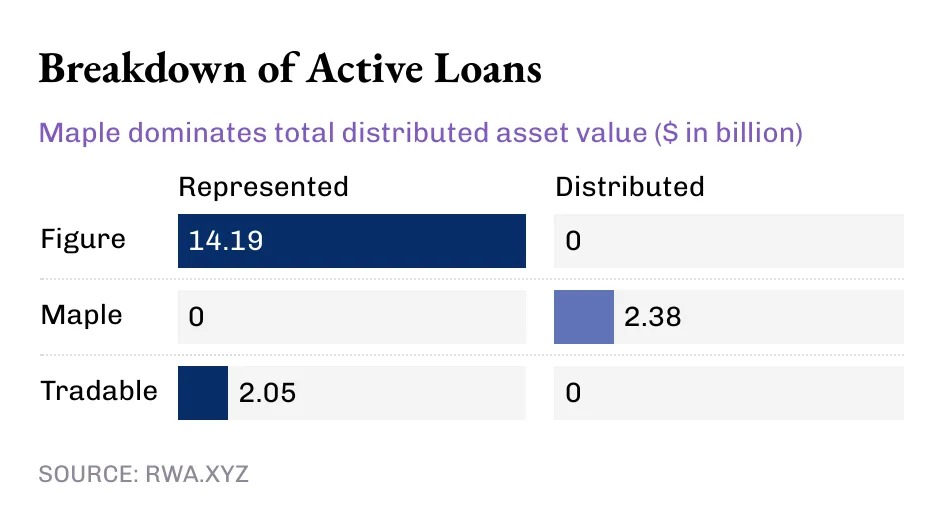
Figure and Tradable hold all their tokenized private credit as representative value, while Maple's value is entirely distributed via the blockchain.

From a macro perspective, the vast majority of the $19 billion in active on-chain loans are recorded on the blockchain. But the trend over the past few months is undeniable: more and more private credit is being distributed via blockchain. Given the immense growth potential of tokenized private credit, this trend will only intensify.

Even at $19 billion, RWAs currently account for less than 2% of the total $1.6 trillion private credit market.

But why is "movable, not just recorded" private credit important?

Movable private credit offers more than just liquidity. Gaining exposure to private credit off-platform through tokens provides portability, standardization, and faster distribution speed.

Assets acquired through traditional private credit channels trap holders within a specific platform's ecosystem. Such ecosystems have limited transfer windows and cumbersome secondary market trading processes. Additionally, secondary market negotiations are slow and primarily led by professionals. This gives existing market infrastructure far more power than asset holders.

Distributable tokens can reduce these frictions by enabling faster settlement, clearer ownership changes, and simpler custody.

More importantly, "movability" is a prerequisite for the large-scale standardized distribution of private credit, which has historically been lacking. In the traditional model, private credit appears in the form of funds, business development companies (BDCs), and collateralized loan obligations (CLOs), each adding multiple layers of intermediaries and opaque fees.

On-chain distribution offers a different path: programmable wrappers enforce compliance (whitelisting), cash flow rules, and information disclosure at the tool level, rather than through manual processes.


İlgili Sorular

QWhat is the current size of the tokenized private credit market, and how does it compare to the total outstanding private credit market?

AThe tokenized private credit market has grown to approximately $24 billion. However, this represents only a small fraction, about 1.2%, of the total $1.6 trillion private credit market.

QWhat is the key difference between 'representative' and 'distributable' tokenized private credit?

A'Representative' tokenized private credit uses the blockchain solely as an operational upgrade to record and reconcile loans from the traditional market on a public ledger. 'Distributable' tokenized private credit allows the assets to be held and transferred as tokens, enabling them to be portable and traded in a blockchain-driven market.

QWhich company is the current market leader in tokenized private credit, and what is unique about its model?

AFigure is the current market leader, holding 73% of the tokenized private credit market. Its model is unique because its entire $14+ billion in value is classified as 'representative' value, meaning the loans are recorded on the Provenance blockchain for operational purposes but are not distributable as transferable tokens.

QWhat are the potential benefits of 'distributable' tokenized private credit over traditional private credit instruments?

ADistributable tokenized private credit offers benefits such as portability, faster settlement, clearer ownership changes, simpler custody, and the potential for standardized, large-scale distribution. It reduces reliance on a single platform's ecosystem and the complex, slow processes of traditional secondary markets dominated by intermediaries.

QWhat does the growth of the distributable segment indicate for the future of private credit?

AThe growth of the distributable segment indicates a shift where private credit is evolving from being a simple on-chain ledger of loans into a true, tradable asset class. This transformation promises greater operational transparency, faster settlement, and more flexible custody options for lenders, while providing borrowers with access to capital that is not reliant on a single distribution channel.

İlgili Okumalar

As Consensus Accelerates, What Are Young Investors Betting On?

Title: As Consensus Forms Faster, What Are Young Investors Betting On? In the rapid evolution of tech investment, a new generation of young investors is navigating a landscape where AI, robotics, commercial aerospace, and quantum computing are advancing simultaneously. Traditional investment logic based on financial models is giving way to a need for deep technical understanding and the ability to act before industry consensus forms. An analysis of trends from the "WAIC FUTURE TECH" list of young investment leaders reveals key shifts in focus. The first major trend is the movement of AI from the digital screen into the physical world. Investment is shifting from large language models and chatbots towards embodied AI, robotics, AI hardware, and edge computing. While demonstrations generate excitement, the real challenge lies in achieving scalable, reliable, and cost-effective delivery in complex real-world environments like factories and logistics. Success depends not just on algorithms but on the integration of sensors, actuators, and control systems. Second, the competitive focus for large models is moving beyond raw capability toward building an "intelligence flywheel." The goal is to create self-reinforcing systems where user interaction generates data, improving the model, which in turn enhances the user experience and attracts more engagement. Companies that successfully embed AI into workflows to create these closed-loop systems can build lasting value that isn't easily erased by the next model upgrade. Third, facing a potential bottleneck in high-quality human-generated data, investors are looking at new underlying technologies. Reinforcement learning and self-play, as demonstrated by AlphaGo Zero, offer paths for AI to generate its own experience. Scientific foundation models, which aim to build general AI capabilities for fields like life sciences and materials discovery, represent a non-consensus direction that could unlock new frontiers of knowledge and data. Finally, in deep-tech areas like quantum computing, commercial aerospace, and space-based infrastructure, patient capital is essential. These fields have long, uncertain development and validation cycles involving complex engineering, supply chains, and regulations. Investment here requires a long-term view, focusing on foundational team capabilities and the eventual emergence of market demand, even if commercial returns are distant. Collectively, these trends illustrate how young investors are adapting to a new era. They are learning to make earlier, technically-informed judgments, balance hype with real-world viability, and provide the patient capital needed to build the deep-tech foundations of the future.

marsbit15 dk önce

As Consensus Accelerates, What Are Young Investors Betting On?

marsbit15 dk önce

Can Japan Buy Growth with AI? Will the Bond Market Believe It?

Japan's cabinet has introduced the 2026 Basic Policy on Economic and Fiscal Management and Reform, shifting its primary fiscal target. The new framework moves away from the traditional annual primary balance goal and instead prioritizes a stable reduction of the debt-to-GDP ratio. This change is tied to a strategy of increased "responsible proactive fiscal" spending, aiming to boost long-term growth through investments in strategic sectors like AI, semiconductors, energy, and robotics. The government estimates total public and private investment in 62 key technologies could exceed 370 trillion yen by 2040. The market reaction has been mixed and cautious. While equity markets may respond to policy signals, bond markets are focused on fiscal credibility. Concerns center on whether the weakening of the clear primary balance anchor could lead to looser fiscal discipline. If investors doubt that these strategic investments will generate sufficient productivity gains, tax revenue, and nominal growth to outpace rising interest costs, they may demand higher yields on Japanese Government Bonds (JGBs). Recent volatility in the yen and JGB yields, with the 10-year yield briefly reaching 2.9%, reflects this skepticism. The success of this new framework hinges on two factors: whether Japan can achieve a nominal growth rate consistently higher than its long-term interest rates, and whether future budgets demonstrate disciplined control over bond issuance. The government's narrative is that strategic investment is essential to break Japan's cycle of low growth, aging, and labor shortages. However, the bond market will continuously assess the credibility of this plan, pricing the risk that it may represent fiscal expansion rather than a viable growth strategy.

marsbit52 dk önce

Can Japan Buy Growth with AI? Will the Bond Market Believe It?

marsbit52 dk önce

Misjudged A-Shares: Resilience, Expectations, and Confidence

China's A-share market recently faced selling pressure, especially in tech sectors, initially triggered by a global tech sell-off that began in South Korea. However, the article argues this is a case of "mistaken injury" and highlights the market's underlying resilience. This resilience stems from three main pillars: **1) Tech Sector Fundamentals:** Unlike Korea's market dominated by a few memory chip stocks, China's tech sector is diversified across computing, communications, electronics, and semiconductors, supported by dual narratives of global AI supply chains and domestic substitution. Core areas like optical modules and fiber optics continue to show strong earnings growth. **2) "National Team" Support:** State-backed institutions and large corporations have made significant market purchases and announced buybacks, providing liquidity and signaling confidence. This is seen as a stabilizing policy signal, often associated with market bottoms. **3) Broader Market Pillars:** Other major sectors are showing endogenous recovery momentum. Consumer stocks benefit from stabilizing CPI and signs of sector recovery (e.g., liquor price hikes). Cyclical sectors like aluminum have high earnings, potential price increases due to tight supply, and low valuations. The financial sector offers stable dividends and low valuations. The conclusion is that the sell-off was driven by external contagion, not a collapse in fundamentals. With strong policy support and recovering momentum across key sectors, the A-share market possesses the toughness to regain stability.

marsbit1 saat önce

Misjudged A-Shares: Resilience, Expectations, and Confidence

marsbit1 saat önce

İşlemler

Spot
活动图片




