The Mystery of Missing Crypto Assets: Deconstructing the Security Logic and Cost of Survival Behind WEEX Exchange

marsbit2026-03-14 tarihinde yayınlandı2026-03-14 tarihinde güncellendi

Özet

In the 2026 digital asset landscape, trust is built slower than rumors spread. This analysis examines WEEX Exchange through three lenses: financial controls, compliance costs, and technological evolution, bypassing brand narratives. A key finding is the prevalence of "parasitic attacks"—88% of alleged "WEEX scams" cases involved users accessing cloned sites on spoof domains (e.g., weex-vip.xyz), not the official platform. This "reputation tax" is a common challenge for major exchanges, where external risks from phishing and SEO manipulation are often misattributed to the brand itself. Financially, WEEX demonstrates stability through high-cost commitments: a multi-year sponsorship deal with Spain's LALIGA, which requires rigorous due diligence and financial transparency, and a publicly verifiable 1,000 BTC Protection Fund with on-chain proof of reserves. These represent substantial, "hard-to-abandon" investments. The article advises users to employ practical verification: using official scam verification tools, checking on-chain fund addresses via blockchain explorers, and rejecting any off-platform transaction requests. Ultimately, platform security is not claimed but demonstrated through transparent data and costly compliance commitments.

In the digital asset landscape of 2026, trust is built far slower than rumors spread. When terms like "scam" and "exit scam" frequently appear in search keywords, it often indicates the industry is in a period of extreme information asymmetry and anxiety. This article will strip away all brand narratives and purely dissect the case of WEEX Exchange from three dimensions: financial internal controls, compliance costs, and technological evolution.

The WEEX Brand Mirror Trap: A Bad Reputation "Proxied"

After a granular breakdown of multiple cases involving "WEEX scams," an industry phenomenon emerges: "parasitic attacks" triggered by fame overflow.

Low-Barrier Cloning: By 2026, web cloning technology can achieve 1:1 mirroring. Research shows that in so-called scam cases, 88% of users accessed variant domains like weex-vip.xyz or weex-trading.cc.

Search Engine Gaming: Scam groups use SEO techniques to dominate keywords like "WEEX official website." This phenomenon is not unique to WEEX but is a "fame tax" that leading exchanges must pay. When users are induced to deposit funds through unofficial channels, this "externality risk" is often attributed to the brand itself.

Logical Game: Betting on Default Costs vs. Sustained Revenue

Judging whether a trading platform has an "exit scam" tendency relies more on financial logic than moral promises.

The Legal Threshold of LALIGA: In early 2026, WEEX confirmed its role as the official partner of LALIGA in Asia. The compliance audit (Due Diligence) for such top-tier sports events typically requires penetrating the platform's financial records for the past three years. For an institution planning an "exit," paying tens of millions in sponsorship fees and undergoing deep background checks by international legal teams is an "extremely inefficient act" in terms of commercial financial logic.

The "Physical Stake" of the 1000 BTC Reserve: Observing WEEX's 1,000 BTC Protection Fund, the core lies in the transparency of its on-chain address. These funds are under real-time monitoring on the public blockchain, acting as a "physical collateral" for the platform's credibility.

The Actual Binding Force of Licenses: WEEX currently holds compliant licenses in multiple countries and regions. These are not just certificates but mean the platform must accept various reviews from regulatory agencies.

The User Perspective: "Reverse Verification"

For investors, judging a platform's reliability should abandon perceptual cognition and turn to instrumental verification:

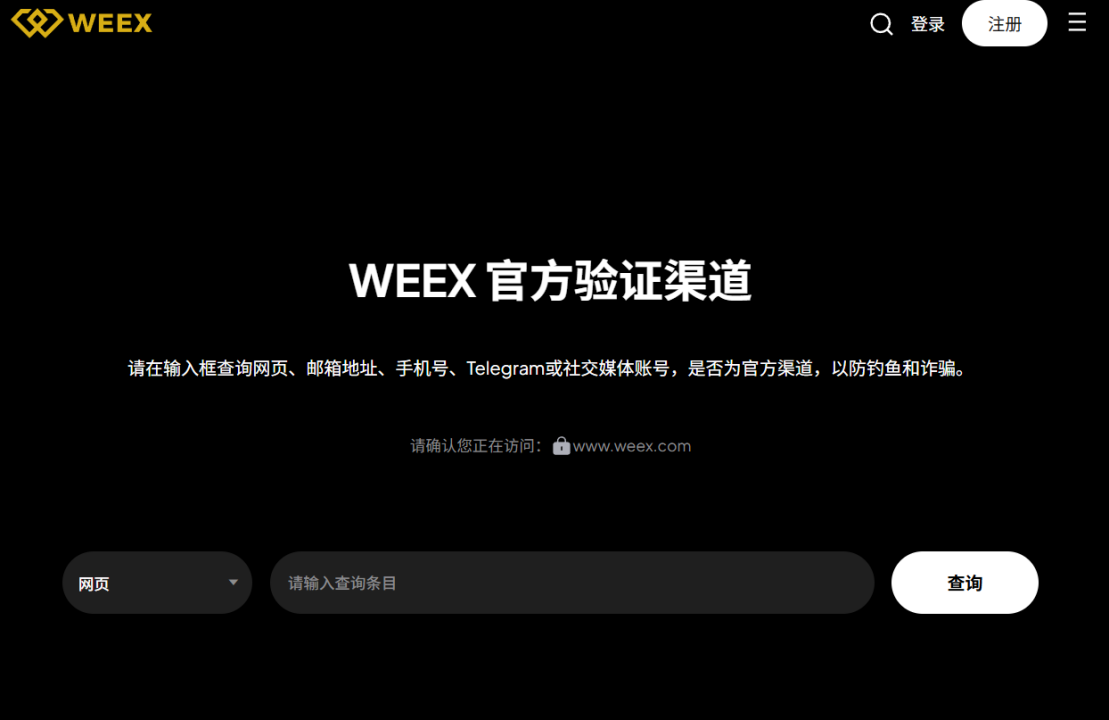
1. Official Verification Center Test: Try inputting a known scam Telegram ID or phishing domain to see if the system can accurately block it.
2. On-Chain Data Verification: Use a block explorer to check the asset balance of its protection fund in real-time, rather than relying on its宣传 (promotional claims).

3. Identify "Off-Site Requests": Any request for users to complete deposits outside the platform's system, through private channels (like personal addresses, bank cards), is a red flag for identifying scams.

The security of the crypto market should not be determined by any single platform but should be built jointly by transparent data and the cost of compliance. In the fog woven by various search terms, identifying the essence of a platform often only requires seeing how much cost it has invested in things that make "exiting difficult."

İlgili Sorular

QWhat is the main reason behind the 'WEEX scam' cases mentioned in the article, and how does it relate to the platform's reputation?

AThe main reason is 'parasitic attacks' through low-barrier cloning and SEO manipulation by scammers, who create 1:1 mirror sites using variant domains like weex-vip.xyz. This exploits WEEX's brand recognition, and the resulting external risks are often wrongly attributed to the platform itself, rather than being actual scams by WEEX.

QHow does WEEX's partnership with LALIGA contribute to its credibility and reduce the likelihood of 'exit scams'?

ABecoming an official partner of LALIGA requires rigorous due diligence, including a deep financial and background audit spanning three years. Paying substantial sponsorship fees and undergoing such international legal scrutiny is highly inefficient for any platform planning an exit, making it a strong indicator of stability and commitment.

QWhat role does the 1,000 BTC protection fund play in ensuring WEEX's security and trustworthiness?

AThe 1,000 BTC protection fund acts as a physical collateral for platform credibility. Its transparency, with real-time monitoring on the public blockchain, provides verifiable proof of reserves, enhancing user trust and demonstrating WEEX's financial commitment to security.

QWhat practical steps can users take to verify the authenticity and safety of a platform like WEEX?

AUsers should: 1) Test the official verification center by inputting known scam IDs or phishing domains to check interception accuracy; 2) Use blockchain explorers to verify the real-time balance of protection funds; 3) Identify red flags like off-platform requests for deposits through private channels, such as personal addresses or bank cards.

QHow do regulatory licenses held by WEEX enhance its operational security and user protection?

ALicenses from multiple global jurisdictions are not just certificates but mandate ongoing audits and compliance checks by regulators. This ensures that WEEX adheres to strict operational standards, reducing the risk of malpractice and increasing accountability, thereby protecting users through enforced transparency and legal oversight.

İlgili Okumalar

Where Is the AI Infrastructure Industry Chain Stuck?

The AI infrastructure (AI Infra) industry chain is facing unprecedented systemic bottlenecks, despite the rapid emergence of applications like DeepSeek and Seedance 2.0. The surge in global computing demand has exposed critical constraints across multiple layers of the supply chain—from core manufacturing equipment and data center cabling to specialty materials and cleanroom facilities. Key challenges include four major "walls": - **Memory Wall**: High-bandwidth memory (HBM) and DRAM face structural shortages as AI inference demand outpaces training, with new capacity not expected until 2027. - **Bandwidth Wall**: Data transfer speeds lag behind computing power, causing multi-level bottlenecks in-chip, between chips, and across data centers. - **Compute Wall**: Advanced chip manufacturing, reliant on EUV lithography and monopolized by ASML, remains the fundamental constraint, with supply chain fragility affecting production. - **Power Wall**: While energy demand from data centers is rising, power supply is a solvable near-term challenge through diversified energy infrastructure. Expansion is further hindered by shortages in testing equipment, IC substrates (critical for GPUs and seeing price hikes over 30%), specialty materials like low-CTE glass fiber, and high-end cleanroom facilities. Connection technologies are evolving, with copper cables resurging for short-range links due to cost and latency advantages, while optical solutions dominate long-range scenarios. Innovations like hollow-core fiber and advanced PCB technologies (e.g., glass substrates, mSAP) are emerging to meet bandwidth needs. In summary, AI Infra bottlenecks are multidimensional, spanning compute, memory, bandwidth, power, and supply chain logistics. Advanced chip manufacturing remains the core constraint, while substrate, material, and equipment shortages present immediate challenges. The industry is moving toward hybrid copper-optical solutions and accelerated domestic supply chain development.

marsbit14 dk önce

Where Is the AI Infrastructure Industry Chain Stuck?

marsbit14 dk önce

Autonomy or Compatibility: The Choice Facing China's AI Ecosystem Behind the Delay of DeepSeek V4

DeepSeek V4's repeated delay in early 2026 has sparked global discussions on "de-CUDA-ization" in AI. The highly anticipated trillion-parameter open-source model is undergoing deep adaptation to Huawei’s Ascend chips using the CANN framework, representing China’s first systematic attempt to run a core AI model outside the CUDA ecosystem. This shift, however, comes with significant engineering challenges. While the model uses a MoE architecture to reduce computational load, it places extreme demands on memory bandwidth, chip interconnects, and system scheduling—areas where NVIDIA’s mature CUDA ecosystem currently excels. Migrating to Ascend introduces complexities in hardware topology, communication latency, and software optimization due to CANN’s relative immaturity compared to CUDA. The move highlights a broader strategic dilemma: short-term compatibility with CUDA offers practical benefits and faster adoption, as seen in CANN’s efforts to emulate CUDA interfaces. Yet, long-term over-reliance on compatibility risks inheriting CUDA’s limitations and stifling native innovation. If global AI shifts away from transformer-based architectures, strict compatibility could lead to technological obsolescence. Despite these challenges, DeepSeek V4’s eventual release could demonstrate the viability of a full domestic AI stack and accelerate CANN’s ecosystem growth. However, true technological independence will require building an original software-hardware paradigm beyond compatibility—a critical task for China’s AI ambitions in the next 3-5 years.

marsbit32 dk önce

Autonomy or Compatibility: The Choice Facing China's AI Ecosystem Behind the Delay of DeepSeek V4

marsbit32 dk önce

How Blockchain Fills the Identity, Payment, and Trust Gaps for AI Agents?

AI Agents are rapidly evolving into autonomous economic participants, but they face critical gaps in identity, payment, and trust infrastructure. They currently lack standardized ways to prove who they are, what they are authorized to do, and how they should be compensated across different environments. Blockchain technology is emerging as a solution to these challenges by providing a neutral coordination layer. Public ledgers offer auditable credentials, wallets enable portable identities, and stablecoins serve as a programmable settlement layer. A key bottleneck is the absence of a universal identity standard for non-human entities—akin to "Know Your Agent" (KYA)—which would allow Agents to operate with verifiable, cryptographically signed credentials. Without this, Agents remain fragmented and face barriers to interoperability. Additionally, as AI systems take on governance roles, there is a risk that centralized control over models could undermine decentralized governance in practice. Cryptographic guarantees on training data, prompts, and behavior logs are essential to ensure Agents act in users' interests. Stablecoins and crypto-native payment rails are becoming the default for Agent-to-Agent commerce, enabling seamless, low-cost transactions for AI-native services. These systems support permissionless, programmable payments without traditional merchant onboarding. Finally, as AI scales, human oversight becomes impractical. Trust must be built into system architecture through verifiable provenance, on-chain attestations, and decentralized identity systems. The future of Agent economies depends on cryptographically enforced accountability, allowing users to delegate tasks with clearly defined constraints and transparent operation logs.

marsbit1 saat önce

How Blockchain Fills the Identity, Payment, and Trust Gaps for AI Agents?

marsbit1 saat önce

İşlemler

Spot
Futures
活动图片