The Inevitable Rise of Equity-like Tokens

marsbit2026-01-21 tarihinde yayınlandı2026-01-21 tarihinde güncellendi

Özet

The article "The Inevitable Rise of Equity-Like Tokens" discusses the long-standing conflict between equity holders and token holders in crypto projects, using Uniswap's delayed fee switch implementation as a key example. It argues that neither extreme—fully eliminating equity for on-chain ownership nor abandoning tokens entirely—is optimal. Equity provides legal rights, governance control, and access to deeper capital markets, while tokens offer transparency, instant settlement, and community alignment. The piece highlights that tokenization of traditional equities is accelerating, with initiatives like the DTC pilot program and Nasdaq’s proposed tokenized securities trading. The author concludes that 2026 will be a year of innovation in equity-like tokens, merging legal protections with digital ownership, ultimately moving beyond the equity-vs-token debate toward a unified model of transparent, legally-backed digital ownership.

Author: Matty

Compiled by: Jiahuan, ChainCatcher

In November 2025, more than 5 years after the $UNI airdrop, Uniswap finally activated the fee switch.

This process involved years of delays and repeated governance battles, even reaching an extremely awkward moment in 2024 when a 'stakeholder' (widely believed to be an equity investor) blocked a proposal that was supposed to benefit token holders. Despite this, the UNIfication proposal ultimately passed with over 62 million votes.
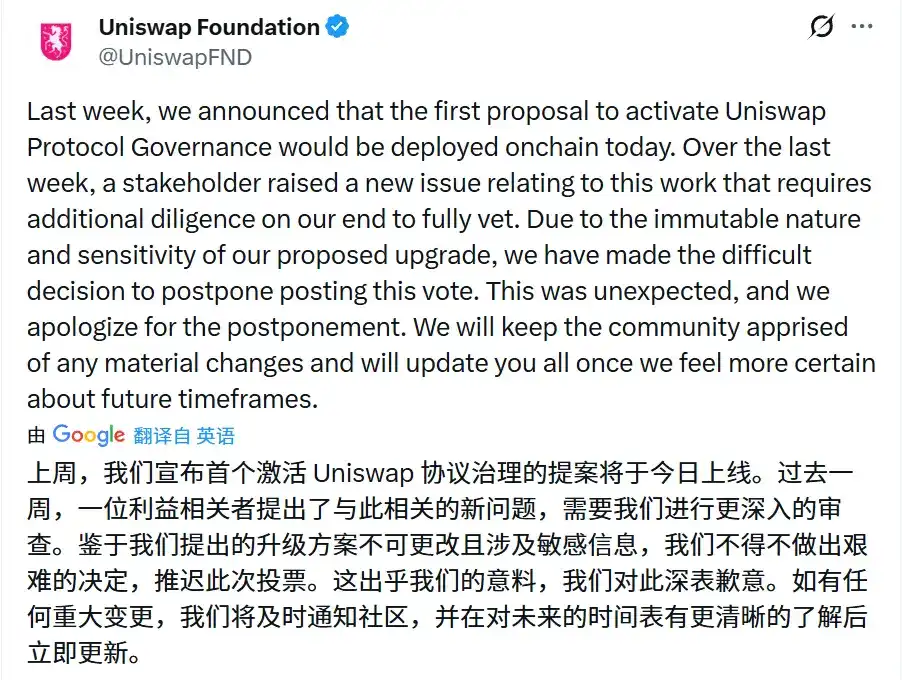
The fact that the largest DEX in crypto took this long to figure out how to reward its token holders is telling of the current state of the relationship between equity and tokens. Although UNI token holders theoretically "own" the protocol, they could only watch from the sidelines as equity investors captured all the value from front-end fees.

While Uniswap is a prime example of the equity-token divide, this issue has worsened over years and affects almost every protocol that consistently generates revenue. Equity holders and token holders often compete for the same value pool, while operating under fundamentally different legal, governance, and economic frameworks.

The proposed solutions within the industry vary widely: from completely eliminating equity and moving all ownership on-chain, to going to the other extreme—abandoning tokens altogether. Both approaches have their proponents, but also significant flaws.

Extreme Path One: Full De-equitization

Completely eliminating equity and moving all ownership concepts on-chain is undoubtedly a theoretical solution. In this vision, smart contracts replace shareholder agreements, on-chain balances replace cap tables, and governance tokens replace board votes.

Instant settlement. Transparent ownership. What's not to like?

One major problem is: Unless the enterprise's assets, operations, and customers are entirely on-chain, the off-chain court system will always be the ultimate arbiter for dispute resolution. You can try to have all your off-chain contracts and agreements reference on-chain logic, but this still doesn't change the fact that off-chain courts are the arbiters, and not everything can be moved on-chain within your control.

For example, I could own a tokenized real estate NFT issued by a smart contract that states I own the corresponding property, but if the off-chain deed for that land says otherwise, good luck presenting your NFT when the sheriff comes to serve the eviction notice. (Again, you can take steps to try to ensure the off-chain deed matches the on-chain state, but this doesn't negate the fact that off-chain enforcement takes precedence).

The "no equity, pure token" approach is only feasible for a small subset of projects:

Fully on-chain networks and protocols, such as Bitcoin, some public blockchains, and fully autonomous DeFi. These projects have no company, no employees, no servers, and no external dependencies. After all, this was the original beauty of Bitcoin! An uncensorable system and unconfiscatable asset.

But for the vast majority of projects (and the vast majority of potential on-chain activity), this is not feasible. Web2 and Web2.5 companies have off-chain assets, customers, payments, and operations.

Extreme Path Two: Full De-tokenization

At the other end of the spectrum, some projects (actually, the vast majority of companies) decide to forgo tokens entirely. They raise equity, build products, and avoid all the headaches tokens can bring—while also sacrificing all the benefits.

  • Benefits: No tokens mean no SEC knocking on your door. No worrying about whether governance tokens are securities. No need to design tokenomics, worry about emissions, or explain buyback mechanisms.

  • Costs: Giving up instant settlement, transparent ownership records, cost efficiency gains, and the ability to align incentives for a global community.

Traditional equity transfer is expensive, settles slowly, and is inaccessible to most potential investors. Gaining exposure to equity in private startups remains expensive, inefficient, and opaque. Even in 2026, the processes required to trade public stocks seem archaic compared to DeFi.

Tokens, despite their flaws, have the potential to solve these problems. They enable community ownership and user-owned products. Abandoning this entirely is a step backward.

To find the optimal balance between these two extremes, we need to understand what equity provides that tokens cannot.

What Equity and Tokens Each Provide
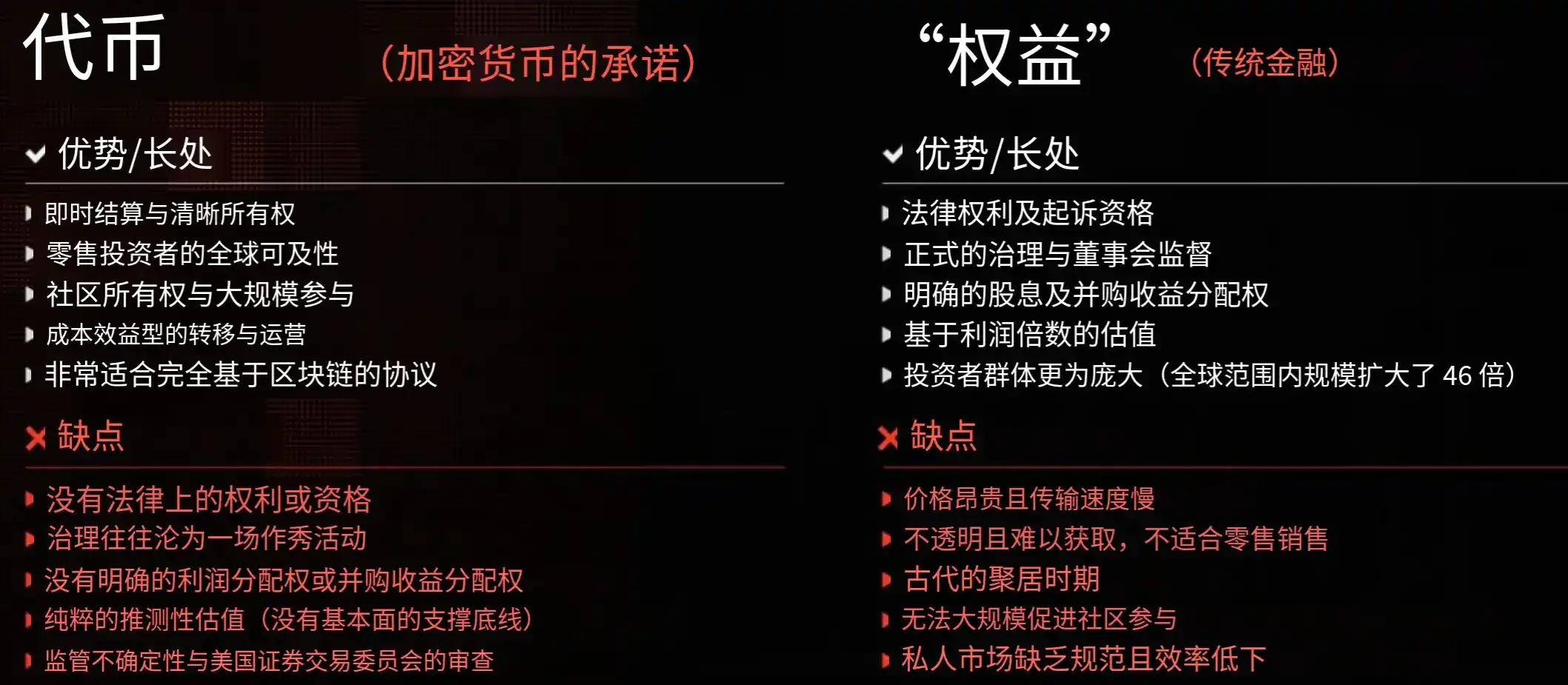
1. Legal Rights and Recourse

When you own equity, you have legal standing. You can sue, enforce rights. If directors breach fiduciary duties or fraud occurs, you have an established legal framework to recover losses.

Token holders (with very few exceptions) have little to no legally recognized rights or protections. They often must simply hope the market saves their investment.

While theoretically a company's entire budget could be placed on-chain, having founders subject every decision to a shareholder vote, without legal rights, introduces massive operational inefficiencies and defeats the purpose of the investment—trusting the team's vision and capabilities.

2. Formal Governance Control

Equity shareholders elect the board, approve major transactions, and have codified rights. In contrast, governance tokens often provide an illusion of control.

As Vitalik has noted, token governance has serious flaws: low turnout (<10%), whale manipulation, lack of expertise. More often, on-chain governance devolves into "decentralized theater," where teams can often ignore votes if they dislike the outcome, as execution still requires manual action.

3. Legal Clarity for Value Accrual

In M&A activity, equity holders have clear legal rights to proceeds. As recent cases involving Tensor and Axelar have shown, token holders are often left out in the cold, even when the related project is acquired.

Because of this strong legal right to profit-sharing, stocks trade more reliably on multiples of expected future profits. Token valuations are often purely speculative, with no fundamental backing.

Even if a project generates revenue, most do not reliably route it to token holders due to regulatory risk and fiduciary duty conflicts. While off-chain agreements can be constructed to simulate this right, it is far less reliable than the legal foundation of equity.

4. Broader and Deeper Investor Pool

Simply put, the investor pool and total buying power of equity markets are vastly larger than token markets.

  • The US stock market alone is worth over 20 times the entire crypto industry.

  • Global equity markets are worth over 46 times the crypto industry.

Projects that choose tokens over equity effectively access only 2%-5% of the potential buying power they could reach.

2026: The Year of the Equity-like Token

One thing is certain: from tokenized equity to new forms of on-chain governance, 2026 will be a year of innovation and experimentation for equity-like tokens.

The DTC Pilot Program (launching in the second half of 2026) will be the first US initiative allowing participants to hold tokenized security entitlements on a blockchain. This represents the backbone of US capital markets infrastructure moving on-chain:

  • Nasdaq has proposed trading tokenized securities.

  • Securitize offers real public stocks with full on-chain legal ownership.

  • Centrifuge and others are tokenizing equity through SEC-registered transfer agents.

The convergence of traditional financial infrastructure with blockchain rails is no longer a pipe dream—it's happening.

For crypto-native projects, Uniswap's five-year journey to the fee switch is a cautionary tale. The equity-token split won't resolve itself automatically. It requires intentional design, clear agreements, and structures to resolve conflicts of interest.

Ultimately, this divergence stems from regulatory uncertainty and a lack of legal frameworks. Whether through the SEC's "crypto projects" or the Clarity Act, the US is expected to get long-awaited regulatory certainty as early as January this year.

By the end of this year, we will no longer be discussing equity vs. tokens. We will be discussing ownership—transparent, transferable, legally protected, and natively digital ownership.


İlgili Sorular

QWhat is the main conflict discussed in the article regarding Uniswap and similar protocols?

AThe main conflict is between equity holders (like venture capital investors) and token holders, who are often competing for the same value pool from protocol revenues, but operate under vastly different legal, governance, and economic frameworks.

QWhat are the two extreme paths proposed to resolve the equity vs. token conflict, and what are their major drawbacks?

AThe two extremes are: 1) Fully eliminating equity and moving all ownership on-chain, which is only feasible for fully on-chain networks and fails when off-chain assets/courts are involved. 2) Fully eliminating tokens, which avoids regulatory headaches but sacrifices the benefits of instant settlement, transparent ownership, and global community coordination.

QAccording to the article, what key advantages does traditional equity have over governance tokens?

AEquity provides: 1) Legal rights and recourse (ability to sue, enforce rights). 2) Formal governance control (election of board, approval of major transactions). 3) Legal clarity for value accumulation (clear rights in M&A). 4) Access to a much larger and deeper pool of investors and capital.

QWhat significant infrastructure development is mentioned for 2026 regarding tokenized securities in the US?

AThe DTC Pilot Program, launching in late 2026, will for the first time allow participants in the US to hold tokenized security entitlements on a blockchain. This is part of a broader trend of traditional finance infrastructure (like Nasdaq) moving on-chain.

QWhat does the author predict will be the focus by the end of the year, moving beyond the 'equity vs. token' debate?

AThe author predicts the focus will shift to discussing 'ownership' itself—transparent, transferable, legally protected, and natively digital ownership, thanks to expected regulatory clarity and technological innovation.

İlgili Okumalar

That Year, Elon Musk and I Talked About His "Space Dream"

"The Year I Talked to Musk About His 'Space Dream'" by Zhang Peng. On June 12, 2024, SpaceX, now incorporating X, xAI, and Starlink, completed a historic IPO, reaching a $2 trillion valuation. This piece reflects on a 2014 conversation between the author, founder of GeekPark, and Elon Musk during his first public appearance in China at the GeekPark Singularity Summit. Their discussion centered on Musk's motivations and unique mindset. Musk described himself not as a CEO but as an "engineer" driven to solve fundamental problems. He explained his work on Tesla aimed to shift the automotive industry's paradigm toward sustainable transport, while SpaceX was born from a desire to make humanity a multi-planetary species, drastically reducing space access costs through reusability. He emphasized persistence in the face of likely failure, noting that traditional entities like NASA, with abundant resources, often lacked the imperative for radical innovation that drives commercial ventures. Musk dismissed the idea of entering politics, believing change is best achieved through compelling products. The author sees the 2020 successful Crew Dragon launch as a pivotal moment, marking the maturation of commercial spaceflight and the true beginning of a scalable, industry-driven space age. He views Musk as a pioneer clearing the path for broader participation, expressing hope that affordable space travel will become a reality, fueled by commercial momentum.

marsbit3 dk önce

That Year, Elon Musk and I Talked About His "Space Dream"

marsbit3 dk önce

US Government Suddenly Halts Anthropic's Strongest Model, "Quasi-IPO Stock Price" Plunges 3.7% Overnight

U.S. Government Halts Anthropic's Top AI Models, 'Pre-IPO' Price Drops 3.7% On June 12, the U.S. government ordered Anthropic to shut down access to its two most powerful AI models, Claude Fable 5 and Claude Mythos 5, citing national security concerns. The directive, issued by the Department of Commerce, required Anthropic to block access for all foreign nationals, leading the company to disable the models globally for all users. Anthropic strongly opposed the move, arguing the government's basis was a "narrow jailbreak vulnerability" and warning that applying such a standard industry-wide would effectively halt all frontier model deployments. The news impacted Anthropic's implied valuation in speculative markets. The Anthropic perpetual contract on Hyperliquid fell approximately 3.7% to around $1,627, down from highs above $1,800 following the models' release. Unauthorized tokenized products linked to Anthropic on Solana also saw significant declines. The models, launched just days earlier on June 9, represented a major capability leap for Anthropic. Fable 5 was its first public release of a "Mythos"-tier model above its flagship Claude Opus. The shutdown creates an ironic situation for Anthropic, a company founded on "AI safety" principles, and adds uncertainty to its ongoing IPO preparations. The company is actively engaging with regulators to resolve what it calls a "misunderstanding" and restore service.

marsbit23 dk önce

US Government Suddenly Halts Anthropic's Strongest Model, "Quasi-IPO Stock Price" Plunges 3.7% Overnight

marsbit23 dk önce

SpaceX IPO Creates Trillion-Dollar Billionaire: Musk's Wealth Equals Half of Crypto Market

SpaceX's record-breaking IPO has propelled Elon Musk to become the first modern billionaire with a personal net worth exceeding $1 trillion, reaching $1.11 trillion according to Bloomberg. This staggering wealth surpasses the total market capitalization of all cryptocurrencies excluding Bitcoin and equals roughly half of the entire crypto market's value. The milestone highlights extreme wealth concentration and the significant devaluation of the altcoin market, whose total cap has nearly halved since late 2025 as capital flows into large tech stocks. SpaceX's Nasdaq debut saw its valuation hit $2.2 trillion, with shares soaring from a $135 offer price to close at $161. Its first-day trading volume of $85 billion set a new global IPO record. Musk owns 42% of the company. Despite his wealth dwarfing the altcoin sector, Musk maintains deep ties to digital assets. He personally holds Bitcoin, Ethereum, and Dogecoin, while his companies, SpaceX and Tesla, collectively hold over 30,000 Bitcoin, ranking among the top corporate BTC holders globally. His acquisition and integration of financial data tools into X (formerly Twitter) further connect his ecosystem to the markets. Ultimately, Musk's trillion-dollar status underscores the immense wealth controlled by tech founders, though this fortune remains largely tied to volatile stock prices rather than liquid assets.

Foresight News31 dk önce

SpaceX IPO Creates Trillion-Dollar Billionaire: Musk's Wealth Equals Half of Crypto Market

Foresight News31 dk önce

Hardcore First Look | Ocean Embodied Intelligence Company 'Shihang Intelligence' Secures Record-Breaking 1 Billion in Funding, Zhu Xiaohu, Temasek Place Bets

Breaking News | Ocean Embodied Intelligence company "Shihang Intelligent" secures a record-breaking 1 billion RMB (approximately 10 billion yuan) in Series A financing, with investment from Zhu Xiaohu and Temasek. Author: Qiu Xiaofen | Editor: Yuan Silai Ocean Embodied Intelligence company "Shihang Intelligent" has completed its Series A funding round, raising over 1 billion RMB. This marks the largest single funding round in the global marine robotics field to date. Investors include upstream momentum funds from chip companies "Moore Thread" and "Kunlunxin," Singapore's state-owned investment platform Vertex Growth, and listed company Dyneo, among others. Existing investors like GSR Ventures (whose founder Zhu Xiaohu has invested for the fifth time), Vertex Ventures China, Hua Ying Capital, and Long Capital also significantly increased their investments. Founder and CEO Chen Xiaobo, a 1989-born alumnus of Harbin Engineering University, is a long-time expert in underwater robotics. He received the National Defense Science and Technology Progress Award at age 28 (the youngest recipient) and led the development of China's first commercial underwater cleaning robot. The funds will be used for core technology R&D, global market expansion, and building the industry chain ecosystem to scale the application of marine robots in complex underwater scenarios. The ocean is considered one of the most challenging environments for robotics due to low light, high turbidity, complex currents, limited communication, high pressure, and corrosion. "Shihang Intelligent" focuses on developing core underlying technologies for marine robots, covering six key systems: power, control, sensing, navigation, sealing, and deployment. Its robots are capable of operating at depths from 0 to 10,000 meters with full degrees of freedom, performing complex maneuvers, autonomous navigation, and multi-robot collaboration. Applications include ship cleaning, underwater security, offshore wind power, marine ranching, and seabed inspection. The company's order value for the first half of 2026 alone has exceeded 1 billion RMB. Its "Orca Robot" is used by major shipping companies and has performed maintenance on over a thousand large vessels. In April of this year, the company launched its ocean embodied large model "Cangqiong CEORION." Unlike traditional remote-controlled or pre-programmed robots, this model integrates environmental perception, task understanding, and action generation into a single end-to-end architecture. Trained on millions of hours of commercial operation data and simulation data, it covers 12 major underwater operation scenarios. In simulations, it achieved over 90% task success rate and over 70% zero-shot adaptation capability to unseen environments. A built-in physics reasoning module reduces collision risk by 80%, enabling autonomous operation even with weak or no communication. Recently, "Shihang Intelligent" was selected as a core technology partner for Singapore's Maritime and Port Authority national hull inspection and cleaning program. These advancements indicate marine robotics is moving from pilot projects to scaled applications, with real-world operations generating valuable data to continuously improve robot capabilities. CEO Chen Xiaobo stated the company will continue investing in core marine robotics technology, the embodied intelligence model, and global application scenarios to expand into more high-risk, high-difficulty, and high-value underwater operations.

marsbit56 dk önce

Hardcore First Look | Ocean Embodied Intelligence Company 'Shihang Intelligence' Secures Record-Breaking 1 Billion in Funding, Zhu Xiaohu, Temasek Place Bets

marsbit56 dk önce

Three Months, 35 Billion Yuan: Investors Rush to Grab the OpenAI of the Physical World

Investors flock to a physical AI startup as the race for the "OpenAI of the physical world" heats up. Ji Jia Shi Jie (GigaWorld), a company dedicated to developing Artificial General Intelligence (AGI) for the physical world, has raised 3.5 billion RMB (approximately $490 million) in just three months, according to a report from investment media outlet Touzijie. The latest B2 funding round of 1 billion RMB attracted a wide range of top-tier investors, including sovereign wealth funds, industrial capital, and financial institutions. This brings the total funding for the young company, now valued over 10 billion RMB, to 3.5 billion RMB across three recent rounds. The company is led by Huang Guan, a post-90s Tsinghua University PhD with extensive experience in AI, autonomous driving, and entrepreneurship. Its core innovation is a "dual-pyramid" system comprising a five-layer data pyramid (from internet videos to real-world robot data) and a three-layer algorithm pyramid focused on world simulation, action alignment, and reinforcement learning. This system underpins its key models: the "World Action Model" (e.g., GigaBrain series for robot control) and the "World Generation Model" (e.g., GigaWorld series for simulating and understanding the physical world). Its models have reportedly achieved top rankings in global robotics benchmarks. Ji Jia Shi Jie argues that while current digital AGI excels in information processing, the next frontier is physical AGI—systems that can understand and interact with the real world. The company believes the field is approaching its "GPT-3 moment," a key inflection point in capability scaling. To achieve this, the company is pursuing a dual-market strategy. For the consumer (C) market, it launched the "SeeLight" brand and its S1 general-purpose humanoid robot, which has secured initial orders for deployment in real homes. For the business (B) market, it focuses on industrial automation with its Maker series robots, having signed agreements for large-scale deployment in factories, and its DriveDreamer world model for autonomous driving, which is already in use with over 30 automakers and tech companies. The report concludes that by bridging the gap between digital intelligence and physical action, Ji Jia Shi Jie aims to unlock a new wave of productivity, ultimately bringing physical AGI into everyday life.

marsbit1 saat önce

Three Months, 35 Billion Yuan: Investors Rush to Grab the OpenAI of the Physical World

marsbit1 saat önce

İşlemler

Spot
Futures
活动图片




