The First to Ride the Hype of Robinhood Chain: Arbitrum, Up Nearly 20%

marsbit2026-07-11 tarihinde yayınlandı2026-07-11 tarihinde güncellendi

Özet

ARB rose nearly 20% recently, becoming one of the top-performing major L2 tokens. The catalyst was the launch of Robinhood Chain, an RWA-focused Layer 2 built on Arbitrum's Orbit tech. A key driver is the revived "Arbitrum Expansion Program" (AEP), a revenue-sharing rule from 2024 requiring independent Orbit chains to give 10% of their net protocol revenue to the Arbitrum ecosystem. While smaller chains already paid this, Robinhood Chain, with its significant TradFi backing, is the first large-scale tenant to make the mechanism economically meaningful. Despite impressive early metrics (over 35k addresses, $2.5B TVL, $1B+ DEX volume in its first week), Robinhood Chain's current contribution to Arbitrum's treasury is minor (~$14.7k net revenue). The price surge reflects a narrative-driven premium on AEP's future potential, given Robinhood's vast off-chain assets. The situation mirrors Optimism's "landlord" model with OP Stack, which is now facing a decline as its major tenant, Base, plans to leave. Similarly, analysts question if the high-earning Robinhood Chain will eventually follow Base's path and seek independence from Arbitrum's tech stack, especially as its activity already benefits Ethereum more directly through ETH fee burns.

Author:angelilu, Foresight News

ARB hit $0.094 intraday today, up nearly 20% in the past week, making it one of the best-performing mainstream L2 tokens over that period.

The catalyst for this rally is the launch of "Robinhood Chain"—Robinhood's RWA (Real World Asset) Layer2 built on Arbitrum technology, which officially went live on mainnet at a launch event in London on July 1.

A more subtle logic behind this is that a year-and-a-half-old rule has been brought back into the spotlight: A portion of Robinhood Chain's revenue will automatically flow back into the Arbitrum ecosystem, with a significant chunk going directly to the ArbitrumDAO treasury. This isn't a new policy, but a previously lukewarm revenue-sharing mechanism that is now being seriously priced in by the market for the first time, thanks to the entry of the heavyweight TradFi brand Robinhood.

The First Major Tenant in a Year and a Half

This rule is called the Arbitrum Expansion Program (AEP), launched jointly by the Arbitrum Foundation and Offchain Labs in January 2024. Simply put, it allows Arbitrum to open up its technology for others to build their own chains, with the condition of revenue sharing.

The sharing logic is straightforward: Any independent chain built using Arbitrum Orbit technology but not settling on Arbitrum One/Nova (e.g., settling directly to Ethereum or Base) must share 10% of its net protocol revenue with the Arbitrum ecosystem—8% to the DAO treasury and 2% to the Developer Guild. However, L3s that settle back to Arbitrum One/Nova, like Xai and Sanko, are exempt from this share and retain their status as first-tier ecosystem members.
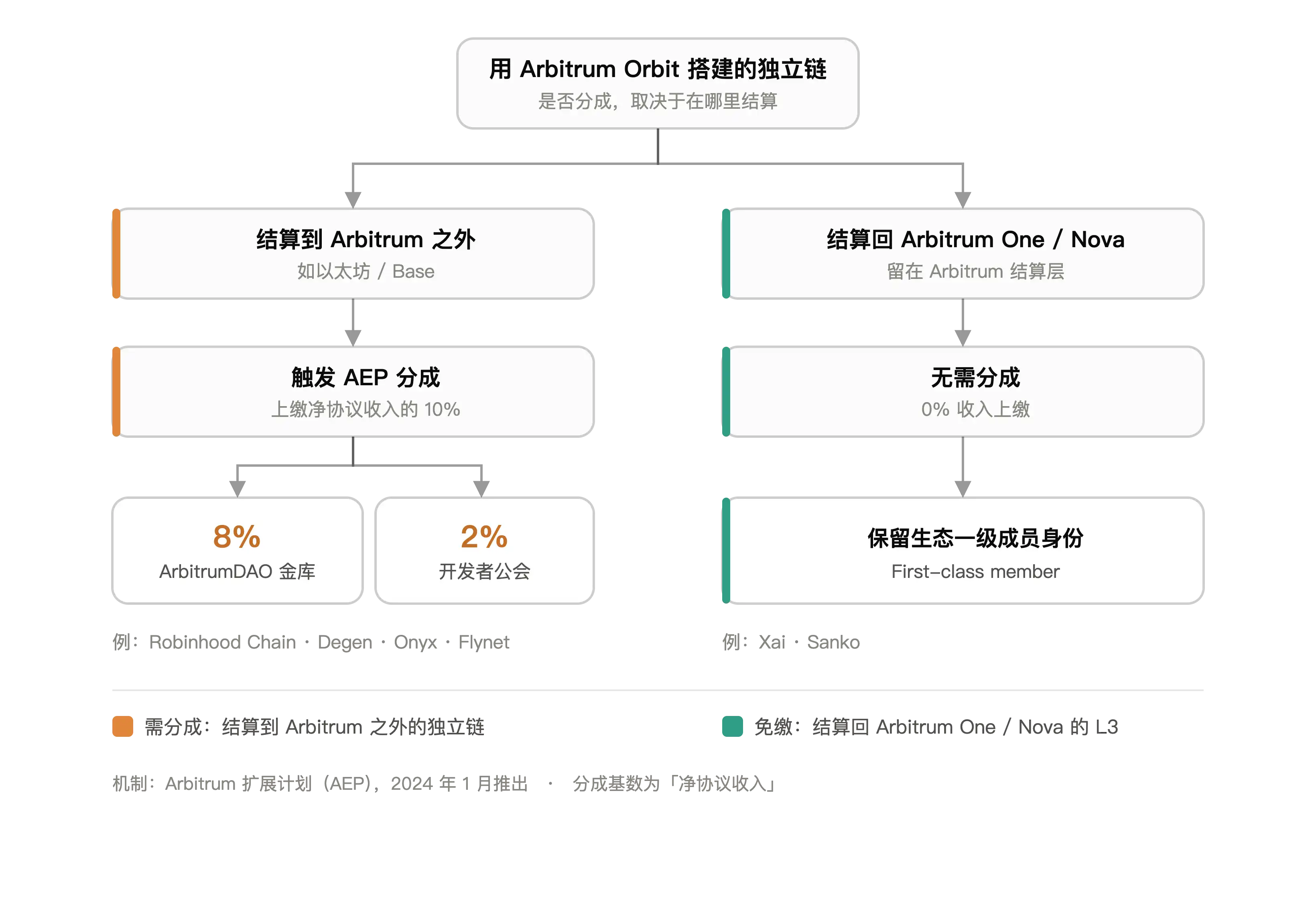
The key point is that Robinhood Chain is not the first chain to trigger the AEP. Smaller chains settling on Base, like Degen Chain, Onyx, and Flynet, have been paying this share for a while, but their volumes were too small to draw attention. What sets Robinhood Chain apart is simply that it's the first heavyweight chain to bring scale to this shared revenue amount.

Impressive Data, but the Rent Plate is Still Small

According to the latest data disclosed by Johann, Robinhood's Head of International & Crypto Business: As of July 10, just over a week after launch, Robinhood Chain has processed over 17 million transactions, has over 350,000 addresses, a TVL of approximately $250 million, and DEX trading volume exceeding $1 billion. For a newly launched chain, this report card is indeed impressive.

But the rent plate is far from this large. According to Dune data, as of the time of writing, Robinhood Chain's current protocol revenue is about $147,000. After deducting the cost of data settlement back to Ethereum L1, it's only $146,000. Even if 10% of this is shared with Arbitrum DAO, the amount is pitifully small. ARB's current rally reflects the market's premium valuation on the future scaling boundaries of the AEP protocol—a typical narrative-driven market move.
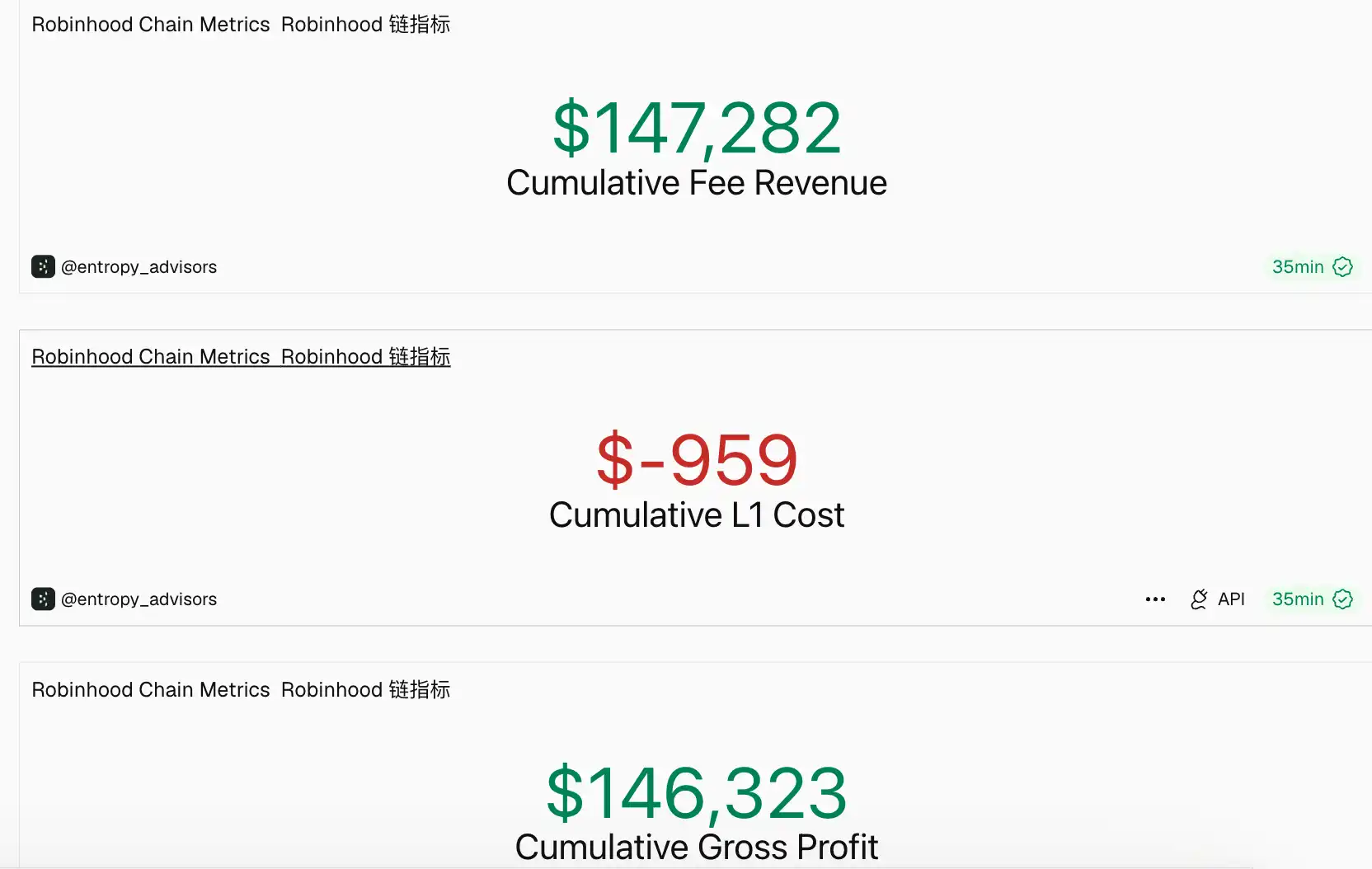
Looking at the potential upside, the ceiling for AEP is indeed not low: The Robinhood platform holds total assets of approximately $324 billion, custodies assets of about $143.6 billion, and its tokenized stocks have expanded to over 2,000 tokens covering 120 countries—most of these assets are not yet on-chain today. Once settlement gradually migrates, the $57,000 sharing base will stand at a completely different scale.

Old Landlord About to Lose Biggest Tenant, New Landlord Just Landed a Big Deal

Arbitrum's "rent collection" model isn't actually new. Optimism has been running the "landlord" business for a long time.

The Optimism Collective collects rent from all Superchain member chains (Base, Zora, Mode, Unichain, etc.) through OP Stack—charging 2.5% of sequencer revenue or 15% of net profit (whichever is higher), and OP Mainnet itself also contributes its net revenue to the treasury. However, its rental income has been gradually shrinking, falling further to about $2.9 million in Q1 2026 (with Base alone contributing about $1.4 million), down 21.5% quarter-on-quarter from $3.7 million in the previous quarter.
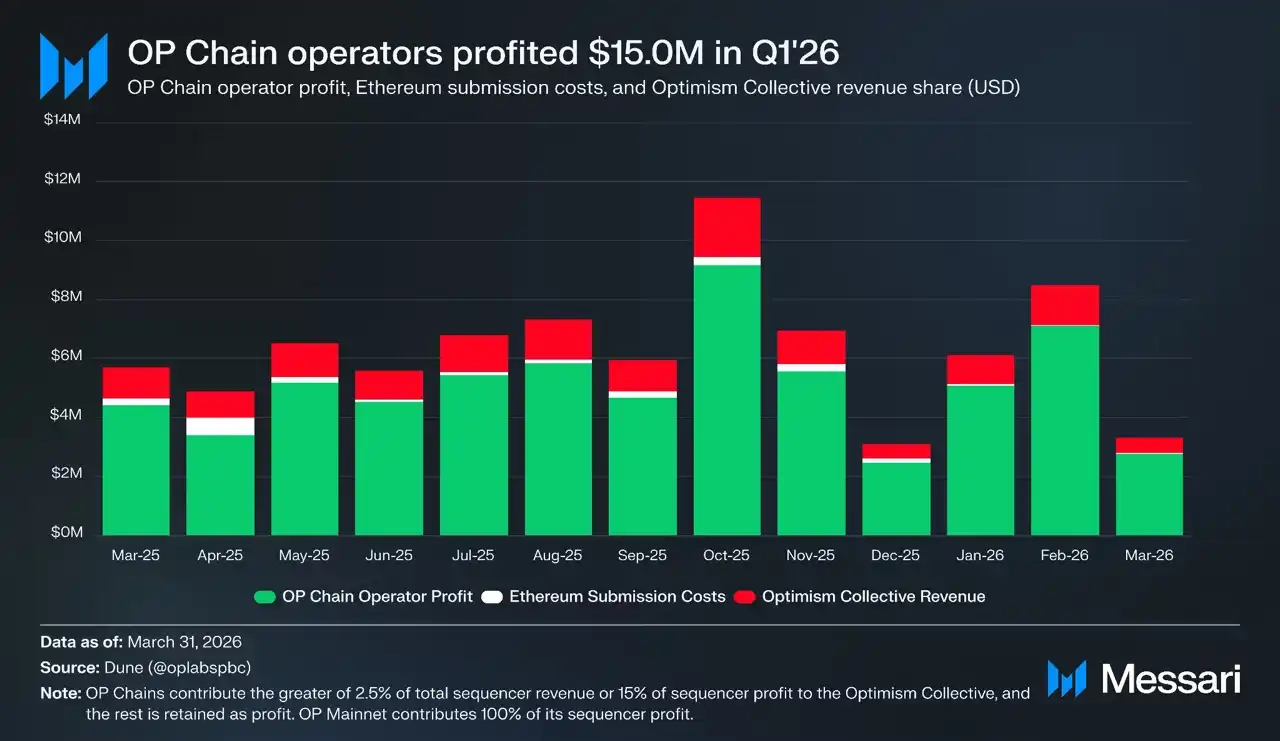
In February of this year, Base officially announced plans to leave OP Stack—Base accounted for about 96.5% of revenue flowing into the Collective on a gas fee basis. Upon the news, the OP token fell 28% within two days.

Meanwhile, Arbitrum just managed to revitalize its own landlord business from zero, thanks to Robinhood Chain. Their structures are completely parallel—both are underlying technologies charging rent from external chains, with the money going into their own DAO treasuries (ArbitrumDAO vs. Optimism Collective). The only difference is that Arbitrum's AEP, although the rules were written in 2024, never had a major tenant until this week, finally giving its "rent collection" a sense of scale for the first time.

But Can This Big Tenant Be Kept?

It's precisely this history with Base that some analysts are using to throw cold water. Some believe that, following the same script, Robinhood Chain will eventually leave Arbitrum Orbit just as Base left OP Stack and align directly with Ethereum. According to growthepie data, Robinhood Chain's daily sequencer revenue is already nearly $60,000, second only to Base's $72,000 among Ethereum L2s, approaching three times that of its parent chain, Arbitrum.
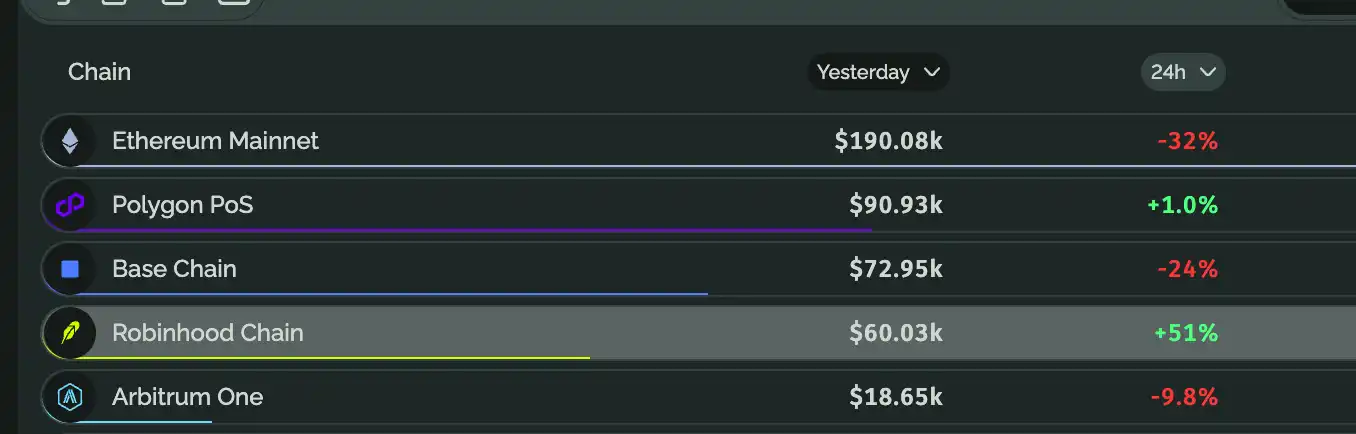
Even more delicate is the question of the beneficiary. In its first week, Robinhood Chain has become the second-largest demand source for Ethereum DA after Base, with its sequencer paying blob fees, settling in ETH, and permanently burning it. Some analysts argue that if this chain can only have one ecosystem currency, it's more likely to be ETH than ARB.


Trend Kriptolar

İlgili Sorular

QWhat is the primary reason behind Arbitrum (ARB) token's recent price surge of nearly 20% according to the article?

AThe primary reason is the launch of 'Robinhood Chain,' a Layer 2 for Real World Assets (RWA) built by Robinhood using Arbitrum technology. This event brought significant market attention to Arbitrum's revenue-sharing model for the first time.

QWhat is the name of Arbitrum's program that mandates revenue sharing from chains built with its technology, and what are the specific terms?

AThe program is called the Arbitrum Expansion Plan (AEP). It requires independent chains built with Arbitrum Orbit technology, which do not settle back to Arbitrum One/Nova (e.g., those settling directly to Ethereum or Base), to share 10% of their net protocol revenue with the Arbitrum ecosystem (8% to the DAO Treasury, 2% to the Developer Guild).

QWhy is Robinhood Chain's launch significant for Arbitrum's revenue-sharing model, unlike previous users of the AEP like Degen Chain?

AWhile other small chains like Degen Chain have been paying under AEP, their volume was too insignificant to matter. Robinhood Chain is significant because it is the first major, heavyweight chain from a major TradFi brand to trigger the AEP, bringing substantial potential scale and market credibility to the revenue-sharing model.

QWhat historical event from the Optimism ecosystem is cited as a cautionary tale regarding the sustainability of such revenue-sharing models?

AThe article cites Base's announcement in February (2026) to break away from the OP Stack as a cautionary tale. Base was the largest contributor (providing ~96.5% of revenue) to the Optimism Collective's treasury, and its departure caused the OP token price to drop 28% over two days.

QAccording to analysts in the article, what are the potential risks that Robinhood Chain might pose to Arbitrum's long-term benefits from the AEP?

AAnalysts suggest Robinhood Chain might eventually follow Base's example and break away from Arbitrum Orbit to align directly with Ethereum, especially as its sequencer revenue grows rapidly. Furthermore, the chain's economic activity primarily benefits Ethereum (ETH) through blob fee payments and burning, not necessarily the ARB token.

İlgili Okumalar

Bitcoin Withdrawals Continue: 8 Years of Storage in a Coldcard Cold Wallet Ended in Zero

Coldcard Hardware Wallet Hacked: Losses Mount Due to Vulnerable Seed Generation A critical vulnerability in Coldcard hardware wallets has led to a continued wave of fund thefts. According to Galaxy Research, the total stolen has reached 1,367.05 BTC (approx. $88.6 million) from 4,585 addresses, a significant increase from the initial 594.5 BTC reported on July 30, 2026. Most of the stolen funds remain on the attackers' addresses. The issue is not with the current firmware, which Coinkite has updated, but with seed phrases generated on vulnerable devices between March 2021 and the release of fixed firmware versions. Due to a programmer error, devices switched from using a hardware random number generator to the software-based Yasmarang generator, which was initialized with publicly accessible data like the chip's serial number. This made the seed phrases predictable through offline brute-force attacks, meaning wallets remain at risk until funds are moved to a new wallet generated with the patched firmware. Affected devices include Mk2/Mk3 with firmware 4.0.1–4.1.9 (and up to 5.0.3), Mk4/Mk5 up to version 5.6.0, and Q models up to 1.5.0Q. The only exceptions are seeds created with a high-entropy method like at least 50 independent dice rolls or a strong unique BIP-39 passphrase. All other owners must generate a new seed on the fixed firmware and transfer their assets. A case highlighting the human impact involves a 39-year-old long-term investor who lost 2 BTC (approx. $130,000) in minutes. He had accumulated the Bitcoin over eight years through physical labor, viewing it as a financial lifeline and a retirement plan in a country suffering from hyperinflation. His story underscores that even conservative "buy and hold in cold storage" strategies can be compromised by such underlying technical flaws. From a technical perspective, this incident echoes historical failures where weak random number generators undermined cryptographic security, challenging the assumption that offline storage is automatically foolproof.

cryptonews.ru4 saat önce

Bitcoin Withdrawals Continue: 8 Years of Storage in a Coldcard Cold Wallet Ended in Zero

cryptonews.ru4 saat önce

İşlemler

Spot

Popüler Makaleler

HYPE Nasıl Satın Alınır

HTX.com’a hoş geldiniz! Hyperliquid (HYPE) satın alma işlemlerini basit ve kullanışlı bir hâle getirdik. Adım adım açıkladığımız rehberimizi takip ederek kripto yolculuğunuza başlayın. 1. Adım: HTX Hesabınızı OluşturunHTX'te ücretsiz bir hesap açmak için e-posta adresinizi veya telefon numaranızı kullanın. Sorunsuzca kaydolun ve tüm özelliklerin kilidini açın. Hesabımı Aç2. Adım: Kripto Satın Al Bölümüne Gidin ve Ödeme Yönteminizi SeçinKredi/Banka Kartı: Visa veya Mastercard'ınızı kullanarak anında Hyperliquid (HYPE) satın alın.Bakiye: Sorunsuz bir şekilde işlem yapmak için HTX hesap bakiyenizdeki fonları kullanın.Üçüncü Taraflar: Kullanımı kolaylaştırmak için Google Pay ve Apple Pay gibi popüler ödeme yöntemlerini ekledik.P2P: HTX'teki diğer kullanıcılarla doğrudan işlem yapın.Borsa Dışı (OTC): Yatırımcılar için kişiye özel hizmetler ve rekabetçi döviz kurları sunuyoruz.3. Adım: Hyperliquid (HYPE) Varlıklarınızı SaklayınHyperliquid (HYPE) satın aldıktan sonra HTX hesabınızda saklayın. Alternatif olarak, blok zinciri transferi yoluyla başka bir yere gönderebilir veya diğer kripto para birimlerini takas etmek için kullanabilirsiniz.4. Adım: Hyperliquid (HYPE) Varlıklarınızla İşlem YapınHTX'in spot piyasasında Hyperliquid (HYPE) ile kolayca işlemler yapın.Hesabınıza erişin, işlem çiftinizi seçin, işlemlerinizi gerçekleştirin ve gerçek zamanlı olarak izleyin. Hem yeni başlayanlar hem de deneyimli yatırımcılar için kullanıcı dostu bir deneyim sunuyoruz.

393 Toplam GörüntülenmeYayınlanma 2024.12.11Güncellenme 2026.06.02

HYPE Nasıl Satın Alınır

Tartışmalar

HTX Topluluğuna hoş geldiniz. Burada, en son platform gelişmeleri hakkında bilgi sahibi olabilir ve profesyonel piyasa görüşlerine erişebilirsiniz. Kullanıcıların HYPE (HYPE) fiyatı hakkındaki görüşleri aşağıda sunulmaktadır.

活动图片












