The First SEC-Compliant Tokenized Stock Launches in the US: Ondo Brings S&P 500 ETF and Micron On-Chain

marsbit2026-07-03 tarihinde yayınlandı2026-07-03 tarihinde güncellendi

Özet

On July 2nd, Ondo Finance announced the tokenization of BlackRock's S&P 500 ETF (IVV) and Micron Technology stock on Ethereum. This marks the first practical implementation in the US of the SEC's proposed "third-party custody model" from January. The underlying securities remain within the traditional custodial system, with token holders able to exercise voting rights via Broadridge. Ondo aims to prove that mainstream assets can be compliantly brought on-chain. Unlike synthetic models (like Robinhood's OpenAI-linked tokens), this custody-backed model grants token holders equivalent shareholder rights and protections. While a significant regulatory milestone involving traditional finance infrastructure like Broadridge, the products are currently unavailable to US investors. Furthermore, the SEC's supportive stance is only a staff statement, not a formal rule, leaving some regulatory uncertainty. The direct impact on Ondo's token price was limited, with broader significance contingent on future US investor access and expansion to more assets.

Author: Claude, Deep Tide TechFlow

Deep Tide Introduction: On July 2nd, Ondo Finance announced the tokenization of BlackRock's S&P 500 ETF (IVV) and Micron stock, becoming the first practical implementation of the "third-party custody model" proposed by the SEC in January of this year. The underlying stocks remain within the traditional custody system, and token holders can exercise voting rights through Broadridge. However, the products are not yet available to US investors, and the SEC staff statement does not constitute formal rules.
Tokenized stocks in the US finally have a version that received a regulatory nod.

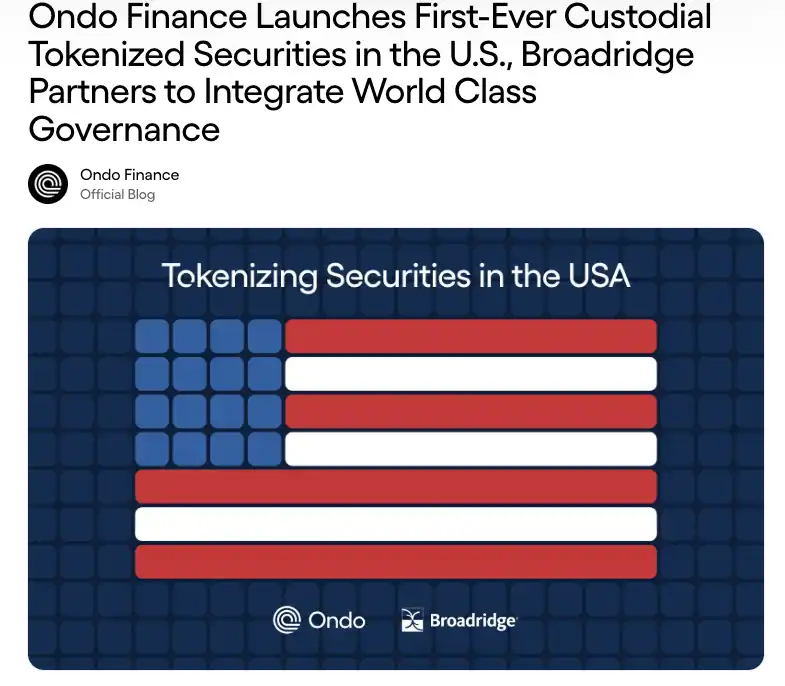
According to CoinDesk, Ondo Finance announced on July 2nd the issuance of tokenized versions of BlackRock's S&P 500 ETF (IVV) and Micron Technology (MU) stock on Ethereum. This is the first production deployment of the "third-party custody model" since the SEC issued a staff statement on tokenized securities in January, and also marks the first time a US-listed security has been tokenized by a third party without leaving the country or circumventing through an offshore structure.

In a statement, Ondo CEO Ian De Bode said, "Today's milestone demonstrates that we can tokenize securities in a way that meets both market and regulatory requirements, serving US and global investors, and laying the groundwork for more US investors to participate in on-chain investments."

The First Batch of Assets Chosen Are Two of the Most Mainstream

The two assets chosen for tokenization are not obscure. IVV is BlackRock's flagship ETF tracking the S&P 500, while Micron is a star stock in the current memory chip cycle. By using a broad-based ETF and a hot tech stock to validate the new model, Ondo's intent is clear: first prove that "mainstream assets can also be brought on-chain in a compliant manner."

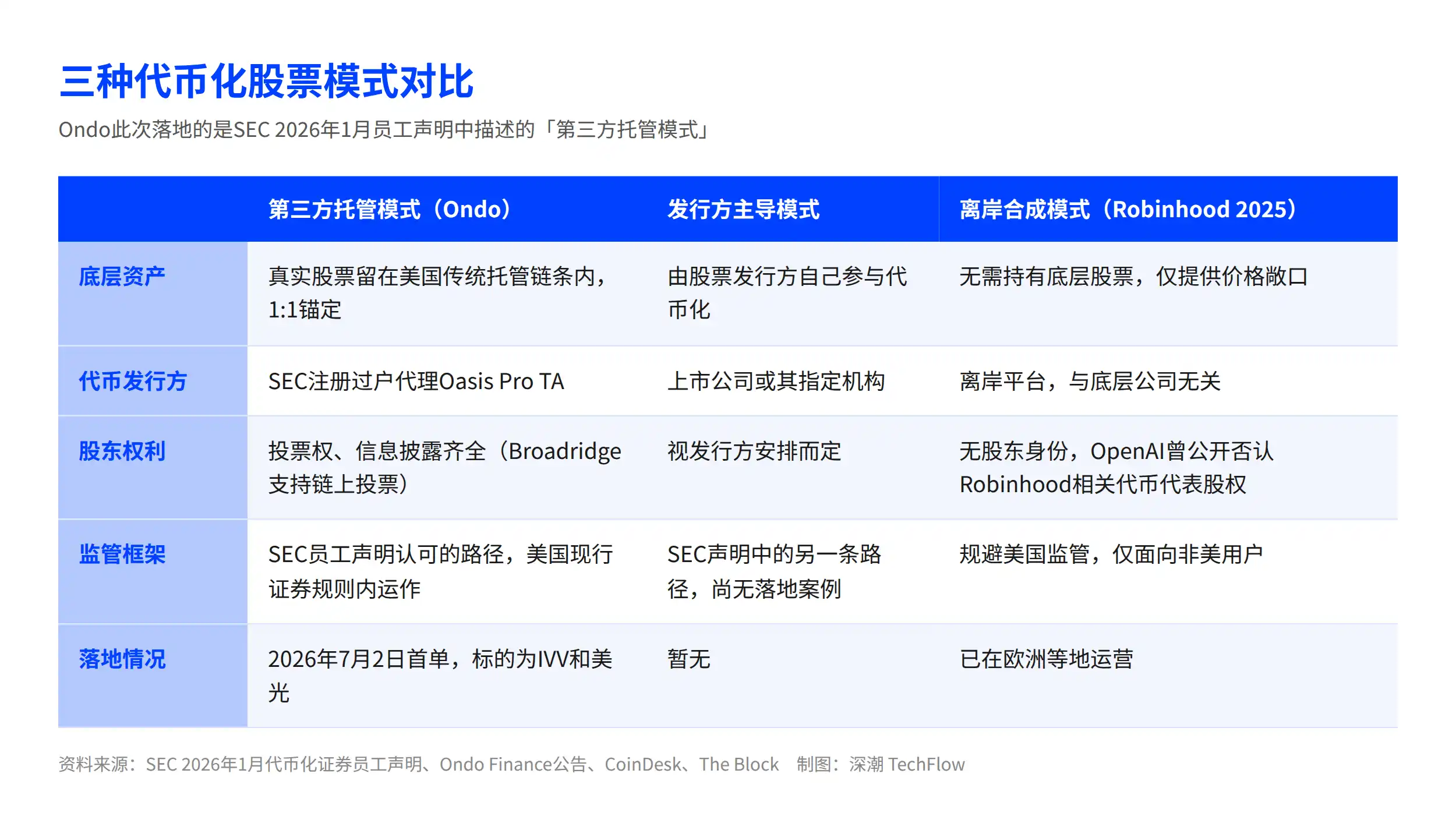
In terms of the specific structure, the underlying IVV and Micron shares remain within the US traditional custody chain, held by regulated custodians. Oasis Pro TA, an SEC-registered transfer agent acquired by Ondo last year, mints corresponding tokens on Ethereum at a 1:1 ratio. Transfer restrictions are enforced jointly by participating broker-dealers, transfer agents, and custodians.

According to Ondo, its overseas Global Markets platform has already tokenized over $1 billion worth of stocks and ETFs, covering more than 430 securities, ranking first in the industry by total value of tokenized securities. This is the company's first extension of its business into the domestic US framework.

Fundamentally Different from the OpenAI-Contradicted Robinhood Model

For the average investor, the real question worth asking about this launch is whether the purchased tokenized stock counts as equity.

Last year, this issue caused controversy. After Robinhood launched tokenized products in Europe linked to OpenAI shares, OpenAI publicly stated it had not authorized the products and warned that the tokens did not represent equity in the company. Those products belonged to a "synthetic model," where the issuer had no relationship with the underlying company, and investors only gained price exposure without shareholder status.

The SEC's staff statement in January offered another path. Under the third-party custody model, a regulated intermediary holds the real stock and issues on-chain tokens representing the holder's rights. According to The Block, Ondo's product is built precisely around this framework, where token holders receive the same shareholder rights and protections as investors in traditional brokerage accounts, including issuer notifications and on-chain proxy voting.

Put in portfolio terms, this difference means that tokens under the custody model have real shares, voting rights, and information disclosure backing them, while the synthetic model only offers a price shadow.
Wall Street Veteran Infrastructure Player Broadridge Steps In to Handle Voting

Another signal from this launch is the deep involvement of traditional financial infrastructure.

Broadridge (NYSE ticker BR) is an infrastructure giant in the US shareholder communication and proxy voting space, with a large portion of shareholder voting for US-listed companies running on its ProxyVote.com platform. In this partnership, Broadridge is responsible for providing proxy voting, regulatory disclosure, and shareholder communication services to Ondo's token holders, who can participate in voting directly on-chain.

In a statement, Doug DeSchutter, President of Broadridge's Investor Communication Solutions business, said, "By providing proxy voting, issuer communications, and regulatory disclosure for Ondo's token holders, we are delivering on our promise to provide complete, trusted governance capabilities to both investors and issuers, regardless of the structure in which assets are held."

The tokenization space has seen frequent moves recently. Robinhood launched its own public blockchain and expanded tokenized stocks beyond Europe on July 1st; the DTCC (Depository Trust & Clearing Corporation) announced in May that it would bring tokenized assets to the Stellar chain; Nasdaq received SEC approval in March to trade tokenized securities; and the NYSE has also announced related plans. According to a Citigroup report cited by CoinDesk in June, the market size for tokenized securities could reach $5.5 trillion by 2030.

Not Open to US Investors Yet; Two Risk Points to Note First

For interested readers, two points require a dose of cold water first.

First, according to CoinDesk, the product is not yet available to US investors. Ondo's current move is more about validating the architecture's feasibility; the actual timeline for opening to US retail investors is undetermined.

Second, the SEC's January statement is a staff statement, representing only the thinking direction of regulatory personnel and does not carry the force of formally adopted rules by the Commission. In other words, the compliance status of this model remains subject to potential modification by subsequent formal rules.

For ONDO token holders, as of the time of writing, ONDO is trading at around $0.33, up about 4% in 24 hours. The direct impact of the news on the token price is limited. The mid-term logic depends on when US investors can actually buy these products and whether the custody model can expand from two assets to the more than 430 securities on Ondo's overseas platform. Until these two milestones are reached, the significance of this launch lies primarily on the regulatory front, rather than the revenue front.


İlgili Sorular

QWhat is the core significance of Ondo Finance's recent tokenization of BlackRock's S&P 500 ETF and Micron stock according to the article?

AThe article states that this is the first production deployment of the 'third-party custody model' outlined in the SEC's January staff statement. It represents the first instance of US-listed securities being tokenized by a third party without leaving the US regulatory perimeter or using offshore structures, marking a regulatory-approved version of tokenized stocks in the US.

QHow does the 'third-party custody model' used by Ondo differ fundamentally from the 'synthetic model' used by Robinhood for its OpenAI-linked product?

AIn Ondo's third-party custody model, the underlying real stocks (like IVV and Micron) are held with regulated custodians within the traditional system, and the tokens represent direct ownership rights, including voting and receiving issuer communications. In Robinhood's synthetic model, there is no direct relationship with the underlying company; the tokens only provide price exposure without conferring any shareholder rights or ownership.

QWhich major traditional financial infrastructure company is involved in providing proxy voting services for Ondo's token holders, and what is its role?

ABroadridge (NYSE: BR), a major US shareholder communications and proxy voting infrastructure firm, is involved. It is responsible for providing proxy voting, regulatory disclosures, and shareholder communications services to Ondo's token holders, allowing them to vote directly on-chain.

QWhat are the two main limitations or risks mentioned regarding Ondo's newly launched tokenized products for potential investors?

A1. The products are currently not available to US investors. 2. The SEC's January guidance is a staff statement, not a formally adopted rule by the Commission, meaning the regulatory status of this model could potentially be changed by future official rules.

QBeyond Ondo, what are some other recent significant developments in the tokenization of securities mentioned in the article?

AThe article mentions several: Robinhood launched its own blockchain and expanded tokenized stocks beyond Europe; DTCC announced plans to bring tokenized assets to the Stellar blockchain; Nasdaq received SEC approval in March to trade tokenized securities; and the NYSE has also announced related plans. A Citigroup report estimates the tokenized securities market could reach $5.5 trillion by 2030.

İlgili Okumalar

Goldman Sachs In-Depth Report: Who Will Be the Long-Term Winners in China's AI Large Model Industry?

Goldman Sachs Report: China's AI Models at an Inflection Point China's open-source/open-weight large language models (LLMs) have reached performance parity with top global proprietary models, according to a Goldman Sachs report. This is driven by architectural innovations and higher parameter efficiency, allowing Chinese models to achieve comparable capabilities at 2%-10% the parameter size and significantly lower cost. The market is evolving into a two-tiered structure: a high-end segment (e.g., GLM5.2, Qwen3.7 Max) with premium pricing and a low-end, price-sensitive segment for global SMEs and individual users. Key points: * **Cost & Performance:** Innovations like Mixture of Experts (MoE) enable high performance with smaller models. Projects like Meituan's LongCat 2.0, trained on domestic hardware, highlight progress in tech self-sufficiency. * **Open-Source Strategy:** Most Chinese players use open-source/open-weight models for flexibility and ecosystem growth. However, Goldman notes this may underreport actual deployment and revenue. A shift toward "open-weight + community license" models with revenue sharing (e.g., MiniMax) could improve monetization. * **Market Shift & Global Expansion:** Enterprise AI adoption is shifting from "token maximization" to "ROI-first." International expansion, especially in non-US markets, is a major growth driver. Chinese models are increasingly available on global platforms like AWS Bedrock and Microsoft Copilot. * **Competitive Landscape:** Using a framework based on pricing power, cost advantage, and financial strength, Goldman identifies **Zhipu AI and DeepSeek** as the strongest in foundational text models, and **ByteDance** as the leader in multimodal/video generation. The report maintains Buy ratings on MiniMax and Kuaishou. * **Market Growth:** China's AI model API and subscription revenue is projected to grow from an estimated ¥35 billion in 2026 to ¥879 billion by 2030.

marsbit10 dk önce

Goldman Sachs In-Depth Report: Who Will Be the Long-Term Winners in China's AI Large Model Industry?

marsbit10 dk önce

Goldman Sachs Deep Dive Report: Who Will Become the Long-Term Winners in China's AI Large Model Industry?

Goldman Sachs Report: Who Will Be the Long-Term Winners in China's AI Large Model Industry? China's AI large model sector is at a historic inflection point. Goldman Sachs argues that the intelligence of Chinese open-source/open-weight models is approaching top global proprietary models. Rapid adoption by domestic enterprises and global SMEs is creating a data flywheel effect that will further drive model iteration. The evolution is summarized as moving from "DeepSeek's cost-efficiency moment last year to GLM's model-intelligence moment this year." Chinese models achieve near-state-of-the-art performance at significantly lower cost, primarily due to architectural innovations like Mixture of Experts (MoE) and higher parameter efficiency. Models like DeepSeek V4 Pro (1.6T params), GLM5.2 (0.7T), and MiniMax M3 (0.4T) are much smaller than global leaders. Recent advancements in coding capability are attributed to better data curation and RLHF. Landmarks like Meituan's LongCat 2.0, trained fully on domestic AI chips, demonstrate progress in hardware stack independence. The market is forming a "two-tiered structure." The high-end tier (e.g., GLM5.2, Alibaba's Qwen3.7 Max) prices around $1 per million tokens, about 10-25% of US top models, with estimated inference gross margins of 10-20%. The low-end tier (priced as low as $0.06-$0.2 per million tokens) targets price-sensitive global SMEs and individuals. MiniMax derives 60-70% of revenue overseas. Goldman forecasts China's AI model API/subscription revenue to grow from an estimated RMB 35bn in 2026 to RMB 879bn by 2030. Most Chinese players adopt open-source/open-weight strategies for deployment flexibility and community feedback, though this limits monetization as deployments on third-party platforms (e.g., Alibaba Cloud) may not generate direct revenue. A shift towards "open-weight + community license" models with revenue-sharing agreements (like MiniMax's approach) could improve unit economics. International expansion, particularly in non-US markets, is the key growth driver. The global enterprise AI paradigm is shifting from "token maximization" to "ROI prioritization." Chinese models are already hosted on major global platforms like AWS Bedrock and are under consideration for integration into Microsoft Copilot. Using a competitive framework based on pricing power, cost advantage, and financial strength, Goldman identifies the strongest players: In foundational text models, Zhipu AI (initiated coverage) and DeepSeek lead. In multimodal/video generation, ByteDance's Seed is the frontrunner, with Kuaishou's Kling and MiniMax's Hailuo also well-positioned. Goldman maintains a Buy rating on MiniMax, citing its attractive valuation.

链捕手15 dk önce

Goldman Sachs Deep Dive Report: Who Will Become the Long-Term Winners in China's AI Large Model Industry?

链捕手15 dk önce

Is Ethereum Truly a "World Computer"?

Title: Is Ethereum Really a "World Computer"? Ethereum, envisioned as a "world computer" by its founder Vitalik Buterin, aims to be a decentralized platform for global applications. However, a recent analysis by Four Pillars raises questions about whether it is more accurately a "Western computer," based on the geographical distribution of its validators. Currently, the United States dominates with 38.19% of all validators, followed by Germany at 13.04%. Combined, these two countries account for over half of the network. In contrast, Asian representation is minimal, with Singapore holding only 3.15%. The concentration is partly due to affordable cloud hosting services like Hetzner and OVH in Europe and North America, as well as the prevalence of residential validators in the U.S., where individuals run nodes via home internet connections. When examining professionally operated validators, the distribution becomes more balanced. The U.S. share drops to 25.81%, while Asian countries like Singapore (7.28%), Hong Kong (6.44%), Japan (6.38%), and South Korea (4.59%) collectively approach the U.S. level. This shift reflects strategic deployments by institutions to meet regulatory requirements and reduce latency for local users. However, regions like South America, the Middle East, and Africa remain underrepresented. Ethereum's peer-to-peer network mechanisms, such as gossipsub, disadvantage areas with low node density, creating a feedback loop where delayed message propagation reduces validator performance and rewards. This imbalance challenges Ethereum's promises of censorship resistance and global accessibility. Despite these issues, opportunities exist for growth in underrepresented regions. As demand for localized staking infrastructure rises, early entrants in areas like the Middle East could establish dominant positions by offering compliant, low-latency solutions. The evolving validator landscape highlights both the structural challenges and the potential for Ethereum to move closer to its "world computer" ideal.

Foresight News2 saat önce

Is Ethereum Truly a "World Computer"?

Foresight News2 saat önce

İşlemler

Spot
活动图片