The First 'Prediction Market' Stock Emerges!

Odaily星球日报2026-06-15 tarihinde yayınlandı2026-06-15 tarihinde güncellendi

Özet

"Prediction market pioneer Kalshi faces a major new challenge from its former key partner, Robinhood. Following a successful collaboration starting in March 2025, where Kalshi provided prediction market infrastructure to Robinhood's user base, Robinhood has now launched its own competing platform, Rothera Exchange. This move, leveraging Robinhood's control over massive retail user distribution, threatens to divert a significant portion of Kalshi's order flow. Rothera strategically launched during the high-traffic 2026 World Cup, quickly processing tens of millions of contracts. Analysts estimate the partnership previously contributed 25%-35% of Kalshi's volume, translating to potential annual revenue diversion worth hundreds of millions of dollars. The shift underscores a broader industry trend: in commoditized markets, control over user access and distribution channels, rather than just the underlying trading platform, may become the ultimate source of power and profit."

Original | Odaily Planet Daily(@OdailyChina)

Author | Azuma(@Azuma_eth)

The fires of the World Cup have been lit, and the total trading volume across prediction markets continues to hit new highs. However, as the industry leader, Kalshi might not be in the best mood right now.

The reason isn't due to fluctuations in Kalshi's own business data, but because a formidable new rival has "suddenly" appeared in front of Kalshi, following Polymarket. This opponent was once Kalshi's most important ally.
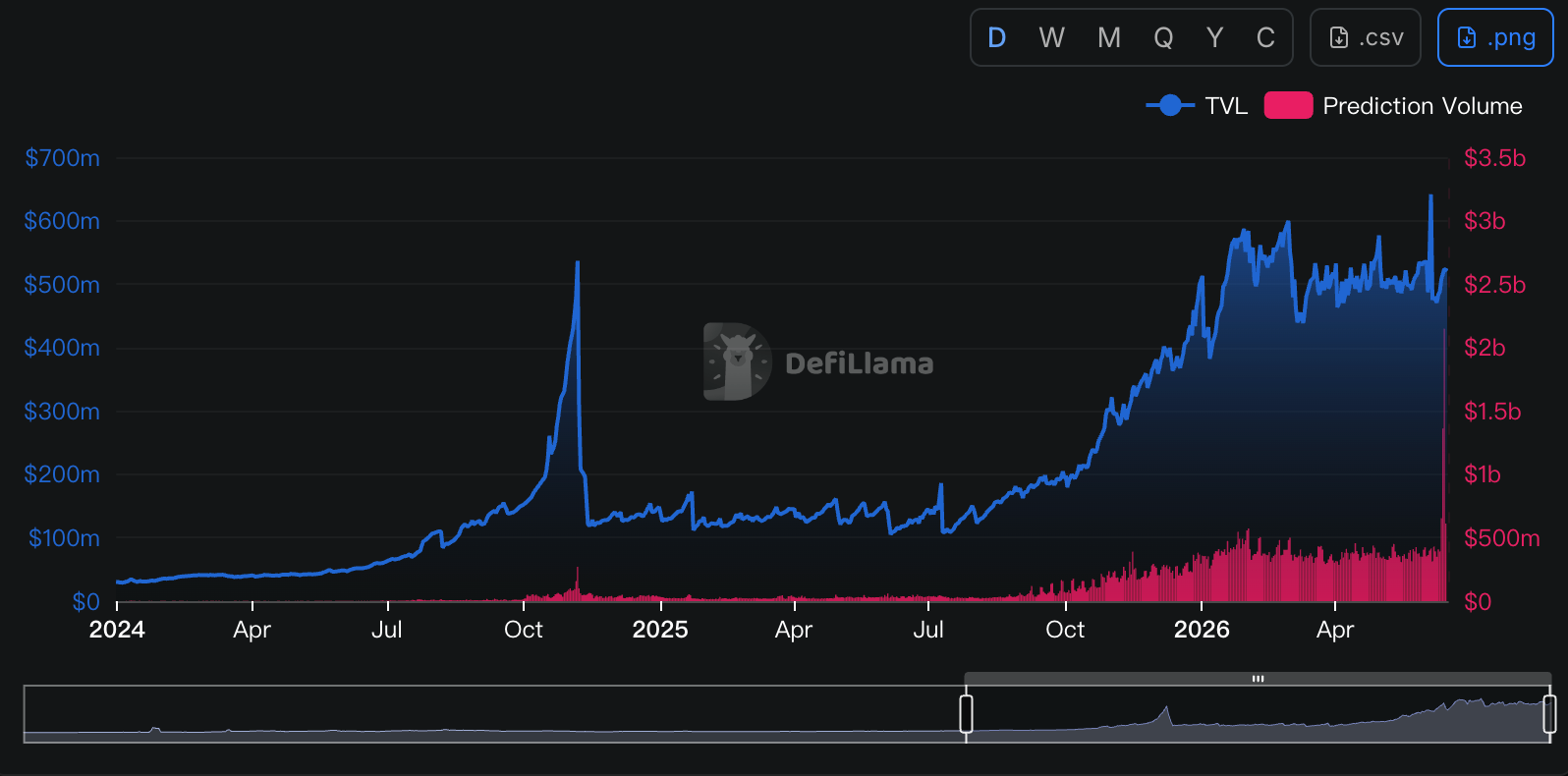
  • Odaily Note: Data sourced from Defillama.

Kalshi's Most Crucial Traffic Channel — Robinhood

Let's turn the clock back to March 2025. At that time, Kalshi announced a partnership with the U.S. online brokerage Robinhood. The latter would leverage Kalshi to offer its users prediction market trading services, allowing users to place bets on events like politics, economics, and sports.

From a business model perspective, this was a typical case of "mutual benefit" — Robinhood, responsible for user access and trade distribution, could directly use Kalshi's mature product. Kalshi, responsible for the underlying market, matching, clearing, and regulatory compliance system, could access Robinhood's massive pool of retail user traffic.

The subsequent story proved the "win-win" outcome of this collaboration. Through Robinhood's distribution channel, Kalshi indirectly gained vast amounts of users and trading volume. Piper Sandler analysts estimated that "trading volume completed through the Robinhood channel accounted for about 25%-35% of Kalshi's total trading volume." These orders ultimately translated into revenue on both parties' ledgers — Robinhood independently charged for all Kalshi event contracts traded through its channel, $0.01 per contract per side, before sharing profits with Kalshi (the specific split was not disclosed).
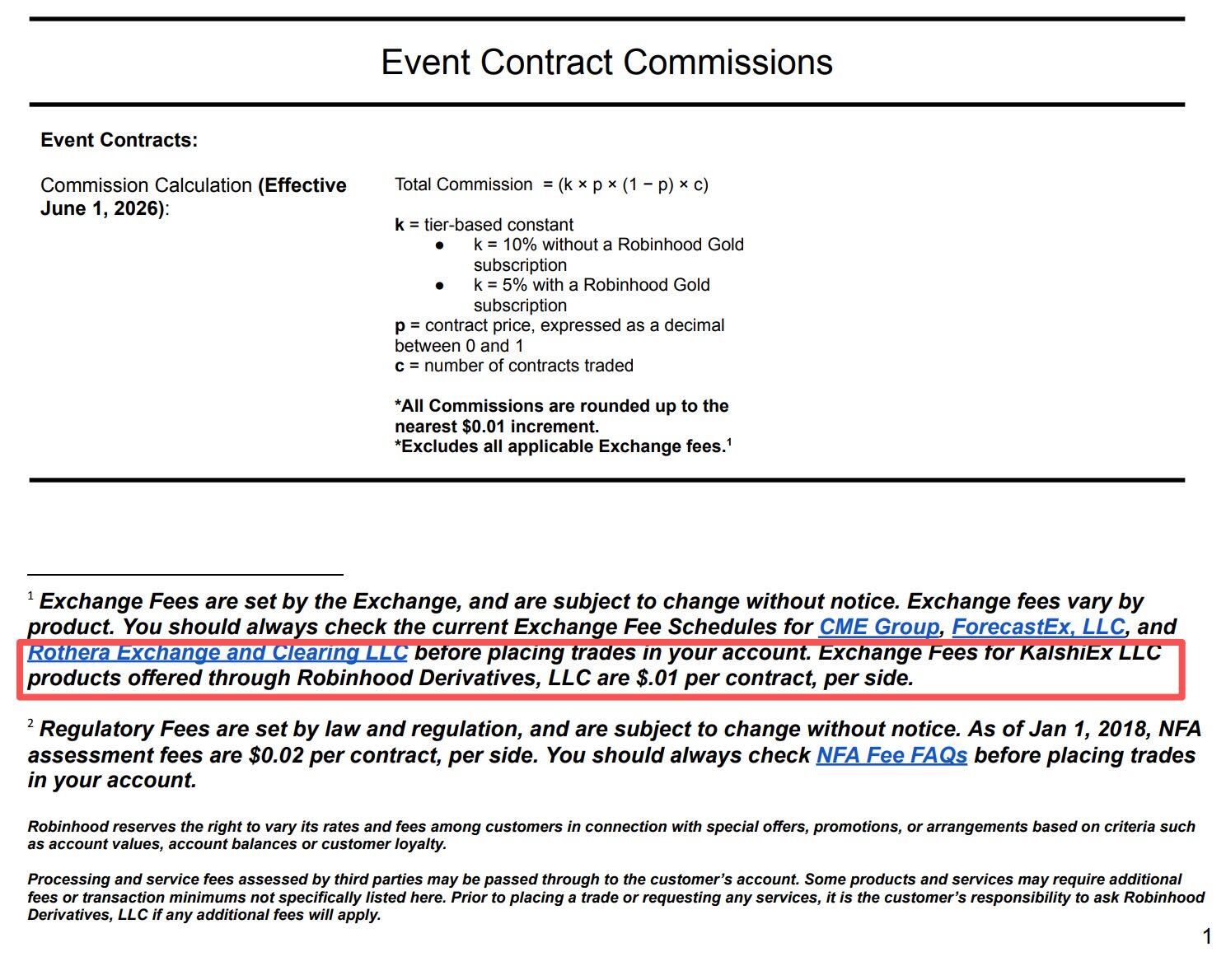
The Q1 financial report disclosed at the end of April this year showed that Robinhood transacted 8.8 billion event contracts in Q1, driving "other transaction revenue" to increase 320% year-over-year, reaching $147 million. Prediction markets had become the brightest growth engine in Robinhood's product line.

But recently, this relationship has undergone some subtle changes.

Robinhood's Ambition: Reclaiming the Cake Shared with Kalshi

As internet history has proven countless times, when a distribution channel gains enough clout, it is no longer satisfied with being just a channel. Robinhood is no exception.

Although the partnership with Kalshi also brought Robinhood considerable revenue, as prediction markets became one of the fastest-growing new businesses on the platform, Robinhood was no longer content with the current profit-sharing arrangement.

In the partnership model, Kalshi provided the market and infrastructure, while Robinhood provided the users and order flow. However, as the collaboration deepened, Robinhood gradually realized that what might truly be scarce was not the market itself, but the user entry point it firmly controlled. After all, for most Robinhood users, they don't care whether orders are ultimately filled on Kalshi or another platform — users only see a trading entry point within the Robinhood app, not the underlying infrastructure provider.

In other words, Robinhood always controlled one of the most important resources for a prediction market — distribution capability. If the users belonged to itself, then why should the order flow go to someone else?

In fact, while Robinhood was rapidly validating the demand for prediction markets through Kalshi, another Plan B was quietly launched shortly after.

In November 2025, Robinhood announced the formation of a joint venture with Wall Street quantitative trading giant Susquehanna and planned to acquire the CFTC-regulated derivatives exchange MIAXdx. According to the official statement, the joint venture would operate an independent futures and derivatives exchange and clearinghouse in the future, with prediction markets being one of its key focuses. At the time, the outside world mostly viewed it as an infrastructure investment. However, as more information was disclosed later, people gradually realized that Robinhood's ambition far exceeded merely finding a new partner for prediction markets.

In January 2026, the deal was officially completed. Robinhood and Susquehanna gained 90% control of MIAXdx, along with a complete CFTC regulatory framework, including Designated Contract Market (DCM) and Derivatives Clearing Organization (DCO) licenses. Subsequently, MIAXdx was renamed Rothera Exchange, and its clearinghouse was renamed Rothera Clearing.

At this point, Robinhood already possessed the core elements required to independently operate a prediction market. What was missing was only a mature product comparable to Kalshi's, but for Robinhood with its rich internet product development experience, this was clearly not a challenge.

Rothera's Opportunity: The World Cup

In June 2026, after about half a year of accelerated development, the Rothera product began to take shape. Robinhood finally made the move that seemed almost inevitable — gradually shifting the order flow that originally went to Kalshi into its own controlled system.

Robinhood specifically chose an excellent debut battlefield for Rothera — the World Cup. For prediction markets, the World Cup is undoubtedly one of the most traffic-generating trading themes. Whether it's match outcomes, advancement results, or the final champion, related markets can attract a large number of new users to trade in a short time. For the new Rothera platform just starting up, there's no better scenario than the World Cup for a cold launch.

According to Robinhood's official disclosure, during this World Cup, which consists of 104 matches, some event contracts would be directed to Rothera for matching and clearing. These include markets for individual World Cup match results, the ultimate World Cup champion, and total goals in single matches. Compared to the previous model that relied entirely on Kalshi, this marked the first time Robinhood would import prediction market orders into its own trading system on a large scale.
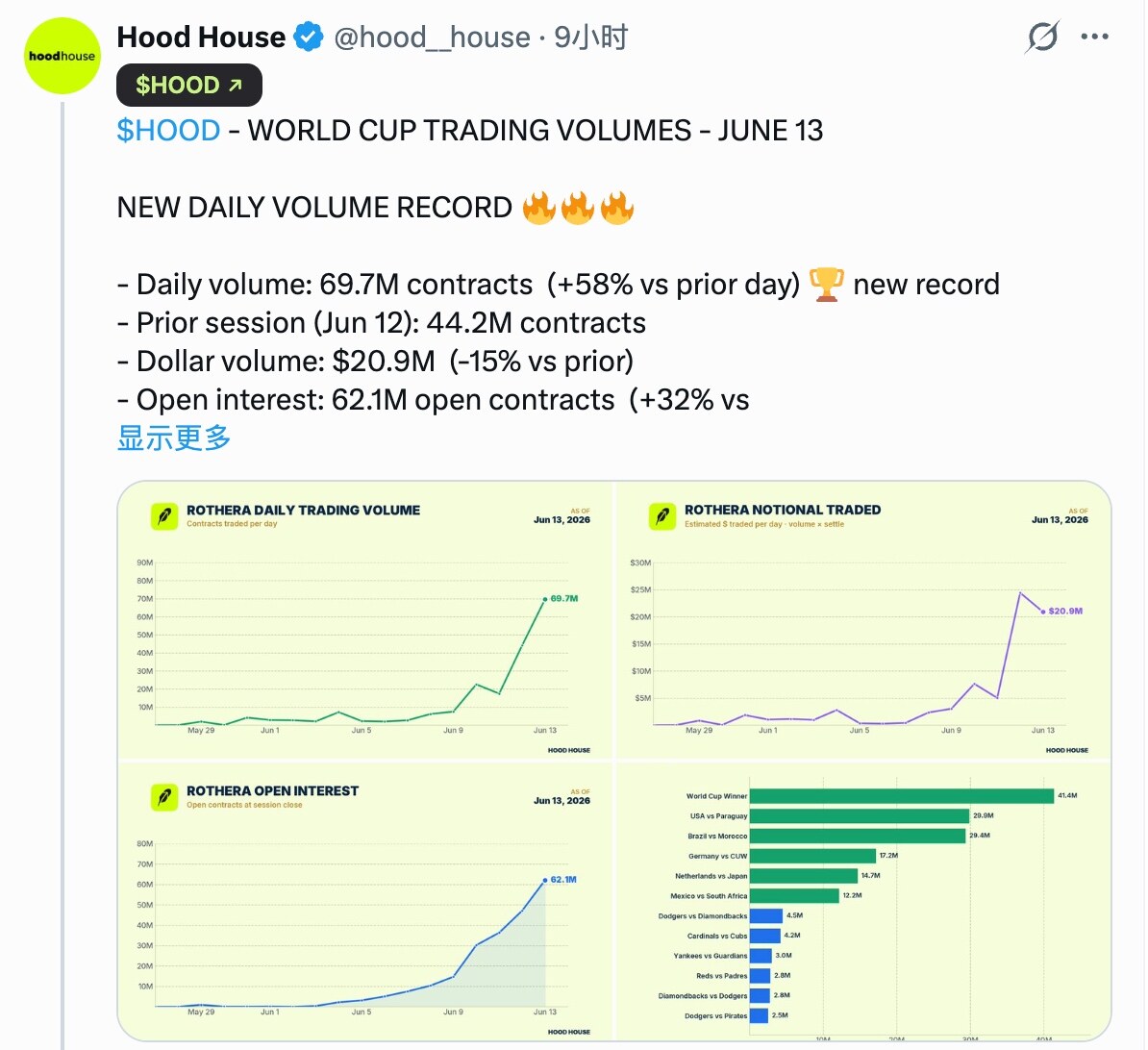
Judging by the results, Rothera clearly seized this opportunity. According to data disclosed by Hood House, a research-focused media outlet tracking Robinhood dynamics, on June 12, Rothera transacted 44.2 million contracts, corresponding to a dollar trading volume of approximately $24.4 million. On June 13, Rothera transacted 69.7 million contracts, corresponding to a dollar trading volume of approximately $20.9 million... Although these figures still have a gap compared to Kalshi's hot markets with billions of dollars in trading volume, considering that Rothera had literally just launched a few days prior, this performance data is already sufficiently successful.

For both Robinhood and Kalshi, this indicates that the balance in their collaboration has begun to tilt. From Robinhood's perspective, the commission revenue that previously needed to be shared with Kalshi can now be retained within its own ecosystem. From Kalshi's perspective, this means that one of its most important growth engines is starting to show signs of weakening.

And the World Cup is clearly just the beginning of Rothera's encroachment on Kalshi. Looking further into the future, Robinhood is bound to expand Rothera's coverage to more sports events as well as economic and political themes. Those orders that originally flowed to Kalshi will be successively intercepted by Rothera.

Since Robinhood and Kalshi have never disclosed their profit-sharing ratio, we cannot know the exact value of this interception. However, considering that Robinhood alone generated $147 million in prediction market-related revenue in Q1, and the Q2 World Cup and the more distant midterm elections will likely bring larger-scale trading activity, the value of this interception could reach billions of dollars on an annual basis.

Who Controls Distribution, Controls Everything

The drama of Robinhood and Kalshi moving from allies to opponents once again illustrates a logic repeatedly proven in the internet market — products are easy to build, but traffic is hard to find; whoever controls distribution controls everything.

Over the past few years, the market generally believed that Kalshi's core moat came from regulatory licenses, exchange qualifications, and clearing capabilities. Therefore, whether it's brokerages like Robinhood or various media, communities, and traffic platforms, they were essentially just Kalshi's distribution channels and traffic inlets. However, the emergence of Rothera proves one thing: in an era of severe product homogenization, the product itself might not be the most important element. What remains truly scarce is always the user.

Where the users are, the liquidity is; where the liquidity is, the market will be. When Robinhood controls the entry point for tens of millions of retail users, it has full capability to direct these users to any trading venue. For users, they don't care whether orders are ultimately filled on Kalshi or Rothera. As long as the experience isn't significantly different, who handles the matching and clearing behind the scenes doesn't matter.

If the theme of the prediction market industry in the past few years was the market battle between Polymarket and Kalshi, then the theme for the coming years might become a channel war. Robinhood incubating Rothera is essentially a reverse integration initiated by the distribution side towards the market layer. As more and more platforms with traffic inlets begin to realize the strategic value of prediction markets, similar stories are highly likely to continue. Whether it's exchanges, brokerages, social platforms, or media platforms, any could become a new entry point for prediction markets.

And when inlets start to control the market, and channels begin to possess pricing power, the ultimate winner in the prediction market industry might no longer be the platform responsible for matching orders, but the one closest to the user, the one who can best control distribution.

This was true in the internet era, and also true in the mobile internet era. This time, it's no exception.

İlgili Sorular

QWhat was the strategic significance of the partnership between Robinhood and Kalshi announced in March 2025?

AThe partnership was strategically significant for both parties. Robinhood leveraged Kalshi's established prediction market product and regulatory infrastructure to offer event contract trading to its user base. In return, Kalshi gained access to Robinhood's massive retail investor traffic. It was a 'win-win' where Robinhood handled distribution and Kalshi provided the underlying market, matching, clearing, and compliance systems.

QAccording to the article, what prompted Robinhood to launch its own prediction market platform, Rothera Exchange?

ARobinhood's launch of Rothera Exchange was driven by its realization that it controlled the most valuable asset: user distribution. As prediction markets became a major growth driver on its platform, Robinhood became dissatisfied with sharing revenue with Kalshi. Recognizing that users trade through the Robinhood interface and are indifferent to the backend provider, Robinhood decided to capture more value by building its own CFTC-regulated market and clearing infrastructure.

QWhat event did Robinhood choose to launch Rothera Exchange, and why was it an opportune moment?

ARobinhood chose the 2026 FIFA World Cup to launch Rothera Exchange. This was an opportune moment because the World Cup is one of the most high-traffic events for prediction markets, attracting大量 new users to trade on match outcomes, tournament winners, and other related markets. It provided the perfect scenario for the 'cold start' of their new platform.

QWhat core industry dynamic does the Robinhood-Kalshi-Rothera case illustrate, according to the article's conclusion?

AThe case illustrates the core dynamic that 'who controls distribution, controls everything.' In a market where products are increasingly commoditized, the article argues that the truly scarce resource is not the trading platform itself, but the user base and the distribution channels. Entities controlling user access (like Robinhood) hold ultimate pricing power and can redirect liquidity, making them the potential ultimate winners, not necessarily the underlying market operators.

QHow does the article characterize the future competitive landscape of the prediction market industry following this development?

AThe article characterizes the future competitive landscape as shifting from a 'market war' (like between Polymarket and Kalshi) to a 'channel war.' It predicts that platforms with significant user traffic—such as exchanges, brokerages, social media, and media platforms—will recognize the strategic value of prediction markets. Following Robinhood's model, these channels may initiate reverse integration by building or acquiring their own market infrastructure, leading to more consolidation where distribution controls the market.

İlgili Okumalar

The Foundation of SpaceX's Trillion-Dollar Valuation: Who is Dividing Up Musk's Annual Tens of Billions in Capital Expenditure?

SpaceX's trillion-dollar valuation is built on its three core businesses: Starlink (profitable, 60% of revenue), rockets (driving down launch costs), and AI (a major investment area). This creates a financial cycle: Starlink funds rocket development, which enables low-cost launches for AI hardware, generating future revenue. This cycle fuels annual capital expenditures of tens of billions, flowing to a vast supply chain. Suppliers are categorized by their replaceability. The first group includes irreplaceable players like NVIDIA (GPU/CUDA ecosystem), Eutelsat (critical radio spectrum), Filtronic (specialized amplifiers), Materion (strategic beryllium), and STMicroelectronics (antenna chips). The second group consists of hard-to-replace suppliers due to high switching costs, such as Honeywell (flight control), Carpenter Technology (specialty alloys), Hexcel (carbon fiber), Broadcom (data exchange), and Linde (industrial gases). The third group comprises high-volume, cost-critical suppliers for mass-produced items like Starlink terminals. Key names include Wistron NeWeb (primary manufacturer) and several A-share companies like Shenzhen Sunway (connectors), Pies New Materials (forgings), Western Superconducting (alloys), and Yingliu (castings). Other niche players include Trimble (timing), Astronics (power distribution), and CTS (thermal management). The article argues that investing in these suppliers, rather than SpaceX stock directly, offers an alternative opportunity. The rationale is threefold: procurement is just beginning to scale, SpaceX's IPO brings new transparency to its supply chain, and the situation mirrors early stages of past "super terminal" ecosystems like Apple or Tesla. While risks exist (commodity cycles, geopolitical factors, technology shifts), the core thesis is that SpaceX's massive, ongoing procurement will translate into reliable revenue for its key suppliers, regardless of its own stock price volatility.

marsbit10 dk önce

The Foundation of SpaceX's Trillion-Dollar Valuation: Who is Dividing Up Musk's Annual Tens of Billions in Capital Expenditure?

marsbit10 dk önce

SpaceX's Trillion-Dollar Valuation Base: Who's Sharing in Musk's Annual Tens of Billions in Capital Expenditure?

**Title: The Foundation of SpaceX's Trillion-Dollar Valuation: Who Benefits from Musk's Annual $100 Billion Capital Expenditure?** This article argues that investors seeking to benefit from SpaceX's growth might find greater opportunities in its supply chain rather than directly investing in the company itself, drawing parallels to historical successes with Apple, Tesla, and NVIDIA suppliers. **SpaceX's Business Model & Cash Flow:** SpaceX generates revenue from three main areas: 1. **Starlink:** Its profitable core, earning $11.3B in 2023 (60% of revenue), funding other ventures. 2. **Rockets (Falcon/Starship):** Requires $3B+ in annual R&D but achieves the world's lowest launch costs. 3. **AI:** Currently unprofitable (-$6B+ in 2023), investing heavily in ground-based supercomputers (220,000 GPUs) and future orbital data centers. The cycle is: Starlink profits → fund cheaper rockets → low-cost launches deploy AI hardware → AI compute rentals generate future revenue. This cycle drives annual procurement spending of tens of billions of dollars. **The Supply Chain Beneficiaries:** Suppliers are categorized by their replaceability: **1. Nearly Irreplaceable (High Barriers to Entry):** * **NVIDIA:** Powers the Colossus supercomputer; its CUDA ecosystem creates immense switching costs. * **Eutelsat (SATS):** Controls critical radio spectrum for satellite communications; holds a ~3% stake in SpaceX. * **Filtronic (FTC):** Supplies millimeter-wave signal amplifiers for Starlink satellites; SpaceX constitutes 83% of its revenue. * **Materion (MTRN):** Global leader in beryllium production, a strategic material used in Starship structures. * **STMicroelectronics (STM):** Supplies phased-array antenna chips for Starlink satellites. **2. Replaceable, but Switching Cost is Prohibitively High:** * **Honeywell (HON):** Provides flight control and inertial navigation systems with decades of certification. * **Carpenter Technology (CRS):** Manufactures ultra-pure specialty steel alloys for Raptor engines. * **Hexcel (HXL):** Supplies custom carbon fiber composites developed over a decade with SpaceX. * **Broadcom (AVGO):** Manages high-speed data switching. * **Linde Group:** Supplies industrial gases (liquid oxygen/nitrogen) from facilities built near SpaceX launch sites. **3. High-Volume, Cost-Critical Manufacturing:** Focuses on mass-producing components like Starlink user terminals (target: 30 million units). * **Key Players:** Wistron NeWeb (6285, primary terminal manufacturer), several Chinese A-share companies (e.g., Sunway Communication, PAX New Materials, Western Metal Materials, Yingliu Co.), and smaller US firms like Trimble (TRMB, timing systems). **Why Now?** Three factors make the supply chain opportunity timely: 1. **Volume Ramp-Up:** SpaceX plans 100 launches in 2026, aims for 30 million Starlink terminals, and will deploy AI data centers, meaning procurement will accelerate. 2. **Increased Transparency:** The IPO provides public financial data, allowing investors to track supplier order growth. 3. **Historical Precedent:** The current phase is likened to Tesla's early mass-production stage (circa 2018), suggesting a long growth runway for suppliers. **Conclusion:** The article posits that while investing in SpaceX stock is betting on Elon Musk's ambitious vision at a high valuation, investing in its established suppliers is a bet on the tangible, recurring revenue from its massive procurement budget, which is largely decoupled from day-to-day stock price volatility.

链捕手13 dk önce

SpaceX's Trillion-Dollar Valuation Base: Who's Sharing in Musk's Annual Tens of Billions in Capital Expenditure?

链捕手13 dk önce

The U.S. Government Blocked the Anthropic Model. It Wasn't About 'Jailbreaking' at All.

Last Friday, the U.S. Commerce Department issued an enforcement letter that forced Anthropic to take its two most advanced AI models, Fable 5 and Mythos 5, offline. The stated reason was unspecified national security concerns, initially linked to potential "jailbreaks" of the models' safeguards. However, new details suggest the action stemmed more from a deteriorating relationship between the Trump administration and Anthropic, rather than a genuine technical threat. According to reports, the government cited a little-known export control regulation, compelling Anthropic to block access for all non-U.S. persons, including its own international employees. The company complied, shutting down the models without a court order or specific technical details from the government. Cybersecurity expert Katie Moussouris revealed she was privately shown a research paper detailing a potential safeguard bypass in Fable 5. She argued the described method was minor and did not warrant an export ban, stating that attempts to "fix" it would only weaken the model's defensive capabilities. Moussouris and other experts have since called for the order to be revoked, warning it dangerously removes advanced cybersecurity tools from U.S. defenders. Analysts like Justin Hendrix suggest the move appears retaliatory and sets a dangerous precedent, signaling that the U.S. government can unilaterally shut down a tech company's products. The incident has raised concerns about the reliability of American AI and the potential for political interference in the tech industry, serving as a warning to the broader sector.

marsbit17 dk önce

The U.S. Government Blocked the Anthropic Model. It Wasn't About 'Jailbreaking' at All.

marsbit17 dk önce

Ray Dalio: AI Bull Market Continues to Soar, Should Investors Go All In or Cash Out and Leave the Field?

In his latest notes, Ray Dalio addresses a critical question for investors amid the AI-driven stock market surge: how should one allocate assets during a transformative technological revolution? Dalio emphasizes that technological advancement does not automatically make related stocks attractive. Historical tech cycles—marked by excitement, crowding, volatility, and eventual shakeouts—show that even long-term winners like Microsoft and Apple experienced severe drawdowns. Today's AI sector faces similar uncertainties: overinvestment, intensifying competition, geopolitical tensions (e.g., Taiwan's chip supply), tax policy shifts, anti-AI sentiment, and potential disruption from future technologies like quantum computing. Dalio's core argument focuses on the highly concentrated market structure, where a few tech giants dominate major indices. He warns investors against unknowingly holding concentrated, correlated exposures. Instead of chasing a handful of AI leaders, he advocates for a robust, diversified portfolio of 15 or more high-quality, uncorrelated investments, risk-balanced to match an investor's volatility tolerance. Mathematically, such diversification significantly improves the risk-return ratio—for example, holding 15 uncorrelated assets can boost the ratio by over four times compared to a single concentrated bet. Dalio cautions that future equity returns appear low, with his bubble indicator suggesting real returns could be negative over the next 5-10 years. He stresses that knowing what you don't know is as important as knowing what you do. In an environment of high uncertainty and concentration, avoiding large, concentrated bets on AI stocks is prudent. The optimal strategy is disciplined diversification—the "holy grail" of investing—to navigate this technologically driven cycle with lower risk and comparable or better returns.

marsbit20 dk önce

Ray Dalio: AI Bull Market Continues to Soar, Should Investors Go All In or Cash Out and Leave the Field?

marsbit20 dk önce

İşlemler

Spot
Futures
活动图片