The First Cut of the New Year! Who is Secretly Harvesting Your 'Red Envelope'? Understand These 4 Signals to Avoid It!

marsbit2026-01-04 tarihinde yayınlandı2026-01-04 tarihinde güncellendi

Özet

The crypto market has seen significant outflows from Bitcoin and Ethereum ETFs at the start of the new year, with institutions potentially taking profits and rotating capital into altcoins like Solana and XRP. This shift suggests a tactical move rather than a bearish turn, as macroeconomic factors such as potential Fed rate cuts and growing crypto adoption create both opportunities and volatility. Key strategies include holding core long-term positions in major cryptocurrencies, cautiously exploring altcoins with institutional inflows, and avoiding emotional reactions to short-term news or price fluctuations. Technical analysis indicates a tug-of-war between bullish and bearish forces near key resistance levels, emphasizing the need for patience and disciplined risk management. Overall, the focus should be on preserving capital, leveraging market inefficiencies, and making informed decisions based on broader trends rather than speculative hype.

Happy New Year, sisters! Qinglan's Crypto Class is starting. I'm Sister Qinglan!

Just after New Year's Day, are you, like me, hoping for a 'bountiful harvest' for your wallet in the new year? But have you noticed that despite all the positive news—expectations of Fed rate cuts, accelerated cryptocurrency adoption... our Bitcoin and Ethereum are actually seeing net outflows?

If you only look at the K-line charts and listen to the news, the 'New Year's red envelope' you just tucked into your pocket might quietly shrink by more than half in the blink of an eye!

Today, Sister Qinglan will cut through the fog for you and see who is behind this 'first cut' of the year. We not only need to avoid pitfalls but also learn to 'simmer' our wealth steadily amidst the waves and fluctuations, just like making soup!

One: ETF Funds 'Flowing Openly but Diverting Secretly': Don't Take the Big Players' Portfolio Adjustments Seriously. Data doesn't lie: At the start of the new year, Bitcoin spot ETFs saw a single-day net outflow of $348 million, Ethereum ETFs also saw an outflow of $72.05 million, and even giants like BlackRock are selling.

On the surface, it looks bearish, but behind it is 'expectation gap harvesting'.

Institutions don't celebrate the Spring Festival. They take advantage of the thin holiday trading and relaxed vigilance of retail investors to do two things:

Lock in profits: After such a big rise, taking profits is the way to go.

Create panic: Use large outflows to scare the market, making inexperienced sisters think 'the bull market is over, run!'.

But did they really run? No. Coinbase is still shouting 'accelerated crypto adoption in 2026'. This is suppressing the price while giving you a candy. Institutions are playing 'feint in the east, attack in the west'—quietly shifting profitable funds from mainstream coins to more promising directions.

Your mistake: Selling the moment you see outflows, only for the price to rise after you sell; chasing the rally as soon as you hear good news, only to get trapped.

Sister Qinglan's advice for you:

Hold your long-term positions (Bitcoin, Ethereum) steady. As long as the fundamentals haven't changed, ignore short-term fluctuations.

Don't rush to chase with short-term funds. Appropriately reduce positions that have risen too much, keep cash, and wait for the market to stabilize or for mistaken selling opportunities before entering the market in batches. This is the steady way of 'long-term foundation + swing trading for extra returns'.

Two: Altcoins 'Undercurrents Surging': Institutions Have Quietly Changed Battlefields. Just as funds were flowing out of Bitcoin and Ethereum, another signal lit up: ETFs for Solana and XRP are being bought by big money! Franklin Templeton's XRP ETF holdings have doubled in market value, and the Solana ETF assets have also broken through $950 million.

This is clearly an open secret of 'asset rotation'! Institutions know that the short-term explosive power of mainstream coins is weakening, so they take profits and switch to埋伏 (ambush) altcoins with stronger narratives and relatively lower positions. When market heat returns,配合 (coordinating with) news to pump the price, it's another perfect harvest.

Your mistake: Only staring at Bitcoin's rises and falls, chasing altcoins only after the rise is over,结果套在山顶 (resulting in being trapped at the top); or completely ignoring fund flows, missing swing opportunities.

Sister Qinglan's advice for you:

Keep holding long-term mainstream coins.

For short-term, you can pay small-position attention to altcoins with institutional inflows and positive expectations (like SOL, XRP). But remember: Altcoins are highly volatile,务必轻仓试探 (must use light positions to test), enter in batches, and run after making a profit—absolutely do not greedily linger in the battle!

Three: Macro Policy 'Simultaneous Ice and Fire': Don't Let News Lead You by the Nose. The macro picture is like a roller coaster:

On one side, Moody's predicts the Fed may aggressively cut rates three times in the first half of 2026 (bullish).

On the other side, market data shows a high probability of maintaining rates unchanged in January and March (reality).

At the same time, many countries are advancing crypto legalization, with Iran even accepting cryptocurrency payments.

This is a typical 'expectation gap game'. Rate cut predictions might just be a 'smokescreen' for institutions to boost market sentiment; when the actual rate cuts land, it might instead be 'buy the rumor, sell the news'. Regulatory legalization is a long-term positive, but it's often used to cover up distribution in the short term.

Your mistake: Hearing about rate cuts and thinking the bull market is confirmed, going All in; treating long-term positives as short-term暴涨 (surging) signals, resulting in being washed out repeatedly.

Sister Qinglan's advice for you:

Be bullish on the industry's future long-term, don't be disturbed by short-term noise.

Use the expectation gap for swing trading (buy low, sell high) short-term, but always set stop-profit and stop-loss, without greed or fear. Remember: Policy is the foundation, but not a guarantee of short-term surges.

Four: The K-line Chart is 'Lying': Bull-Bear Tug-of-War, the Calm Win. The technicals are interesting:

The daily and 1-hour trends are weakly downward.

But the 4-hour chart is strongly upward. The price is stuck near $88,000, with the $90,000关口 (gateway/level) close at hand.
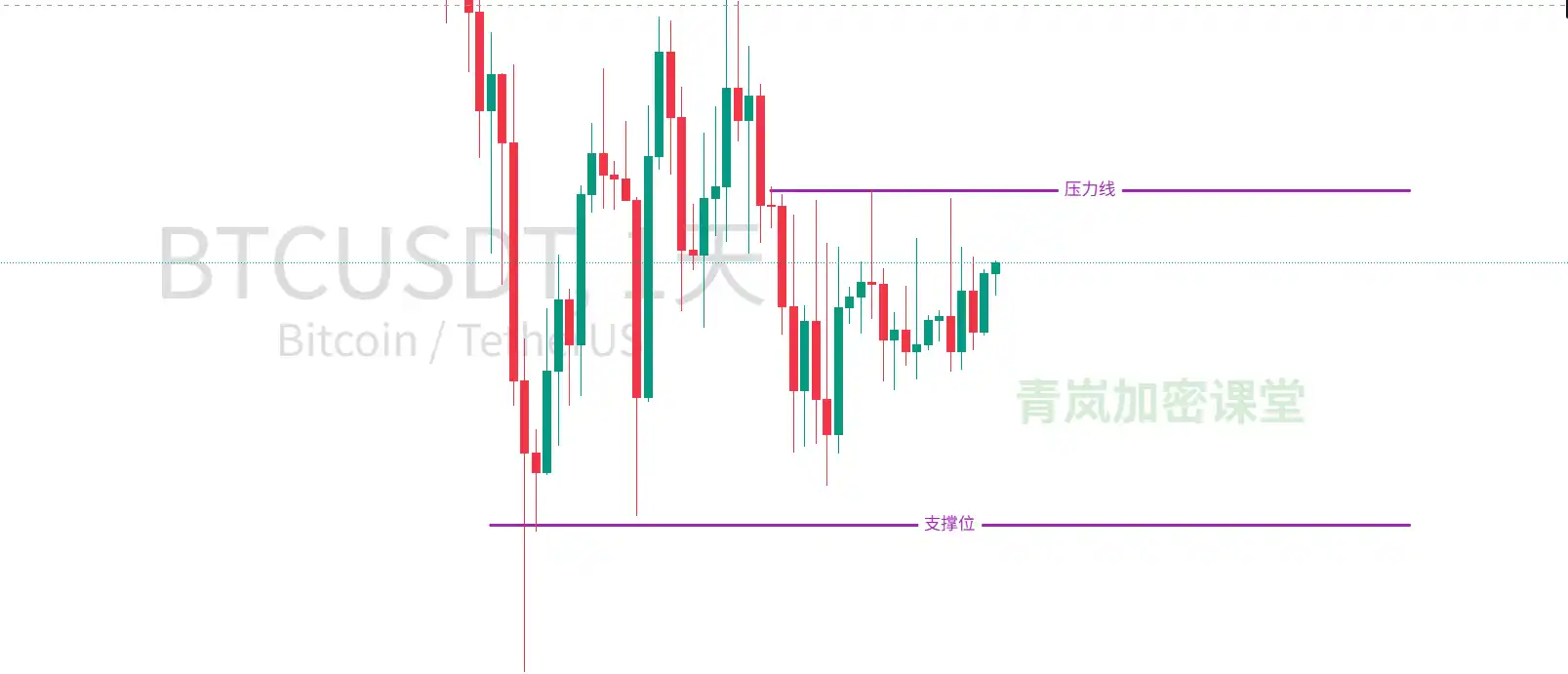
This is precisely a microcosm of the bull-bear psychological game: The weak trend shows bears are still applying pressure, possibly wanting to smash the price to accumulate; The strong rebound shows bulls are also gathering strength, wanting to use the opportunity to break through. Many sisters waver here, thinking the bull market is back when it rises, and thinking it will crash immediately when it falls.

Your mistake: Being confused by short-term fluctuations, trading frequently, losing all the money to fees, and容易在关键点位冲动决策 (easily making impulsive decisions at key points).

Sister Qinglan's advice for you:

Look at the major trend. Before the daily chart stabilizes, treat rebounds as 'dead cat bounces'.

If you want to speculate short-term, only试探 (test) with small positions at key support levels (like near $87,000), and must use a stop-loss.

The真正安全的加仓点 (truly safe point to add positions) is after a volume breakout above $90,000 and holding steady. Before that, hold cash and wait patiently.

Summary: For the Start of 2026, Do This to Protect Your Red Envelope and Grow Steadily. See through fund flows: ETF outflows don't mean the bull market is over; it could be institutional repositioning. Stabilize your long-term core holdings.

Follow the smart money: Pay attention to altcoins where funds are flowing,布局 (position) with small sizes, quick in and out.

Be rational about macro: Long-term positive ≠ short-term surge, use the expectation gap, but don't迷信 (superstitiously believe) news.

Respect the technicals: Look at the trend combining multiple timeframes, don't act impulsively at key points, wait for clear signals.

The crypto circle is like a江湖 (river lake - meaning a complex world), deep waters and rough waves. Don't just focus on how much others have earned; think more about how you can step on fewer pitfalls and survive more cycles. In 2026, let's together, with patience and strategy, simmer our wealth out steadily!

I am Sister Qinglan, accompanying you through bull and bear markets, earning money within our understanding clearly. See you next time!


Trend Kriptolar

İlgili Sorular

QAccording to the article, what is the main reason for the net outflow of funds from Bitcoin and Ethereum ETFs at the beginning of the new year?

AThe main reason is that institutions are locking in profits and creating panic to manipulate the market, while secretly shifting funds to more promising areas like certain altcoins.

QWhat strategy does Qinglan suggest for dealing with the short-term volatility of mainstream cryptocurrencies like Bitcoin and Ethereum?

AQinglan suggests holding long-term positions steady and not reacting to short-term fluctuations, while using short-term funds to reduce positions in overvalued assets, retain cash, and wait for market stabilization or opportunities to buy in batches.

QWhich altcoins are mentioned as receiving significant institutional investment inflows despite the outflow from major cryptocurrencies?

ASolana and XRP are mentioned as altcoins that are being bought by large funds, with Franklin Templeton's XRP ETF holdings doubling and Solana ETF assets exceeding $950 million.

QHow does the article advise interpreting macroeconomic policy signals like interest rate cuts and crypto legalization?

AThe article advises viewing interest rate cut predictions as potential 'smoke screens' to boost market sentiment and recognizing that long-term regulatory benefits are not guarantees of short-term price surges. It recommends using expectation disparities for trading but not relying solely on news.

QWhat technical analysis insight does Qinglan provide regarding the current price action of Bitcoin near the $88,000 to $90,000 range?

AQinglan notes that daily and 1-hour charts show weak downward trends, while the 4-hour chart shows a strong upward trend, indicating a tug-of-war between bulls and bears. She advises treating rebounds as potential 'dead cat bounces' until the daily trend stabilizes, and only cautiously testing key support levels with small positions and stop-losses.

İlgili Okumalar

From South Korea to the United States: Blue-Collar Jobs Are Becoming Increasingly Popular, Thanks to AI

AI is reshaping the labor market's value proposition. The traditional four-year college degree is losing its appeal as a guaranteed career path, while skilled blue-collar trades like electricians, welders, and plumbers are experiencing historic demand and wage premiums. This shift is driven by dual pressures: AI's displacement of certain white-collar roles and a booming need for physical infrastructure and data center construction. Data confirms the trend. In the U.S., vocational school revenue surged, and a significant portion of recent layoffs are AI-related. Surveys show a majority of Gen Z adults plan to pursue blue-collar work, citing better job security against AI automation. Vocational education interest has exploded recently. Experts cite a psychological shift as younger generations seek tangible, AI-resistant careers and avoid high student debt. In many cases, salaries for skilled trades now match or exceed those requiring a bachelor's degree. In South Korea, semiconductor vocational high schools boast near-total employment, with graduates securing high-paying roles at companies like Samsung. The shortage is structural, exacerbated by a retiring baby boomer workforce and massive infrastructure projects. Companies like JPMorgan Chase, Meta, and Lowe's are investing heavily in training programs. However, overcoming historical stigma and a "perception gap" around trade careers remains a key challenge to closing the talent gap.

marsbit5 dk önce

From South Korea to the United States: Blue-Collar Jobs Are Becoming Increasingly Popular, Thanks to AI

marsbit5 dk önce

Qualcomm: AI Hype Subsides, When Will Smartphones Emerge from the Gloom?

Qualcomm reported its Q3 FY2026 results (ending June 2026), with revenue of $9.95B, down 4% YoY but above expectations. Gross margin declined to 53.1%, pressured by rising costs across manufacturing and memory. Key business segments showed mixed performance: Handset revenue fell 19.6% YoY to $5.09B, dragged by an 11% decline in non-Apple Android shipments and weaker high-end mix. Conversely, Automotive revenue surged 61% to $1.59B, and IoT grew 9% to $1.83B. Core operating profit dropped 41% YoY due to margin compression and higher expenses. Management's Q4 FY2026 guidance projects revenue of $9.7B-$10.5B, in line with consensus, but Non-GAAP EPS guidance of $2.05-$2.25 fell short of expectations. Amidst persistent weakness in its core handset market, Qualcomm is pursuing growth in AI, focusing on Edge AI (smartphones, PCs, automotive) and Data Center AI. Its data center strategy includes four pillars: AI accelerators (e.g., AI200), commercial CPUs (Dragonfly C1000), custom silicon, and connectivity solutions. While these initiatives initially boosted its stock, concerns over AI capital expenditure sustainability have since erased those gains. The company targets $5B in data center revenue for FY2027 and $15B for FY2029. The report concludes that with the traditional handset business still under pressure, the data center opportunity is currently viewed as a longer-term option, and a more conservative valuation based on core operations may be warranted until AI contributions materialize.

marsbit9 dk önce

Qualcomm: AI Hype Subsides, When Will Smartphones Emerge from the Gloom?

marsbit9 dk önce

From TPU to Self-Evolving Agents: How Jeff Dean Predicts the Next Step in AI

At the 2026 YC Startup School, Jeff Dean outlined his vision for AI's next phase, shifting focus from simply scaling models to building intelligent, autonomous systems. He believes AI's progress is no longer just about creating smarter models, but about integrating them into systems capable of long-term, iterative work, automated experimentation, and continuous learning. This evolution moves the competition from "who has the bigger model" to "who can best organize intelligence." Dean suggests AI capabilities are now comparable to a junior engineer, enabling the automation of complex workflows. However, the true challenge and opportunity lie in managing these AI "workers" at scale. He emphasizes the importance of **context engineering**—structuring tools, memory, and feedback loops—over raw model power. For startups, this means building deep expertise in niche domains where general models currently fail (near 0-1% success rates), leveraging proprietary data, specialized tools, and domain-specific evaluators. A recurring theme is re-examining fundamental constraints. Dean's past work, like moving Google's search index to memory or creating the TPU, stemmed from questioning outdated assumptions about hardware and cost. He sees similar inflection points today, particularly in **specialized inference hardware** to drastically reduce latency and energy consumption for real-time Agent operation. Notably, he points out that in modern AI systems, the dominant cost is often not computation but **data movement**. Reliable, long-running Agents require robust system design, borrowing concepts from distributed computing like checkpointing, state management, and parallel exploration to handle failures and maintain progress over days or weeks. As AI automates execution, the scarcest human skills will shift to **defining clear specifications**, **judging what problems are worth solving** (taste), and designing effective feedback loops. Ultimately, Dean's framework prioritizes understanding the problem deeply, identifying the true bottlenecks, and systematically building closed-loop systems where AI can not only perform tasks but also improve AI itself.

marsbit9 dk önce

From TPU to Self-Evolving Agents: How Jeff Dean Predicts the Next Step in AI

marsbit9 dk önce

İşlemler

Spot

Popüler Makaleler

RED Nasıl Satın Alınır

HTX.com’a hoş geldiniz! RedStone (RED) satın alma işlemlerini basit ve kullanışlı bir hâle getirdik. Adım adım açıkladığımız rehberimizi takip ederek kripto yolculuğunuza başlayın. 1. Adım: HTX Hesabınızı OluşturunHTX'te ücretsiz bir hesap açmak için e-posta adresinizi veya telefon numaranızı kullanın. Sorunsuzca kaydolun ve tüm özelliklerin kilidini açın. Hesabımı Aç2. Adım: Kripto Satın Al Bölümüne Gidin ve Ödeme Yönteminizi SeçinKredi/Banka Kartı: Visa veya Mastercard'ınızı kullanarak anında RedStone (RED) satın alın.Bakiye: Sorunsuz bir şekilde işlem yapmak için HTX hesap bakiyenizdeki fonları kullanın.Üçüncü Taraflar: Kullanımı kolaylaştırmak için Google Pay ve Apple Pay gibi popüler ödeme yöntemlerini ekledik.P2P: HTX'teki diğer kullanıcılarla doğrudan işlem yapın.Borsa Dışı (OTC): Yatırımcılar için kişiye özel hizmetler ve rekabetçi döviz kurları sunuyoruz.3. Adım: RedStone (RED) Varlıklarınızı SaklayınRedStone (RED) satın aldıktan sonra HTX hesabınızda saklayın. Alternatif olarak, blok zinciri transferi yoluyla başka bir yere gönderebilir veya diğer kripto para birimlerini takas etmek için kullanabilirsiniz.4. Adım: RedStone (RED) Varlıklarınızla İşlem YapınHTX'in spot piyasasında RedStone (RED) ile kolayca işlemler yapın.Hesabınıza erişin, işlem çiftinizi seçin, işlemlerinizi gerçekleştirin ve gerçek zamanlı olarak izleyin. Hem yeni başlayanlar hem de deneyimli yatırımcılar için kullanıcı dostu bir deneyim sunuyoruz.

382 Toplam GörüntülenmeYayınlanma 2025.03.05Güncellenme 2026.07.21

RED Nasıl Satın Alınır

Tartışmalar

HTX Topluluğuna hoş geldiniz. Burada, en son platform gelişmeleri hakkında bilgi sahibi olabilir ve profesyonel piyasa görüşlerine erişebilirsiniz. Kullanıcıların RED (RED) fiyatı hakkındaki görüşleri aşağıda sunulmaktadır.

活动图片












