The Ethereum Foundation is Dead, The Era of Ethereum's Pluralistic Organizations Has Dawned

marsbit2026-07-10 tarihinde yayınlandı2026-07-10 tarihinde güncellendi

Özet

The Ethereum Foundation (EF) has announced the dissolution of its Protocol Support Team, marking a significant organizational shift. This move, described as the largest layoff in EF's history with a 20% staff reduction, follows a major internal restructuring announced in late June. The restructuring, which EF framed as necessary to streamline for future challenges, has drawn criticism for its perceived cold execution. Concurrently, several new independent non-profit organizations have emerged, founded by former EF members. These include Ethlabs, a research and development lab, and Ethereum Institutional, which focuses on promoting institutional adoption of Ethereum. Their rise is seen as both filling roles vacated by EF's downsizing and signaling a fragmentation of the Ethereum ecosystem's leadership. Amidst these changes, EF is also integrating advanced AI tools into its security operations. The security team has begun using AI agents to conduct red-team testing, which has already uncovered vulnerabilities in Ethereum's code. While EF states that AI complements rather than replaces human researchers, this technological shift hints at potential future reductions in human-centric roles within the organization. The article posits that these developments—massive layoffs, the exodus of key personnel like former Executive Director Xiaowei Wang, the rise of rival organizations, and AI integration—collectively point to a decline in EF's central authority. Once the undisputed lead...

Original | Odaily Planet Daily (@OdailyChina)

Author | Wenser (@wenser 2010 )
Last night, the Ethereum Foundation's Protocol Support Team officially announced its dissolution. Prior to this, Wang Xiaowei, co-executive director of the Ethereum Foundation, who was seen as "one of the representative figures of the EF's organizational reform," had also officially resigned. So far this year, at least 8 senior personnel have left the Ethereum Foundation.

Alongside the organizational and personnel changes, there is the functional replacement and encroachment on the Ethereum Foundation's role by non-profit independent organizations such as ETHLabs and Ethereum Institutional; there is also the technical progress, like the EF's security team recently using AI agents for red team testing of the ETH network and discovering real vulnerabilities.

As ETH's price faces wave after wave of industry scrutiny, what lies before the Ethereum Foundation are the more complex and diverse contradictions and tests following its internal reform. Related to this is the divisive transformation that the leading body of Ethereum is directly confronting.

The Ethereum Foundation Enters an Era of Decline: The Rise of Multiple Contenders, Talent Drain, and the AI Transformation

The Ethereum Foundation (hereinafter referred to as EF) has long been criticized for its rigid structure, decision-making by a few, organizational value, and actions affecting market sentiment through token sales. Criticism of the EF within the Ethereum community is particularly fierce. Not long ago, Bankless founder David Hoffman even went so far as to "sell his final ETH holdings" to express his dissatisfaction with the EF, urging the Ethereum community to build the ecosystem in their own way.

Now, the formal dissolution of the EF's Protocol Support Team is like a thunderclap, fully exposing the internal contradictions and crisis of division within the EF organization to everyone. It is noteworthy that this round of organizational changes is particularly different from the organizational changes initiated by Ethereum founder Vitalik last year—this is a thorough personnel purge, also seen as 'the largest round of layoffs since the EF's establishment,' not merely changes among some leadership personnel as before.

When the Ethereum Ecosystem Leader Chooses to Sever Its Tail to Survive: The Course of EF's Major Layoffs

It all begins with the official announcement "New EF Structure" officially released by the EF on June 23.

In this lengthy article spanning thousands of words, the EF distinguished its new organizational structure into layers: Protocol, Access, User, Community, and Institutional. It later explained that "this organizational restructuring involves laying off 54 people, representing 20% of EF's membership." What feels even more disheartening is that the announcement begins by stating: "Through this process, we have obtained the structure, activities, and personnel necessary to execute the critical tasks we will soon face." In other words, the laid-off personnel and departments are considered obsolete, unnecessary, and without value.

It must be said that the EF, which has always presented itself as a research-oriented organization and an ecosystem leader with a scholarly demeanor, has for the first time revealed a冷酷 aspect of its organizational management.
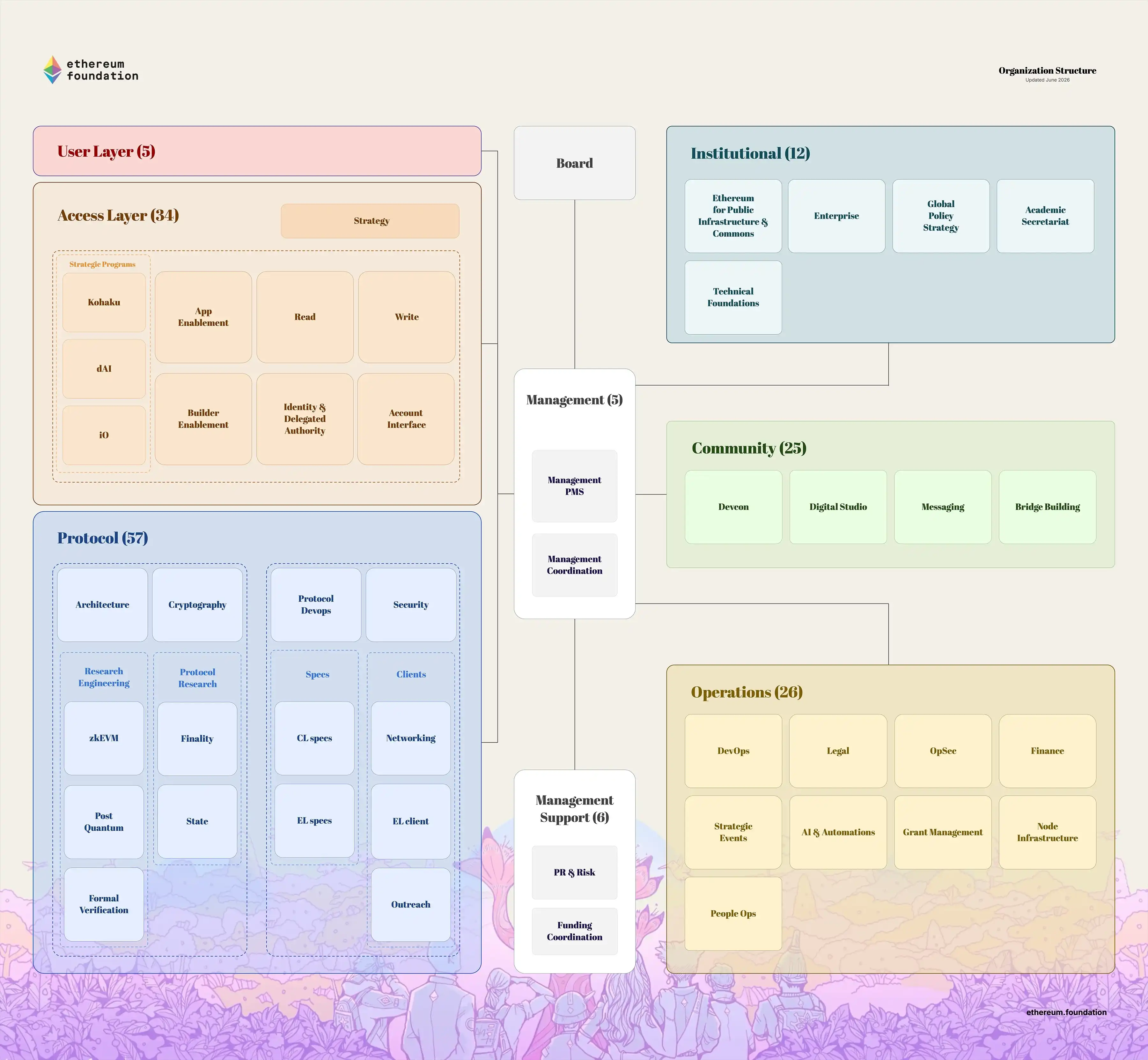
Schematic diagram of the new EF structure

The Dissolution of the EF Protocol Support Department Becomes a Significant Marker of EF's Organizational Split

It is worth mentioning that the work of the EF Protocol Support Department leaned towards infrastructure construction, primarily responsible for coordinating the Ethereum protocol development process, including organizing and coordinating core developer meetings, tracking Ethereum network upgrades, supporting EIP progression, running the Ethereum protocol, etc. Now, its main functions have been allocated to the Protocol layer part of the EF.

Coinciding with the day the EF announced its new structure, Ethlabs, a non-profit R&D lab co-founded by 5 former EF researchers, was officially announced. This organization aims to promote Ethereum as the settlement layer for the global economy and has received support from a series of investment institutions, Ethereum ecosystem projects, independent individuals, and EF members, including Ethereum co-founder Joe Lubin (Chairman of Sharplink, founder of Consensys), ETH treasury company BitMine (Ethereum treasury company under Tom Lee), Sharplink, and crypto investment firm SNZ.
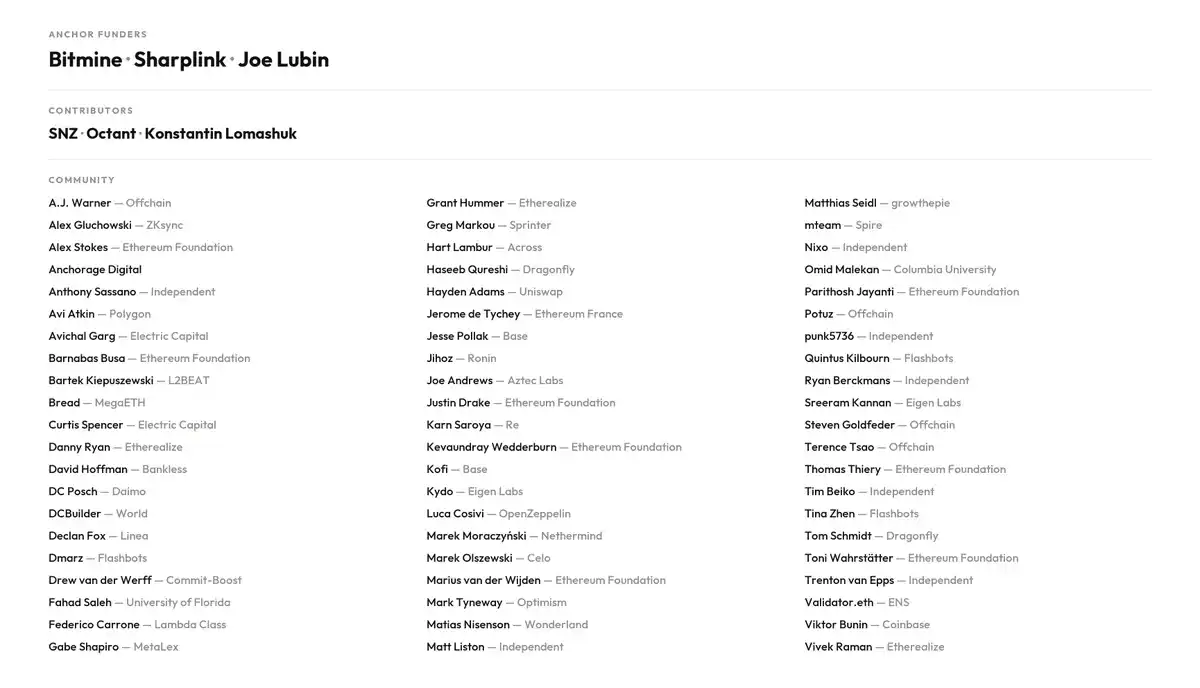
List of ETHLabs community participants (Source: Official account)

On July 1st, Ethereum Institutional, co-founded by former EF members David Walsh, Marius Smith, and Matthew Dawson, was officially unveiled.

This organization's main concept is "Ethereum's Institutional Finance Application Plan," dedicated to promoting the institutionalization and institutional-grade application of Ethereum, its secondary layers, applications, and the entire ecosystem. Simultaneously, the organization emphasizes its collaboration with Ethlabs, Etherealize, and the Enterprise Ethereum Alliance, responsible for institutional demand对接 and explaining Ethereum's value proposition to banks; Ethlabs focuses on translating related demands into technical products. As a non-profit independent institution, Ethereum Institutional will provide free consulting related to Ethereum applications for banks and asset management companies.

A week later, Ethereum Institutional announced the commencement of core team recruitment, focusing in the coming weeks on hiring for roles such as Institutional Business Development (Institutional GTM), Marketing & Community Operations, and technical positions like Solutions Architect, Technical Project Lead.

Thus, the EF layoff turmoil formally concluded with the emergence of two major non-profit independent organizations and the dissolution of the Protocol Support Department, also drawing an imperfect full stop to the "internal organizational transformation" personally pushed by Vitalik last year. Beyond the organizational-level split and the loss of top talent like Executive Director Wang Xiaowei, the EF also faces the impact of AI technology.

The Era of AI Attack and Defense Begins, Upgrades in EF Security Team Testing

Yesterday, researchers from the EF Protocol Security Team stated in a blog post that they have deployed a series of AI agents to test software dependencies within the Ethereum ecosystem, searching for vulnerabilities in cryptographic systems, protocol code, and smart contracts.

Vulnerabilities discovered by the AI agents include a remotely triggerable panic issue in the libp2p gossipsub peer-to-peer layer used by Ethereum consensus clients. This issue has been fixed and disclosed on Github as CVE-2026-34219.

Researchers stated that the AI agents were organized into specialized roles such as reconnaissance, searching, gap filling, and verification to find potential attack paths, reproduce failures, and verify their applicability to production code. The EF stated that AI has not replaced security researchers but has changed the way of working, enabling the team to cover a far greater scope than manual review, but requiring researchers to exercise more cautious judgment over a large number of seemingly credible conclusions.

Considering today's news of the official launch of the GPT 5.6 model, the future maintenance of Ethereum protocol security will likely be jointly handled by AI models and EF security researchers. Moreover, although the EF currently mentions that "AI has not replaced researchers," with the continuous development and evolution of AI models, personnel in the EF security team and even across the entire organizational structure may be further reduced in the future. In other words, the EF will also face the test of AI models on its organizational structure and the fulfillment of its functions.

Summary: The EF Organizational Reform Phase Concludes, Might It Become an Ecosystem Mascot in the Future?

In January of last year, we systematically analyzed the EF's organizational reform in the article "Vitalik Fires the First Shot of 'Reform', Where is the Ethereum Foundation Heading?" Back then, Vitalik was still ambitiously and forcefully pushing for EF organizational reform; in May of this year, after more than a year of organizational renewal, Vitalik surprisingly changed his tune, stating that "the Ethereum Foundation should not be the center of the ETH ecosystem and will shift towards a smaller, long-termist approach."

It must be said that as ETH has grown into an asset worth hundreds of billions, the EF, this official ecosystem organization established for nearly a decade, has also entered the awkward position of being "a large ship hard to turn." No wonder Vitalik previously declared—"will no longer write regular blog posts and has decided to try writing some science fiction on the topic of decentralized governance."

As former EF researcher and Ethlabs member Ansgar Dietrichs said earlier this month in a podcast, "After five years of failing to break through $5,000, ETH still lacks a clear value narrative."

Currently, it seems the EF can hardly shoulder the banner of "revitalizing the Ethereum ecosystem and driving a breakthrough in ETH's price." Future large-scale adoption and institutional-grade investment may have to be hoped for from organizations like ETHlabs, Ethereum Institutional, and Etherealize.

Perhaps, in the not-too-distant future, playing the role of an "ecosystem mascot" would be more suitable for the EF.

Recommended Reading

Ethereum in a "Mid-Life Crisis," Analyzing Its Development Performance from a Data Perspective

Given: ETH = Nokia, Find: Ethereum = iOS?

Ethereum is 'Sick,' Are These Three Prescriptions the Right Cure?

Where is the Road? A Brief Analysis of the 3 Major Abstract Problems Facing the Ethereum Ecosystem

Listing Ethereum's Seven Deadly Sins, Who Can Play the "Divine Comedy of Salvation" for It?

Where Lies Ethereum's Orthodoxy? A Detailed Explanation of the "Cryptocurrency Masterpiece" in Vitalik's Mind

Ethereum's Tenth Anniversary: Revisiting ETH's Journey of Changing Hands, The Resurgence of Token Centralization

Are L2s a Detour for Ethereum?

Bankless Founder Liquidates ETH Holdings, Collective Disillusionment with Ethereum Faith

Trend Kriptolar

İlgili Sorular

QWhat significant organizational change was announced by the Ethereum Foundation's Protocol Support Team, and what was its broader implication?

AThe Ethereum Foundation's Protocol Support Team announced its formal dissolution. This event is seen as a major indicator of internal conflict and a splitting crisis within the EF, marking one of its largest rounds of layoffs to date.

QAccording to the article, what are the names and primary goals of the two new non-profit independent organizations that emerged following the EF restructuring?

AThe two new organizations are Ethlabs and Ethereum Institutional. Ethlabs aims to promote Ethereum as a global economic settlement layer. Ethereum Institutional focuses on driving the institutionalization and enterprise-level application of Ethereum and its ecosystem.

QHow has the Ethereum Foundation's security team incorporated AI, and what was a key outcome of this integration?

AThe EF security team deployed a series of AI agents to test software relied upon by the Ethereum ecosystem, searching for vulnerabilities. A key outcome was the discovery of a remotely triggerable panic issue in the libp2p gossipsub library (CVE-2026-34219), which has since been patched.

QWhat shift in perspective did Vitalik Buterin reportedly express regarding the Ethereum Foundation's role, as mentioned in the article's conclusion?

AVitalik Buterin shifted from actively pushing for organizational reform to stating that the Ethereum Foundation should not be the center of the ETH ecosystem and should move towards a smaller, more long-termist approach. The article suggests he may even see a future where the EF plays more of a 'mascot' role.

QWhat criticism from within the Ethereum community towards the EF is highlighted in the article, and who exemplified this sentiment?

AThe EF has been criticized for its rigid structure, decision-making by a few, organizational value, and market-affecting sell-offs. Bankless founder David Hoffman exemplified this sentiment by selling his remaining ETH holdings to express dissatisfaction and encouraging the community to build independently of the EF.

İlgili Okumalar

June Transaction Volume Doubles: x402 Ecosystem Continues to Expand, Content Monetization Narrative Faces Crucial Test

X402, a protocol for AI and data services, experienced significant growth in June. Its transaction volume doubled compared to May, primarily driven by the AI inference routing service BlockRun. The ecosystem expanded with new integrations: Apify enabled data scraping services, Exa extended its AI search to Solana, and Seal launched 'Hacks', a marketplace for automated AI agents. The protocol itself received crucial upgrades, including 'Builder Codes' for tracking and affiliate systems and 'Batch Settlement' to enable practical micropayments for high-frequency AI tasks. Major external validation came from tech giants. Amazon Web Services (AWS) launched a solution for AI traffic metering at its edge nodes. More significantly, Cloudflare opened its waitlist for a Content Monetization Gateway. This gateway allows websites to charge AI bots and other automated agents for accessing content, using x402 for stablecoin payments. This addresses a core internet monetization problem and represents x402's most promising path to mass adoption, though Cloudflare's CEO noted current blockchain scalability remains a critical hurdle. Current leading use cases are AI inference routing and paid data feeds. However, the large-scale real-world test with Cloudflare's gateway will be decisive in determining if x402 can transition from a useful tool to a fundamental infrastructure component for a new web economy where AI agents pay for the content they consume.

Foresight News14 dk önce

June Transaction Volume Doubles: x402 Ecosystem Continues to Expand, Content Monetization Narrative Faces Crucial Test

Foresight News14 dk önce

RWA Weekly: EU Proposes Revision of MiCA to Cover Tokenization and Non-EU Stablecoins; Swift and 17 Banks to Pilot Tokenized Cross-Border Payments

RWA Weekly: EU Proposes MiCA Revision for Tokenization and Non-EU Stablecoins; Swift to Pilot Tokenized Cross-Border Payments with 17 Banks During the statistical period of July 3-10, 2026, the RWA sector showed signs of recovery. The total on-chain market capitalization of RWAs rebounded to $33.12 billion, ending a prolonged decline. The stablecoin market cap also returned above $300 billion, with active addresses and holders increasing, indicating restored market vitality. Key regulatory developments include China promoting the use of digital yuan in consumption vouchers, the EU considering revisions to its MiCA framework to cover tokenization and non-EU stablecoins, and Kazakhstan authorizing stablecoin use for cross-border corporate and government payments. In Hong Kong, HSBC issued its first "digitally native" structured product. Major project updates feature Swift announcing readiness of its blockchain ledger for a 24/7 tokenized cross-border payment pilot involving 17 global banks. Ondo launched a perpetuals platform allowing tokenized stocks as collateral. Sony received conditional U.S. OCC approval to launch a stablecoin-focused trust bank in 2027. Tether plans to natively issue USDT on Bitcoin via the RGB protocol. Significant funding rounds saw Securitize planning to deploy over $400 million for acquisitions to expand its institutional tokenization business, while Tether invested $20 million in Brazil's Mercado Bitcoin to support its growth in on-chain financial services. Analysis highlights that stablecoins are evolving into global financial infrastructure with regional specializations and that institutions should consider international expansion to gain practical experience in the RWA tokenization space amidst evolving regulations.

marsbit47 dk önce

RWA Weekly: EU Proposes Revision of MiCA to Cover Tokenization and Non-EU Stablecoins; Swift and 17 Banks to Pilot Tokenized Cross-Border Payments

marsbit47 dk önce

The first to catch the wave of the Robinhood Chain hype is Arbitrum, up nearly 20%

"ARB, the native token of Arbitrum, surged nearly 20% recently, emerging as a top-performing L2 token. This rally is attributed to the launch of 'Robinhood Chain,' a Real-World Asset (RWA) Layer 2 built using Arbitrum's technology. The launch has brought renewed attention to the 'Arbitrum Expansion Plan' (AEP), a year-and-a-half-old program. AEP allows external projects to build their own chains using Arbitrum's Orbit technology. In return, these 'tenant' chains that do not settle on Arbitrum's main networks must share 10% of their net protocol revenue with the Arbitrum ecosystem—8% to the DAO treasury and 2% to the developer guild. While smaller chains like Degen Chain previously triggered AEP, Robinhood Chain is the first major, high-profile tenant, making the revenue-sharing model economically significant for the first time. Initial data from Robinhood Chain is impressive, with over 35 million transactions, 350,000 addresses, $2.5 billion in TVL, and over $1 billion in DEX volume shortly after launch. However, its current protocol revenue, at roughly $146,000 net, translates to only a minimal payout to Arbitrum DAO. The ARB price surge thus reflects the market's anticipation of future revenue as Robinhood's vast $324 billion platform assets potentially migrate on-chain. This 'landlord' model mirrors Optimism's approach with its OP Stack and Superchain. However, Optimism's model faces pressure as its largest tenant, Base, announced plans to depart, causing a significant drop in OP's price. Similarly, analysts question Robinhood Chain's long-term dependence on Arbitrum, noting its daily sequencer revenue already nears three times that of Arbitrum itself. There is speculation that, like Base, it may eventually seek independence, with ETH potentially being its primary economic token rather than ARB."

Foresight News1 saat önce

The first to catch the wave of the Robinhood Chain hype is Arbitrum, up nearly 20%

Foresight News1 saat önce

İşlemler

Spot

Popüler Makaleler

$S$ Nedir

SPERO'yu Anlamak: Kapsamlı Bir Genel Bakış SPERO'ya Giriş İnovasyonun manzarası gelişmeye devam ederken, web3 teknolojilerinin ve kripto para projelerinin ortaya çıkışı dijital geleceği şekillendirmede önemli bir rol oynamaktadır. Bu dinamik alanda dikkat çeken projelerden biri SPERO, $$s$$ olarak adlandırılmaktadır. Bu makale, SPERO hakkında ayrıntılı bilgi toplamak ve sunmak amacıyla, meraklılar ve yatırımcıların web3 ve kripto alanlarındaki temellerini, hedeflerini ve yeniliklerini anlamalarına yardımcı olmayı amaçlamaktadır. SPERO,$$s$$ Nedir? SPERO,$$s$$, kripto alanında merkeziyetsizlik ve blok zinciri teknolojisi ilkelerini kullanarak etkileşimi, faydayı ve finansal kapsayıcılığı teşvik eden bir ekosistem yaratmayı amaçlayan benzersiz bir projedir. Proje, kullanıcıların yenilikçi finansal çözümler ve hizmetler sunarak eşler arası etkileşimleri yeni yollarla kolaylaştırmayı hedeflemektedir. SPERO,$$s$$'nin temel amacı, bireyleri güçlendirmek ve kripto para alanındaki kullanıcı deneyimini artıran araçlar ve platformlar sağlamaktır. Bu, daha esnek işlem yöntemlerini mümkün kılmayı, topluluk odaklı girişimleri teşvik etmeyi ve merkeziyetsiz uygulamalar (dApp'ler) aracılığıyla finansal fırsatlar yaratmayı içermektedir. SPERO,$$s$$'nin temel vizyonu kapsayıcılık etrafında dönmekte olup, geleneksel finansal sistemlerdeki boşlukları kapatmayı ve blok zinciri teknolojisinin faydalarından yararlanmayı hedeflemektedir. SPERO,$$s$$'nin Yaratıcısı Kimdir? SPERO,$$s$$'nin yaratıcısının kimliği bir miktar belirsizdir, çünkü kurucusu(ları) hakkında ayrıntılı arka plan bilgisi sağlayan sınırlı kamuya açık kaynaklar bulunmaktadır. Bu şeffaflık eksikliği, projenin merkeziyetsizlik taahhüdünden kaynaklanabilir—birçok web3 projesinin paylaştığı bir etik anlayışı, bireysel tanınmanın yerine kolektif katkıları önceliklendirmektedir. Topluluk ve onun kolektif hedefleri etrafında tartışmaları merkezileştirerek, SPERO,$$s$$, belirli bireyleri öne çıkarmadan güçlendirme özünü taşımaktadır. Bu nedenle, SPERO'nun etik anlayışını ve misyonunu anlamak, tek bir yaratıcının kimliğini belirlemekten daha önemlidir. SPERO,$$s$$'nin Yatırımcıları Kimlerdir? SPERO,$$s$$, kripto sektöründe yeniliği teşvik etmeye adanmış girişim sermayedarlarından melek yatırımcılara kadar çeşitli yatırımcılar tarafından desteklenmektedir. Bu yatırımcıların odak noktası genellikle SPERO'nun misyonuyla uyumlu olup, toplumsal teknolojik ilerlemeyi, finansal kapsayıcılığı ve merkeziyetsiz yönetimi vaat eden projeleri önceliklendirmektedir. Bu yatırımcı temelleri, yalnızca yenilikçi ürünler sunan projelere değil, aynı zamanda blok zinciri topluluğuna ve ekosistemlerine olumlu katkılarda bulunan projelere de ilgi duymaktadır. Bu yatırımcıların desteği, SPERO,$$s$$'yi hızla gelişen kripto projeleri alanında dikkate değer bir rakip haline getirmektedir. SPERO,$$s$$ Nasıl Çalışır? SPERO,$$s$$, onu geleneksel kripto para projelerinden ayıran çok yönlü bir çerçeve kullanmaktadır. İşte benzersizliğini ve yeniliğini vurgulayan bazı temel özellikler: Merkeziyetsiz Yönetim: SPERO,$$s$$, kullanıcıların projenin geleceğiyle ilgili karar alma süreçlerine aktif olarak katılmalarını sağlayan merkeziyetsiz yönetim modellerini entegre etmektedir. Bu yaklaşım, topluluk üyeleri arasında sahiplik ve hesap verebilirlik duygusunu teşvik etmektedir. Token Kullanımı: SPERO,$$s$$, ekosistem içinde çeşitli işlevler sunmak üzere tasarlanmış kendi kripto para token'ını kullanmaktadır. Bu token'lar, işlemleri, ödülleri ve platformda sunulan hizmetlerin kolaylaştırılmasını sağlayarak genel etkileşimi ve faydayı artırmaktadır. Katmanlı Mimari: SPERO,$$s$$'nin teknik mimarisi, modülerlik ve ölçeklenebilirliği destekleyerek projenin evrimi sırasında ek özelliklerin ve uygulamaların sorunsuz bir şekilde entegrasyonuna olanak tanımaktadır. Bu uyum sağlama yeteneği, sürekli değişen kripto manzarasında geçerliliği sürdürmek için hayati öneme sahiptir. Topluluk Katılımı: Proje, işbirliği ve geri bildirim teşvik eden mekanizmalar kullanarak topluluk odaklı girişimlere vurgu yapmaktadır. Güçlü bir topluluk oluşturarak, SPERO,$$s$$, kullanıcı ihtiyaçlarını daha iyi karşılayabilir ve piyasa trendlerine uyum sağlayabilir. Kapsayıcılığa Odaklanma: Düşük işlem ücretleri ve kullanıcı dostu arayüzler sunarak, SPERO,$$s$$, daha önce kripto alanında yer almamış bireyler de dahil olmak üzere çeşitli bir kullanıcı tabanını çekmeyi hedeflemektedir. Bu kapsayıcılık taahhüdü, erişilebilirlik yoluyla güçlendirme misyonuyla uyumludur. SPERO,$$s$$ Zaman Çizelgesi Bir projenin tarihini anlamak, gelişim yolculuğu ve kilometre taşları hakkında kritik bilgiler sağlar. Aşağıda, SPERO,$$s$$'nin evriminde önemli olayları haritalayan önerilen bir zaman çizelgesi bulunmaktadır: Kavram Geliştirme ve Fikir Aşaması: SPERO,$$s$$'nin temelini oluşturan ilk fikirler, blok zinciri endüstrisindeki merkeziyetsizlik ve topluluk odaklılık ilkeleriyle yakından uyumlu olarak geliştirildi. Proje Beyaz Kağıdının Yayınlanması: Kavramsal aşamayı takiben, SPERO,$$s$$'nin vizyonunu, hedeflerini ve teknolojik altyapısını ayrıntılı bir şekilde açıklayan kapsamlı bir beyaz kağıt yayımlandı ve topluluk ilgisini ve geri bildirimini toplamak amacıyla sunuldu. Topluluk Oluşturma ve Erken Katılımlar: Projenin hedefleri etrafında tartışmalar yürüterek destek toplamak ve erken benimseyenler ile potansiyel yatırımcılar için bir topluluk oluşturmak amacıyla aktif iletişim çabaları gerçekleştirildi. Token Üretim Etkinliği: SPERO,$$s$$, yerel token'larını erken destekçilere dağıtmak ve ekosistem içinde başlangıç likiditesini sağlamak amacıyla bir token üretim etkinliği (TGE) gerçekleştirdi. İlk dApp'in Yayınlanması: SPERO,$$s$$ ile ilişkili ilk merkeziyetsiz uygulama (dApp) faaliyete geçti ve kullanıcıların platformun temel işlevleriyle etkileşimde bulunmalarını sağladı. Sürekli Gelişim ve Ortaklıklar: Projenin tekliflerine sürekli güncellemeler ve iyileştirmeler yapılmakta olup, blok zinciri alanındaki diğer oyuncularla stratejik ortaklıklar, SPERO,$$s$$'yi rekabetçi ve gelişen bir oyuncu haline getirmiştir. Sonuç SPERO,$$s$$, web3 ve kripto paranın finansal sistemleri devrim niteliğinde dönüştürme ve bireyleri güçlendirme potansiyelinin bir kanıtıdır. Merkeziyetsiz yönetime, topluluk katılımına ve yenilikçi tasarlanmış işlevselliğe olan bağlılığıyla, daha kapsayıcı bir finansal manzaraya doğru bir yol açmaktadır. Hızla gelişen kripto alanındaki herhangi bir yatırımda olduğu gibi, potansiyel yatırımcılar ve kullanıcılar, SPERO,$$s$$ içindeki devam eden gelişmelerle ilgili olarak kapsamlı bir araştırma yapmaları ve düşünceli bir şekilde katılmaları teşvik edilmektedir. Proje, kripto endüstrisinin yenilikçi ruhunu sergileyerek, sayısız olasılığını keşfetmeye davet etmektedir. SPERO,$$s$$'nin yolculuğu hala devam ederken, temel ilkeleri, teknoloji, finans ve birbirimizle etkileşim biçimimizi etkileyebilir.

166 Toplam GörüntülenmeYayınlanma 2024.12.17Güncellenme 2024.12.17

$S$ Nedir

AGENT S Nedir

Agent S: Web3'te Otonom Etkileşimin Geleceği Giriş Web3 ve kripto para dünyasında sürekli gelişen manzarada, yenilikler bireylerin dijital platformlarla etkileşim biçimlerini sürekli olarak yeniden tanımlıyor. Bu tür öncü projelerden biri olan Agent S, açık ajans çerçevesi aracılığıyla insan-bilgisayar etkileşimini devrim niteliğinde değiştirmeyi vaat ediyor. Otonom etkileşimlerin yolunu açarak, Agent S karmaşık görevleri basitleştirmeyi ve yapay zeka (AI) alanında dönüştürücü uygulamalar sunmayı hedefliyor. Bu detaylı inceleme, projenin karmaşıklıklarına, benzersiz özelliklerine ve kripto para alanındaki etkilerine dalacaktır. Agent S Nedir? Agent S, bilgisayar görevlerinin otomasyonunda üç temel zorluğu ele almak üzere özel olarak tasarlanmış çığır açıcı bir açık ajans çerçevesidir: Alan Spesifik Bilgi Edinimi: Çerçeve, çeşitli dış bilgi kaynaklarından ve iç deneyimlerden akıllıca öğrenir. Bu çift yönlü yaklaşım, alan spesifik bilgi açısından zengin bir veri havuzu oluşturmasını sağlar ve görev yürütmedeki performansını artırır. Uzun Görev Ufukları Üzerinde Planlama: Agent S, karmaşık görevlerin verimli bir şekilde parçalanmasını ve yürütülmesini kolaylaştıran deneyim artırımlı hiyerarşik planlama kullanır. Bu özellik, çoklu alt görevleri etkili ve verimli bir şekilde yönetme yeteneğini önemli ölçüde artırır. Dinamik, Homojen Olmayan Arayüzlerle Başlama: Proje, ajanlar ve kullanıcılar arasındaki etkileşimi geliştiren yenilikçi bir çözüm olan Ajan-Bilgisayar Arayüzü'ni (ACI) tanıtmaktadır. Çok Modlu Büyük Dil Modellerini (MLLM'ler) kullanarak, Agent S çeşitli grafik kullanıcı arayüzlerini sorunsuz bir şekilde gezinebilir ve manipüle edebilir. Bu öncü özellikler aracılığıyla, Agent S, makinelerle insan etkileşimini otomatikleştirmede karşılaşılan karmaşıklıkları ele alan sağlam bir çerçeve sunarak, AI ve ötesinde birçok uygulama için zemin hazırlıyor. Agent S'nin Yaratıcısı Kimdir? Agent S'nin kavramı temelde yenilikçi olsa da, yaratıcısı hakkında spesifik bilgiler belirsizliğini koruyor. Yaratıcı şu anda bilinmiyor, bu da projenin yeni aşamasını veya kurucu üyeleri gizli tutma stratejik tercihini vurguluyor. Anonimlikten bağımsız olarak, odak çerçevenin yetenekleri ve potansiyeli üzerinde kalıyor. Agent S'nin Yatırımcıları Kimlerdir? Agent S, kriptografik ekosistemde oldukça yeni olduğundan, yatırımcıları ve finansal destekçileri hakkında ayrıntılı bilgiler açıkça belgelenmemiştir. Projeyi destekleyen yatırım temelleri veya organizasyonları hakkında kamuya açık bilgilerdeki eksiklik, finansman yapısı ve gelişim yol haritası hakkında sorular doğuruyor. Destekleyicilerin anlaşılması, projenin sürdürülebilirliğini ve potansiyel pazar etkisini değerlendirmek için kritik öneme sahiptir. Agent S Nasıl Çalışır? Agent S'nin temelinde, çeşitli ortamlarda etkili bir şekilde çalışmasını sağlayan son teknoloji bir sistem yatmaktadır. İşleyiş modeli birkaç ana özellik etrafında inşa edilmiştir: İnsan Benzeri Bilgisayar Etkileşimi: Çerçeve, bilgisayarlarla etkileşimleri daha sezgisel hale getirmeyi amaçlayan gelişmiş AI planlaması sunar. Görev yürütmedeki insan davranışını taklit ederek, kullanıcı deneyimlerini yükseltmeyi vaat eder. Anlatı Belleği: Yüksek düzeyde deneyimlerden yararlanmak için kullanılan Agent S, görev geçmişlerini takip etmek amacıyla anlatı belleğini kullanarak karar verme süreçlerini geliştirir. Episodik Bellek: Bu özellik, kullanıcılara adım adım rehberlik sağlayarak, çerçevenin görevler gelişirken bağlamsal destek sunmasına olanak tanır. OpenACI Desteği: Yerel olarak çalışabilme yeteneği ile Agent S, kullanıcıların etkileşimleri ve iş akışları üzerinde kontrol sağlamasına olanak tanır ve Web3'ün merkeziyetsiz felsefesiyle uyumlu hale gelir. Dış API'lerle Kolay Entegrasyon: Çeşitli AI platformlarıyla uyumluluğu ve çok yönlülüğü, Agent S'nin mevcut teknolojik ekosistemlere sorunsuz bir şekilde entegre olmasını sağlar ve geliştiriciler ile organizasyonlar için cazip bir seçenek haline getirir. Bu işlevsellikler, Agent S'nin kripto alanındaki benzersiz konumuna katkıda bulunarak, karmaşık, çok aşamalı görevleri minimum insan müdahalesi ile otomatikleştirir. Proje geliştikçe, Web3'teki potansiyel uygulamaları dijital etkileşimlerin nasıl gelişeceğini yeniden tanımlayabilir. Agent S'nin Zaman Çizelgesi Agent S'nin gelişimi ve kilometre taşları, önemli olaylarını vurgulayan bir zaman çizelgesinde özetlenebilir: 27 Eylül 2024: Agent S'nin kavramı, “Bilgisayarları İnsan Gibi Kullanan Açık Bir Ajans Çerçevesi” başlıklı kapsamlı bir araştırma makalesi ile tanıtıldı ve projenin temelini sergiledi. 10 Ekim 2024: Araştırma makalesi arXiv'de kamuya açık olarak yayınlandı ve çerçevenin derinlemesine bir incelemesini ve OSWorld benchmark'ına dayalı performans değerlendirmesini sundu. 12 Ekim 2024: Agent S'nin yetenekleri ve özellikleri hakkında görsel bir içgörü sağlayan bir video sunumu yayımlandı ve potansiyel kullanıcılar ve yatırımcılarla daha fazla etkileşim sağlandı. Bu zaman çizelgesindeki işaretler, sadece Agent S'nin ilerlemesini değil, aynı zamanda şeffaflık ve topluluk katılımına olan bağlılığını da göstermektedir. Agent S Hakkında Ana Noktalar Agent S çerçevesi gelişmeye devam ederken, birkaç ana özellik öne çıkmakta ve yenilikçi doğasını ve potansiyelini vurgulamaktadır: Yenilikçi Çerçeve: İnsan etkileşimine benzer bir bilgisayar kullanımı sağlamak üzere tasarlanan Agent S, görev otomasyonuna yeni bir yaklaşım getiriyor. Otonom Etkileşim: GUI aracılığıyla bilgisayarlarla otonom olarak etkileşim kurabilme yeteneği, daha akıllı ve verimli hesaplama çözümlerine doğru bir sıçrama anlamına geliyor. Karmaşık Görev Otomasyonu: Sağlam metodolojisi ile karmaşık, çok aşamalı görevleri otomatikleştirerek süreçleri daha hızlı ve daha az hata payı ile gerçekleştirebilir. Sürekli İyileştirme: Öğrenme mekanizmaları, Agent S'nin geçmiş deneyimlerden öğrenmesini sağlar ve sürekli olarak performansını ve etkinliğini artırır. Çok Yönlülük: OSWorld ve WindowsAgentArena gibi farklı işletim ortamlarında uyumlu olması, geniş bir uygulama yelpazesine hizmet edebilmesini sağlar. Agent S, Web3 ve kripto alanında kendini konumlandırırken, etkileşim yeteneklerini artırma ve süreçleri otomatikleştirme potansiyeli, AI teknolojilerinde önemli bir ilerlemeyi temsil etmektedir. Yenilikçi çerçevesi aracılığıyla, Agent S dijital etkileşimlerin geleceğini örneklemekte ve çeşitli sektörlerde kullanıcılar için daha sorunsuz ve verimli bir deneyim vaat etmektedir. Sonuç Agent S, AI ve Web3'ün birleşiminde cesur bir sıçramayı temsil ediyor ve teknoloji ile etkileşim biçimimizi yeniden tanımlama kapasitesine sahip. Henüz erken aşamalarında olmasına rağmen, uygulama olanakları geniş ve çekici. Kritik zorlukları ele alan kapsamlı çerçevesi ile Agent S, otonom etkileşimleri dijital deneyimin ön plana çıkmasına taşımayı hedefliyor. Kripto para ve merkeziyetsizlik alanlarına daha derinlemesine girdikçe, Agent S gibi projelerin teknoloji ve insan-bilgisayar işbirliğinin geleceğini şekillendirmede önemli bir rol oynayacağı kesin.

650 Toplam GörüntülenmeYayınlanma 2025.01.14Güncellenme 2025.01.14

AGENT S Nedir

S Nasıl Satın Alınır

HTX.com’a hoş geldiniz! Sonic (S) satın alma işlemlerini basit ve kullanışlı bir hâle getirdik. Adım adım açıkladığımız rehberimizi takip ederek kripto yolculuğunuza başlayın. 1. Adım: HTX Hesabınızı OluşturunHTX'te ücretsiz bir hesap açmak için e-posta adresinizi veya telefon numaranızı kullanın. Sorunsuzca kaydolun ve tüm özelliklerin kilidini açın. Hesabımı Aç2. Adım: Kripto Satın Al Bölümüne Gidin ve Ödeme Yönteminizi SeçinKredi/Banka Kartı: Visa veya Mastercard'ınızı kullanarak anında Sonic (S) satın alın.Bakiye: Sorunsuz bir şekilde işlem yapmak için HTX hesap bakiyenizdeki fonları kullanın.Üçüncü Taraflar: Kullanımı kolaylaştırmak için Google Pay ve Apple Pay gibi popüler ödeme yöntemlerini ekledik.P2P: HTX'teki diğer kullanıcılarla doğrudan işlem yapın.Borsa Dışı (OTC): Yatırımcılar için kişiye özel hizmetler ve rekabetçi döviz kurları sunuyoruz.3. Adım: Sonic (S) Varlıklarınızı SaklayınSonic (S) satın aldıktan sonra HTX hesabınızda saklayın. Alternatif olarak, blok zinciri transferi yoluyla başka bir yere gönderebilir veya diğer kripto para birimlerini takas etmek için kullanabilirsiniz.4. Adım: Sonic (S) Varlıklarınızla İşlem YapınHTX'in spot piyasasında Sonic (S) ile kolayca işlemler yapın.Hesabınıza erişin, işlem çiftinizi seçin, işlemlerinizi gerçekleştirin ve gerçek zamanlı olarak izleyin. Hem yeni başlayanlar hem de deneyimli yatırımcılar için kullanıcı dostu bir deneyim sunuyoruz.

1.7k Toplam GörüntülenmeYayınlanma 2025.01.15Güncellenme 2026.06.02

S Nasıl Satın Alınır

Tartışmalar

HTX Topluluğuna hoş geldiniz. Burada, en son platform gelişmeleri hakkında bilgi sahibi olabilir ve profesyonel piyasa görüşlerine erişebilirsiniz. Kullanıcıların S (S) fiyatı hakkındaki görüşleri aşağıda sunulmaktadır.

活动图片