The Era of Population Deflation: The Future Belongs to 'Super Individuals + AI + Web3'

marsbit2026-01-20 tarihinde yayınlandı2026-01-20 tarihinde güncellendi

Özet

The article "The Era of Population Deflation: The Future Belongs to 'Super Individuals + AI + Web3'" argues that global population decline is not merely a labor issue but a fundamental structural shift that will redefine economic and technological systems. Key points include: - Population collapse (e.g., China’s birth rate halving in 7 years) erodes labor supply, content creation, and long-term demand for assets like real estate and pensions. - AI is not just an efficiency tool but a structural solution to replace human labor, enable exponential productivity growth, and empower "super individuals" and solo creators. - Web3 provides the infrastructure for trustless collaboration, transparent value distribution, and programmable rules in a low-trust, low-human environment. - Together, AI and Web3 form a complete response: AI handles production, while Web3 enables decentralized coordination and economic participation for both humans and AI agents. The article advises investors to focus on AI, productivity tools, and Web3 infrastructure, and urges individuals to become AI-augmented, platform-independent, and self-sovereign economic units.

Author: Amelia I Biteye Content Team

Over the past century, almost all economic growth models have assumed one premise: the next generation will be larger than the current one.

More people mean a more abundant labor force, a larger consumer market, and more predictable long-term returns.

But this premise is failing globally.

China, Japan, South Korea, Europe, and even the United States - declining birth rates are shifting from "statistical data" to a structural reality.

And when "people" are no longer the most abundant, cheapest, and most replicable factor of production, the entire narrative of technology and institutions will be forced to rewrite.

The emergence of Web3 and AI is not an accidental technological wave but an inevitable response to the era of population deflation.

I. Population Cliff: The Underestimated Systemic Risk

When discussing population decline, many debates only focus on "labor shortage."

But if you only understand it as a "labor issue," you severely underestimate its destructive power.

What population deflation truly erodes are three deeper layers of structure.

Labor: From a Cyclical Problem to an Irreversible Structural Scarcity
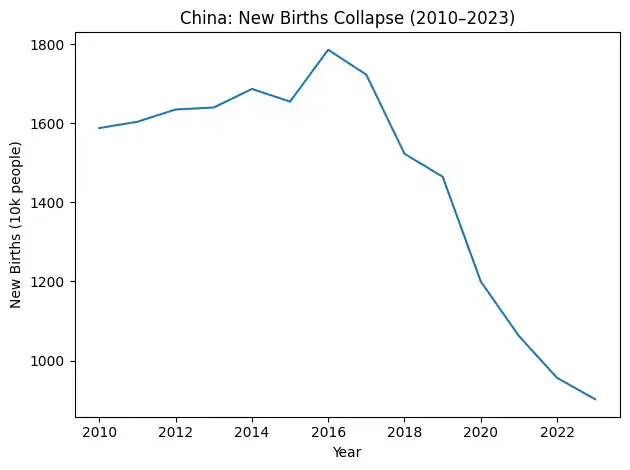
China's Birth Population Cliff (2010–2023)

Visually, what you see is not a "decline" but a clear cliff-like drop.

Taking China as an example:

  • 2016: approximately 17.86 million newborns

  • 2023: approximately 9 million newborns

  • 2025: expected to fall below 8 million

Halved in just 7 years.

What does this mean?

Those born in 2023 will enter the labor market around 2045: not "a bit fewer," but "half as many."

This is not a cyclical fluctuation but a structural collapse of the population.

More critically, this trend has been confirmed by long-term projections: according to the UN's "World Population Prospects 2022" report, China's working-age population (15–64 years) will decrease by approximately 170 million between 2020 and 2050.

In the past, business systems assumed: "People can always be hired; it's just a matter of price."

In the era of population deflation, the problem changes.

Delayed retirement, immigration, and birth subsidies are slow variables.

But business systems cannot wait twenty years.

This is precisely where all technological narratives begin to transform.

Attention and Creator Supply Shrink Simultaneously: Web2's Hidden Fatal Flaw

A declining young population brings not only a reduction in labor but also a more hidden, more fatal problem: Who will produce content, and who will consume it?

  • Declining number of content producers

  • Slower diffusion of new culture and narratives

  • Failure of platform traffic growth logic

Web2's reliance on the "user growth → traffic → advertising → commissions" model is essentially built on population expansion.

When new users no longer appear, platforms begin to compete internally, rules change frequently, and trust between creators and platforms collapses.

This is Web2's most difficult structural flaw to repair in the era of population deflation.

Systemic Collapse on the Long-Term Demand Side: Long-Termism Forced to Be Revalued

Real estate, education, long-term consumer goods, pension systems...

The commonality of these systems is: they all assume that there will be more people in the future.

When this assumption is broken, all "long-termist assets" will be repriced.

II. Why Is AI a Necessity in the Era of Population Deflation?
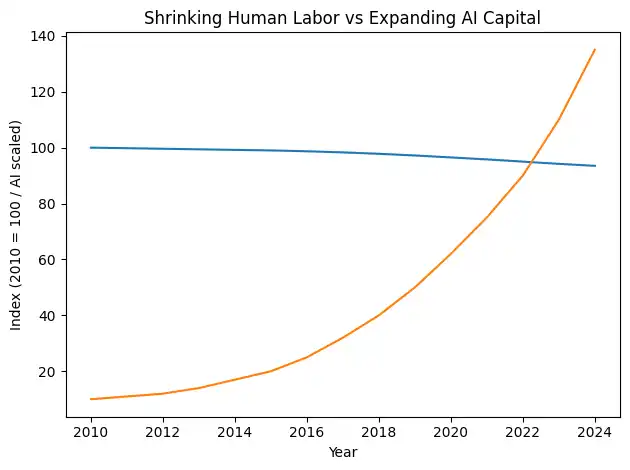
Human Labor Contraction vs. AI Capital Exponential Expansion

One side is a slow but certain decline, the other is exponential growth. The only "labor force" that can still expand is not human.

If population deflation changes the problem itself, then AI is becoming the only viable answer.

AI Is Not an Efficiency Tool but a "De-humanizing Tool"

We are accustomed to describing AI as an "efficiency tool."

But in the real world, it does not solve efficiency problems but a structural one: the system no longer needs so many people.

AI customer service, AI content generation, AI research assistants, AI trading systems - their significance is not to make people 20% faster but to remove "people" from the necessary conditions of the system.

In a population-deflated world, the real question is no longer: "Can we hire someone for this position?" but: "Does this环节 still require human participation?"

AI is not replacing inefficient people; it is rewriting the entire society's assumption of dependence on "human labor."

AI Is the Only Labor Force Capable of Exponential Growth

  • Population: Linear growth, even negative growth

  • AI: Computing power, models, data → Exponential expansion

This is also why, despite extreme macroeconomic uncertainty, capital still chooses to heavily invest in AI.

Because in the era of population deflation, only AI has the "ability to scale."

AI Allows the "Individual" to Become a Production Unit Again
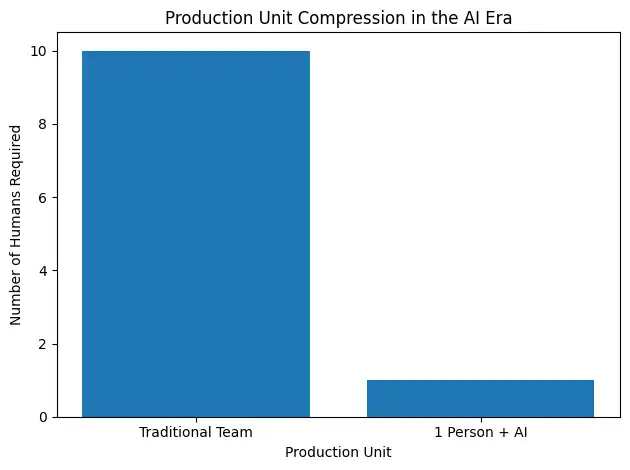
Production Unit Compression Diagram (Team → Individual + AI)

From a "10-person team" to "1 person + AI," production units are being rapidly compressed.

AI is giving rise to a new organizational form:

  • One-person companies

  • Super individuals

  • Solo Founders

  • AI Native creators

When society cannot mass-produce young people, the system can only choose to: amplify the individual.

III. What Role Does Web3 Play Here?

If AI solves "who will do the work," then Web3 solves a more fundamental problem:

In an era of fewer people, how do we collaborate, distribute, and build trust?

How to Collaborate at Low Cost in an Era of Fewer People?

DAOs, Permissionless collaboration, project-based contributions—

Web3 restructures "organizations" from long-term employment relationships into temporary, flexibly combinable collaboration networks.

When hiring people becomes increasingly expensive, trust and settlement must be automated.

How to Distribute Value in an Era of Fewer People?

In an era where labor becomes scarce, if value distribution is not transparent, the system will quickly lose participants.

Tokens, on-chain incentives, and instant settlement do not address "speculation" but a practical problem:

How to make scarce labor willing to stay and continue to build?

How to Build Long-Term Trust in an Era of Fewer People?

The younger generation's trust in long-term commitments is collapsing:

  • Distrust in pensions

  • Distrust that platforms won't change rules

  • Distrust in long-term incentives from centralized institutions

Smart contracts and on-chain rules essentially answer:

When there aren't enough people and not enough trust, can the rules execute themselves?

IV. Web3 + AI: The Complete Solution for the Era of Population Deflation

An increasingly clear judgment is forming: Web3 is not a competitor to AI but the institutional shell for the AI era.

What do AI Agents need?

  • Identity

  • Wallet

  • Autonomous transaction capability

  • Programmable rules

These are precisely the native capabilities of Web3.

In the near future, we may see:

  • AI-native companies

  • AI autonomous DAOs

  • AI-to-AI economic collaboration

In this system, humans may no longer be the largest group of economic participants.

V. Final Thoughts: What Does This Mean for the Individual?

For the individual, it is a harsh but real fact: you will no longer be lifted by the红利 of "population growth."

But it also意味着 new windows of opportunity:

  • AI amplifies individual productivity

  • Web3 allows individuals to directly participate in global systems

  • A world with fewer people is反而 more friendly to high-cognition, high-action individuals

If you are an investor/creator, here is actionable advice from Biteye:

For investors:

  • Population deflation is a 20–30 year-level certain variable, not macroeconomic noise

  • All business models relying on "population expansion" should be discounted valuations

  • Only three categories are truly worth long-term attention:

    • AI that can directly replace human labor

    • Tools that amplify individual productivity

    • Web3 infrastructure that operates in low-trust environments

For creators / individuals:

  • Stop assuming "the platform will give you long-term returns"

  • Try to turn yourself into:

    • A node that can be amplified by AI

    • A personal brand that can migrate across platforms

    • An independent production unit capable of direct settlement

After all, in the era of population deflation: the system will not take care of you, but the system needs you.

This is not an era of more and more people,

but an era where each individual must become stronger and stronger; and what you must rely on are AI and Web3.


İlgili Okumalar

From a $300 Million Valuation to a 'Fire Sale' at Tens of Millions: What Happened to Messari?

On June 12, leading crypto data and capital markets platform Blockworks announced its acquisition of competitor Messari for over $10 million. This price represents a significant discount from Messari's 2022 valuation peak of approximately $300 million, highlighting the survival pressures faced by high-valuation startups during the bear market and a consolidation wave in data infrastructure. Blockworks, founded in 2018, began as a media and events company but has pivoted to focus on institutional-grade data, investor relations, and compliance tools. Its recent Series A extension round, valuing the company at $192 million, aimed to fund this shift and strategic acquisitions like this one. Messari, also founded in 2018, grew as a go-to platform for professional crypto research and data, raising a $35 million Series B at its $300 million valuation in late 2022. However, the prolonged bear market and subsequent internal changes, including founder Ryan Selkis's departure in 2024, increased operational pressures. The acquisition integrates Messari's extensive data platform and API capabilities with Blockworks's strengths in issuer-side disclosure, investor relations, and compliance workflows. The combined entity aims to build a unified "system of record" for the on-chain market. This reflects a broader industry trend where high-quality, structured data is becoming critical for institutional adoption, AI agents, and creating data moats akin to traditional financial platforms like Bloomberg. The deal exemplifies how market consolidation is reshaping the fragmented crypto data landscape.

marsbit2 dk önce

From a $300 Million Valuation to a 'Fire Sale' at Tens of Millions: What Happened to Messari?

marsbit2 dk önce

If the AI Bubble Is Already Bursting, Who Will Truly Survive?

If the AI Bubble is Bursting, Who Will Remain? The debate over an AI bubble is intensifying, with figures like Ray Dalio warning of high levels and Jensen Huang seeing immense, early-stage opportunity. Both views hold truth: a speculative bubble in capital markets likely exists, mirroring the dot-com era, but the underlying technological shift is real and transformative. History shows that while bubbles burst—wiping out overvalued companies and speculative capital—they often leave behind critical physical and digital infrastructure. The dot-com bust, for instance, eliminated many firms but left the global fiber optic networks and data centers that enabled the rise of Amazon, Netflix, and cloud computing. Today's massive AI infrastructure investments (projected at trillions by 2030) in data centers, power, cooling, and GPUs may follow a similar path, creating the foundation for future applications. A key divergence from past bubbles is the "Jevons Paradox" effect in AI. As the cost of AI inference has plummeted by over 99.7% since 2023, enterprise spending on AI has skyrocketed. Cheap "tokens" have unlocked vast, previously uneconomical use cases, moving AI from simple chatbots into core business workflows—code generation, legal document review, scientific simulation, and financial analysis. The market is now in a phase of self-correction, weeding out superficial "API-wrapper" startups, but this cleansing process strengthens the ecosystem. The long-term trajectory is clear. The value is gradually shifting from capital expenditure (CapEx) on hardware to operational expenditure (OpEx) on transformative applications. As AI becomes a utility, the winners will be firms that deeply integrate it to solve vertical industry problems in law, healthcare, finance, and manufacturing. The泡沫 will recede, but the foundational shift towards an AI-powered era across all sectors is irreversible. The underlying productive force of AI contains no bubble.

marsbit34 dk önce

If the AI Bubble Is Already Bursting, Who Will Truly Survive?

marsbit34 dk önce

If the AI Bubble Is Already Bursting, Who Will Truly Remain?

**Summary: If the AI Bubble is Bursting, What Will Remain?** The debate around an AI bubble is intensifying, with figures like Ray Dalio warning of high valuations while Jensen Huang sees immense opportunity. This echoes the dot-com bubble, which saw massive wealth destruction but ultimately left behind critical infrastructure like undersea cables and broadband, enabling future giants like Amazon and Netflix. Similarly, today's AI boom involves trillions invested in data centers, power, cooling, and GPUs, while application-layer revenue remains comparatively modest. This investment-disparity signals a bubble. However, the core technological progress is real and accelerating. AI inference costs have plummeted by over 99.7% since 2023, making intelligence increasingly cheap and accessible. This cost collapse is unlocking vast new demand. Instead of reducing spending, enterprises are tripling their AI cloud expenditure. Cheap "tokens" enable AI to move beyond simple chatbots into complex workflows—automating code writing, legal document review, financial analysis, and scientific research. This follows "Jevons's paradox": improved efficiency leads to greater total consumption. The market is now undergoing a necessary purification, weeding out "API-wrapper" startups with no real moat. The deeper evolution involves a shift from capital expenditure (CapEx) on infrastructure to operational expenditure (OpEx) on value-creation in applications. While hardware vendors currently profit most, long-term value will migrate to AI-native firms solving vertical industry problems. Ultimately, a market correction will cleanse speculative excess but will not reverse the AI+ trend. The massive physical and algorithmic infrastructure being built will endure, becoming a cheap, utility-like foundation. Just as the internet became indispensable to all industries post-2000, AI is poised to empower and redefine every sector, moving society irreversibly toward an intelligence-augmented era. The bubble may burst, but the underlying productive momentum is solid.

链捕手41 dk önce

If the AI Bubble Is Already Bursting, Who Will Truly Remain?

链捕手41 dk önce

Microsoft CEO: In the AI Era, How Do You Define a Company's Moat?

Microsoft CEO Satya Nadella argues that in the AI era, a company's true competitive edge, or "moat," is not determined by choosing the single most powerful model, but by its ability to build a continuous "learning loop." This system integrates and evolves by connecting human workflows, domain expertise, organizational judgment, and employee experience. He posits that future companies will accumulate two types of capital: Human Capital (employee knowledge, judgment, creativity) and "Token Capital" (a firm's own built and owned AI capabilities). Importantly, AI amplifies rather than devalues human capital. Human direction is essential to guide progress, as computational power alone is aimless. The core opportunity lies in creating a closed-loop system where human and token capital reinforce each other in a compound, self-improving cycle. A company must be able to preserve its unique institutional knowledge—its "company veteran" expertise—even if it switches underlying general-purpose AI models. This requires private evaluation benchmarks, reinforcement learning environments based on internal data, and queryable knowledge bases. Nadella warns against a future where economic value is concentrated by a few dominant models that commoditize entire industries' knowledge. Instead, the priority should be building a broad "frontier ecosystem" where every company, industry, and nation can own its learning loop. This allows organizations to retain control of their intellectual property, amplify employee capabilities, and ensure the economic value created by AI is captured within their own businesses and communities. True corporate sovereignty in the AI age comes from turning organizational knowledge into a compounding system that creates enduring, defensible value.

marsbit1 saat önce

Microsoft CEO: In the AI Era, How Do You Define a Company's Moat?

marsbit1 saat önce

İşlemler

Spot
Futures

Popüler Makaleler

ERA Nasıl Satın Alınır

HTX.com’a hoş geldiniz! Caldera (ERA) satın alma işlemlerini basit ve kullanışlı bir hâle getirdik. Adım adım açıkladığımız rehberimizi takip ederek kripto yolculuğunuza başlayın. 1. Adım: HTX Hesabınızı OluşturunHTX'te ücretsiz bir hesap açmak için e-posta adresinizi veya telefon numaranızı kullanın. Sorunsuzca kaydolun ve tüm özelliklerin kilidini açın. Hesabımı Aç2. Adım: Kripto Satın Al Bölümüne Gidin ve Ödeme Yönteminizi SeçinKredi/Banka Kartı: Visa veya Mastercard'ınızı kullanarak anında Caldera (ERA) satın alın.Bakiye: Sorunsuz bir şekilde işlem yapmak için HTX hesap bakiyenizdeki fonları kullanın.Üçüncü Taraflar: Kullanımı kolaylaştırmak için Google Pay ve Apple Pay gibi popüler ödeme yöntemlerini ekledik.P2P: HTX'teki diğer kullanıcılarla doğrudan işlem yapın.Borsa Dışı (OTC): Yatırımcılar için kişiye özel hizmetler ve rekabetçi döviz kurları sunuyoruz.3. Adım: Caldera (ERA) Varlıklarınızı SaklayınCaldera (ERA) satın aldıktan sonra HTX hesabınızda saklayın. Alternatif olarak, blok zinciri transferi yoluyla başka bir yere gönderebilir veya diğer kripto para birimlerini takas etmek için kullanabilirsiniz.4. Adım: Caldera (ERA) Varlıklarınızla İşlem YapınHTX'in spot piyasasında Caldera (ERA) ile kolayca işlemler yapın.Hesabınıza erişin, işlem çiftinizi seçin, işlemlerinizi gerçekleştirin ve gerçek zamanlı olarak izleyin. Hem yeni başlayanlar hem de deneyimli yatırımcılar için kullanıcı dostu bir deneyim sunuyoruz.

488 Toplam GörüntülenmeYayınlanma 2025.07.17Güncellenme 2026.06.02

ERA Nasıl Satın Alınır

Tartışmalar

HTX Topluluğuna hoş geldiniz. Burada, en son platform gelişmeleri hakkında bilgi sahibi olabilir ve profesyonel piyasa görüşlerine erişebilirsiniz. Kullanıcıların ERA (ERA) fiyatı hakkındaki görüşleri aşağıda sunulmaktadır.

活动图片












