The Era of On-Chain Voting Is Here: Do Your Stocks Truly 'Belong' to You?

marsbit2026-04-10 tarihinde yayınlandı2026-04-10 tarihinde güncellendi

Özet

The era of on-chain shareholder voting is approaching, as Galaxy Digital (GLXY) pioneers the first-ever on-chain voting for a public company, scheduled for its 2026 annual meeting. This initiative, developed in partnership with fintech firm Broadridge on the Avalanche blockchain, aims to transform tokenized stocks from mere "digital IOUs" into full-fledged equity with complete voting and dividend rights. The move addresses a critical flaw in traditional finance exposed during the 2021 GameStop saga: the disconnect between nominal ownership and actual shareholder rights due to multi-layered intermediation. Broadridge’s solution enables direct, transparent, and immutable voting via digital wallets, eliminating inefficiencies and opacity in the current proxy system. Key features include multi-chain auditability, a streamlined voting interface, and real-time transparency, which could empower retail and institutional investors alike. While this innovation promises greater shareholder engagement and governance transparency, the IMF warns of potential risks, such as accelerated crisis propagation due to blockchain’s settlement speed. Widespread adoption still faces hurdles, including regulatory uncertainty, resistance from traditional financial intermediaries, and technical barriers for users. However, with major players like Nasdaq and Blackrock advancing tokenization efforts, on-chain voting could mark a significant step toward authentic ownership and shareholder-centric cap...

Remember the轰轰烈烈的"GameStop (GME) retail investors versus Wall Street" battle in 2021? At that time, countless retail investors bought GME through platforms like Robinhood, aiming to counter short-selling institutions. But a dramatic scene unfolded: multiple brokerages temporarily restricted buying, allowing only selling. Many angry investors questioned: I paid for these stocks, why can't I decide how to trade them? This exposed the rights gap between retail investors as "nominal holders" and "actual beneficiaries" in the traditional financial system.

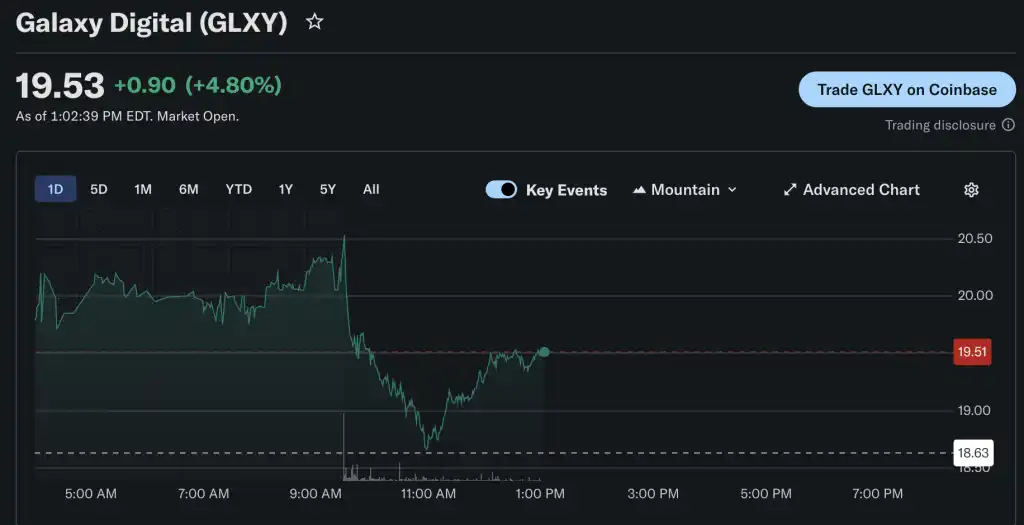
Today, a deeper transformation is taking place, one that could fundamentally solve this problem. Recently, led by cryptocurrency investment bank Galaxy Digital (GLXY), the world's first on-chain shareholder voting for a publicly traded company is set to occur at its annual meeting in May 2026. This is not just a technical experiment; it signifies that tokenized stocks are evolving from "digital replicas" into "true equity" with full shareholder rights, potentially reshaping the corporate governance landscape for decades to come.
From "Digital IOU" to "True Equity": The Coming of Age for Tokenized Assets

Over the past few years, we have witnessed the evolution of tokenized real-world assets (RWA) from concept to infrastructure. From U.S. Treasury bonds to real estate funds, various assets have been "moved" onto the blockchain. But tokenized stocks have long had an awkward "original sin": many were more like "digital IOUs" tracking stock prices or synthetic derivatives, with holders not enjoying core shareholder rights such as voting rights and dividend rights.

This might be unimportant for retail investors seeking stable returns, but for institutional investors bound by fiduciary duties (such as pension funds, mutual funds), it is a fatal flaw. They cannot invest client funds into a "pseudo-equity" without a voice. Therefore, tokenized stocks have long remained in niche trading scenarios, struggling to gain favor from mainstream institutions.

Galaxy Digital's collaboration with fintech giant Broadridge aims to pierce through this layer. Through a dedicated platform built on the Avalanche blockchain, holders of tokenized GLXY stock will be able to receive meeting materials and submit votes directly from their digital wallets. As Galaxy CEO and Wall Street legend Mike Novogratz stated: "Proxy voting is a core function of equity ownership. Enabling on-chain proxy voting for public companies is no longer a theoretical discussion."

This reminds me of my experience investing in certain Stock Connect (Hong Kong) targets. As a mainland investor, the process for participating in shareholder meeting votes was so cumbersome that it made one give up. The directness, transparency, and immutability brought by on-chain voting are the perfect remedy for such pain points.

Dissecting the "On-Chain Voting" Engine: How Transparency Defeats the "Black Box"?

Broadridge's solution is crucial because it directly addresses the core chronic problems of the traditional proxy voting system: opacity and inefficiency.

Under the current "street name" holding system centered around the Depository Trust Company (DTC), your stock may pass through multiple intermediaries like brokers, custodian banks, and clearinghouses before being registered. Your voting instruction is like a letter needing to be forwarded through multiple post offices; delays or losses at any point could prevent your voice from being heard at the shareholder meeting. Historically, cases of "vote reconciliation failure" due to this are not uncommon.

Broadridge's on-chain platform does three smart things:

  1. Direct Wallet Voting: Voting materials go directly to your digital wallet, and the voting action is completed on-chain. The path is the shortest, with no intermediaries to "cause trouble".
  2. Multi-Chain Auditing: Voting records are not stored on a single chain but are distributed across multiple chains for auditing. This is like storing meeting minutes simultaneously in a bank vault, a court archive, and the cloud. Anyone can trace and verify, greatly enhancing credibility.
  3. Unified Interface: Regardless of whether your stock is held via direct registration, through a broker, or in tokenized form, all voting data is aggregated in one interface. This solves the problem of rights fragmentation due to different holding methods.

According to data disclosed by Broadridge, its platform currently handles a monthly volume of tokenized assets reaching $8 trillion, processing over 70 billion investor communications annually. This is no longer a "small-scale test" but financial-grade infrastructure tested by massive transaction volumes. Its CEO Tim Gokey views precise and low-cost governance tools as a prerequisite for the large-scale institutional adoption of tokenized stocks, not an afterthought.

Opportunities and Undercurrents: When Corporate Governance Enters the "Live Broadcast Era"

The proliferation of on-chain voting will push corporate governance from "black box meetings" towards "transparent live broadcasts." Imagine the voting process for all major resolutions (like board elections, M&A deals, executive compensation) being real-time queryable and immutable. This would greatly reduce the information asymmetry that currently exists between registered shareholders and beneficial owners.

For active investors and activist shareholders, this is undoubtedly good news. They can more precisely aggregate voting power to drive strategic changes in companies. For listed companies, this is also a spur, forcing management to pay more attention to communication with all shareholders (especially small shareholders).

However, the International Monetary Fund (IMF) issued a sober warning in a recent report. It pointed out that tokenized finance could amplify financial crises by accelerating the transmission of market stress, as blockchain settlement speeds could outpace regulators' response times. This risk channel becomes more relevant when both governance and settlement functions migrate to shared blockchain infrastructure.

This is not alarmist. If a company's controversial resolution is quickly passed and executed via on-chain voting, market panic and selling could also spread at the speed of light. Therefore, programmable regulation (such as setting voting cooling-off periods, delayed settlement for large transactions) must develop in sync with technological innovation.

Future Outlook: Who Will Follow? What Are the Obstacles?

Galaxy Digital fired the first shot, but who is next? This is key to determining whether this transformation will be a "solo performance" or a "grand chorus."

Broadridge's platform is designed from the outset to support multiple issuers; it's not tailor-made for Galaxy. Nasdaq has received SEC approval to pilot a tokenized securities trading program, and the New York Stock Exchange is also partnering with Securitize to prepare for launching a digital trading platform. The infrastructure is falling into place.

But widespread adoption still faces obstacles:

  • Regulatory Clarity: Despite pilots, a comprehensive regulatory framework for on-chain securities issuance, trading, and governance is still under construction.
  • Traditional Interest Structures: The existing proxy voting, clearing, and settlement systems involve vast networks of interests, and change will inevitably meet resistance.
  • Technical Threshold and Security: Ordinary investors still need to learn to manage private keys and use wallets; security risks like smart contract vulnerabilities and wallet theft cannot be ignored.

From my personal market observation, since 2024, the scale of tokenized funds issued by asset management giants like BlackRock and Fidelity has continued to grow, indicating institutional capital is quietly entering the market in the form of "asset tokenization." This paves the way for "equity tokenization." Once a few benchmark tech or financial companies follow Galaxy's lead, creating a cluster effect, a tipping point could arrive quickly.

Conclusion: Your Investment, Your Rights

Ultimately, Galaxy Digital's on-chain voting experiment is about a most fundamental principle: the authenticity of ownership. In the digital age, what we invest in is not just a string of price codes, but should also be a clear, complete, and executable certificate of rights.

This transformation will not happen overnight; it will advance amidst applause, controversy, and磨合. But for every investor, it means that in the future, we might truly be able to participate more directly in the fate of the companies we invest in, as "owners." When every vote you cast is clearly recorded on-chain like an inscription, the capital market will have taken a major step towards the ideal of "shareholder primacy." Of course, while embracing new technology, we must also remain清醒 about the new risks that come with it—this is always the unerring rule of investing.


İlgili Sorular

QWhat is the core issue exposed by the GameStop (GME) event in 2021 regarding retail investors?

AThe event exposed the rights gap between retail investors as 'nominal holders' and 'beneficial owners' in the traditional financial system, where their ability to trade was restricted despite owning the shares.

QWhat significant milestone is Galaxy Digital (GLXY) achieving in 2026, and why is it important?

AGalaxy Digital is conducting the world's first on-chain shareholder voting for a public company in May 2026. This is important because it evolves tokenized stocks from mere 'digital replicas' into 'true equity' with full shareholder rights, potentially reshaping corporate governance.

QHow does Broadridge's on-chain voting platform address the problems of traditional proxy voting systems?

AIt addresses opacity and inefficiency by enabling direct voting from digital wallets (shortest path, no intermediaries), distributing voting records across multiple chains for auditability, and providing a unified interface to aggregate votes from different holding methods.

QWhat potential downside or risk does the IMF report highlight regarding tokenized finance and on-chain governance?

AThe IMF warns that tokenized finance could amplify financial crises by accelerating the transmission of market stress, as blockchain settlement speeds may outpace regulatory responses, especially when governance and settlement functions share the same infrastructure.

QWhat are some key obstacles to the widespread adoption of on-chain voting and tokenized securities?

AKey obstacles include the need for clearer comprehensive regulatory frameworks, resistance from existing traditional financial利益格局 (interest networks), and challenges like technical barriers for investors (e.g., managing private keys) and security risks (e.g., smart contract vulnerabilities).

İlgili Okumalar

Has Hook Summer Truly Arrived? sato, Lo0p, FLOOD Ignite the New Uniswap v4 Narrative

With the broader market showing signs of recovery, a new wave of interest has emerged around Ethereum-based meme coins. Following ASTEROID, tokens like sato, sat1, Lo0p, and FLOOD, built upon the Uniswap v4 Hook protocol, are capturing market attention. Their market capitalizations range from millions to tens of millions of dollars, injecting much-needed focused liquidity into a market lacking narratives. This article explores whether this trend signifies an incoming "Hook Summer" and its potential impact on UNI's price. Hooks are essentially plug-in smart contracts for Uniswap v4 liquidity pools, allowing developers to inject custom logic at key points in a pool's lifecycle (like initialization, adding/removing liquidity, swaps). This transforms the AMM into programmable building blocks. Key highlighted projects include: * **sato**: Peaked over $38M market cap. It utilizes a v4 curve for minting/burning; buying locks ETH as reserve to mint new tokens, while selling redeems ETH from the reserve and burns tokens. * **sat1**: Market cap briefly exceeded $10M, promoted as an "optimized sato," but later declined significantly. * **Lo0p**: Reached nearly $6.6M. It's a lending AMM protocol where buying LO0P tokens locks them as collateral, allowing users to borrow ETH from the pool reserve at 40% LTV, aiming to improve capital efficiency for idle ETH in LPs. * **FLOOD**: Peaked near $6M. Its mechanism directs asset reserves from buys into Aave v3 to generate yield, with fees and interest retained in the pool to potentially influence the token's price long-term. In the long term, the development of the Hook ecosystem can attract users and liquidity to Uniswap v4, benefiting UNI's fundamentals—especially combined with the recent activation of the protocol fee switch, where a portion of fees is used to burn UNI. However, in the short term, these Hook-based tokens are unlikely to directly drive significant UNI price appreciation. Their impact is moderated by factors like token sustainability, price volatility, and broader market and regulatory conditions. Currently, Uniswap v4's TVL ($595M) still trails behind v2 and v3, indicating adoption and growth will take time. The article concludes that while the Hook ecosystem provides long-term "nourishment" for UNI, its short-term role is more of a "catalyst" than a "booster." Readers are cautioned that these are early-stage experimental tokens and may carry unknown risks.

Odaily星球日报2 dk önce

Has Hook Summer Truly Arrived? sato, Lo0p, FLOOD Ignite the New Uniswap v4 Narrative

Odaily星球日报2 dk önce

Interview with Michael Saylor: I Did Say I Would Sell Bitcoin, But Never a Net Sale

Interview with Michael Saylor: I Said We'd Sell Bitcoin, But Never Be a Net Seller In a recent podcast, MicroStrategy Executive Chairman Michael Saylor clarified the company's stance on potentially selling Bitcoin. Following MicroStrategy's earnings call statement about being prepared to sell BTC to fund dividends for its STRC (Strategic) credit product, Saylor emphasized the distinction between selling and being a "net seller." Saylor explained the core business model: MicroStrategy sells credit instruments like STRC and uses the proceeds to buy Bitcoin, which is viewed as "digital capital" expected to appreciate around 30-40% annually. A portion of these capital gains can then be used to pay the dividends on the credit products. He stressed that even if the company sells some Bitcoin for dividends, it simultaneously buys much more with new credit issuance. For example, after raising $3.2 billion from STRC sales in April, the dividend obligation was only $80-90 million, making the company a net buyer. The clarification aims to counter market narratives questioning the value of Bitcoin on MicroStrategy's balance sheet if it were never sold, and to dismiss claims of a "Ponzi scheme." Saylor reiterated his personal philosophy for investors: "Don't be a net seller of bitcoin" and ensure your Bitcoin holdings increase each year. Saylor also discussed Bitcoin's role as the foundation for "digital credit," noting that STRC has become the largest and most liquid preferred stock issue in the U.S., offering high risk-adjusted returns (Sharpe ratio). He highlighted Bitcoin's deep liquidity, stating that even large purchases by MicroStrategy do not move the market significantly, which is driven by macro factors, geopolitical tensions, and capital flows from ETFs and credit products. Finally, Saylor reflected on his early inspiration from sci-fi books, which motivated his path to MIT, and maintained his fundamental thesis on Bitcoin remains unchanged: it is superior digital capital enabling superior digital credit.

链捕手6 dk önce

Interview with Michael Saylor: I Did Say I Would Sell Bitcoin, But Never a Net Sale

链捕手6 dk önce

Beaten SK Hynix Employees in China: Year-end Bonus Less Than 5% of Korean Staff's

"SK Hynix Chinese Staff Hit Hard: Bonuses Less Than 5% of Korean Counterparts" Driven by the AI boom, South Korea's SK Hynix is experiencing record performance, with media reports predicting massive year-end bonuses for its employees, making them highly desirable in the matchmaking market. However, this prosperity starkly contrasts with the situation for the company's Chinese employees. According to reports, SK Hynix operates under a rule allocating 10% of operating profit for employee bonuses. While projections suggest Korean employees could receive bonuses reaching millions of RMB, a Chinese employee with over a decade of technical experience revealed the disparity: "If they get 3 million, Chinese staff get less than 5% of that." After adjustments based on KPI ratings, this employee's highest bonus was slightly over 100,000 RMB. Bonuses are paid annually in Korea but semi-annually in China. During the industry downturn in 2023-2024, Chinese employees received no bonus at all. The gap extends beyond bonuses. Recruitment posts for SK Hynix's Chinese factories (in Wuxi, Dalian, Chongqing) show engineer monthly salaries ranging from 10,000 to 35,000 RMB, with a 13th-month salary promised. Chinese employees also receive standard benefits like annual leave but lack stock incentives, which are reportedly unavailable to them. Furthermore, management positions in China are predominantly held by Korean personnel, though industry observers note a gradual increase in local middle managers over time. SK Hynix has confirmed the 10% bonus rule but cautioned that specific future bonus amounts remain unpredictable. The company forecasts strong demand for HBM and other high-value enterprise products for the next 2-3 years, driven by AI infrastructure investment. This focus on business-to-business markets may continue to constrain supply for consumer products, potentially prolonging price increases for components like memory.

链捕手20 dk önce

Beaten SK Hynix Employees in China: Year-end Bonus Less Than 5% of Korean Staff's

链捕手20 dk önce

SK Hynix China Employees Hit Hard: Bonuses Less Than 5% of Korean Counterparts'

"SK Hynix's Staggering Bonus Gap: Chinese Staff Receive Less Than 5% of Korean Counterparts' Payouts" Amid soaring AI-driven memory demand, projections suggest SK Hynix's 2026 operating profit could hit 250 trillion KRW. Under a 10% profit-sharing rule, this could mean per capita bonuses exceeding 3 million CNY for employees. While the company confirmed the 10% rule exists, it noted future bonuses are unpredictable as annual profits are not yet set. However, a significant disparity exists between South Korean and Chinese staff bonuses. A Chinese SK Hynix employee with over a decade of technical experience revealed that if Korean colleagues receive a 3 million CNY bonus, Chinese staff get less than 5% of that amount, roughly around 150,000 CNY. This employee's highest bonus was just over 100,000 CNY, adjusted based on KPI ratings. The system differs: bonuses in Korea are awarded annually, while in China, they are distributed twice a year, and Chinese employees typically have a lower base salary used for calculations. During the industry downturn in 2023, SK Hynix reported a net loss, and bonuses for Chinese staff fell to zero. Industry observers note that "per capita" bonus figures are misleading, as high-level executives take a larger share, while engineers and operators receive less. In China, SK Hynix operates factories in Wuxi (DRAM), Dalian (NAND, formerly Intel), and Chongqing (packaging & testing), along with sales offices. Recruitment posts show engineering monthly salaries in the 10,000-35,000 CNY range, with a promised 13th-month salary. Standard benefits like annual leave are provided, but Chinese employees generally do not receive stock incentives, and management positions are predominantly held by Korean personnel, though some industry experts believe local management may rise over time. Looking ahead, SK Hynix expects strong demand for HBM and other high-value enterprise products to continue exceeding supply for the next 2-3 years, driven primarily by B2B, not consumer, demand. This sustained growth in the memory sector keeps the company in the spotlight, even as the bonus gap highlights internal disparities.

marsbit40 dk önce

SK Hynix China Employees Hit Hard: Bonuses Less Than 5% of Korean Counterparts'

marsbit40 dk önce

İşlemler

Spot
Futures

Popüler Makaleler

ERA Nasıl Satın Alınır

HTX.com’a hoş geldiniz! Caldera (ERA) satın alma işlemlerini basit ve kullanışlı bir hâle getirdik. Adım adım açıkladığımız rehberimizi takip ederek kripto yolculuğunuza başlayın. 1. Adım: HTX Hesabınızı OluşturunHTX'te ücretsiz bir hesap açmak için e-posta adresinizi veya telefon numaranızı kullanın. Sorunsuzca kaydolun ve tüm özelliklerin kilidini açın. Hesabımı Aç2. Adım: Kripto Satın Al Bölümüne Gidin ve Ödeme Yönteminizi SeçinKredi/Banka Kartı: Visa veya Mastercard'ınızı kullanarak anında Caldera (ERA) satın alın.Bakiye: Sorunsuz bir şekilde işlem yapmak için HTX hesap bakiyenizdeki fonları kullanın.Üçüncü Taraflar: Kullanımı kolaylaştırmak için Google Pay ve Apple Pay gibi popüler ödeme yöntemlerini ekledik.P2P: HTX'teki diğer kullanıcılarla doğrudan işlem yapın.Borsa Dışı (OTC): Yatırımcılar için kişiye özel hizmetler ve rekabetçi döviz kurları sunuyoruz.3. Adım: Caldera (ERA) Varlıklarınızı SaklayınCaldera (ERA) satın aldıktan sonra HTX hesabınızda saklayın. Alternatif olarak, blok zinciri transferi yoluyla başka bir yere gönderebilir veya diğer kripto para birimlerini takas etmek için kullanabilirsiniz.4. Adım: Caldera (ERA) Varlıklarınızla İşlem YapınHTX'in spot piyasasında Caldera (ERA) ile kolayca işlemler yapın.Hesabınıza erişin, işlem çiftinizi seçin, işlemlerinizi gerçekleştirin ve gerçek zamanlı olarak izleyin. Hem yeni başlayanlar hem de deneyimli yatırımcılar için kullanıcı dostu bir deneyim sunuyoruz.

412 Toplam GörüntülenmeYayınlanma 2025.07.17Güncellenme 2025.07.17

ERA Nasıl Satın Alınır

Tartışmalar

HTX Topluluğuna hoş geldiniz. Burada, en son platform gelişmeleri hakkında bilgi sahibi olabilir ve profesyonel piyasa görüşlerine erişebilirsiniz. Kullanıcıların ERA (ERA) fiyatı hakkındaki görüşleri aşağıda sunulmaktadır.

活动图片












