The Era of Encryption: The Boundary Between Payment and Investment Is Disappearing

marsbit2026-04-02 tarihinde yayınlandı2026-04-02 tarihinde güncellendi

Özet

The boundaries between payments and investment are dissolving in the age of programmable money. While payments represent a $2.5 trillion revenue stream driven by essential, daily transactions, investment management generates $850–900 billion from a much smaller, more passive user base. Payments are a universal financial behavior, whereas investing remains a luxury activity for a minority. Historically, these systems operated separately—with distinct infrastructure, products, and user experiences. However, blockchain technology now enables a unified account model: the same balance in a single application can simultaneously serve both payment and investment functions. This means funds can be used for transactions while also earning yield or participating in DeFi protocols, all within the same interface. This convergence allows users to benefit from both high-frequency, low-value payment activity and capital appreciation from investments without transferring between separate systems—a significant shift from traditional finance.

Written by: Jack Simison

Compiled by: Chopper, Foresight News

Payments and investments collectively generate $3 trillion in annual revenue, surpassing the total market capitalization of cryptocurrencies. They rely on entirely different user behaviors, completely different underlying infrastructures, and until today, they correspond to entirely different product systems. Here, I want to directly compare these two worlds.
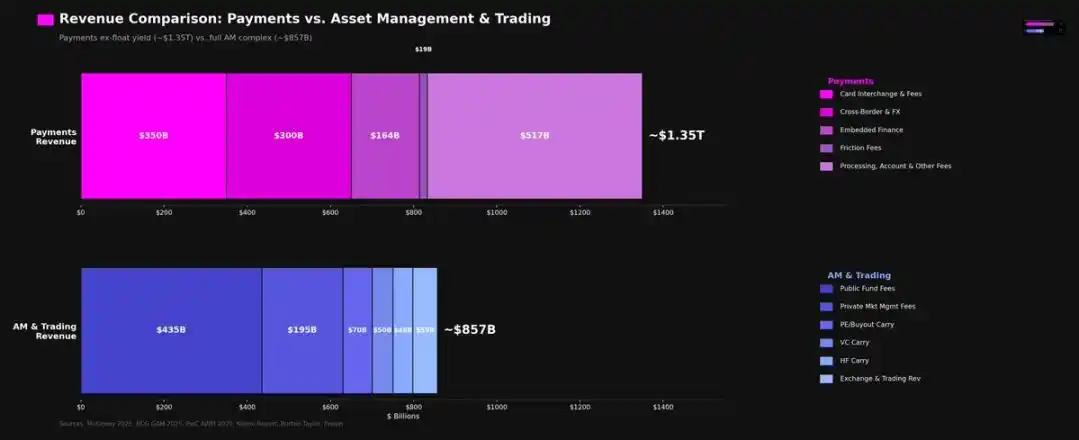
One sector earns money that everyone must pay—payment is a necessity for survival, a rigid demand. The other sector earns money that the majority of people will never choose to invest—investment is a luxury behavior.

Payment and investment management are the two largest revenue-generating areas in financial services. They have long operated within independent systems: different products, different accounts, different regulatory frameworks, and different interfaces. This is both a legacy of historical system architecture and because there was no practical need to integrate payments and investments in the past.

Programmable money is breaking down this barrier. The same balance, stored in the same wallet, blockchain, or application, can now participate in both revenue streams. The two worlds are converging in the form of unified accounts.

To understand why this is important, one must see the huge differences in their underlying behavioral logic.
Payment: A Universal Behavior

Payment is the only necessary financial behavior for participating in daily economic life. Buying food, paying rent, settling utility bills... without payment, one cannot survive.

In 2025, about two-thirds of adults globally made or received digital payments. In the United States, consumers complete about 48 payments per month; in India, UPI has over 500 million unique users; in Brazil, Pix has increased the average annual transactions per person to about 193; in parts of sub-Saharan Africa, mobile payments are no longer just a convenient payment method but a core component of the financial system.

Payment is not an optional financial activity for a minority of active people but a daily behavior for the masses. It is instant, high-frequency, with low psychological burden, and the cost is usually negligible. Consumers do not consciously calculate fees at the checkout counter. Compared to cash, digital payments reduce the pain of payment, further increasing usage frequency. The lower the friction, the higher the transaction volume.

This behavioral foundation brings enormous business coverage. According to McKinsey data, the global payment system processes about 3.4–3.6 trillion transactions annually, with an annual fund flow scale of about $1.8–2.0 quadrillion. Salary payments, merchant payments, cross-border remittances, bill payments, subscription services, personal transfers... at every step, intermediaries can take a cut.

Every layer of the payment chain is profiting from it.

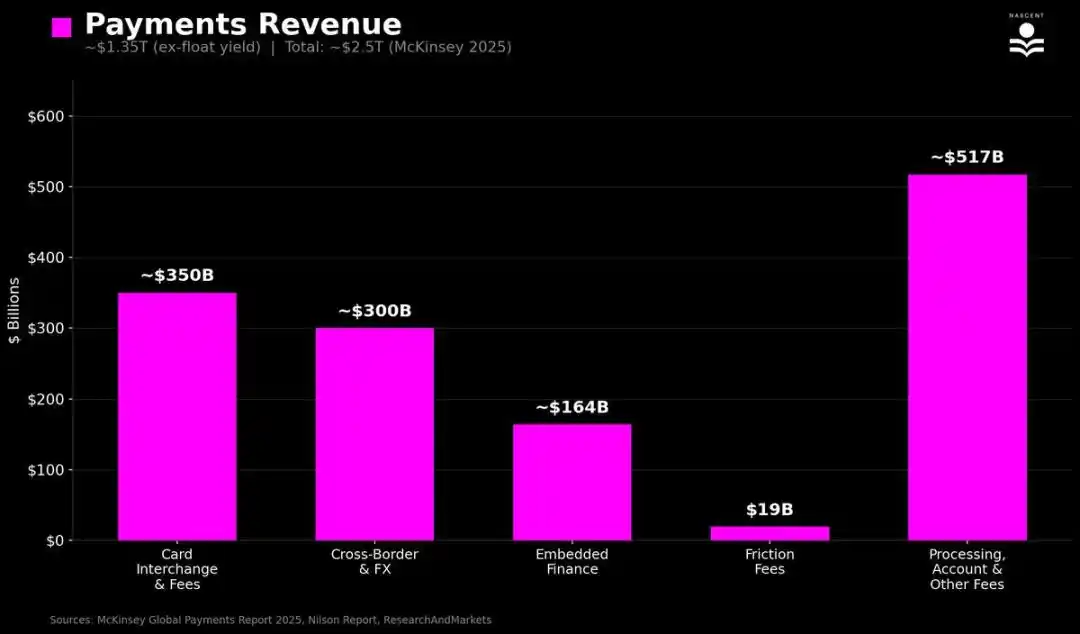
McKinsey's "2025 Global Payments Report" shows that global payment revenue is about $2.5 trillion. But nearly half of that (about $1.15 trillion) is net interest income: the earnings from idle funds in bank and payment accounts during transaction intervals. This is more like idle fund earnings rather than pure payment fees. Excluding this part, the core payment revenue from fund transfers, interchange fees, processing fees, embedded finance (Shopify, installment payments, Stripe), and friction charges (ATMs, overdrafts, on-chain fees) still amounts to about $1.35 trillion.
Investment: A Luxury Behavior

In contrast, investment is a financial behavior that no one is forced to undertake. A person can go through their entire economic life without buying stocks, opening a brokerage account, or consulting a financial advisor. Most people do just that. Active individual traders are statistically a minority.

Unlike payments, investment directly confronts loss aversion and carries a heavy cognitive burden. People instinctively avoid trading, so the funds of ordinary investors mostly lie in pension accounts, investment portfolios, ETFs, and index funds, bought and then held long-term without further action. Among those who participate in investment through pension accounts, 94% do not adjust their plans once joined and almost never trade.

The result is: the behavioral foundation of investment is narrow, passive, but extremely sticky.

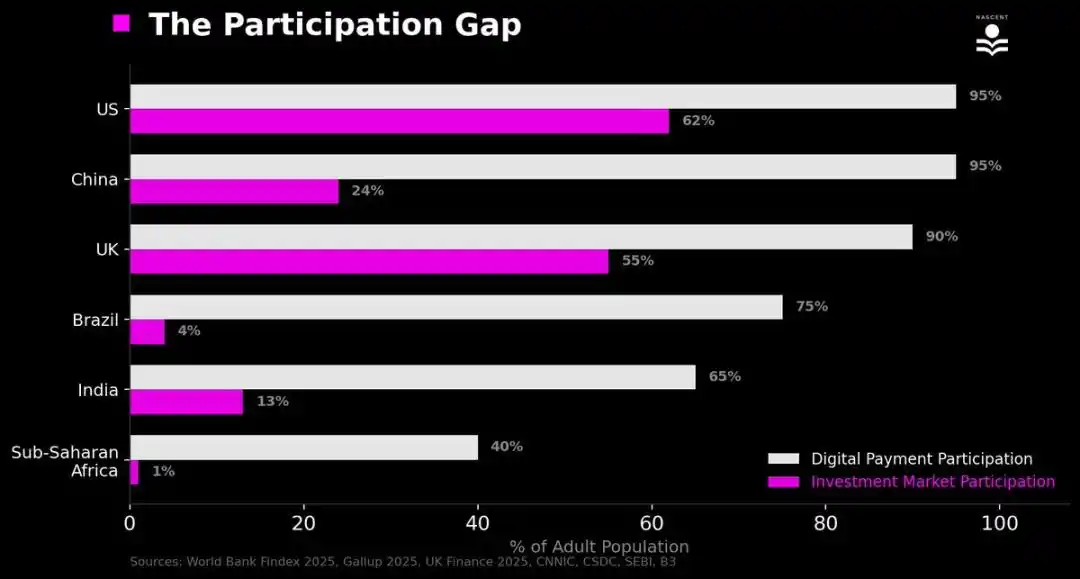
The participation rate comparison is telling: even in countries with the highest investment penetration, only about half the population participates in the investment market in some form, while digital payment penetration is as high as 95%.

  • United States: About 62% of adults hold some investment, mostly in rarely touched pension accounts
  • United Kingdom: Follows closely, about 55%
  • China: About 24% of adults have securities accounts
  • India: About 13%
  • Brazil: 4%
  • Sub-Saharan Africa: Only about 1%

Even having an account does not mean active operation.

This leads to a global asset management scale of about $147 trillion managed by professional intermediaries, including ETFs, mutual funds, pensions, and private market funds, accounting for 43% of global household financial wealth (about $305 trillion). The vast majority of this is passive index funds with extremely low fees: stock ETFs average only 14 basis points, bond ETFs 10 basis points. Even so, the global fund industry, managing about $135 trillion in assets, still has annual revenue of about $435 billion.

A minority of assets managed by private equity, venture capital, real estate, and hedge funds (about $13 trillion) charge 1%–2% management fees + 12.5%–20% performance fees, with annual revenue of about $363 billion.

Combining private market advisory fees, hedge fund performance fees, PE/VC carry, securities lending, trading commissions, etc., the total annual revenue of the investment industry is about $850–900 billion.
The overall revenue of the payment industry is still higher than that of investment, but the per capita revenue in the investment industry is much higher than in payments.

The Collapse of the Boundary

This asymmetric pattern has been stable for decades because the two fields have long operated in separate systems with independent infrastructures.

Payment business is scattered among banks, card networks, and payment processors. Asset management business is scattered among fund companies, wealth advisors, and pension platforms, while trading business is handled by brokerage firms.

Even if the same bank offers both checking accounts and investment services, they are packaged and operated as independent products, including separate customer registration, compliance processes, and user experience. The behavioral barrier between "spending money" and "investing" is further reinforced by the system.

The real change is that blockchain infrastructure allows modern payment applications to offer real investment services, and investment applications can offer real payment services, all using the same underlying system.

Investment balances can be directly used for payments without transferring through independent systems. The traditional brokerage process is: deposit funds → buy → sell → transfer to bank → spend. Crypto infrastructure compresses this into one step.

Wallets, neobanks, trading applications, or any programmable balance can allow the same dollar to complete cross-border transfer settlement while earning yield in a lending protocol, or be exchanged for other assets in the same interface, within the same operating session. Account holders can profit from both investment and payment ends simultaneously.

For the first time in history, the same balance, the same interface, can earn returns from both tracks at the same time.


İlgili Sorular

QWhat is the main argument of the article regarding the relationship between payments and investments in the crypto era?

AThe article argues that the boundary between payments and investments is disappearing due to programmable money and blockchain infrastructure, allowing the same balance in a unified account to simultaneously participate in both payment and investment activities, generating revenue from both sectors.

QAccording to the article, what are the key behavioral differences between payments and investments?

APayments are a universal, daily necessity for economic survival, characterized by high frequency, low psychological burden, and low cost. Investments, in contrast, are a luxury behavior that is not mandatory, with low participation rate, high cognitive burden, and passive, long-term holding patterns.

QHow does the revenue of the global payment industry compare to the investment management industry, as cited in the article?

AThe global payment industry generates approximately $2.5 trillion in annual revenue, with a core revenue of about $1.35 trillion after removing net interest income. The investment management industry has an annual revenue of about $850-900 billion, meaning the overall payment industry revenue is higher, but investment revenue per participant is much higher.

QWhat role does blockchain infrastructure play in merging payments and investments?

ABlockchain infrastructure enables modern payment applications to offer real investment services and vice versa, using the same underlying system. It allows an investment balance to be used directly for payments without transfers between independent systems, compressing multiple traditional steps into a single action within a unified interface.

QWhat does the article cite as the traditional reason for the separation between payment and investment systems?

AThe separation was a legacy of historical system architecture, with different products, accounts, regulatory frameworks, and interfaces for each. There was previously no practical need to integrate payments and investments, and the behavioral barrier between 'spending' and 'investing' was further reinforced by institutional structures.

İlgili Okumalar

Can DeepSeek Save China One Trillion Dollars?

"DeepSeek and the $1 Trillion Infrastructure Question" The article examines whether DeepSeek's AI optimization breakthroughs could potentially save China $1 trillion in future AI infrastructure costs. The analysis begins with Nvidia's upcoming Vera Rubin AI platform, costing ~$7.8 million, where memory (HBM4/LPDDR5X) constitutes $2 million—a 435% cost increase in one year, highlighting how AI hardware spending is shifting toward expensive memory components. DeepSeek's approach works in the opposite direction. Through three key technical innovations showcased in DeepSeek V4, the company dramatically improves hardware efficiency: 1. **Memory Compression (MLA)**: Re-engineers the attention mechanism to compress long-context memory (KV Cache) by over 90%, drastically reducing expensive HBM usage. 2. **Selective Activation (MoE)**: Employs Mixture-of-Experts architecture where only a small fraction of parameters (e.g., 49B out of 1.6T in V4-Pro) are activated per token, allowing most parameters to reside in cheaper memory/SSD. 3. **Computation Caching**: Reuses previously computed results via cache hits, replacing expensive GPU computations with cheap memory reads. Combined, these optimizations allow the same hardware to produce approximately 4x more tokens, effectively reducing required hardware investment by 75%. DeepSeek's pricing reflects this: a 10-billion token workload costs ~$522 monthly versus ~$9,000-$10,000 for competitors. The $1 trillion savings projection stems from McKinsey's estimate that global AI infrastructure will require ~$5.2 trillion investment by 2030. As China's daily token consumption grows toward quadrillions, even marginal efficiency gains scale massively. With a conservative 4x throughput improvement, China could avoid building tens of thousands of AI data centers equivalent to ~7 trillion RMB ($1 trillion) in saved investment. Critically, this strategy shifts dependency from scarce, expensive GPU/HBM—where China lags—toward more accessible storage, caching, and systems engineering where domestic suppliers like CXMT are gaining strength. Rather than "replacing Nvidia," DeepSeek rebalances AI's value chain away from monolithic hardware dependency. Ultimately, DeepSeek's technical breakthroughs could lower the barrier to AI adoption across Chinese industries by making advanced capabilities affordable at scale—transforming who can access next-generation AI.

marsbit47 dk önce

Can DeepSeek Save China One Trillion Dollars?

marsbit47 dk önce

Overturning the Mainstream Approach to Hallucinations: Metacognition is the New Solution for Large Models to Break the Hallucination Barrier

This paper, "Hallucinations Undermine Trust; Metacognition is a Way Forward," proposes a paradigm shift in combating AI hallucination. It argues that the current mainstream approaches—striving for omniscience by scaling data/models or having AI abstain from uncertain answers—are fundamentally flawed. The former has inevitable knowledge gaps, while the latter imposes a crippling "utility tax," requiring the rejection of many correct answers to achieve high accuracy, due to models' poor "discrimination" (the ability to distinguish correct from incorrect answers internally). The core contribution is redefining hallucination not as "being wrong," but as "expressing false information with unwarranted certainty." The proposed solution is **Faithful Uncertainty** or **Metacognition**: enabling AI to accurately perceive its internal uncertainty and honestly express it in its language (e.g., using hedging phrases when unsure). This creates a more reliable assistant that provides useful information while signaling its confidence, minimizing harm from errors. The paper emphasizes that metacognition is critical for the era of AI Agents. Without it, Agents cannot intelligently decide when to use tools like search engines, leading to inefficiency and misuse. Key implementation challenges are highlighted: the "bootstrapping paradox" of training with static uncertainty data, the "alignment distortion signal" where human preference training suppresses internal uncertainty cues, and the difficulty of causally evaluating true metacognition vs. its superficial imitation. The paper concludes that the goal should not be an infallible AI, but one that is honest about the limits of its knowledge, thereby building user trust through transparent communication of its certainty.

marsbit52 dk önce

Overturning the Mainstream Approach to Hallucinations: Metacognition is the New Solution for Large Models to Break the Hallucination Barrier

marsbit52 dk önce

Hedge by Buying Gold and Oil, Chase Soaring Returns with AI. ‘Dated’ Bitcoin Enters a Bear Market

Bitcoin has recently declined, hitting a two-month low near $66,123, while Ethereum fell to a three-month low around $1,837. Analysts suggest the drop is not merely due to factors like ETF outflows or MicroStrategy's selling but reflects a deeper issue: Bitcoin is losing a broader asset competition. In a near-zero interest rate environment, Bitcoin previously thrived as an outlet for investor dissatisfaction with inflation and limited options. However, the market landscape has shifted. Bitcoin now occupies an "awkward middle ground," facing competition on three fronts. For inflation hedging, investors prefer gold, energy stocks, and commodity producers—assets with tangible backing and clearer pricing power. For growth exposure, AI-related companies with actual revenues and profits are more attractive. Even within crypto, investors can choose stablecoins, exchanges, or infrastructure firms tied directly to adoption, offering clearer business models and leverage. Thus, Bitcoin is no longer the top choice for hedging, growth, or crypto exposure. This shift is evident in market reactions: despite recent warnings about persistent inflation from a Fed official, Bitcoin did not rally as it might have in the past. Instead, capital flowed to assets with direct commodity or energy exposure. The recent ETF outflows and MicroStrategy sales are symptoms, not causes, of this new reality. Investors are becoming more selective, demanding clearer value propositions beyond mere scarcity. The emerging bear case for Bitcoin is not about it being a bubble or failed technology, but that scarcity alone is no longer sufficient.

华尔街日报54 dk önce

Hedge by Buying Gold and Oil, Chase Soaring Returns with AI. ‘Dated’ Bitcoin Enters a Bear Market

华尔街日报54 dk önce

İşlemler

Spot
Futures

Popüler Makaleler

ERA Nasıl Satın Alınır

HTX.com’a hoş geldiniz! Caldera (ERA) satın alma işlemlerini basit ve kullanışlı bir hâle getirdik. Adım adım açıkladığımız rehberimizi takip ederek kripto yolculuğunuza başlayın. 1. Adım: HTX Hesabınızı OluşturunHTX'te ücretsiz bir hesap açmak için e-posta adresinizi veya telefon numaranızı kullanın. Sorunsuzca kaydolun ve tüm özelliklerin kilidini açın. Hesabımı Aç2. Adım: Kripto Satın Al Bölümüne Gidin ve Ödeme Yönteminizi SeçinKredi/Banka Kartı: Visa veya Mastercard'ınızı kullanarak anında Caldera (ERA) satın alın.Bakiye: Sorunsuz bir şekilde işlem yapmak için HTX hesap bakiyenizdeki fonları kullanın.Üçüncü Taraflar: Kullanımı kolaylaştırmak için Google Pay ve Apple Pay gibi popüler ödeme yöntemlerini ekledik.P2P: HTX'teki diğer kullanıcılarla doğrudan işlem yapın.Borsa Dışı (OTC): Yatırımcılar için kişiye özel hizmetler ve rekabetçi döviz kurları sunuyoruz.3. Adım: Caldera (ERA) Varlıklarınızı SaklayınCaldera (ERA) satın aldıktan sonra HTX hesabınızda saklayın. Alternatif olarak, blok zinciri transferi yoluyla başka bir yere gönderebilir veya diğer kripto para birimlerini takas etmek için kullanabilirsiniz.4. Adım: Caldera (ERA) Varlıklarınızla İşlem YapınHTX'in spot piyasasında Caldera (ERA) ile kolayca işlemler yapın.Hesabınıza erişin, işlem çiftinizi seçin, işlemlerinizi gerçekleştirin ve gerçek zamanlı olarak izleyin. Hem yeni başlayanlar hem de deneyimli yatırımcılar için kullanıcı dostu bir deneyim sunuyoruz.

473 Toplam GörüntülenmeYayınlanma 2025.07.17Güncellenme 2026.06.02

ERA Nasıl Satın Alınır

Tartışmalar

HTX Topluluğuna hoş geldiniz. Burada, en son platform gelişmeleri hakkında bilgi sahibi olabilir ve profesyonel piyasa görüşlerine erişebilirsiniz. Kullanıcıların ERA (ERA) fiyatı hakkındaki görüşleri aşağıda sunulmaktadır.

活动图片












