The Economist: The Real Threat of Cryptocurrency to Traditional Banks

深潮2025-12-16 tarihinde yayınlandı2025-12-16 tarihinde güncellendi

Özet

The Economist article "The Real Threat Cryptocurrency Poses to Traditional Banks" examines the escalating tensions between the traditional banking sector and the crypto industry. Despite both benefiting from a more favorable regulatory environment, especially following the passage of the GENIUS Act which provided a legal framework for stablecoins, a significant power shift is occurring. Banks' most immediate concern is regulatory arbitrage in stablecoins. Although the GENIUS Act prohibits issuers from paying interest to prevent deposit outflows, companies like Circle circumvent this by sharing revenue with exchanges, which then pay "rewards" to users. Banks are demanding this loophole be closed. Furthermore, crypto firms are breaking into the core of the financial system. In a landmark move, U.S. regulators granted national bank trust charters to five digital asset firms, including Circle and Ripple, allowing them to provide custody services nationwide. The collective impact of these developments poses a profound threat. The core of the banks' dilemma is their waning political influence. Crypto has firmly entrenched itself within the right-wing, anti-establishment political sphere, amassing a massive war chest for lobbying. Banks are no longer the most powerful financial voice in the Republican party. In a ironic twist, they now sometimes find themselves allied with Democratic senators and left-leaning groups who share concerns over stablecoin risks, proving that political...

Source: The Economist

Compiled by: Chopper, Foresight News

"First they ignore you, then they laugh at you, then they attack you, then you win." This phrase is often attributed to Mahatma Gandhi, but the leader of the Indian independence movement never actually said it. Nevertheless, this fabricated maxim has become a popular mantra in the cryptocurrency industry. The pioneers of digital finance once endured the arrogance, ridicule, and disdain of Wall Street elites, but now, their influence is stronger than ever.

The past year has been a period of bounty for both bankers and digital asset practitioners. The cryptocurrency industry's ability to gain a firm foothold is largely due to the GENIUS Act passed in July, which provided a clear legal basis for the legitimacy of stablecoins. Since Donald Trump won the election, market expectations of a more relaxed regulatory environment have caused bank stocks to rise by 35%. Even if some bankers dislike Trump for other reasons, very few of them favored the regulatory policies of the Joe Biden administration.

Despite this, tensions between the old and new forces are intensifying, and the threat posed by cryptocurrency is far more severe than many bankers once anticipated. While banks may benefit from regulatory loosening, their privileged status as the "financial aristocracy" within the Republican camp is now precarious. Sharing this status with the nouveau riche of the cryptocurrency industry undoubtedly represents a long-term threat to traditional banks.

The most pressing concern for bankers currently is the regulation of stablecoins. The GENIUS Act explicitly prohibits stablecoin issuers from paying interest to purchasers. This compromise clause was originally intended to prevent stablecoins from siphoning off bank deposit demand, thereby weakening banks' lending capacity. However, a regulatory workaround has emerged in the market: stablecoin issuers, represented by Circle, the issuer of USDC, share the proceeds with cryptocurrency exchanges like Coinbase, which then distribute "rewards" to users who purchase stablecoins. Traditional banks are strongly demanding that this regulatory loophole be closed.
The interest issue is not the entirety of their disagreement. In other areas, cryptocurrency is also attempting to break through the barriers to entry in traditional finance. In October, Christopher Waller, a Federal Reserve Governor and candidate for Fed Chair, suggested that more institutions might be allowed access to the Federal Reserve's payment system, a statement that alarmed bankers. However, Waller later walked back these comments, stating that applicants for such Fed accounts would still need to hold a bank charter.

Finally, on December 12th, the cryptocurrency industry successfully pried open the door to the U.S. federal banking system. U.S. banking regulators approved applications for national bank trust charters from five digital finance companies, including Circle and Ripple. Although this qualification does not grant these institutions the authority to accept deposits or conduct lending businesses, it allows them to provide asset custody services nationwide without relying on state-level approvals. Previously, banks had lobbied regulators intensely against granting new charters to these companies.

Individually, each development—a speech, a bank charter, a certain regulatory workaround for stablecoin issuers—might seem insignificant. But taken together, these movements pose a serious threat to traditional banks. In fact, the core position of traditional banks in lending and brokerage has already been eroded by private credit institutions and new market makers outside the banking system. They are naturally reluctant to lose more ground.

Cryptocurrency firms argue that the preferential policies enjoyed by traditional banks create an unfair competitive environment and harm market competition. This argument may have its merits, but paying interest on stablecoins under the guise of "rewards" is undoubtedly a blatant attempt to circumvent regulation. The fact that lawmakers who voted to ban stablecoin interest payments just months ago are not stepping in to stop such behavior precisely reveals the real dilemma traditional banks face: their political influence has significantly declined.

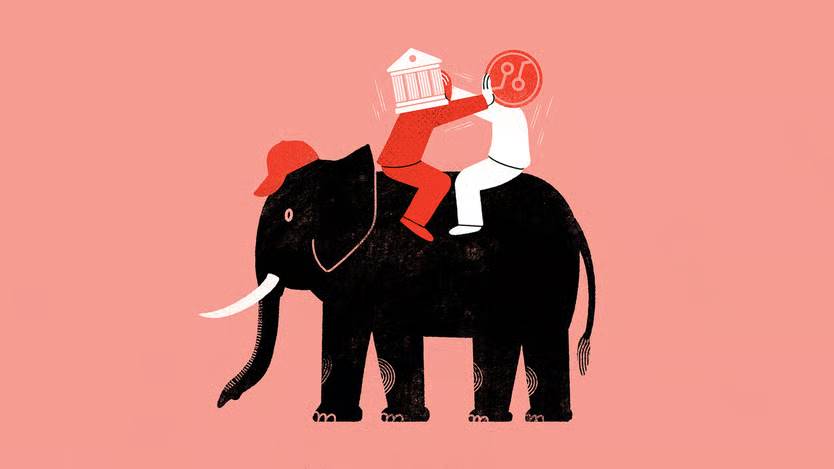
Traditional banks are no longer the most influential financial force within the Republican camp. Instead, the cryptocurrency industry has firmly established itself within the American right's "anti-establishment, anti-elite" political faction. The industry's largest political action committee, armed with hundreds of millions of dollars, is ready to invest in the 2026 midterm elections, and money has always been a powerful weapon in political games. Now, when the interests of traditional banks conflict with those of the cryptocurrency nouveau riche, the outcome of the game is no longer a foregone conclusion, and may no longer even favor the traditional banks.

There was a time when bankers complained about the stringent regulations of the Biden administration. Ironically, however, they now find themselves relying on the support of a group of Democratic senators. These Democratic lawmakers are more concerned about the potential risks of stablecoins circumventing interest payments and the associated money laundering dangers. In opposing cryptocurrency firms obtaining bank charters, America's largest banks have even formed an alliance with labor unions and center-left think tanks. As in another saying never actually uttered by Gandhi: "The enemy of my enemy is my friend."


İlgili Sorular

QWhat is the main threat that cryptocurrencies pose to traditional banks according to The Economist article?

AThe main threat is that cryptocurrencies are eroding the privileged status of traditional banks as the dominant financial force, particularly within the Republican political camp, and are successfully challenging them through new regulations, licenses, and circumvention of rules like the stablecoin interest ban.

QWhat was the significance of the GENIUS Act passed in July for the crypto industry?

AThe GENIUS Act provided a clear legal framework for the legitimacy of stablecoins, which was a major factor in helping the cryptocurrency industry establish a firm footing.

QHow are stablecoin issuers like Circle circumventing the GENIUS Act's ban on paying interest to purchasers?

AStablecoin issuers share the revenue from the assets backing the stablecoins with cryptocurrency exchanges, such as Coinbase, which then distribute 'rewards' to users who purchase the stablecoins, effectively paying interest under a different name.

QWhat major milestone did the cryptocurrency industry achieve on December 12th regarding the US banking system?

AOn December 12th, US banking regulators approved national bank trust charter applications for five digital finance companies, including Circle and Ripple, allowing them to provide custody services nationwide without needing state-by-state approval.

QWhy does the article suggest that traditional banks' political influence has waned?

ATheir political influence has waned because the cryptocurrency industry has become a powerful financial force within the right-wing, anti-establishment political camp, boasting a massive political action committee with hundreds of millions of dollars, making political outcomes in conflicts between banks and crypto firms no longer a foregone conclusion in the banks' favor.

İlgili Okumalar

From South Korea to the United States: Blue-Collar Jobs Are Becoming Increasingly Popular, Thanks to AI

AI is reshaping the labor market's value proposition. The traditional four-year college degree is losing its appeal as a guaranteed career path, while skilled blue-collar trades like electricians, welders, and plumbers are experiencing historic demand and wage premiums. This shift is driven by dual pressures: AI's displacement of certain white-collar roles and a booming need for physical infrastructure and data center construction. Data confirms the trend. In the U.S., vocational school revenue surged, and a significant portion of recent layoffs are AI-related. Surveys show a majority of Gen Z adults plan to pursue blue-collar work, citing better job security against AI automation. Vocational education interest has exploded recently. Experts cite a psychological shift as younger generations seek tangible, AI-resistant careers and avoid high student debt. In many cases, salaries for skilled trades now match or exceed those requiring a bachelor's degree. In South Korea, semiconductor vocational high schools boast near-total employment, with graduates securing high-paying roles at companies like Samsung. The shortage is structural, exacerbated by a retiring baby boomer workforce and massive infrastructure projects. Companies like JPMorgan Chase, Meta, and Lowe's are investing heavily in training programs. However, overcoming historical stigma and a "perception gap" around trade careers remains a key challenge to closing the talent gap.

marsbit1 saat önce

From South Korea to the United States: Blue-Collar Jobs Are Becoming Increasingly Popular, Thanks to AI

marsbit1 saat önce

Qualcomm: AI Hype Subsides, When Will Smartphones Emerge from the Gloom?

Qualcomm reported its Q3 FY2026 results (ending June 2026), with revenue of $9.95B, down 4% YoY but above expectations. Gross margin declined to 53.1%, pressured by rising costs across manufacturing and memory. Key business segments showed mixed performance: Handset revenue fell 19.6% YoY to $5.09B, dragged by an 11% decline in non-Apple Android shipments and weaker high-end mix. Conversely, Automotive revenue surged 61% to $1.59B, and IoT grew 9% to $1.83B. Core operating profit dropped 41% YoY due to margin compression and higher expenses. Management's Q4 FY2026 guidance projects revenue of $9.7B-$10.5B, in line with consensus, but Non-GAAP EPS guidance of $2.05-$2.25 fell short of expectations. Amidst persistent weakness in its core handset market, Qualcomm is pursuing growth in AI, focusing on Edge AI (smartphones, PCs, automotive) and Data Center AI. Its data center strategy includes four pillars: AI accelerators (e.g., AI200), commercial CPUs (Dragonfly C1000), custom silicon, and connectivity solutions. While these initiatives initially boosted its stock, concerns over AI capital expenditure sustainability have since erased those gains. The company targets $5B in data center revenue for FY2027 and $15B for FY2029. The report concludes that with the traditional handset business still under pressure, the data center opportunity is currently viewed as a longer-term option, and a more conservative valuation based on core operations may be warranted until AI contributions materialize.

marsbit1 saat önce

Qualcomm: AI Hype Subsides, When Will Smartphones Emerge from the Gloom?

marsbit1 saat önce

From TPU to Self-Evolving Agents: How Jeff Dean Predicts the Next Step in AI

At the 2026 YC Startup School, Jeff Dean outlined his vision for AI's next phase, shifting focus from simply scaling models to building intelligent, autonomous systems. He believes AI's progress is no longer just about creating smarter models, but about integrating them into systems capable of long-term, iterative work, automated experimentation, and continuous learning. This evolution moves the competition from "who has the bigger model" to "who can best organize intelligence." Dean suggests AI capabilities are now comparable to a junior engineer, enabling the automation of complex workflows. However, the true challenge and opportunity lie in managing these AI "workers" at scale. He emphasizes the importance of **context engineering**—structuring tools, memory, and feedback loops—over raw model power. For startups, this means building deep expertise in niche domains where general models currently fail (near 0-1% success rates), leveraging proprietary data, specialized tools, and domain-specific evaluators. A recurring theme is re-examining fundamental constraints. Dean's past work, like moving Google's search index to memory or creating the TPU, stemmed from questioning outdated assumptions about hardware and cost. He sees similar inflection points today, particularly in **specialized inference hardware** to drastically reduce latency and energy consumption for real-time Agent operation. Notably, he points out that in modern AI systems, the dominant cost is often not computation but **data movement**. Reliable, long-running Agents require robust system design, borrowing concepts from distributed computing like checkpointing, state management, and parallel exploration to handle failures and maintain progress over days or weeks. As AI automates execution, the scarcest human skills will shift to **defining clear specifications**, **judging what problems are worth solving** (taste), and designing effective feedback loops. Ultimately, Dean's framework prioritizes understanding the problem deeply, identifying the true bottlenecks, and systematically building closed-loop systems where AI can not only perform tasks but also improve AI itself.

marsbit1 saat önce

From TPU to Self-Evolving Agents: How Jeff Dean Predicts the Next Step in AI

marsbit1 saat önce

İşlemler

Spot
活动图片




