The Door to Offshore Stablecoins Quietly Closes Amid the Vision of RMB Internationalization

比推2026-02-12 tarihinde yayınlandı2026-02-12 tarihinde güncellendi

Özet

China's recent regulatory crackdown has effectively closed the door on offshore issuance of yuan-pegged stablecoins, dealing a significant blow to Hong Kong’s ambitions to become a digital asset hub. The new rules, announced on February 7, explicitly prohibit domestic institutions from issuing digital tokens overseas without approval, citing concerns over monetary sovereignty. This move dashes earlier market expectations of a policy thaw in China’s stance toward digital assets, particularly after PBOC Governor Pan Gongsheng’s earlier comments about the yuan challenging dollar dominance. Industry observers note that the tightening was foreshadowed as early as August 2024, when Chinese authorities began restricting stablecoin-related research and promotional events. The latest policy removes any ambiguity around private yuan stablecoin issuance and reinforces capital control priorities. As a result, firms that had planned to apply for stablecoin licenses in Hong Kong—including Ant Group and JD.com—are now expected to focus solely on Hong Kong dollar-pegged stablecoins, if they proceed at all. Market data reflects the dampening effect: open interest in Bitcoin perpetual futures has fallen roughly 50% since October, and investors have withdrawn approximately $3.3 billion from U.S. Ethereum ETFs since last fall. The regulatory shift underscores the fundamental tension between China’s capital controls and the borderless nature of crypto innovation, forcing industry players to con...

Author: Suvashree Ghosh, Bloomberg

Compiled by: Saoirse, Foresight News


Editor's Note: Recently, the global cryptocurrency market has continued to slump, and China has once again tightened regulations on cryptocurrencies and stablecoins, explicitly prohibiting the issuance of RMB-pegged stablecoins overseas without approval, directly impacting the progress of Hong Kong's digital asset hub construction. This article focuses on the market reaction and industry impact after the policy implementation, revealing the core contradiction between capital controls and crypto innovation. Against the backdrop of intensified industry reshuffling and accelerated capital withdrawal, the crypto sector is returning to pragmatic development. The regulatory boundaries and future direction are worth continuous attention.
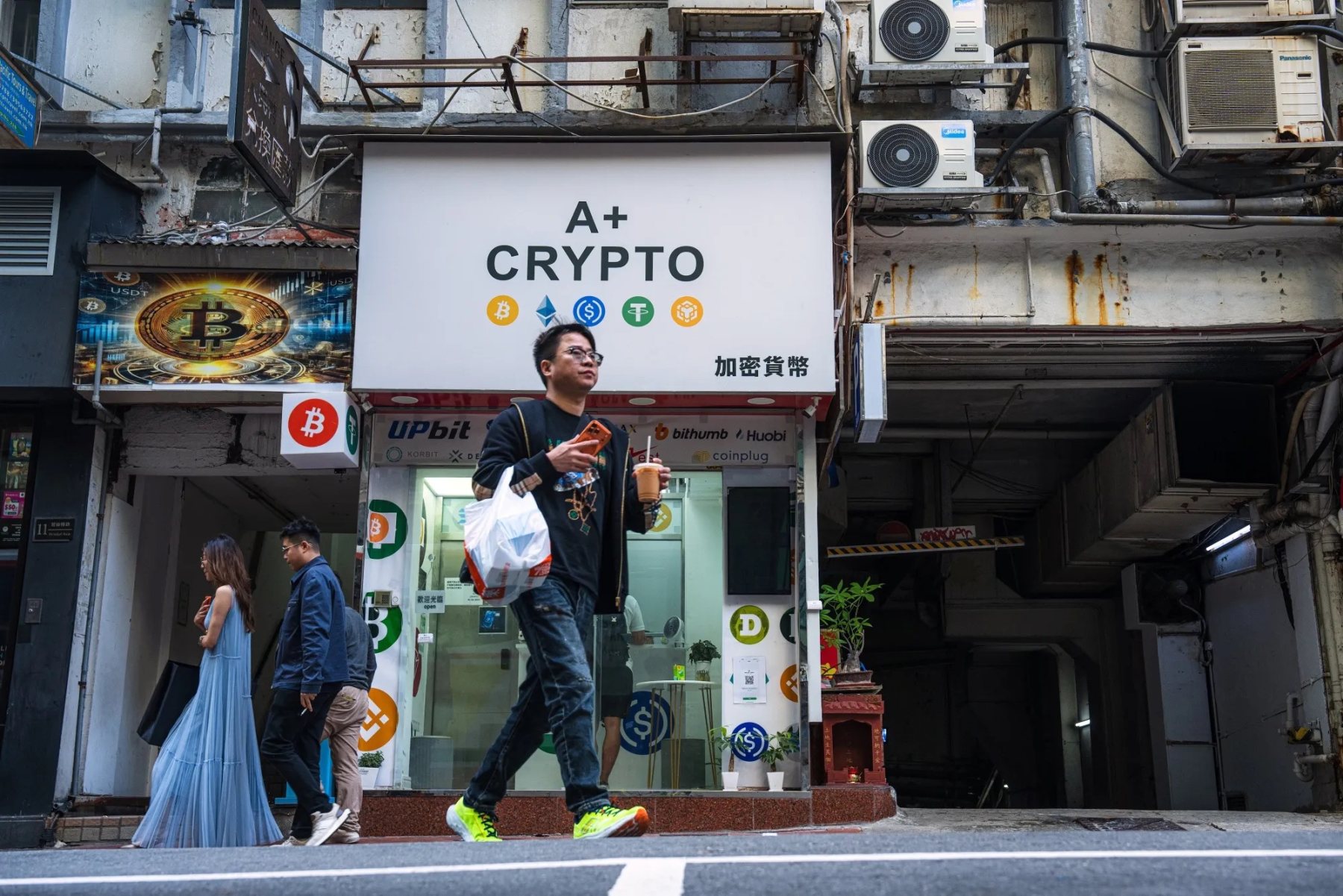
November 26, 2025, a cryptocurrency exchange storefront in Hong Kong. Photo: Lam Yik/Bloomberg

Setback in the Digital Realm

Last year, an increasing number of crypto industry commentators believed that China's stance on the digital asset sector might be softening.

After People's Bank of China Governor Pan Gongsheng proposed the vision that the RMB has the potential to challenge the dominance of the US dollar, market talk of a "policy thaw" kept emerging.

But on February 7th, all these expectations came to an abrupt halt.

Amid the latest round of cryptocurrency crash, China tightened regulations on cryptocurrencies and the tokenization of physical assets, prohibiting domestic institutions from issuing digital tokens overseas and banning the issuance of RMB-pegged stablecoins abroad without approval. Officials stated this move was to prevent monetary sovereignty risks.

Angela Ang, Head of APAC Policy and Strategic Partnerships at blockchain intelligence firm TRM Labs, said: "China's attitude towards stablecoins has been tentative at best and has cooled significantly in recent months."

She stated that the central bank's latest announcement "completely dashes any hope for the launch of an offshore RMB stablecoin in the short term — certainly not in Hong Kong, and most likely not elsewhere either."

For Hong Kong and its years-long goal of building a digital asset hub, this is a major setback.

In June last year, Hong Kong's Secretary for Financial Services and the Treasury, Christopher Hui, had said that, subject to regulatory requirements, the possibility of pegging Hong Kong stablecoins to the RMB was not ruled out. It is now widely believed that he will shut this door completely.

Surge in USD Stablecoin Supply During Trump Administration
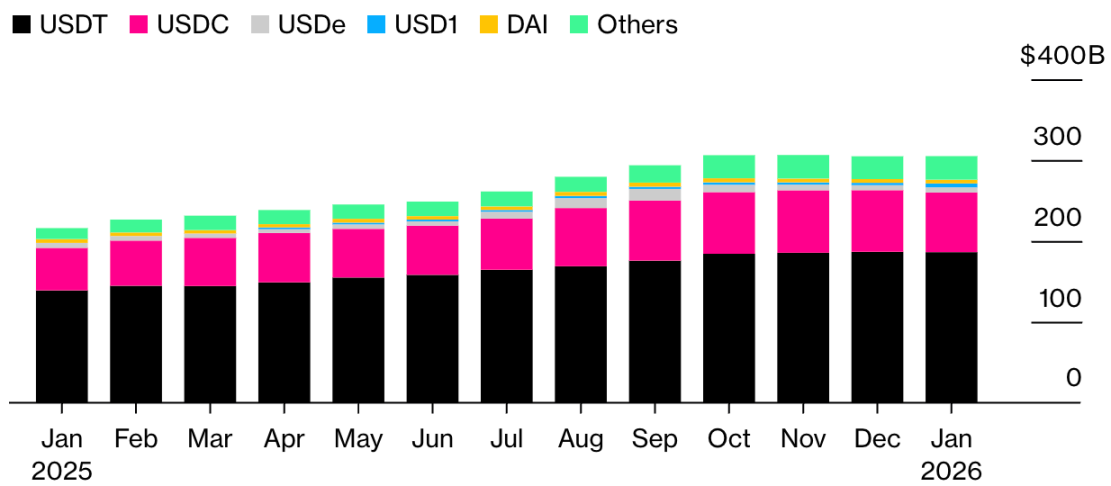
Source: Artemis Analytics

As Angela Ang mentioned, signals of this regulatory tightening had already emerged.

As early as last August, China had required local securities firms and related institutions to stop publishing stablecoin research reports and hosting related promotional seminars to curb overheated market sentiment.

Patrick Tan, General Counsel at blockchain intelligence firm ChainArgos, said last week's policy announcement "removes the uncertainty hanging over the market regarding the private issuance of RMB stablecoins. Issuers now know exactly where the red lines are."

Entities applying for licenses can only focus on issuing stablecoins pegged to the Hong Kong dollar.

Bloomberg News previously reported that up to 50 companies in Hong Kong planned to apply for stablecoin licenses last year, including tech giants Ant Group and JD.com. But according to an October report by the Financial Times, these companies were forced to suspend their stablecoin plans after intervention from Beijing.

Ant Group and JD.com did not respond to requests for comment.

As of this Tuesday, Hong Kong had issued licenses to 11 cryptocurrency exchanges, while approving 62 companies to conduct digital asset trading for clients. The list includes China-backed institutions such as CMB International Securities Limited, Guotai Junan Securities (Hong Kong) Limited, and Tinful Futures Limited.

But industry players worry that without access to the RMB, the entire setup might be in vain.

"The issue was never about Hong Kong's regulatory framework, but always about whether China would tolerate RMB-denominated instruments circulating outside its control," Patrick Tan said, adding, "Capital controls and stablecoin liberalization are fundamentally incompatible."

Market Data Continues to Weaken

Bitcoin Perpetual Futures Open Interest Continues to Decline
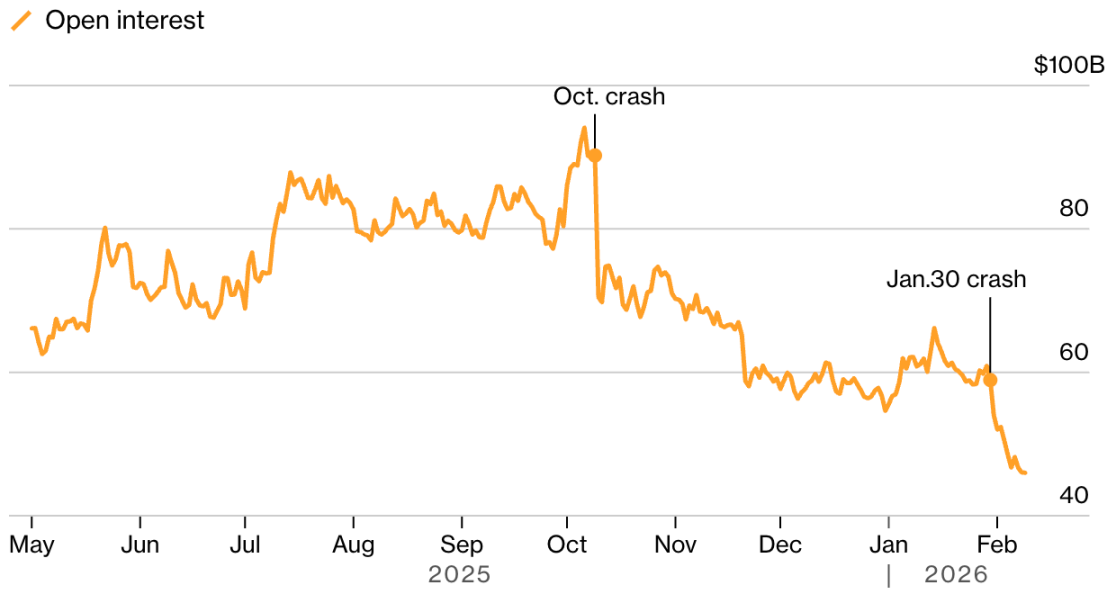
Source: Coinglass

Bitcoin perpetual futures open interest has failed to rebound since starting to decline last October, highlighting the lack of confidence supporting this rally. Data from Coinglass shows it has fallen by about 50% from the October high.

Capital Outflow: $3.3 Billion

Data compiled by Bloomberg Intelligence shows that investors have withdrawn approximately $3.3 billion from US Ethereum ETFs since the crash in early October, with over $500 million withdrawn this year. Data shows that Ethereum ETF assets have fallen below $13 billion, the lowest level since last July.

Industry Perspectives

"The market is consolidating around what actually works. Even well-funded crypto-native VCs are pivoting heavily into fintech, stablecoin businesses, and prediction markets; it's hard to get attention for anything else."

— Santiago Roel Santos, Founder and CEO of crypto private equity firm Inversion

Venture capital funds in the crypto industry are shifting their focus to better-performing areas, such as stablecoin infrastructure, on-chain prediction markets, and expanding into related adjacent fields.


Twitter:https://twitter.com/BitpushNewsCN

BitPush TG Discussion Group:https://t.me/BitPushCommunity

BitPush TG Subscription: https://t.me/bitpush

Original link:https://www.bitpush.news/articles/7611508

İlgili Sorular

QWhat was the key regulatory change announced by China regarding stablecoins on February 7th?

AChina tightened regulations on cryptocurrencies and tokenization of real-world assets, prohibiting domestic institutions from issuing digital tokens overseas and banning the issuance of RMB-pegged stablecoins abroad without approval to prevent monetary sovereignty risks.

QHow did Angela Ang from TRM Labs describe China's attitude towards stablecoins and the possibility of offshore RMB stablecoins?

AAngela Ang stated that China's attitude towards stablecoins was tentative at best and had cooled in recent months, and the announcement completely dashed any hopes of launching offshore RMB stablecoins in the near future, especially in Hong Kong and likely elsewhere.

QWhat impact did the new regulations have on Hong Kong's ambitions to become a digital asset hub?

AThe new regulations were a significant setback for Hong Kong's goal of becoming a digital asset hub, as they effectively closed the door on the possibility of issuing RMB-pegged stablecoins, forcing companies to focus only on Hong Kong dollar-pegged stablecoins.

QAccording to Patrick Tan from ChainArgos, what is the fundamental conflict between capital controls and stablecoin liberalization?

APatrick Tan stated that capital controls and stablecoin liberalization are fundamentally incompatible, as the issue was never about Hong Kong's regulatory framework but whether China would tolerate RMB-denominated instruments circulating outside its control.

QWhat trend did Santiago Roel Santos, CEO of Inversion, observe in crypto venture capital investments?

ASantiago Roel Santos noted that crypto-native venture capital firms are consolidating around areas that actually work, such as stablecoin infrastructure and on-chain prediction markets, and are expanding into adjacent areas, while other sectors struggle to attract attention.

İlgili Okumalar

Must-Watch Events Next Week|CLARITY Act Could Face Senate Vote; SpaceX, Circle to Report Earnings (8.3-8.9)

**Summary: Key Events and Developments to Watch (August 3-9)** The upcoming week is marked by significant financial disclosures, key legislative deadlines, and notable product updates. **Major Financial Events:** Several companies are scheduled to release their Q2 2026 earnings. American Bitcoin (ABTC) will report on August 3, followed by SpaceX and Hut 8 Mining Corp. on August 4, and Circle on August 5. Notably, a significant portion of SpaceX shares (up to 12% of total shares) will be unlocked on August 6 following their earnings release. **Key Legislative Deadline:** The U.S. Senate faces an August 7 deadline to secure 60 votes for the CLARITY Act, a bipartisan bill aiming to establish a federal regulatory framework for cryptocurrencies. The Senate may hold a full vote on the bill during the week. **Economic Data:** The U.S. July Non-Farm Payrolls report will be released on August 7, providing crucial labor market data. **Technology & Product Updates:** * **Shutdowns:** DeFi portfolio tracker Zapper and wallet app Ctrl Wallet will cease operations on August 3. * **Upgrades:** LayerZero will deprecate its v1 relayers on August 3. XRP Ledger's new version 3.3.0, featuring five new functions, is expected next week. * **AI:** Elon Musk announced that the advanced Grok 4.6 AI model is set for release around August 7. * **Bitcoin:** The BIP-110 forced signaling for a potential Bitcoin network change is scheduled to begin around August 8. **Other Notable Events:** Chinese robotics firm Unitree Tech has set its preliminary price inquiry for its IPO for August 5. South Korean exchange Upbit will delist AQT and AERGO tokens on August 3.

marsbit1 saat önce

Must-Watch Events Next Week|CLARITY Act Could Face Senate Vote; SpaceX, Circle to Report Earnings (8.3-8.9)

marsbit1 saat önce

Stocks Are Plummeting More Sharply Than Cryptocurrencies. Where Has the Money Gone?

Stock Markets Plunge Deeper Than Cryptocurrencies: Where Did the Money Go? In late July, Seoul's Kospi index triggered circuit breakers for two consecutive days, plummeting over 40% from its June high. The collapse was led by heavyweight stocks like SK Hynix, whose record profits still disappointed investors, and devastating leveraged ETFs, with one major product losing over 83% of its value. This signaled a global, forced deleveraging targeting the most crowded trades. Interestingly, while stocks exhibited extreme volatility akin to crypto markets, Bitcoin rose nearly 15% in July after a prior steep drop. Analysis shows the money fleeing equities did not flow into Bitcoin. Instead, Bitcoin had already absorbed its sell-off in May-June, when U.S. spot Bitcoin ETFs saw historic outflows. The true safe-haven beneficiary was gold, whose price rose over 20% year-on-year, highlighting a decoupling between Bitcoin and gold as "digital gold." The sell-off was a targeted unwinding of leveraged positions in tech and semiconductors, accelerated by broker-dealer risk management and shifts in the AI narrative, including new competition from Chinese memory chipmakers. The retreat path was clear: from high-valuation tech stocks to cash and U.S. Treasuries, then to gold. For Bitcoin to attract sustained institutional inflows, conditions like eased global liquidity pressure, a "soft-landing" Fed rate cut, and U.S. regulatory clarity via legislation like the stalled CLARITY Act are needed. Currently, Bitcoin is not a safe haven but an already-cleared asset. Its low correlation with tech stocks, however, makes it a potential diversification play for institutional portfolios once the storm passes. The money isn't here yet, but the positioning is underway.

marsbit1 saat önce

Stocks Are Plummeting More Sharply Than Cryptocurrencies. Where Has the Money Gone?

marsbit1 saat önce

In Conversation with Ray Dalio: We Are Currently in an AI Bubble, with 1% of My Portfolio in Bitcoin

Ray Dalio, founder of Bridgewater Associates, warns in an interview that the current AI boom shows classic bubble characteristics, which could lead to significant economic downturns as seen in past cycles like 1929 or 2000. He explains that speculative enthusiasm, fueled by debt and overvaluation, often precedes a crash when rising rates or taxation force asset sales, causing widespread losses and recession. Dalio also outlines his "Big Cycle" theory, describing an approximate 80-year pattern where widening wealth gaps, massive government deficits, and shifting geopolitical power (like China's rise) create internal conflict and global instability. He emphasizes that we are in a late-cycle, transitional phase where traditional powers like the US and UK face decline. For personal wealth protection, Dalio advises diversification beyond cash into assets like stocks, bonds, real estate, and particularly gold, which he prefers over Bitcoin. While he holds about 1% of his portfolio in Bitcoin as a non-printable hard asset, he views gold as more secure from technological or governmental threats. Regarding AI's impact, Dalio believes it will disproportionately benefit capital owners, worsening inequality by replacing both physical and cognitive labor. He suggests that human intuition and emotional intelligence, combined with AI, will be key for future workers. On taxation, Dalio argues that wealth taxes are impractical and risk triggering asset sell-offs, reducing productive investment. He points to the UK as a cautionary example of debt, low productivity, and political strife. Geopolitically, Dalio foresees a more regionalized world, with the US showing weakness in prolonged conflicts like with Iran, akin to past imperial declines. The ideal outcome, he suggests, is coexisting powerful blocs (e.g., Americas, China-Asia Pacific) without major war.

marsbit5 saat önce

In Conversation with Ray Dalio: We Are Currently in an AI Bubble, with 1% of My Portfolio in Bitcoin

marsbit5 saat önce

İşlemler

Spot
活动图片





