Author: Hu Tao, ChainCatcher
As the crypto industry becomes increasingly mainstream, Chinese entrepreneurs seem to be moving further away from the center stage.
There was a time when projects founded by Chinese entrepreneurs occupied half of the industry, including well-known cryptocurrency exchanges such as Binance, OKX, Bybit, Bitget, Gate, HTX, and Bitmart. This was even more true in the mining sector, where projects like Bitmain, Canaan, and Spark Pool held significant positions. Their commonality is that they were all established in 2017-2018 or even earlier.
Although figures like Changpeng Zhao, Mingxing Xu, Jihan Wu, and Justin Sun continue to be active on the front lines of the industry, a general consensus has gradually formed since the DeFi Summer boom in 2020: the visibility and influence of the new generation of Chinese entrepreneurs in the global crypto industry have declined, and no leaders comparable to the previous generation have yet emerged. Given this gap, what has happened to the ecosystem of Chinese entrepreneurs, and where do future opportunities lie?
Regulatory and Geopolitical Reshaping: The First Impact on the Ecosystem Disruption
The most significant factor over the past five years has been the drastic changes in regulatory and geopolitical environments.
Starting in 2021, China significantly increased its regulatory efforts on cryptocurrency-related activities, swiftly shutting down previously gray-area scenarios such as trading and mining. In recent market trends, almost any popular concept has been flagged by regulators, from earlier ICOs, NFTs, and digital collectibles to recent payment and real-world asset initiatives. This undoubtedly limits the inflow and support of quality resources into the Chinese crypto ecosystem.
These crackdowns not only accelerated the relocation of mining and exchange businesses but, more critically, deprived Chinese entrepreneurs of a native market with natural network effects, a dense talent pool, and capital aggregation advantages, forcing them to develop in unfamiliar overseas environments.
In the early crypto ecosystem, many explosively growing Chinese projects rapidly accumulated users through the mobilization mechanisms of Chinese internet communities: WeChat group fission, KOL networks, media matrices, offline gatherings... These channels were once among the most efficient systems for spreading crypto narratives. However, regulatory changes have largely rendered this system ineffective.
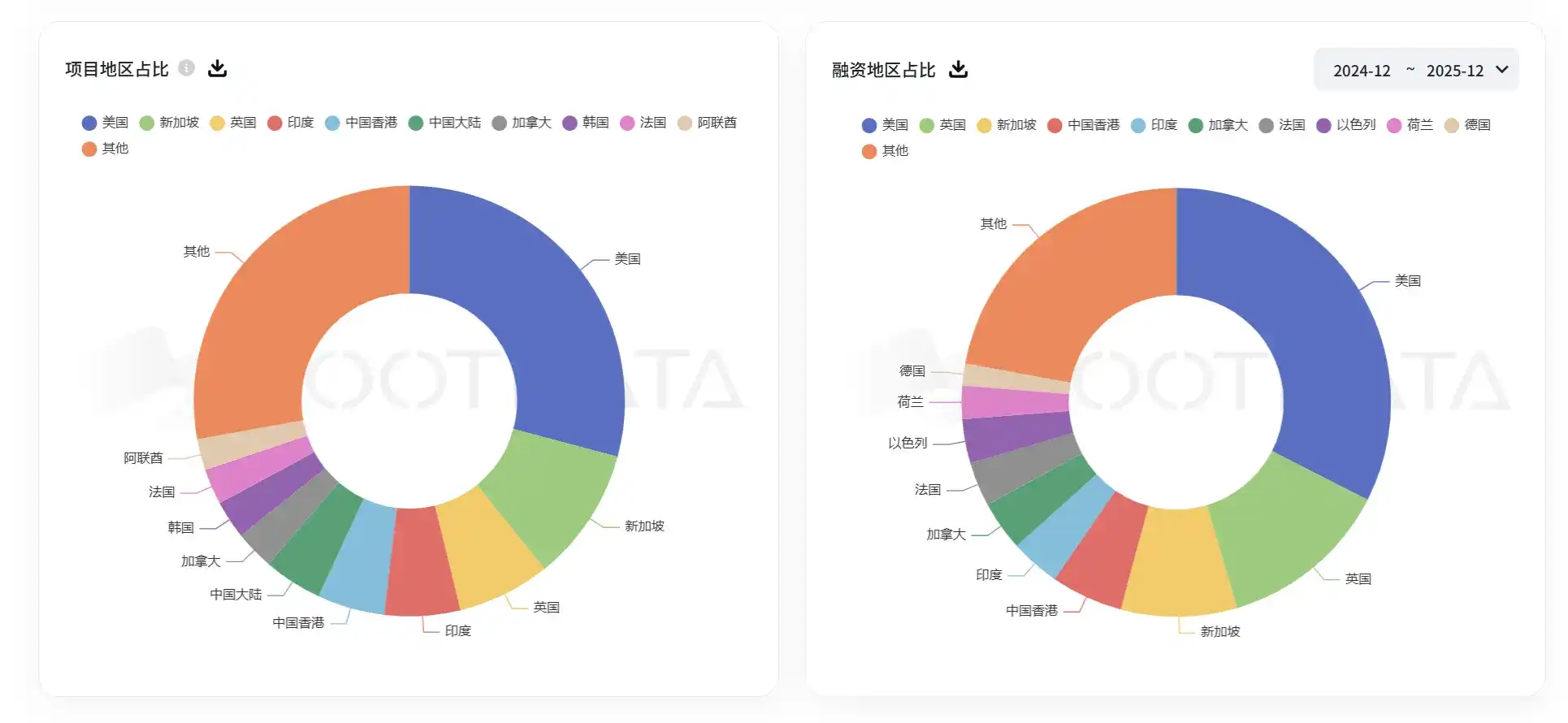
Proportion of projects and funding amounts from Mainland China in the industry. Source: RootData
Following this, the industry's power center quickly shifted to Europe and the United States—driven by U.S. compliance leadership, the influx of institutional capital, and increasingly mature regulatory frameworks, shaping an industry order starkly different from that of 2017–2018. New narratives, regulatory landscapes, and capital structures naturally favor English-speaking markets and compliance-oriented entrepreneurial teams. For instance, prediction markets, which have certain gambling-like properties, are unlikely to emerge in the Chinese-speaking market due to strict regulations on gambling.
In such an industry environment, the new generation of Chinese entrepreneurs also finds it harder to gain "default trust" from global media, regulators, capital, and users, requiring more trial and error costs in marketing, compliance, and other areas compared to similar Western projects.
Shift in Capital Preferences: The Second Impact on the Ecosystem Disruption
If regulatory and geopolitical barriers constitute the first impact, then the "structural shift in preferences" from the capital market side further exacerbates the marginalization trend of Chinese entrepreneurs in the new cycle.
In today's industry environment, without strong VC funding and resource support, projects are at a disadvantage in user acquisition, token listings, and narrative building. Chinese entrepreneurs are already at a disadvantage on the funding front.
Due to the poor performance of altcoins and a significant decline in investment returns, Chinese-background VCs have substantially reduced their investment frequency over the past 2-3 years, with some halting entirely. Chinese entrepreneurs face constrained options in both fundraising and exit paths. When dealing with Western-dominated VCs, Chinese projects struggle to leverage advantages due to language and cultural differences, leading to a continued decline in the amount and number of funding rounds secured by Chinese projects in recent years.
This year, the crypto industry has seen a wave of IPOs and acquisitions, with companies like Circle and Gemini successfully listing on U.S. stock exchanges, and Coinbase and Ripple frequently making acquisitions. This has significantly boosted confidence among entrepreneurs and VCs, but these developments have largely bypassed Chinese projects. It can be said that Western projects are enjoying the institutional红利 (benefits) of the crypto industry's mainstreaming.
From the perspective of mainstream capital, Western projects have inherent advantages in compliance, cultural alignment, and exit strategies. Chinese projects, unless they possess exceptional team composition and technical backgrounds, find it difficult to win the favor of Western capital.
Misalignment of Skill Sets and Industry Maturity: The Third Impact on the Ecosystem Disruption
Over the past decade, the main theme of the crypto industry has consistently been infrastructure and tooling sectors. Although there have been iterations of new concepts like DeFi, NFTs, gaming, and inscriptions, most have failed to become mainstream projects.
In a previous interview with ChainCatcher, Jason Kam, founder of Folius Ventures, stated that the development of Web3 over the past 5 to 10 years has been about laying the foundation, focusing more on product categories and states. This has been a decade偏重于 (leaning towards) ecosystem, infrastructure, tools, and consensus-building. In other words, a decade of B2B products.
The West has three generations of extremely talented engineers who are very adept at building this B2B ecosystem. In contrast, the Asia-Pacific region mainly has young engineers from the 80s and 90s generations, whose career paths developed alongside the wave of China's B2C industry starting around 2005. In other words, their engineering experience is in B2C and applications, which is格格不入 (incompatible) with the development trajectory of blockchain. Therefore, they might not excel in public chains and infrastructure.
"If Asia-Pacific entrepreneurs compete with Western entrepreneurs on the To C front, I believe Asia-Pacific entrepreneurs are at no disadvantage; in fact, they have advantages. Their strengths lie in their rich product experience and their highly aggressive tactics for capturing market share."
Although Chinese entrepreneurs have proven this point in the more Web2-like exchange sector, and in on-chain C-end products, the昙花一现 (short-lived) success of Stepn demonstrated the talent of Chinese entrepreneurs in C-end products, the overall market explosion for consumer-grade products has been slow to arrive. This is closely related to the maturity of industry infrastructure; the market has not yet reached the "comfort zone" for Chinese entrepreneurs.
Entrepreneurs with Multicultural Backgrounds Are Becoming Industry Leaders
Strictly speaking, there have been new representative cases of Chinese entrepreneurs in recent years. Jeff Yan, founder of Hyperliquid, is of Chinese descent. His parents were immigrants from China, and he was born and raised in Palo Alto, California. He later attended Harvard University, majoring in mathematics and computer science. After graduation, Jeff joined high-frequency trading giant Hudson River Trading as a quantitative trader. In 2022, Jeff founded Hyperliquid and, with a philosophy of "small but refined," no VC backing, and user-driven growth, built it into one of the fastest-growing giants in the crypto industry in recent years.
However, although Hyperliquid is one of the most successful projects this cycle with "Chinese heritage" involvement, it is difficult to view it as a continuation of the influence of Chinese entrepreneurs. Jeff is almost never active in the Chinese ecosystem, projects almost entirely Western values externally, and has never expressed himself in Chinese. The rise of Jeff and Hyperliquid highlights a fact: in the new cycle, Chinese heritage can still produce global influence, but the prerequisite is integration into the mainstream cultural system, not reliance on the old path of Chinese entrepreneurship. Relying solely on one cultural system can only make you a regional leader, not achieve outstanding results in the globalization process.
In fact, the founders of many well-known Chinese projects that have become sector leaders this cycle mostly have multicultural backgrounds, having studied in Europe or the US至少 (at least) at the university level. Examples include Sean Ren, founder of Sahara; Yu Hu, founder of Kaito; and Erick Zhang, founder of BuidlPad. Their long-term experience in the West plays a significant role in their development path.
Indeed, entrepreneurs with multicultural backgrounds are more popular in the crypto industry. For example, Ethereum's founder, Solana's founder, and Binance's founder Changpeng Zhao all immigrated from China/Russia to North American countries during their childhood. The collision of different political systems and cultures allowed these entrepreneurs to recognize the value of blockchain in empowering individual sovereignty earlier and take rapid action. They prioritize cultural inclusivity in team building, resource对接 (connection), and daily operations, ultimately making it easier to gain the favor of users from different regional cultural backgrounds.
The inherent borderless nature of crypto, conflicting and磨合 (grinding in/adapting) with the regulatory and interest demands of various countries, will dominate the development trend of the crypto industry for a long time. Chinese entrepreneurs indeed face increasing challenges against the backdrop of multiple Sino-US conflicts and the mainstreaming of the crypto industry. However, as the industry recently faces skepticism towards gambling tendencies, nihilism, and the disproval of more project concepts, the development态势 (situation) of Chinese entrepreneurs may no longer be a critical industry issue. What truly deserves attention is: as speculative growth and narrative泡沫 (bubbles) gradually recede, who can continue to invest in the long-term value of decentralized technology and redefine the industry's direction through real products and verifiable innovation.
The core competitiveness of the future industry landscape will depend more on whether founding teams possess cross-cultural collaboration skills, long-termist technological investment capabilities, and institutional understanding and organizational resilience in the face of regulatory uncertainty. Regardless of cultural or national origin, those who can persistently excel in these dimensions may become the true beneficiaries of the next cycle. In other words, the secret to success in the crypto industry has never been about "where they are from" but about "what they can achieve."






