The CLARITY Act Could Kill Stablecoin Yield – Here Is Where the Money Goes Instead

bitcoinist2026-03-25 tarihinde yayınlandı2026-03-25 tarihinde güncellendi

Özet

The CLARITY Act's proposed ban on stablecoin yield is causing significant market shift, as evidenced by Circle's (USDC) 18% value drop, erasing $4.6 billion. This legislative move aims to separate stablecoins' dual functions—yield generation and utility—by restricting passive returns. The report argues this won't eliminate yield demand but redirect it to DeFi, tokenized Treasuries, or offshore markets. Meanwhile, stablecoins may evolve into pure utility tools for payments, settlement, and collateral, with on-chain data showing active addresses at all-time highs, indicating sustained capital movement and usage.

The stablecoin market is facing a critical test. Not a market cycle. Not a liquidity event. A legislative one — and the damage is already visible.

An XWIN Research Japan report documents what happened in a single session: Circle, the issuer behind USDC, shed 18% of its market value yesterday, erasing roughly $4.6 billion in a matter of hours. The trigger was not an earnings miss or an exchange collapse. It was a draft amendment — a proposed update to the CLARITY Act that would ban yield on stablecoins entirely.

That one legislative clause, not yet law, not yet finalized, was enough to reprice the entire thesis of what Circle is worth. The market understood the implication before the headlines did.

The report places the price reaction in its proper context: this is not volatility. It is a structural signal. For years, stablecoins operated as dual-purpose instruments — digital dollars for payments and settlement, yield-generating assets for the wallets that held them. That combination was the product. The CLARITY framework, as currently drafted, moves to separate those functions permanently, restricting passive yield while permitting only activity-based rewards.

One draft law. Two functions severed. The model that built USDC into a market cornerstone is now the model under review.

Stablecoin Capital Does Not Disappear. It Relocates.

The report is precise about what is actually at stake beneath the regulatory language: this is a competition for capital, and every participant in the financial system knows it. Banks are not lobbying against stablecoin yield out of principle. They are lobbying because deposit outflows are a solvency concern. Crypto platforms are not defending yield out of ideology. They are defending the incentive structure that keeps liquidity on their platforms. Regulation is the arena. Capital is the prize.

What history tells us — and the report invokes it directly — is that capping yield does not destroy yield demand. It redirects it. When deposit rates were capped in an earlier era, money flowed into money market funds. The same logic applies here. Yield demand will migrate toward DeFi protocols, tokenized Treasuries, or offshore markets that operate outside the CLARITY framework’s reach. The capital will move. It always does.

What remains — and this is the report’s most consequential observation — may be more durable than what is lost. Strip yield from stablecoins and what survives is utility: payments, settlement, collateral, liquidity. They stop being financial products competing with savings accounts and start being infrastructure competing with correspondent banking.
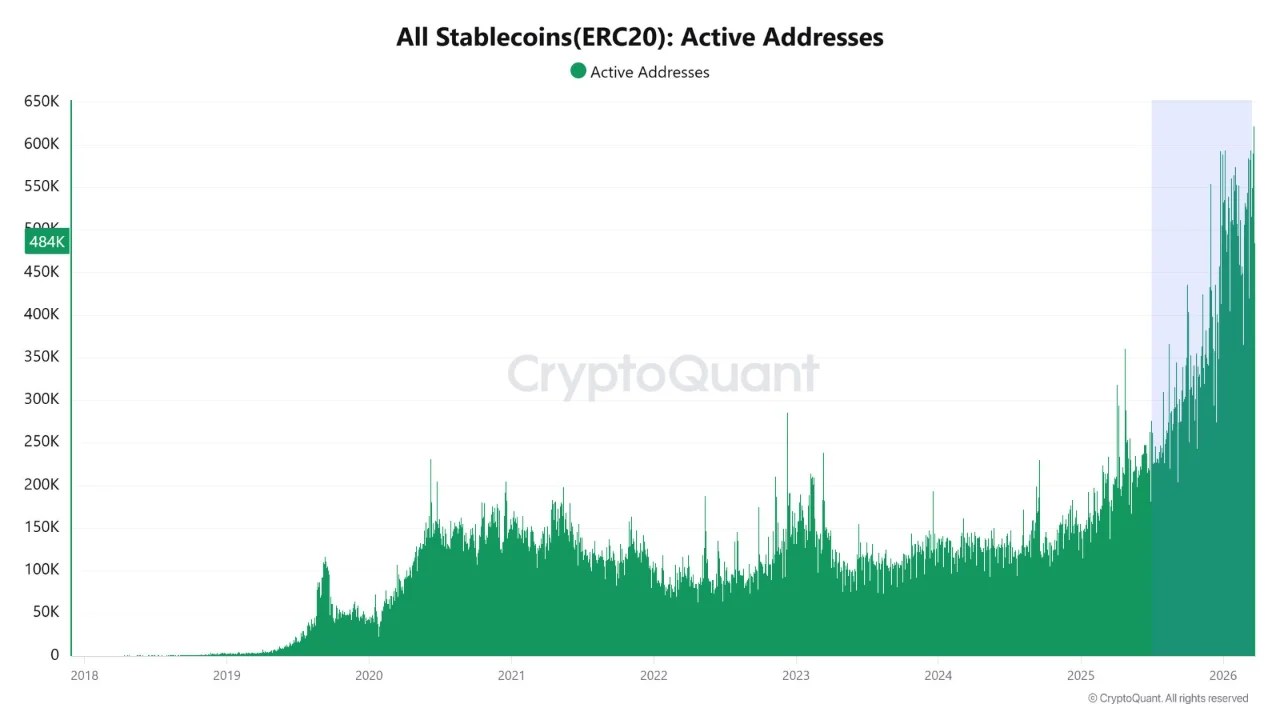
All Stablecoin (ERC20) Active Addresses | Source: CryptoQuant

The on-chain data already reflects this transition. Stablecoin active addresses are at all-time highs. The capital is not idle. It is being used — and if regulation delivers the clarity it promises, that usage curve has further to climb.


İlgili Sorular

QWhat was the immediate market impact of the proposed CLARITY Act amendment on Circle and USDC?

ACircle, the issuer of USDC, lost 18% of its market value in a single session, erasing approximately $4.6 billion in market capitalization.

QAccording to the article, what is the fundamental purpose of the CLARITY Act's proposed restriction on stablecoin yield?

AThe proposed update to the CLARITY Act would ban yield on stablecoins entirely, separating their dual functions by restricting passive yield while permitting only activity-based rewards.

QWhere does the article suggest capital will flow if stablecoin yields are capped by regulation?

AThe article suggests yield demand will migrate toward DeFi protocols, tokenized Treasuries, or offshore markets that operate outside the CLARITY framework's reach, similar to how money flowed into money market funds when deposit rates were capped historically.

QWhat does the article identify as the core utility that will remain for stablecoins if yield is removed?

AIf yield is stripped from stablecoins, their core utility that remains includes payments, settlement, collateral, and liquidity functions, transforming them from financial products into infrastructure competing with correspondent banking.

QWhat on-chain metric does the article cite as evidence that stablecoin capital remains active despite regulatory concerns?

AThe article cites that stablecoin active addresses are at all-time highs, indicating the capital is not idle but is being used, with potential for further growth if regulatory clarity is achieved.

İlgili Okumalar

Anthropic's IPO Launch: Commercial Miracle or Valuation Bubble?

Anthropic has confidentially filed for an IPO, led by Morgan Stanley and Goldman Sachs, potentially going public by October. Following its latest $650 billion funding round, its pre-IPO valuation stands at $965 billion, with projections reaching up to $2 trillion at listing, which would make it the highest-valued private company ever. The article, written by Fu Sheng, addresses skepticism that this represents an AI bubble akin to the 2000 dot-com crash. It argues the current situation differs fundamentally. Unlike the internet bubble era, which relied on speculative narratives with little revenue, Anthropic's valuation is backed by unprecedented, measurable financial performance. Key data points include: * **Revenue Growth:** ARR skyrocketed from $10 billion in early 2025 to $470 billion by May 2026, targeting $100 billion by year-end—a growth curve unmatched in business history. * **Profitability:** It achieved operating profitability in Q2 2026 with an estimated $5.6 billion profit. * **Efficiency:** With ~3,000 employees and ~$470 billion ARR, its revenue per employee exceeds $10 million. Products like Claude Code, launched less than a year ago, already generate $25 billion in annualized revenue. * **Enterprise Adoption:** It boasts a strong enterprise client base, with 8 of the Fortune 10 and over 1,000 large firms spending over $1 million annually on Claude. The valuation is framed using a traditional SaaS model (e.g., a 10x Price-to-Sales multiple on $100 billion revenue). The author contends the core question for analysts has shifted from "How big could this be?" to "How much is it earning and will earn next quarter?" The discussion extends beyond Anthropic to a broader paradigm shift: the transition from a "carbon-based" to a "silicon-based" economy. Companies are increasingly prioritizing investment in compute and AI capabilities over human resources, as these directly scale productivity and competitive advantage. Anthropic's IPO is thus positioned not just as a corporate milestone, but as a price anchor for this new economic era.

链捕手1 saat önce

Anthropic's IPO Launch: Commercial Miracle or Valuation Bubble?

链捕手1 saat önce

Near Returns to the AI Stage: Transformation into a Public Chain Due to 'Payroll Difficulties,' Agent and Privacy Emerge as New Growth Narratives

NEAR Returns to AI Origins: From Payroll Struggles to Blockchain, Now Focusing on AI Agents and Privacy NEAR Protocol's journey began not with grand blockchain ambitions, but from a practical hurdle: its AI startup founders, including Transformer paper co-author Illia Polosukhin, couldn't efficiently pay international developers in 2017. This led them to pivot and build a high-performance, scalable blockchain. After years navigating various crypto narratives like sharding and cross-chain interoperability, NEAR is now leveraging its AI roots to re-enter the AI arena. A key driver is its "NEAR Intents" layer, which abstracts complex cross-chain transactions. Users simply state their goal (e.g., swap BTC for ETH), and a solver network finds the optimal route. This system has processed over $20B in cross-chain volume, generating significant fee revenue. A major growth area is private transactions via "Confidential Intents/Swaps," which hide trade details until settlement to protect against MEV and front-running. Remarkably, private swaps recently accounted for over 40% of NEAR's transaction volume, highlighting strong demand but also potential regulatory scrutiny. With its AI-founder pedigree, NEAR is positioning itself at the intersection of blockchain, AI agents, and privacy, aiming to become infrastructure for the emerging agent economy while navigating the challenges of its rapid adoption.

marsbit4 saat önce

Near Returns to the AI Stage: Transformation into a Public Chain Due to 'Payroll Difficulties,' Agent and Privacy Emerge as New Growth Narratives

marsbit4 saat önce

İşlemler

Spot
Futures
活动图片