The Brutal Reckoning of the Public Chain Market in 2025: The Thriving Casino, The Fake Ghost Town, and VC's Harvesting Scheme

marsbit2025-12-18 tarihinde yayınlandı2025-12-18 tarihinde güncellendi

Özet

Crypto Public Chains Face a Reality Check: A Grim Settlement in 2025 The crypto market, often perceived as a lens of soaring market caps and futuristic promises, reveals a starkly different reality when analyzed through on-chain fee data. A deep dive into DeFiLlama’s “Fees by Chain” metrics exposes a severe structural issue: the public chain ecosystem is dominated by profit concentration, while the long tail languishes in zombification. Notable examples highlight this disparity. Algorand, a chain backed by Turing Award-winning cryptography, recorded a meager $17 in daily protocol revenue despite a billion-dollar valuation. Similarly, Cardano, a top-ten asset by market cap, generates only around $6,000 in daily fees, indicating a lack of substantial economic activity beyond basic transfers. In contrast, the chains capturing real value are those serving clear, immediate demands. Tron leads with $1.24 million in daily fees, powered primarily by its role as a low-cost payment rail for USDT transfers. Solana follows with nearly $600,000, driven largely by its vibrant on-chain casino of meme coin trading and speculation. Base, backed by Coinbase’s distribution power, has also emerged as a serious contender. These cases underscore that proven, fee-generating business models in crypto are currently limited to payments, high-frequency speculation, and Ethereum’s role as a settlement layer. The analysis further reveals the failure of the VC-driven model. Newer chains like Sui, Sei,...

Author: BlockWeeks Block Weekly

In the cryptocurrency market, if you only look at Market Cap, you see a thriving, flourishing digital utopia. Valuations in the tens of billions of dollars, grand technical whitepapers, the aura of Turing Award winners... everything looks like the dawn of the next generation of the internet.

But if you put on a different pair of glasses—glasses that only see "On-Chain Real Revenue (Fees)"—you see a completely different, even spine-chilling picture: In this so-called trillion-dollar market, the vast majority of "unicorns" are actually zombies that have long stopped breathing.

Recently, BlockWeeks conducted a detailed analysis of the "Fees" data for public chains from DeFiLlama, and we discovered an unavoidable structural problem: The crypto public chain ecosystem has entered an era of "extreme profit concentration and collective zombification of the long tail."
The core data in this article is sourced from the "Fees / Revenue by Chain" panel on DeFiLlama (capture time: December 16, 2025). The "Fees" defined here refer to the total fees paid by users on-chain (top-line), an approximate indicator for measuring the scale of on-chain economic activity, not the protocol's net retained income (Protocol Revenue). This article aims to use this public, unified standard to examine the on-chain value capture capability of various public chains.

I. The $17 Humiliation: The Demise of the Technological Utopia

According to the public data we captured from DeFiLlama, the most alarming number is not the million-dollar giants at the top, but the $17 at the bottom.

This is the daily total protocol revenue for Algorand—a chain once crowned the "blockchain trilemma solver," founded by Turing Award winner Silvio Micali, and boasting top-tier technical credentials.

You read that correctly, not $170,000, but $17.
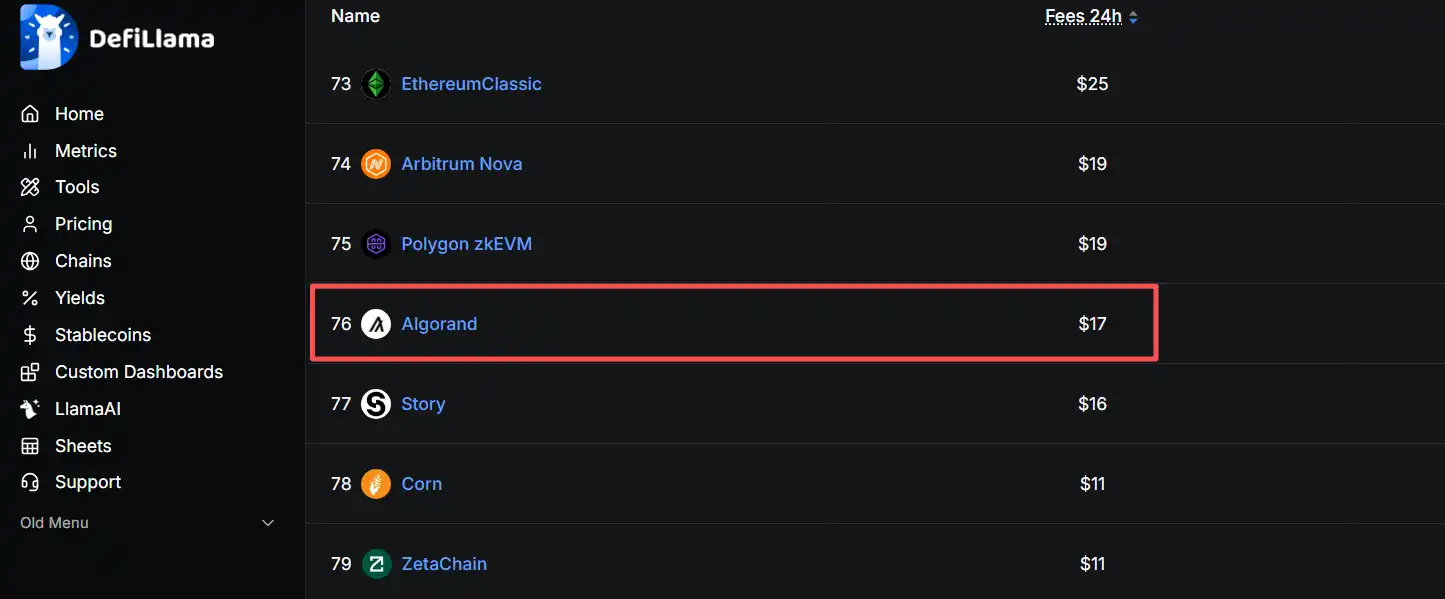
At this very moment, Algorand's market capitalization remains in the billion-dollar range. A "digital nation" valued at a billion dollars generates a direct tax revenue from its digital economy that isn't enough to buy four lattes at Starbucks. It shows that despite possessing the most advanced decentralized technology, without real, sustained application demand, its economic value capture capability approaches zero.

This is not just Algorand's embarrassment; it is the death knell for the entire "classic public chain" camp.

Look at Cardano (ADA), a behemoth steadily ranked in the top ten by market cap, with millions of token holding addresses. Yet the data tells us its recent average daily on-chain transaction fees hover around $6,000. This means that aside from asset transfers between holders and network maintenance staking, that chain lacks commercial activity significant enough to generate substantial fees—no large-scale lending, no high-frequency trading, no real, paid value exchange.

These public chains are like luxurious empty cities built at great expense in the middle of a desert. The infrastructure is complete, the roads are wide, the city hall (foundation) is well-funded, but no residents (active paying users) are seen on the streets. Their method of sustaining operation is often for the city hall to continuously sell off reserves (dumping tokens) to cover operational costs.

II. An Ugly Victory: Who is Actually Capturing Value?

When shifting focus to the top of the list, a fact that makes "technological purists" even more uncomfortable emerges: The ones making the most money are often not the most "elegant" or "decentralized" in terms of technology.

Topping the list is Tron, with average daily fees as high as $1.24 million. In the eyes of many elitists, Tron might hardly be considered "technical." But the market voting with its feet gives the ultimate answer: Payments are a rigid demand. Tron carries the vast majority of global USDT on-chain transfer demand. In this industry full of speculation and bubbles, Tron has inadvertently become the only payment application layer adopted at mass scale (Mass Adoption)—even if it merely serves as a shadow banking channel for fiat currencies.

One could say: Payments, the oldest and most basic internet need, is currently the only Mass Adoption in the Crypto world. Tron's success is a powerful mockery of all project teams that pursue "perfect technology" while ignoring "real demand."

Close behind is Solana, with average daily fees nearing $600,000. Its success logic is even more straightforward: It is the world's most active on-chain casino. Meme coins, high-frequency DEX trading, front-running—these activities contribute the vast majority of its fees. Solana's moat is no longer TPS, but "attention traffic." The rise of Base is even more disruptive (approx. $105k daily): it proves that distribution channels are far more important than the technology itself. Backed by Coinbase's huge user base, Base delivers a dimensional打击 to other L2s.

This provides a cruel and clear revelation: The current Crypto market has only two and a half business models that have been verified to generate large-scale on-chain fees—low-cost payments (Tron), high-frequency speculation (Solana/Base), and the asset settlement layer (Ethereum), which is being eroded by L2s.

Beyond these, those once highly anticipated "enterprise-level applications," "supply chain traceability," and "Web3 social" have, in the face of cold on-chain fee data, at least at this stage, not yet demonstrated scaled付费 demand.

III. The VC-Led Dilemma: Why "Peak at Launch"?

This data also reveals another deep crisis: The narrative model for new L1/L2s driven by massive venture capital (VC) funding is facing a brutal reality check regarding monetization.

We see that new public chains like Sui (approx. $12k daily), Sei (approx. $320 daily), and Starknet (approx. $10k daily), which launched with great fanfare and raised hundreds of millions of dollars, have on-chain fee revenues severely disconnected from their fully diluted valuations (FDV) of tens or even hundreds of billions.

The standard playbook of the past few years has been: VC investment -> Team piles on technical highlights -> Attract airdrop farmers to inflate metrics -> Token lists on exchanges creating wealth -> Retail investors buy into the narrative -> Airdrop farmers exit -> On-chain activity metrics plummet.

This is why many new chains show astonishing TPS and hundreds of thousands of daily active users at launch, only to quickly become "ghost towns" months later. Because those users are mercenaries, not residents. When airdrop expectations are met, when incentive subsidies stop, the real, organic demand is exposed for what it is—daily fees of a few thousand or tens of thousands of dollars simply cannot support the dream of a billion-dollar valuation.

We are facing a severe case of "block space inflation." The industry has built too many chains, too many L2s, too many Data Availability (DA) layers, but innovation at the application layer is extremely scarce. It's like, in the early days of broadband internet,狂热ly laying成千上万条光纤, but Netflix, YouTube, or any killer app that must consume that bandwidth hasn't been born yet.

IV. Investor Awakening: From "Listening to Stories" to "Checking the Books"

For a long time, the valuation logic of the crypto market has been built on "P/E ratio of dreams". The grander the narrative, the richer the imagination, the higher the market cap could soar.

But 2024-2025 is becoming a watershed moment. As macro liquidity tightens and institutional investors demand more substantial returns, the market is being forced to return to rationality.

For investors, the logic must change:

  1. Beware of "Zombie Coins": If a project has a market cap in the tens of billions but daily on-chain fees of only a few hundred or thousand dollars, this extreme case of "unworthiness" is often the starting point for a long-term decline. Its only support—community faith—will eventually run out.

  2. Focus on "Positive Cash Flow" Capability: Look for ecosystems where users are willing to持续 pay for services even without token incentives. Tron's stablecoin transfer fees, Base and Solana's transaction fees, are direct reflections of real demand.

  3. Acknowledge "Channels and Ecosystems are King": Base's success proves that pure technical superiority can hardly be a moat anymore. Giants entering with massive user bases (like Coinbase), or native communities capable of nurturing狂热 cultures, are more valuable assets at this stage. Purely technical public chains, if they cannot solve the "who will use it and why" problem, will ultimately become academic showpieces like Algorand.

  4. See Through the VC Game: Stop paying for false繁荣 driven by subsidies and airdrops.

Facing the harsh reality of $17 in daily revenue, rather than paying for grand narratives and empty "digital ghost towns," it's better to tighten your purse strings and turn to the few ecosystems that can generate real cash flow and have active paying users.

This is not to deny the long-term value of all technological exploration, but rather a necessary清算 of the current畸形的 valuation system. Only when the market learns to pay for "value actually generated," rather than透支 for "stories promised in the future," can this industry usher in a truly healthy dawn.

Important Notes and Evaluation Framework

The core of this article is to use the unified, public ruler of "On-Chain Fees" to measure the "Immediate Value Capture Capability" of various public chains. When reading and citing the conclusions of this article, please be sure to understand the following key context and limitations:

1. General Context

  • Differences in Development Stage: Some public chains may be technologically advanced but are in their early stages, and their user base has not yet formed scale effects. The data in this article reflects the "current state," not the "ultimate potential."

  • Impact of Fee Models: Some public chains are designed to pursue ultra-low transaction fees (Gas Fee), and their native token prices are low. This means that even if the number of on-chain transactions is considerable, the "total fee revenue" denominated in USD appears微小. This suggests that evaluating such chains should combine indicators like number of transactions, number of active addresses, but the upper limit of their economic throughput denominated in USD remains an objective fact.

2. Evaluation Notes for Specific Types of Chains

For a fairer discussion, we provide the following evaluation ideas for specific types of projects:

Chain Type This Article's Evaluation and Suggestion
Storage/Service Networks

(e.g., Filecoin, Arweave)

There is indeed a difference in scope. The core value of these networks lies in storage/retrieval services, and their revenue model differs from simple transaction fees. DeFiLlama's "Fees" metric may severely underestimate their actual commercial activity. If you are an investor, you should focus on examining their storage market capacity, active storage deals, and real storage revenue streams.
Off-Chain/Consortium Business-Driven Public Chains

(e.g., some enterprise chains)

The data has limitations. DeFiLlama only统计 public on-chain activity, and BlockWeeks完全认同 this point. But we同样 wonder, if the main value of a public chain is not reflected on-chain, then what supports the market capitalization of its publicly issued tokens used for on-chain governance and security?
Technically Low-Fee/High-TPS Public Chains The design初衷 is good. However, extremely low per-transaction fees mean the value captured by the chain itself and its validators is extremely low. The success of this model must rely on extremely high transaction volume to compensate for the low price disadvantage. If low fees fail to attract massive transaction volume, its economic model may face challenges.
Chains with Ecosystem Traffic Concentrated on CEXs Hard to evaluate. If a public chain's on-chain economic activity is weak and cannot generate sufficient fees, then its practical value and value capture capability as a "decentralized settlement layer" or "smart contract platform" are low. Its value might be closer to a mere "digital collectible."

We始终 believe that in a world of highly concentrated profits, projects in the long tail are almost sentenced to fate unless they find unique application scenarios (like gaming or specific AppChains). Only platforms that can generate cash flow through real, sustained user demand have the potential to survive long-term and outperform the market.


İlgili Sorular

QWhat is the core metric used in the article to evaluate the health and value capture of public blockchains, and why is it considered crucial?

AThe core metric is on-chain fees (total fees paid by users), as it serves as a direct, public, and unified proxy for measuring the scale of real economic activity and value capture on a blockchain, moving beyond market cap narratives to assess actual usage and demand.

QAccording to the article, which two and a half business models have been validated to generate significant on-chain fees in the current crypto market?

AThe two and a half validated business models are: 1) Low-cost payments (exemplified by Tron's USDT transfers), 2) High-frequency speculation (exemplified by Solana and Base's meme coin and trading activity), and the half being the settlement layer for assets (Ethereum), which is being increasingly fragmented by Layer 2 solutions.

QWhat does the '17 dollars' figure associated with Algorand represent, and what broader point does it illustrate about the public blockchain space?

AThe '17 dollars' represents Algorand's daily on-chain fee revenue at the time of the analysis. It illustrates the critical point that even a blockchain with advanced technology and a high market capitalization can have near-zero economic value capture if it lacks real, sustained application demand and user activity, making it a 'zombie chain'.

QWhat is the primary criticism the article levels against the venture capital (VC)-driven model for launching new Layer 1 and Layer 2 blockchains?

AThe article criticizes the VC-driven model for creating a cycle of 'artificial prosperity': massive funding -> technical hype -> airdrop farming to inflate metrics -> token listing and wealth generation for insiders -> retail investors buying the narrative -> farmers leaving -> a cliff-like drop in on-chain activity. This reveals a lack of organic demand and results in valuations that are severely disconnected from meager on-chain fee revenue.

QHow does the article suggest investors should change their evaluation framework when assessing blockchain projects, moving away from traditional crypto valuation methods?

AThe article suggests investors shift from valuing narratives ('storytelling') to scrutinizing financial fundamentals ('checking the books'). Key recommendations include: avoiding 'zombie coins' with high valuations but negligible fees, focusing on chains that generate positive cash flow from real user-paid fees, prioritizing distribution channels and vibrant communities over pure technical specs, and seeing through the artificial cycles created by VC and airdrop farming games.

İlgili Okumalar

The AI Agent Era Accelerates Its Arrival: Questflow Defines a New Paradigm of Financial Intelligence with On-Chain AI Brokerage

The AI Agent era is accelerating, with the CB Insights AI 100 list highlighting global investment confidence. The focus has shifted from whether AI works to its speed of deployment and ability to manage complex workflows, with autonomous AI Agents driving this transformation. At the forefront is Questflow, a Singapore-based startup redefining financial intelligence through its on-chain AI brokerage. Unlike tools that merely provide data dashboards, Questflow deploys AI Agents that proactively scan markets, form judgments, and execute trades via a conversational interface—operating 24/7 without requiring manual confirmation for each decision. This embodies the new AI paradigm of agents capable of executing multi-step workflows autonomously. Questflow's mission is to democratize institutional-grade trading intelligence. Historically reserved for the ultra-wealthy, this capability is now accessible starting from just $1 through Questflow's "AI Clone + Copy Trade" model. The platform charges only a 1% execution fee, aligning its incentives directly with users and eliminating traditional management or performance fees. The timing is opportune, aligning with key trends identified by CB Insights: the scalable deployment of AI Agents, accelerated AI adoption in financial services, and the maturation of on-chain infrastructure. With robust liquidity on platforms like Hyperliquid and Polymarket, alongside advancements in AI reasoning and non-custodial wallet security, Questflow is positioned to merge the roles of broker, fund, and exchange into a single, accessible platform for millions.

链捕手53 dk önce

The AI Agent Era Accelerates Its Arrival: Questflow Defines a New Paradigm of Financial Intelligence with On-Chain AI Brokerage

链捕手53 dk önce

Why Pricing Social Interactions is Doomed to Fail?

Titled "Why Putting a Price on Social Interaction Is Doomed to Fail," this article critiques attempts to monetize social networks directly through SocialFi models, arguing their inevitable failure stems from a fundamental misunderstanding of media dynamics. Using Marshall McLuhan's theory of "hot" and "cold" media, the author posits that social networks are inherently "cold" media. Their value isn't contained in individual posts but is co-created through user participation, interpretation, and fragmented, ongoing interaction (e.g., replies, shares). This ambiguity and need for user involvement are core to their function. The article asserts that SocialFi projects like Friend.tech failed because introducing real-time, tradable financial pricing (a definitive "hot" signal) into this "cold" environment doesn't add a layer—it replaces the medium's essence. The unambiguous price signal overshadows and nullifies the nuanced, participatory social signal. Users become traders, not participants, and when speculative profits vanish, the underlying social ecosystem—never genuinely cultivated—collapses entirely. This principle extends beyond crypto. The author argues platforms like Twitter have gradually "heated up" through metrics (likes, retweets counts, algorithmically defined value), shifting users from participants to performers and eroding organic engagement. The solution isn't to abandon capital but to manage its entry point. Successful models like Substack, Patreon, or Bandcamp allow capital to "condense" at specific, isolated nodes (e.g., subscriptions, one-time payments) without permeating and "heating" every social interaction. They preserve the core "cold," participatory medium while enabling monetization at designated boundaries. The NFT boom and bust serves as a stark parallel: the ancient "cold" medium of collecting (valued for story, community, gradual accumulation) was rapidly destroyed by platforms that introduced real-time floor prices, rarity scores, and trading dashboards, transforming collectors into speculators and vaporizing cultural value when prices fell. The core lesson: "Liquidity equals heat." Injecting high liquidity and definitive pricing into a "cold" participatory medium doesn't optimize it; it fundamentally alters and destroys its value-creating mechanism. The future lies not in pricing every social gesture but in finding precise, non-invasive points for capital to condense without overheating the entire ecosystem.

marsbit1 saat önce

Why Pricing Social Interactions is Doomed to Fail?

marsbit1 saat önce

İşlemler

Spot
Futures

Popüler Makaleler

$S$ Nedir

SPERO'yu Anlamak: Kapsamlı Bir Genel Bakış SPERO'ya Giriş İnovasyonun manzarası gelişmeye devam ederken, web3 teknolojilerinin ve kripto para projelerinin ortaya çıkışı dijital geleceği şekillendirmede önemli bir rol oynamaktadır. Bu dinamik alanda dikkat çeken projelerden biri SPERO, $$s$$ olarak adlandırılmaktadır. Bu makale, SPERO hakkında ayrıntılı bilgi toplamak ve sunmak amacıyla, meraklılar ve yatırımcıların web3 ve kripto alanlarındaki temellerini, hedeflerini ve yeniliklerini anlamalarına yardımcı olmayı amaçlamaktadır. SPERO,$$s$$ Nedir? SPERO,$$s$$, kripto alanında merkeziyetsizlik ve blok zinciri teknolojisi ilkelerini kullanarak etkileşimi, faydayı ve finansal kapsayıcılığı teşvik eden bir ekosistem yaratmayı amaçlayan benzersiz bir projedir. Proje, kullanıcıların yenilikçi finansal çözümler ve hizmetler sunarak eşler arası etkileşimleri yeni yollarla kolaylaştırmayı hedeflemektedir. SPERO,$$s$$'nin temel amacı, bireyleri güçlendirmek ve kripto para alanındaki kullanıcı deneyimini artıran araçlar ve platformlar sağlamaktır. Bu, daha esnek işlem yöntemlerini mümkün kılmayı, topluluk odaklı girişimleri teşvik etmeyi ve merkeziyetsiz uygulamalar (dApp'ler) aracılığıyla finansal fırsatlar yaratmayı içermektedir. SPERO,$$s$$'nin temel vizyonu kapsayıcılık etrafında dönmekte olup, geleneksel finansal sistemlerdeki boşlukları kapatmayı ve blok zinciri teknolojisinin faydalarından yararlanmayı hedeflemektedir. SPERO,$$s$$'nin Yaratıcısı Kimdir? SPERO,$$s$$'nin yaratıcısının kimliği bir miktar belirsizdir, çünkü kurucusu(ları) hakkında ayrıntılı arka plan bilgisi sağlayan sınırlı kamuya açık kaynaklar bulunmaktadır. Bu şeffaflık eksikliği, projenin merkeziyetsizlik taahhüdünden kaynaklanabilir—birçok web3 projesinin paylaştığı bir etik anlayışı, bireysel tanınmanın yerine kolektif katkıları önceliklendirmektedir. Topluluk ve onun kolektif hedefleri etrafında tartışmaları merkezileştirerek, SPERO,$$s$$, belirli bireyleri öne çıkarmadan güçlendirme özünü taşımaktadır. Bu nedenle, SPERO'nun etik anlayışını ve misyonunu anlamak, tek bir yaratıcının kimliğini belirlemekten daha önemlidir. SPERO,$$s$$'nin Yatırımcıları Kimlerdir? SPERO,$$s$$, kripto sektöründe yeniliği teşvik etmeye adanmış girişim sermayedarlarından melek yatırımcılara kadar çeşitli yatırımcılar tarafından desteklenmektedir. Bu yatırımcıların odak noktası genellikle SPERO'nun misyonuyla uyumlu olup, toplumsal teknolojik ilerlemeyi, finansal kapsayıcılığı ve merkeziyetsiz yönetimi vaat eden projeleri önceliklendirmektedir. Bu yatırımcı temelleri, yalnızca yenilikçi ürünler sunan projelere değil, aynı zamanda blok zinciri topluluğuna ve ekosistemlerine olumlu katkılarda bulunan projelere de ilgi duymaktadır. Bu yatırımcıların desteği, SPERO,$$s$$'yi hızla gelişen kripto projeleri alanında dikkate değer bir rakip haline getirmektedir. SPERO,$$s$$ Nasıl Çalışır? SPERO,$$s$$, onu geleneksel kripto para projelerinden ayıran çok yönlü bir çerçeve kullanmaktadır. İşte benzersizliğini ve yeniliğini vurgulayan bazı temel özellikler: Merkeziyetsiz Yönetim: SPERO,$$s$$, kullanıcıların projenin geleceğiyle ilgili karar alma süreçlerine aktif olarak katılmalarını sağlayan merkeziyetsiz yönetim modellerini entegre etmektedir. Bu yaklaşım, topluluk üyeleri arasında sahiplik ve hesap verebilirlik duygusunu teşvik etmektedir. Token Kullanımı: SPERO,$$s$$, ekosistem içinde çeşitli işlevler sunmak üzere tasarlanmış kendi kripto para token'ını kullanmaktadır. Bu token'lar, işlemleri, ödülleri ve platformda sunulan hizmetlerin kolaylaştırılmasını sağlayarak genel etkileşimi ve faydayı artırmaktadır. Katmanlı Mimari: SPERO,$$s$$'nin teknik mimarisi, modülerlik ve ölçeklenebilirliği destekleyerek projenin evrimi sırasında ek özelliklerin ve uygulamaların sorunsuz bir şekilde entegrasyonuna olanak tanımaktadır. Bu uyum sağlama yeteneği, sürekli değişen kripto manzarasında geçerliliği sürdürmek için hayati öneme sahiptir. Topluluk Katılımı: Proje, işbirliği ve geri bildirim teşvik eden mekanizmalar kullanarak topluluk odaklı girişimlere vurgu yapmaktadır. Güçlü bir topluluk oluşturarak, SPERO,$$s$$, kullanıcı ihtiyaçlarını daha iyi karşılayabilir ve piyasa trendlerine uyum sağlayabilir. Kapsayıcılığa Odaklanma: Düşük işlem ücretleri ve kullanıcı dostu arayüzler sunarak, SPERO,$$s$$, daha önce kripto alanında yer almamış bireyler de dahil olmak üzere çeşitli bir kullanıcı tabanını çekmeyi hedeflemektedir. Bu kapsayıcılık taahhüdü, erişilebilirlik yoluyla güçlendirme misyonuyla uyumludur. SPERO,$$s$$ Zaman Çizelgesi Bir projenin tarihini anlamak, gelişim yolculuğu ve kilometre taşları hakkında kritik bilgiler sağlar. Aşağıda, SPERO,$$s$$'nin evriminde önemli olayları haritalayan önerilen bir zaman çizelgesi bulunmaktadır: Kavram Geliştirme ve Fikir Aşaması: SPERO,$$s$$'nin temelini oluşturan ilk fikirler, blok zinciri endüstrisindeki merkeziyetsizlik ve topluluk odaklılık ilkeleriyle yakından uyumlu olarak geliştirildi. Proje Beyaz Kağıdının Yayınlanması: Kavramsal aşamayı takiben, SPERO,$$s$$'nin vizyonunu, hedeflerini ve teknolojik altyapısını ayrıntılı bir şekilde açıklayan kapsamlı bir beyaz kağıt yayımlandı ve topluluk ilgisini ve geri bildirimini toplamak amacıyla sunuldu. Topluluk Oluşturma ve Erken Katılımlar: Projenin hedefleri etrafında tartışmalar yürüterek destek toplamak ve erken benimseyenler ile potansiyel yatırımcılar için bir topluluk oluşturmak amacıyla aktif iletişim çabaları gerçekleştirildi. Token Üretim Etkinliği: SPERO,$$s$$, yerel token'larını erken destekçilere dağıtmak ve ekosistem içinde başlangıç likiditesini sağlamak amacıyla bir token üretim etkinliği (TGE) gerçekleştirdi. İlk dApp'in Yayınlanması: SPERO,$$s$$ ile ilişkili ilk merkeziyetsiz uygulama (dApp) faaliyete geçti ve kullanıcıların platformun temel işlevleriyle etkileşimde bulunmalarını sağladı. Sürekli Gelişim ve Ortaklıklar: Projenin tekliflerine sürekli güncellemeler ve iyileştirmeler yapılmakta olup, blok zinciri alanındaki diğer oyuncularla stratejik ortaklıklar, SPERO,$$s$$'yi rekabetçi ve gelişen bir oyuncu haline getirmiştir. Sonuç SPERO,$$s$$, web3 ve kripto paranın finansal sistemleri devrim niteliğinde dönüştürme ve bireyleri güçlendirme potansiyelinin bir kanıtıdır. Merkeziyetsiz yönetime, topluluk katılımına ve yenilikçi tasarlanmış işlevselliğe olan bağlılığıyla, daha kapsayıcı bir finansal manzaraya doğru bir yol açmaktadır. Hızla gelişen kripto alanındaki herhangi bir yatırımda olduğu gibi, potansiyel yatırımcılar ve kullanıcılar, SPERO,$$s$$ içindeki devam eden gelişmelerle ilgili olarak kapsamlı bir araştırma yapmaları ve düşünceli bir şekilde katılmaları teşvik edilmektedir. Proje, kripto endüstrisinin yenilikçi ruhunu sergileyerek, sayısız olasılığını keşfetmeye davet etmektedir. SPERO,$$s$$'nin yolculuğu hala devam ederken, temel ilkeleri, teknoloji, finans ve birbirimizle etkileşim biçimimizi etkileyebilir.

89 Toplam GörüntülenmeYayınlanma 2024.12.17Güncellenme 2024.12.17

$S$ Nedir

AGENT S Nedir

Agent S: Web3'te Otonom Etkileşimin Geleceği Giriş Web3 ve kripto para dünyasında sürekli gelişen manzarada, yenilikler bireylerin dijital platformlarla etkileşim biçimlerini sürekli olarak yeniden tanımlıyor. Bu tür öncü projelerden biri olan Agent S, açık ajans çerçevesi aracılığıyla insan-bilgisayar etkileşimini devrim niteliğinde değiştirmeyi vaat ediyor. Otonom etkileşimlerin yolunu açarak, Agent S karmaşık görevleri basitleştirmeyi ve yapay zeka (AI) alanında dönüştürücü uygulamalar sunmayı hedefliyor. Bu detaylı inceleme, projenin karmaşıklıklarına, benzersiz özelliklerine ve kripto para alanındaki etkilerine dalacaktır. Agent S Nedir? Agent S, bilgisayar görevlerinin otomasyonunda üç temel zorluğu ele almak üzere özel olarak tasarlanmış çığır açıcı bir açık ajans çerçevesidir: Alan Spesifik Bilgi Edinimi: Çerçeve, çeşitli dış bilgi kaynaklarından ve iç deneyimlerden akıllıca öğrenir. Bu çift yönlü yaklaşım, alan spesifik bilgi açısından zengin bir veri havuzu oluşturmasını sağlar ve görev yürütmedeki performansını artırır. Uzun Görev Ufukları Üzerinde Planlama: Agent S, karmaşık görevlerin verimli bir şekilde parçalanmasını ve yürütülmesini kolaylaştıran deneyim artırımlı hiyerarşik planlama kullanır. Bu özellik, çoklu alt görevleri etkili ve verimli bir şekilde yönetme yeteneğini önemli ölçüde artırır. Dinamik, Homojen Olmayan Arayüzlerle Başlama: Proje, ajanlar ve kullanıcılar arasındaki etkileşimi geliştiren yenilikçi bir çözüm olan Ajan-Bilgisayar Arayüzü'ni (ACI) tanıtmaktadır. Çok Modlu Büyük Dil Modellerini (MLLM'ler) kullanarak, Agent S çeşitli grafik kullanıcı arayüzlerini sorunsuz bir şekilde gezinebilir ve manipüle edebilir. Bu öncü özellikler aracılığıyla, Agent S, makinelerle insan etkileşimini otomatikleştirmede karşılaşılan karmaşıklıkları ele alan sağlam bir çerçeve sunarak, AI ve ötesinde birçok uygulama için zemin hazırlıyor. Agent S'nin Yaratıcısı Kimdir? Agent S'nin kavramı temelde yenilikçi olsa da, yaratıcısı hakkında spesifik bilgiler belirsizliğini koruyor. Yaratıcı şu anda bilinmiyor, bu da projenin yeni aşamasını veya kurucu üyeleri gizli tutma stratejik tercihini vurguluyor. Anonimlikten bağımsız olarak, odak çerçevenin yetenekleri ve potansiyeli üzerinde kalıyor. Agent S'nin Yatırımcıları Kimlerdir? Agent S, kriptografik ekosistemde oldukça yeni olduğundan, yatırımcıları ve finansal destekçileri hakkında ayrıntılı bilgiler açıkça belgelenmemiştir. Projeyi destekleyen yatırım temelleri veya organizasyonları hakkında kamuya açık bilgilerdeki eksiklik, finansman yapısı ve gelişim yol haritası hakkında sorular doğuruyor. Destekleyicilerin anlaşılması, projenin sürdürülebilirliğini ve potansiyel pazar etkisini değerlendirmek için kritik öneme sahiptir. Agent S Nasıl Çalışır? Agent S'nin temelinde, çeşitli ortamlarda etkili bir şekilde çalışmasını sağlayan son teknoloji bir sistem yatmaktadır. İşleyiş modeli birkaç ana özellik etrafında inşa edilmiştir: İnsan Benzeri Bilgisayar Etkileşimi: Çerçeve, bilgisayarlarla etkileşimleri daha sezgisel hale getirmeyi amaçlayan gelişmiş AI planlaması sunar. Görev yürütmedeki insan davranışını taklit ederek, kullanıcı deneyimlerini yükseltmeyi vaat eder. Anlatı Belleği: Yüksek düzeyde deneyimlerden yararlanmak için kullanılan Agent S, görev geçmişlerini takip etmek amacıyla anlatı belleğini kullanarak karar verme süreçlerini geliştirir. Episodik Bellek: Bu özellik, kullanıcılara adım adım rehberlik sağlayarak, çerçevenin görevler gelişirken bağlamsal destek sunmasına olanak tanır. OpenACI Desteği: Yerel olarak çalışabilme yeteneği ile Agent S, kullanıcıların etkileşimleri ve iş akışları üzerinde kontrol sağlamasına olanak tanır ve Web3'ün merkeziyetsiz felsefesiyle uyumlu hale gelir. Dış API'lerle Kolay Entegrasyon: Çeşitli AI platformlarıyla uyumluluğu ve çok yönlülüğü, Agent S'nin mevcut teknolojik ekosistemlere sorunsuz bir şekilde entegre olmasını sağlar ve geliştiriciler ile organizasyonlar için cazip bir seçenek haline getirir. Bu işlevsellikler, Agent S'nin kripto alanındaki benzersiz konumuna katkıda bulunarak, karmaşık, çok aşamalı görevleri minimum insan müdahalesi ile otomatikleştirir. Proje geliştikçe, Web3'teki potansiyel uygulamaları dijital etkileşimlerin nasıl gelişeceğini yeniden tanımlayabilir. Agent S'nin Zaman Çizelgesi Agent S'nin gelişimi ve kilometre taşları, önemli olaylarını vurgulayan bir zaman çizelgesinde özetlenebilir: 27 Eylül 2024: Agent S'nin kavramı, “Bilgisayarları İnsan Gibi Kullanan Açık Bir Ajans Çerçevesi” başlıklı kapsamlı bir araştırma makalesi ile tanıtıldı ve projenin temelini sergiledi. 10 Ekim 2024: Araştırma makalesi arXiv'de kamuya açık olarak yayınlandı ve çerçevenin derinlemesine bir incelemesini ve OSWorld benchmark'ına dayalı performans değerlendirmesini sundu. 12 Ekim 2024: Agent S'nin yetenekleri ve özellikleri hakkında görsel bir içgörü sağlayan bir video sunumu yayımlandı ve potansiyel kullanıcılar ve yatırımcılarla daha fazla etkileşim sağlandı. Bu zaman çizelgesindeki işaretler, sadece Agent S'nin ilerlemesini değil, aynı zamanda şeffaflık ve topluluk katılımına olan bağlılığını da göstermektedir. Agent S Hakkında Ana Noktalar Agent S çerçevesi gelişmeye devam ederken, birkaç ana özellik öne çıkmakta ve yenilikçi doğasını ve potansiyelini vurgulamaktadır: Yenilikçi Çerçeve: İnsan etkileşimine benzer bir bilgisayar kullanımı sağlamak üzere tasarlanan Agent S, görev otomasyonuna yeni bir yaklaşım getiriyor. Otonom Etkileşim: GUI aracılığıyla bilgisayarlarla otonom olarak etkileşim kurabilme yeteneği, daha akıllı ve verimli hesaplama çözümlerine doğru bir sıçrama anlamına geliyor. Karmaşık Görev Otomasyonu: Sağlam metodolojisi ile karmaşık, çok aşamalı görevleri otomatikleştirerek süreçleri daha hızlı ve daha az hata payı ile gerçekleştirebilir. Sürekli İyileştirme: Öğrenme mekanizmaları, Agent S'nin geçmiş deneyimlerden öğrenmesini sağlar ve sürekli olarak performansını ve etkinliğini artırır. Çok Yönlülük: OSWorld ve WindowsAgentArena gibi farklı işletim ortamlarında uyumlu olması, geniş bir uygulama yelpazesine hizmet edebilmesini sağlar. Agent S, Web3 ve kripto alanında kendini konumlandırırken, etkileşim yeteneklerini artırma ve süreçleri otomatikleştirme potansiyeli, AI teknolojilerinde önemli bir ilerlemeyi temsil etmektedir. Yenilikçi çerçevesi aracılığıyla, Agent S dijital etkileşimlerin geleceğini örneklemekte ve çeşitli sektörlerde kullanıcılar için daha sorunsuz ve verimli bir deneyim vaat etmektedir. Sonuç Agent S, AI ve Web3'ün birleşiminde cesur bir sıçramayı temsil ediyor ve teknoloji ile etkileşim biçimimizi yeniden tanımlama kapasitesine sahip. Henüz erken aşamalarında olmasına rağmen, uygulama olanakları geniş ve çekici. Kritik zorlukları ele alan kapsamlı çerçevesi ile Agent S, otonom etkileşimleri dijital deneyimin ön plana çıkmasına taşımayı hedefliyor. Kripto para ve merkeziyetsizlik alanlarına daha derinlemesine girdikçe, Agent S gibi projelerin teknoloji ve insan-bilgisayar işbirliğinin geleceğini şekillendirmede önemli bir rol oynayacağı kesin.

475 Toplam GörüntülenmeYayınlanma 2025.01.14Güncellenme 2025.01.14

AGENT S Nedir

S Nasıl Satın Alınır

HTX.com’a hoş geldiniz! Sonic (S) satın alma işlemlerini basit ve kullanışlı bir hâle getirdik. Adım adım açıkladığımız rehberimizi takip ederek kripto yolculuğunuza başlayın. 1. Adım: HTX Hesabınızı OluşturunHTX'te ücretsiz bir hesap açmak için e-posta adresinizi veya telefon numaranızı kullanın. Sorunsuzca kaydolun ve tüm özelliklerin kilidini açın. Hesabımı Aç2. Adım: Kripto Satın Al Bölümüne Gidin ve Ödeme Yönteminizi SeçinKredi/Banka Kartı: Visa veya Mastercard'ınızı kullanarak anında Sonic (S) satın alın.Bakiye: Sorunsuz bir şekilde işlem yapmak için HTX hesap bakiyenizdeki fonları kullanın.Üçüncü Taraflar: Kullanımı kolaylaştırmak için Google Pay ve Apple Pay gibi popüler ödeme yöntemlerini ekledik.P2P: HTX'teki diğer kullanıcılarla doğrudan işlem yapın.Borsa Dışı (OTC): Yatırımcılar için kişiye özel hizmetler ve rekabetçi döviz kurları sunuyoruz.3. Adım: Sonic (S) Varlıklarınızı SaklayınSonic (S) satın aldıktan sonra HTX hesabınızda saklayın. Alternatif olarak, blok zinciri transferi yoluyla başka bir yere gönderebilir veya diğer kripto para birimlerini takas etmek için kullanabilirsiniz.4. Adım: Sonic (S) Varlıklarınızla İşlem YapınHTX'in spot piyasasında Sonic (S) ile kolayca işlemler yapın.Hesabınıza erişin, işlem çiftinizi seçin, işlemlerinizi gerçekleştirin ve gerçek zamanlı olarak izleyin. Hem yeni başlayanlar hem de deneyimli yatırımcılar için kullanıcı dostu bir deneyim sunuyoruz.

1.4k Toplam GörüntülenmeYayınlanma 2025.01.15Güncellenme 2025.03.21

S Nasıl Satın Alınır

Tartışmalar

HTX Topluluğuna hoş geldiniz. Burada, en son platform gelişmeleri hakkında bilgi sahibi olabilir ve profesyonel piyasa görüşlerine erişebilirsiniz. Kullanıcıların S (S) fiyatı hakkındaki görüşleri aşağıda sunulmaktadır.

活动图片