The Boundaries and Channels of Finance: The New Pricing Logic of Global Markets

比推2026-03-11 tarihinde yayınlandı2026-03-11 tarihinde güncellendi

Özet

The article "Financial Boundaries and Channels: The New Pricing Logic of Global Markets" explores the evolving relationship between traditional finance and decentralized finance (DeFi), focusing on the growing interest of asset management giants like BlackRock and Apollo in on-chain vaults and RWA (Real World Assets). It argues that while DeFi has adopted USDT/USDC as de facto standards due to their scale, this reliance on U.S. Treasury-backed stablecoins means DeFi is subject to external monetary policies without reciprocal influence. The piece highlights the absence of a native DeFi risk-free rate and examines past attempts, like algorithmic stablecoins, which failed to challenge this dominance. The author suggests that vaults and curators may become central to a new financial architecture, facilitating global capital flow and efficiency. However, these structures currently lack mechanisms for asset price inflation and face risks from code vulnerabilities and governance issues. The future may lie in broker-like channels that enhance capital fluidity beyond centralized exchanges, potentially leading to a more integrated and efficient global market system. Ultimately, the article concludes that while DeFi infrastructure matures, the real innovation opportunity resides in creating channels that enable seamless, scalable capital interaction, moving beyond traditional token economics.

Written by: Zuo Ye

Original Title: The Limits of Finance, The Channel Value of Global Markets


On-Chain Asset Management Vaults and Channels

No matter how many lies are woven, the truth will still illuminate the outline of light.

Asset management giants' interest in on-chain Vaults is growing daily, and the mainstreaming of the DeFi dream seems to be becoming a reality.

This is the best of times: BlackRock buys $UNI tokens, Apollo commits to buying hundreds of millions of dollars worth of $Morpho tokens, and Wall Street is collectively bullish on the future of DeFi.

This is the worst of times: BlackRock, Blackstone, and Blue Owl face concentrated redemption waves, and the founder of Aave warns that Wall Street is using RWA as a liquidity exit channel.

Crises always contain rare bargain prices. Faced with future asset price inflation, emerging forces are excited, completely disregarding the iceberg ahead.

No matter what it's called—DeFi/RWA/Vault—on-chain finance must eat the sugar coating and fire the cannonball back. Only by being good at breaking an old world can a new Eden possibly be built.

This sweet apple can even be made concrete—the risk-free rate.

The Dream of a Risk-Free Rate

Establish a risk-free rate market based on on-chain asset-backed stablecoins to have bargaining power against traditional asset management giants.

Let's start with a question to anchor our discussion: Why has DeFi not yet achieved a risk-free rate?

Or, reframe it as the linear narrative of how "U.S. Treasuries" became the benchmark rate for DeFi.
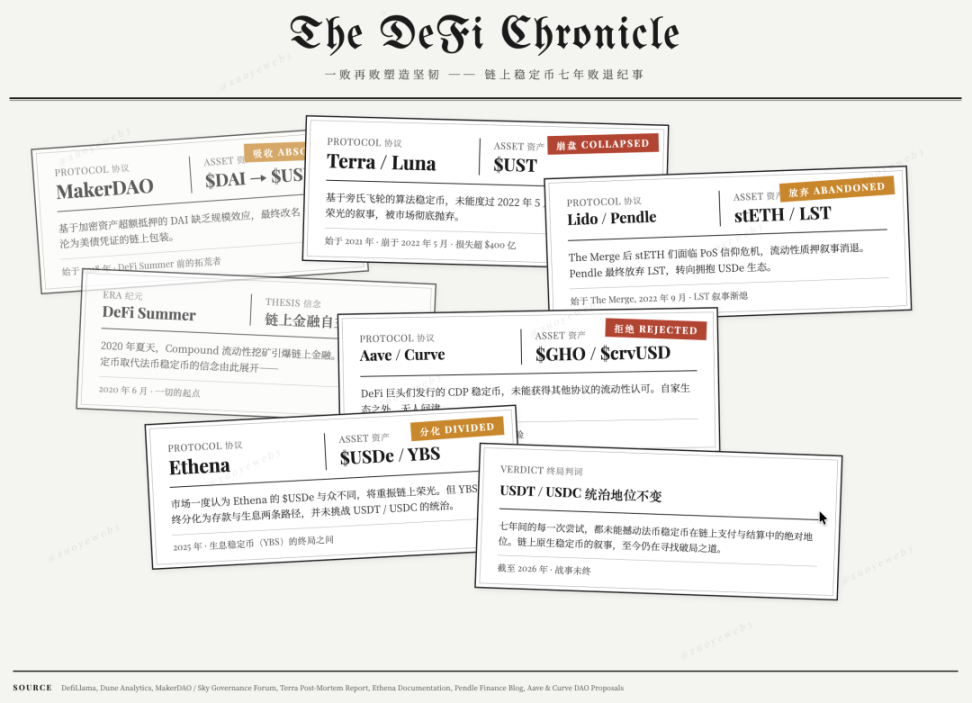
Image Caption: Stablecoin Chronicle

Image Source: @zuoyeweb3

Starting from the DeFi Summer of 2020, repeated defeats have forged resilience:

  • Starting in 2018, DAI based on crypto assets lacked scale, $USDS ultimately became a U.S. Treasury certificate

  • Starting in 2021, the ponzi-based $UST did not survive the 2022 bank run crisis; the story of rebuilding algorithmic stablecoin glory was abandoned

  • In 2022, stETH and others faced a PoS faith crisis post-The Merge; Pendle ultimately abandoned LST for USDe

  • In 2023/24, CDP stablecoins issued by DeFi giants like Aave/Curve were not recognized by other protocols

  • In 2025, the market once believed Ethena's $USDe was different, reviving on-chain glory, but yield-bearing stablecoins ultimately split into deposit and yield-bearing activities, failing to challenge the dominance of USDT/USDC in their respective domains.

The facts are very clear: it's not that USDT swallowed user profits, but that DeFi chose the scale effect of USDT/USDC.

Exchanging the Treasury profits generated by $300 billion for the entire market's trading foundation is not a bad deal for DeFi and the crypto market.

But at what cost?

The cost is not the evil claimed by yield-bearing stablecoin challengers that Tether takes profits, or the selfishness accused by Coinbase and Trump Jr. that banks prohibit interest-bearing accounts.

The bitter pill DeFi swallowed is that the U.S. Treasury rate, as the risk-free rate, is transmitted on-chain via stablecoins, but the U.S. Treasury is an asset of the U.S. government and its actions do not care about on-chain sentiments.

This is also the fundamental reason for the bankruptcy of tokenomics: UNI relies on A16Z, A16Z relies on USD financing, the USD is the embodiment of U.S. Treasuries, so UNI is just the fourth derivative relying on U.S. Treasuries. Why not just buy Treasuries directly, with no middleman taking a cut?

U.S. Treasuries are the de facto DeFi benchmark, but DeFi can only passively endure it, unable to interact with it bidirectionally. This is the root of all happiness or pain.
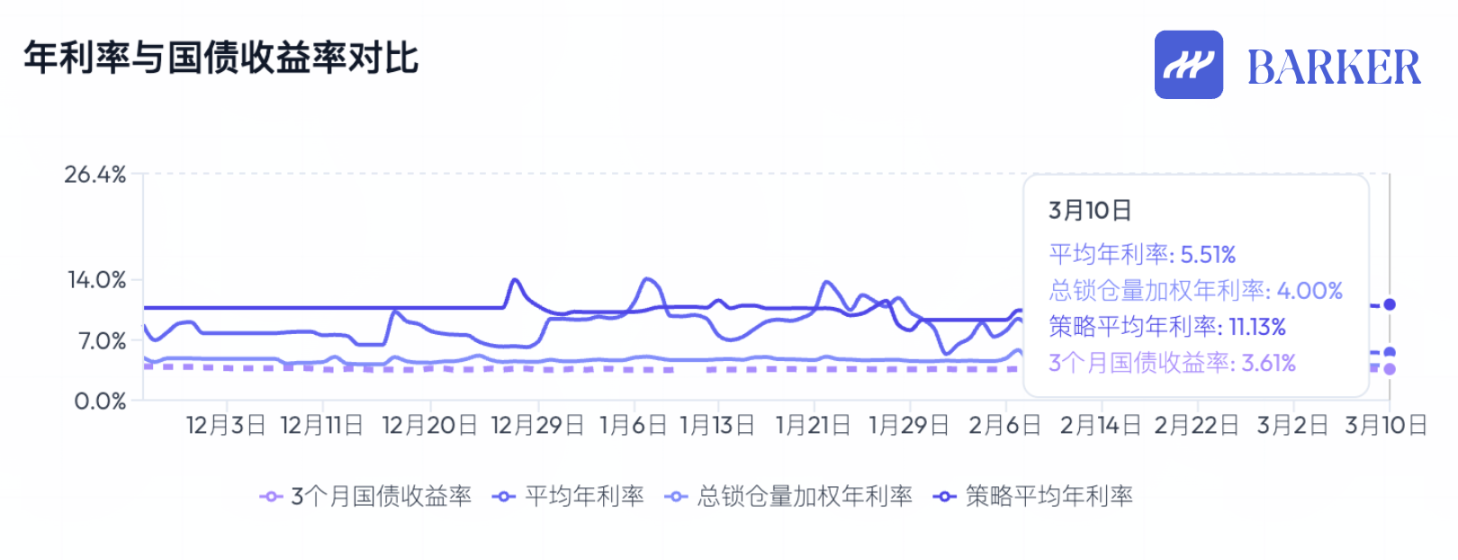
Image Caption: Comparison of On-Chain Stablecoin Yield APY and U.S. Treasuries

Image Source: @BarkerMoneyX

The salvation of DeFi never stops. Although tokenomics are bankrupt and DAO governance structures have collapsed, the overall direction of DeFi remains clear:

  1. Fixed-rate investment and financing,公认 risk grading system, unsecured credit lending –> The main themes of the next stage,蕴含某种形式的 mass-market products;

  2. The expansion period for public chains, exchanges, and DeFi protocols is over; new application forms are evolving into Vaults. It's not yet certain that Vaults are the form of mass-market products, but this is the starting point of the new stage.

Note here that public chains and exchanges are no longer the central links for value capture, but this does not mean their time is zero. Their period of asset price inflation is over, and only linear, steady growth remains.

This can also connect to the progressive relationship between UNI and U.S. Treasuries. Aave/Morpho are closer to asset management itself; their businesses don't have much narrative space, but are indispensable for the industry.

The real star products will definitely be Vaults used by the masses, based on public chains and DeFi protocols, utilizing分散 RWA assets, and triggering asset price inflation mechanisms.

For mass usage, Curators choose to ally with exchanges: Morpho enters Coinbase via Stakehouse, Aave expands to C-end users via Metamask and other U-cards.

Based on RWA assets, Curators partner with custodians like Galaxy to constantly maneuver between crypto and real-world assets, such as Grove buying Galaxy's CLO bonds.

But what's missing is the Vault that triggers the price inflation mechanism. Even before this wave of large-scale asset management moving on-chain, BlackRock's BUILD token was already live, and Circle's USYC also supports yield, but neither could replicate their own success.

It's not important that Vaults lack their own tokens. Asset price inflation is a mechanism. U.S. stocks, real estate, bonds, tulips, graphics cards, and Mac Minis all have their own price cycles. Current Vaults only have yield-bearing black boxes but始终 fail to solve two problems:

  1. Where does the high yield actually come from?

  2. How is high risk actually handled?

Towards a New Financial System

The form of channels is evolving; Vaults are not the endpoint.

The crypto industry evolves extremely fast. Before this year, we never dared to imagine that the global financial system would truly move on-chain, but today this is an undeniable ongoing process.

It's not yet time for a victory banquet. RWA can only serve as a funding source, Vaults are still boring deposit products, various Curators haven't demonstrated brand effects, and white-label Vaults like Veda are highly similar to SaaS, with the operator Curator only earning management fees.

This has no imagination for price inflation. If traditional asset management, with a scale of $2 trillion, endures cyclical煎熬, it's hard to imagine Vaults can withstand it.
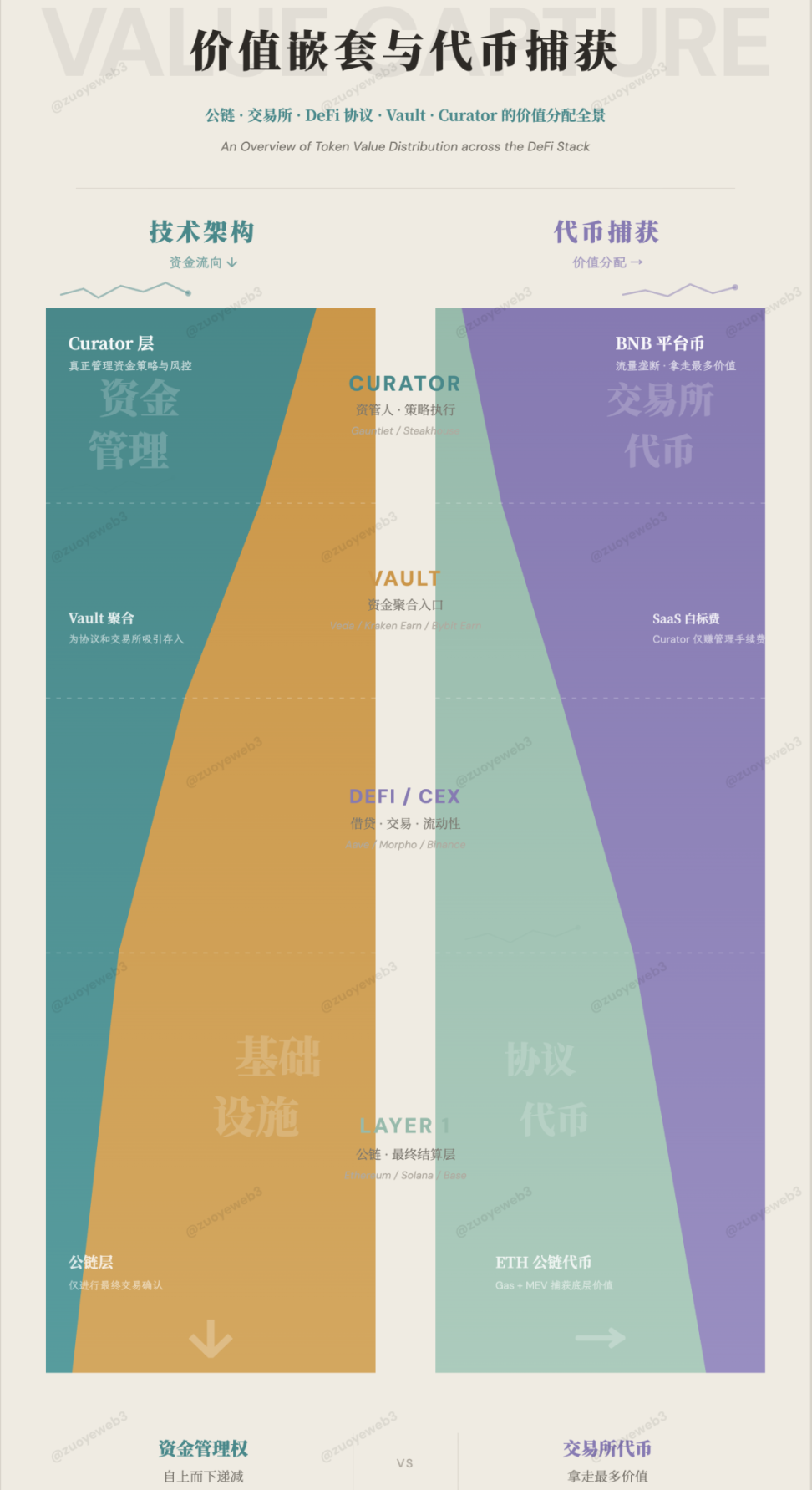
Image Caption: Fund Flows and Value Distribution

Image Source: @zuoyeweb3

Asset management moving on-chain is not driven by短暂 sentiment. In a sense, it's like the banking industry's IOE—you can't go back to the paper era. Even Spark has begun unifying the calculation of CEX/DEX position adjustment margins. DeFi is becoming the next step for TradFi.

Whether Vaults, after absorbing sufficient funds, will trigger the establishment of a risk-free rate is the biggest博弈 point of this cycle.

During the previous DeFi Summer, TVL was the decisive metric. The amount of资金 mapped to the get-rich coefficient of tokens, creating mining that continued into airdrop farming, studios, and Binance Alpha. The core logic was "projects need more funds to support token growth."

But with Vaults, for the first time, there is a huge demand for deposits but an inability to support their own tokens. Even if Morpho captures more market share from Aave, it cannot trigger a token surge.

Extending this, Hyperliquid compared to Binance, Lighter compared to Hyperliquid—their market sizes and token prices show a huge inversion. This is a great change unprecedented in DeFi.

On one hand, old infrastructure continues to吸血. For example, after the listing effect disappeared, $BNB should have declined, but CEXs still have a larger user base than the entire on-chain + DeFi. A very ironic fact: exchanges have retail users; DeFi protocols like Aave and Morpho have completely become the domain of a few professionals.

In this context, the high risk of Vault&Curator comes from code and structure:

  • Curve's immutable contract programming language can have problems; the xUSD team self-issued tokens

  • Aave ended the表面 harmony between the DAO and the development team; Re7 severely damaged on-chain asset management credibility

In this context, where does the high yield of Vault&Curator come from?

I know it's not regulatory arbitrage, HLP fees, or token incentives, but many still cling to these three, believing traditional finance's compliance creates too-big-to-fail credibility.

They completely forget that tokenomics are already bankrupt, while Vault deposits keep growing. Sky is already deeply integrated into the Morpho system, and the future of Aave V4 is also institutionalization and modularization.

Moreover, this article has always emphasized that the scale of Vault funds has not triggered some price inflation mechanism. This is the structural dilemma of Vaults.

The yield of Vaults essentially comes from the trading efficiency of global markets. If CEXs don't provide a certain Vault, then configure it on-chain. The personified Curator happens to be suitable for dealing with all sorts of people.

Even in TradFi's global markets, like U.S. stocks, one faces lengthy account opening, trading times, and process limitations. Can we really say that the gradual move towards全天候 trading for U.S. stocks and DTCC going on-chain is also for arbitrage?

The final question: What mechanism can actually trigger asset price inflation, allowing the funds沉淀 in Vaults to create a legendary price-to-dream ratio?

In other words, what is missing between Vaults and asset price inflation?

Channels are missing. Channels for funds to couple with each other. The personification of Curators hinders the programmability of DeFi Legos.

Currently, CEXs serve as a placeholder, still the fastest place for funds to intertwine.

Referencing the evolution of Perp DEXs, they are capturing market share from CEX futures. RWA funding sources are also抢夺 CEX market share.

CEXs only have存量. They themselves cannot solve user acquisition problems, let alone help Vaults expand to hundreds of millions of users. Vaults start by white-labeling, but in the future, they must build their own超级 factories.

I speculate the channel will be some form of Broker product.

Under高度 social division of labor, Super Apps like exchanges that integrate deposit/withdrawal, trading, custody, and清算 will gradually separate into different businesses. Binance's compliance framework in Abu Dhabi's ADGM is already divided into three parts.

This will fundamentally facilitate the professionalism of fund handling, utilize the unified ledger system of blockchain, and require the居中 coordination of Vault&Curator.

Referencing Neobrokers like Robinhood/Trade Republic, they attract年轻化, retail users to participate in professional trading, then build asset management, wealth management, and other business forms. The model of stablecoins at the front end and Curators managing Vaults is more efficient.

In summary, Binance monopolizes fund flow, BNB gets the strongest empowerment. Next, Brokers handle fund interaction. Some asset form, or even纯粹 business flow, could be highly profitable. After all, Robinhood is just a little disguise for a profitable market maker.

Conclusion

Compared to code and trading, regulation and tokens appear more stable.

Private credit and the RWA cycle have halted.抢先 issuing the 402 document feels prophetic. DeFi can serve as a liquidity exit channel, but it lacks the asset price inflation mechanism.

Asset Management ≈ Aave/Morpho will slowly, like public chains, end their historical mission. They will exist long-term but only with scale growth and stable token prices;

Vault&Curator ≈ Star fund managers are quickly acquiring customers and monopolizing markets. Giantization already shows preliminary signs. Whether they can continuously capture value is highly doubtful;

Channel ≈ CEX (temporary)反而 has the most innovation space. Facilitating the freedom of funds will always receive the highest reward.

A highly efficient global market is operating on a next-generation blockchain that doesn't need traditional tokens. This is the proposition of the next era, and everyone must provide an answer.


Twitter:https://twitter.com/BitpushNewsCN

Bitpush TG Discussion Group:https://t.me/BitPushCommunity

Bitpush TG Subscription: https://t.me/bitpush

Original Link:https://www.bitpush.news/articles/7618714

İlgili Sorular

QWhy does the article claim that DeFi has no risk-free rate, and what is the role of US Treasury bonds in this context?

AThe article states that DeFi lacks a true risk-free rate because it relies on USDT and USDC, which are backed by US Treasury bonds. These stablecoins transmit the US Treasury yield on-chain, but DeFi cannot interact with or influence US monetary policy, making it a passive recipient of this benchmark rate rather than an active participant in setting it.

QWhat is the significance of Vaults in the current evolution of DeFi and traditional finance integration?

AVaults represent a new application layer in DeFi, acting as on-chain asset management products that attract institutional and retail capital. They are seen as the starting point for mass adoption and value capture, but they currently lack a mechanism for asset price inflation and face challenges in generating sustainable yields and managing risks.

QHow does the article describe the relationship between CeFi (like CEXs) and DeFi in the context of global financial markets?

AThe article suggests that centralized exchanges (CEXs) currently serve as temporary channels for capital flow and liquidity, but their role may evolve as DeFi infrastructure matures. It predicts that super-apps like CEXs will eventually unbundle into specialized services (e.g., brokerage, custody), with DeFi Vaults and Curators facilitating more efficient global market operations.

QWhat are the main challenges facing Vaults and Curators in achieving sustainable growth and value capture?

AVaults and Curators struggle with two core issues: the source of high yields (beyond temporary incentives like token rewards or regulatory arbitrage) and the management of high risks (including smart contract vulnerabilities and governance failures). They also lack a price inflation mechanism to drive token value, unlike earlier DeFi protocols that benefited from TVL-driven speculation.

QWhat does the article propose as the potential solution to DeFi's structural limitations in establishing a independent financial system?

AThe article suggests that the future lies in creating efficient 'channels' or brokerage-like products that enhance capital fluidity and interoperability between TradFi and DeFi. This would involve unbundling CEX functions into specialized services, leveraging blockchain's unified ledger, and enabling Vaults to act as intermediaries for global asset allocation, ultimately fostering a new price discovery mechanism.

İlgili Okumalar

İşlemler

Spot
Futures

Popüler Makaleler

G Nasıl Satın Alınır

HTX.com’a hoş geldiniz! Gravity (G) satın alma işlemlerini basit ve kullanışlı bir hâle getirdik. Adım adım açıkladığımız rehberimizi takip ederek kripto yolculuğunuza başlayın. 1. Adım: HTX Hesabınızı OluşturunHTX'te ücretsiz bir hesap açmak için e-posta adresinizi veya telefon numaranızı kullanın. Sorunsuzca kaydolun ve tüm özelliklerin kilidini açın. Hesabımı Aç2. Adım: Kripto Satın Al Bölümüne Gidin ve Ödeme Yönteminizi SeçinKredi/Banka Kartı: Visa veya Mastercard'ınızı kullanarak anında Gravity (G) satın alın.Bakiye: Sorunsuz bir şekilde işlem yapmak için HTX hesap bakiyenizdeki fonları kullanın.Üçüncü Taraflar: Kullanımı kolaylaştırmak için Google Pay ve Apple Pay gibi popüler ödeme yöntemlerini ekledik.P2P: HTX'teki diğer kullanıcılarla doğrudan işlem yapın.Borsa Dışı (OTC): Yatırımcılar için kişiye özel hizmetler ve rekabetçi döviz kurları sunuyoruz.3. Adım: Gravity (G) Varlıklarınızı SaklayınGravity (G) satın aldıktan sonra HTX hesabınızda saklayın. Alternatif olarak, blok zinciri transferi yoluyla başka bir yere gönderebilir veya diğer kripto para birimlerini takas etmek için kullanabilirsiniz.4. Adım: Gravity (G) Varlıklarınızla İşlem YapınHTX'in spot piyasasında Gravity (G) ile kolayca işlemler yapın.Hesabınıza erişin, işlem çiftinizi seçin, işlemlerinizi gerçekleştirin ve gerçek zamanlı olarak izleyin. Hem yeni başlayanlar hem de deneyimli yatırımcılar için kullanıcı dostu bir deneyim sunuyoruz.

436 Toplam GörüntülenmeYayınlanma 2024.12.10Güncellenme 2025.03.21

G Nasıl Satın Alınır

@G Nedir

Graphite Ağı, $@G: Geleneksel Finans ve Web3 Arasında Köprü Kurma Graphite Ağı, $@G'ye Giriş Kripto para birimleri ve web3 projeleriyle dolu canlı dünyada, Graphite Ağı yeniliğin bir simgesi olarak ortaya çıkıyor. Yerel token'ı $@G ile bu Katman-1, Yetki Kanıtı (PoA) blok zinciri, geleneksel finans (TradFi) ile hızla gelişen Web3 ekosistemi arasındaki boşluğu kapatmak için tasarlanmıştır. Dijital para birimleri popülerlik kazandıkça, Graphite Ağı güvenlik, uyum ve hız önceliği olan bir blok zinciri platformu sunmayı hedefliyor ve kendisini güven ve hesap verebilirliğin bir kolaylaştırıcısı olarak tanıtıyor. Graphite Ağı, $@G Nedir? Graphite Ağı, yalnızca başka bir blok zinciri projesi değildir; dijital finans alanında merkeziyetsizlik, güvenlik ve kullanıcı hesap verebilirliğinin nasıl algılandığını yeniden tanımlamayı amaçlamaktadır. Proje, bir dizi ayırt edici özellik sunmaktadır: İtibara Dayalı Blok Zinciri: Graphite Ağı, entegre Müşterinizi Tanıyın (KYC) doğrulama ve puanlama mekanizmaları ile güçlendirilmiş bir kullanıcı başına bir hesap politikası uygular. Bu tasarım, kullanıcı gizliliği ile şeffaflık arasında bir denge sağlar; bu, günümüz dijital dünyasında finansal işlemlerin kritik bir yönüdür. Giriş Noktası Düğüm Geliri: Ağ, kullanıcıları giriş noktası düğümleri kurmaya teşvik eder ve operatörlerin ağ işlemlerinden ödüller kazanmasını sağlar. Bu gelir modeli yalnızca kullanıcı katılımını artırmakla kalmaz, aynı zamanda ağ sağlığını ve merkeziyetsizliği de güçlendirir. EVM Uyumluluğu: Ethereum uyumlu sanal makine (VM) ile Graphite Ağı, mevcut Solidity merkeziyetsiz uygulamaların (dApps) ve akıllı sözleşmelerin sorunsuz entegrasyonunu sağlar ve geliştiricilerin kapsamlı değişiklikler yapmadan yeteneklerinden yararlanmalarını davet eder. KYC Entegrasyonu: Uyumun en önemli olduğu bir çağda, çoklu doğrulama katmanları ile entegre KYC çerçevesi, zorunlu katılım olmaksızın finansal işlemler üzerindeki kontrolü artırır ve kullanıcı özerkliği için bir örnek teşkil eder. Graphite Ağı, $@G'nin Yaratıcısı Kimdir? Graphite Ağı, Graphite Vakfı'nın çabalarıyla doğmuştur; bu, Graphite Ağı'nın geliştirilmesi, bakımı ve evrimine adanmış kar amacı gütmeyen bir kuruluştur. Vakfın taahhüdü, projenin güvenli ve sürdürülebilir bir blok zinciri ortamı yaratma vizyonunu vurgular ve gerçek kullanıcı katılımı ile uyum odaklıdır. Graphite Ağı, $@G'nin Yatırımcıları Kimlerdir? Şu anda, Graphite Ağı girişimini destekleyen belirli yatırımcılar hakkında sınırlı bilgi bulunmaktadır. Kurucu kuruluş olan Graphite Vakfı, projenin büyümesini teşvik etmek için bağımsız olarak çalışmakta ve uyumlu ve erişilebilir bir blok zinciri platformu vizyonuna uygun ortaklıklar aramaktadır. Graphite Ağı, $@G Nasıl Çalışır? Graphite Ağı'nın işletimi, yüksek verimlilik ile merkeziyetsizlik arasında etkileyici bir denge kuran benzersiz Yetki Kanıtı konsensüs mekanizmasına dayanır. İşleyişini tanımlayan çeşitli bileşenlere bakalım: Taşıma Düğümleri: Giriş noktası düğümleri olarak hizmet eden bu düğümler, ekosistem için kritik öneme sahiptir. Operatörler, ağdan geçen işlemlerden gelir elde edebilir; bu, bireysel kullanıcıları güçlendirirken ağın merkeziyetsizliğini de artırır. Yetkili Düğümler: Graphite Ağı'nın kalbinde, sağlam KYC doğrulaması ve teknik değerlendirmeleri içeren titiz uyum testlerinden geçen temel doğrulayıcılar bulunmaktadır. Bu güven katmanı, ağ içindeki işlemlerin yüksek bir bütünlük seviyesini korumasını sağlamak için gereklidir. Ticker Sistemi: Graphite Ağı, sarılmış token'ları için @G olarak adlandırılan ayırt edici bir ticker sistemi kullanır. Bu özellik, varlık entegrasyonunda netliği artırarak kullanıcı işlemlerini anlaşılır ve basit hale getirir. Graphite Ağı'nın yenilikçi yaklaşımı, dijital finansın kritik sorunlarını ele almakta önemli bir adım olarak yansıyor ve daha fazla kullanıcının geleneksel finans biçimlerinden merkeziyetsiz uygulamalar dünyasına geçiş yapmasıyla gelecekte kendini olumlu bir şekilde konumlandırıyor. Graphite Ağı, $@G'nin Zaman Çizelgesi Graphite Ağı'nın ilerlemesini ve kilometre taşlarını anlamak için zaman çizelgesindeki önemli olayları gözden geçirmek faydalıdır: 2021: Graphite Vakfı tarafından Graphite Ağı'nın kuruluşu, uyum ve kullanıcı güçlendirmeye odaklanan blok zinciri geliştirme alanında yeni bir bölümün başlangıcını işaret eder. Ana Gelişmeler: Lansmanının ardından, giriş noktası düğüm geliri, itibara dayalı modelin kurulması, entegre KYC doğrulaması ve EVM uyumluluğunun sağlanması, projede önemli ilerlemeleri temsil eder. Son Faaliyetler: Graphite Vakfı'nın sürekli gelişim ve bakım çabaları, ağ özelliklerini artırmaya ve ekosistemin büyümesini teşvik etmeye odaklanarak sürdürülebilirlik ve yenilik için uzun vadeli bir taahhüt göstermektedir. Ek Anahtar Noktalar Temel bileşenlerinin ötesinde, Graphite Ağı, kullanılabilirliğini artıran birkaç araç ve özellik içermektedir: Graphite Cüzdanı: Kullanıcıların Ethereum uyumlu zincirler üzerindeki çeşitli ağ özelliklerine ve uygulamalarına erişimini kolaylaştıran kullanıcı dostu bir Chrome uzantısıdır. Graphite Köprüsü: Bu araç, Graphite varlıklarının farklı ağlar arasında sorunsuz bir şekilde transfer edilmesini sağlar ve entegre ve birlikte çalışabilir bir ekosistem oluşturur. Graphite Explorer: Ekosistem içinde temel bir araç olarak hizmet veren bu özellik, kullanıcıların akıllı sözleşme kaynak kodunu görüntülemesine ve doğrulamasına, işlemleri takip etmesine ve diğer önemli bilgileri gerçek zamanlı olarak keşfetmesine olanak tanır. Graphite Testnet: Proje, geliştiricilere ana ağ dağıtımından önce stabilite ve ölçeklenebilirliği sağlama imkanı sunan sağlam bir test ortamı sağlar. Bu girişim, yalnızca geliştiricileri güçlendirmekle kalmaz, aynı zamanda tüm ağın güvenilirliğini artırır. Sonuç Graphite Ağı, yerel token'ı $@G ile birlikte, geleneksel finans ile en son blok zinciri teknolojisi arasında köprü kurma yolunda önemli bir adımı temsil etmektedir. Güvenlik, uyum ve merkeziyetsizlik odaklı bu yenilikçi platform, Web3 dönemine geçişte liderlik yapmaya hazırdır. Kullanıcı katılımı arttıkça ve daha fazla proje yeteneklerinden yararlandıkça, Graphite Ağı hızla gelişen dijital manzaraya kalıcı katkılarda bulunmaya hazırlanıyor. Sonuç olarak, Graphite Ağı, yenilikçi düşüncenin modern finans ve teknolojinin artan talepleriyle buluştuğunda nelerin başarılabileceğinin bir kanıtıdır. Dünya merkeziyetsiz finansın potansiyelini keşfederken, Graphite Ağı bu alanda dikkate değer bir oyuncu olmaya devam edecektir.

8 Toplam GörüntülenmeYayınlanma 2025.01.06Güncellenme 2025.01.06

@G Nedir

Tartışmalar

HTX Topluluğuna hoş geldiniz. Burada, en son platform gelişmeleri hakkında bilgi sahibi olabilir ve profesyonel piyasa görüşlerine erişebilirsiniz. Kullanıcıların G (G) fiyatı hakkındaki görüşleri aşağıda sunulmaktadır.

活动图片