Author:Will Manidis
Compiled by: Deep Tide TechFlow
In 2004, if you asked a tech investor where the world's best software companies were located, they would give two answers: Boston and San Francisco.
Clearly, things are very different now. Over the past two decades, San Francisco has created $14 trillion in enterprise value, while Boston has contributed only $100 billion.
If you had told that investor back then that New York, once known for its "cocaine and pinstripe-suited financial glory," would replace Boston as a regional tech hub, they would have thought you were crazy.
So, why did Boston lose its status? This question is worth exploring in depth.
From an input perspective, the city seems to have all the advantages. Two of the world's top universities are located here (referring to Harvard University and MIT). The renowned startup incubator Y Combinator was also founded here. Without a doubt, it is one of the most beautiful cities in the United States. Mark Zuckerberg attended college here. The founders of Stripe, Cursor, and Dropbox also studied here. So, what went wrong?
To understand the scale of Boston's decline, we must remember that for decades, Boston's "Route 128" was the center of the software world. Digital Equipment Corporation (DEC) was once the world's second-largest computer company, employing 140,000 people at its peak. Lotus developed applications that were key to bringing businesses into the PC era. Akamai built the foundation of the modern internet. So, where did Boston go wrong?
This is a question worth discussing. However, anyone trying to answer it usually gives one of two answers:
- "Boston's decline began when Zuckerberg couldn't raise funds here and had to go to the West Coast."
- "Who says Boston is failing? We just led a Series F investment in TurboLogs at a $15 million valuation."
Of course, neither of these answers fully tells the story. Understanding Boston's real problem is not just a matter of survival for Boston but a key issue for the entire U.S. tech ecosystem.
My answer is simple: Boston's story shows what happens when negative cultural and regulatory feedback loops interact. As a tech ecosystem, the city's decline stems from three simple forces:
1. A progressive regulatory system that treats businesses as assets for property owners to exploit
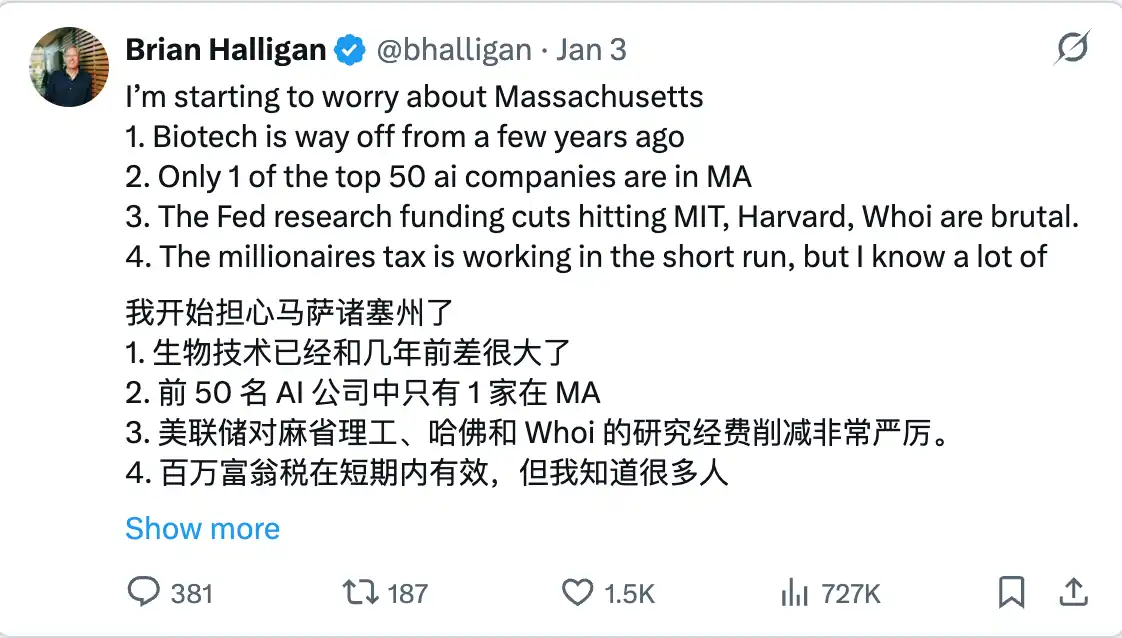
For decades, Massachusetts refused to comply with the federal Qualified Small Business Stock (QSBS) exemption rules. The state only began complying in 2022. However, that same year, they passed the "Millionaire's Tax." In Massachusetts, a founder selling a company for $10 million would pay $860,000 in taxes, while a founder in Austin would pay nothing. Additionally, Massachusetts imposes a 6.25% sales tax on SaaS (Software as a Service) revenue, while most states do not tax software at all.
2. A Puritan culture entrenched in elite institutions, making self-regulation difficult
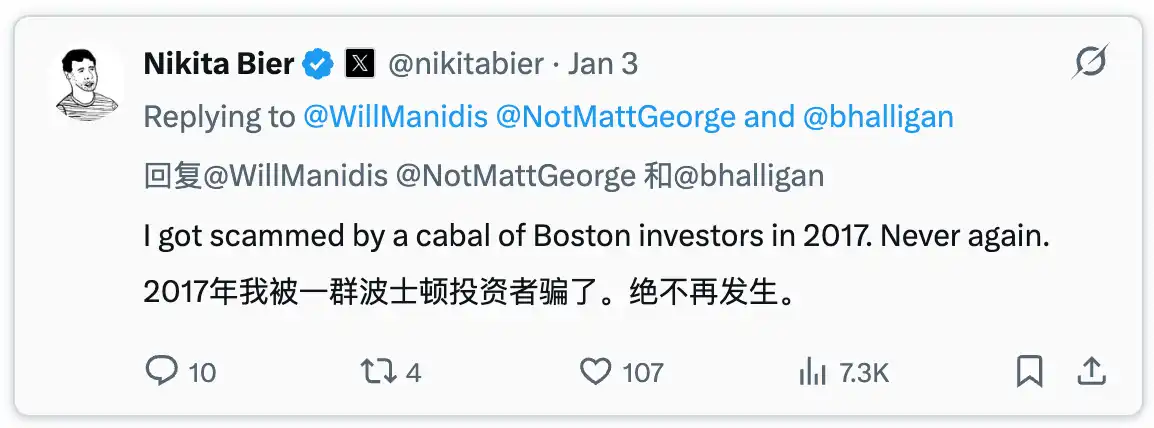
After 2010, the main activity of Boston's venture capital was no longer helping businesses grow but rather squeezing founders, almost like running an organized crime syndicate. The culture that should have overseen this behavior—including foundation donors, large limited partners (LPs), and the celebrities attending charity galas—was too closely tied to these perpetrators and their networks, so no one dared to speak out. This phenomenon has led to an invisible "trust tax" in Boston's business environment.
3. An "input-first" perspective on technological progress
We have the world's top universities, we've built vast laboratory spaces (though 40% are now vacant), and we've gathered the world's best talent. So, why isn't this working? Can't we build another innovation hub? Is our soil just not "magic"?
If these three explanations sound too simple or even familiar, it's because they are. This is a common problem facing the entire U.S. tech industry, and I suspect it could have equally fatal consequences.
Tech ecosystems are inherently fragile networks that generate trillions of dollars in tax revenue for their regions, but the parasitic host (referring to the government) cannot resist killing the "golden goose" every few decades.
Let's imagine what happens when the host rejects the ecosystem:
First, the talent network begins to disintegrate. Need to hire a VP of Engineering who has scaled a company from 25 to 500 people? In San Francisco, there are 600 candidates; in Boston, there are only 5, and soon those 5 will also leave for San Francisco, where they can demand higher salaries and have a higher chance of success. As for junior talent, new graduates no longer stay local; they take the first flight out every summer.
As the network dissipates, the state government "tightens its grip," trying to extract the same amount of revenue from those who remain. And as the ecosystem collapses, some bad actors start profiting through various means: for example, through preferential pricing ("Who would fly to Boston for a seed round? Fine, we'll accept a $10 million valuation") or through more unscrupulous methods, such as extorting founders through non-market or even illegal means (refer to some legally shareable stories shared by Nikita and others on Twitter). Even some companies that started in Boston and moved to the West Coast retained a degree of "organized crime" behavior (except for Matrix, they're good people).
These issues are complex, involving human nature and reality. They not only destroy cities and people's lives but also lead to the loss of trillions of dollars in enterprise value, all due to the state government's short-sighted actions.
The worst part: this loss is irreversible.
Although I deeply sympathize with those calling for Boston to revive as a great tech ecosystem—I myself would love to move back and avoid New York's chaos—I find it hard to imagine that the remaining ecosystem won't collapse completely.
You cannot legislate your way out of a collapsing network, nor can you reboot a network that has already imploded.
However, both San Francisco and the entire U.S. tech ecosystem seem to be heading toward the same fate: a regulatory system that treats tech as a "cash cow." Examples include Proposition M (a bill limiting commercial real estate development) and office vacancy taxes.
Meanwhile, a culture deeply embedded in elite networks struggles to self-regulate. Artificial intelligence (AI) has attracted many bad actors into the ecosystem, and the kind of rigidity that Boston once found difficult to clean up is now taking root here as well.
Add to that the "input-first" progressive notion: We have the best AI labs, we have the most GPUs (graphics processing units), even the president bought us some GPUs. We have the most advanced models. So, what could go wrong?
The difference lies in the cost. Boston's collapse cost the U.S. hundreds of billions of dollars in enterprise value, while San Francisco's decline would erase one-third of the U.S.'s GDP growth over the past decade.
But the problem isn't just economic failure. It's a failure of survival.
Our tech industry has failed to provide a clear rationale for its existence at the national level. If this issue isn't addressed, 2028 will become a referendum on "imprisoning, destroying, and plundering the tech industry," with the trigger being accusations about water and energy usage.
Right now, the AI boom's public perception is not ambiguous. Recent polls show that the average American believes AI is something that wastes water, drives up energy costs, and in return delivers tools that deceive the elderly, expose children to inappropriate sexual content, promote sports gambling, and commit various other evils.
If our best answer to "why shouldn't we imprison tech executives, burn down data centers, and destroy the U.S. tech industry" is: "so we can build better chatbots for your sports betting," then voters will not hesitate to vote in favor of those actions.
In a zero-sum world, voters won't consider long-term benefits; they will first feel envy, then start plundering. We don't plunder sewage systems or power grids because we know they are defenses against chaos. We accept their costs because they hold back chaos. So, does the average voter also see tech as playing a similar role?
Technology is our only way out of the Malthusian trap. However, because we are too cowardly to articulate this clearly, because we have replaced a clear theory of progress with "rationalism" and "Artificial General Intelligence (AGI)," the nation sees the tech industry as a parasite to be squeezed dry.
If we cannot clearly express why innovation is a moral necessity, we can only watch the entire tech industry follow in Boston's footsteps: first taxed, then plundered, and finally drained. And we will be left wondering: Where did it all go?
In a zero-sum world, voters won't look to the long term; they will first feel envy, then start plundering. We don't plunder sewage systems or power grids because we understand they are barriers against chaos. We accept their costs because they hold chaos at bay. So, does the average voter also believe that tech serves a similar role for society?
Technology is our only escape from the Malthusian trap. However, because we are too timid to state this clearly, because we have replaced a coherent idea of "progress" with "rationalism" and "AGI," the nation sees the tech industry as a parasite that can be milked dry.
If we cannot articulate why innovation is a moral imperative, we can only watch the entire tech industry retrace Boston's path: first taxed, then plundered, and finally exhausted. And we will be left puzzled, asking: Where did it all go?






