‘The Big Short’ Prototype Doubles Down on AI Crash Bets: Continues Shorting Nvidia and Palantir, While Buying Software Stocks

marsbit2026-05-09 tarihinde yayınlandı2026-05-09 tarihinde güncellendi

Özet

Michael Burry, the investor made famous by "The Big Short" for betting against the subprime mortgage bubble, is now building a comprehensive portfolio to bet against the AI rally. He maintains and has increased his bearish bets on AI beneficiaries Nvidia and Palantir, while expanding his short positions to include semiconductor ETF SOXX, Nasdaq 100 ETF QQQ, and Oracle. Concurrently, he is buying shares of traditional software companies like Adobe, Autodesk, Salesforce, and Veeva Systems, which have seen their prices decline amid the AI frenzy. Burry's core thesis is that an "AI infrastructure overbuild" is creating a bubble, drawing parallels to the dot-com era. He argues that major cloud customers are extending GPU depreciation schedules to inflate profits and that current capital expenditures are based on overly optimistic demand forecasts. While his short on Palantir is currently profitable, his Nvidia put options are underwater as the stock nears all-time highs. The combination of shorting high-flying AI stocks and buying depressed "AI victim" stocks forms a market-neutral hedge. Burry is betting that a repricing of the AI narrative will punish the former group while benefiting the latter.

Author: Claude, Shenchao TechFlow

Shenchao Insight: As the Nasdaq hits consecutive record highs and Nvidia's market cap nears $5.3 trillion, Michael Burry, the investor who famously shorted the subprime mortgage market during the 2008 financial crisis and was immortalized in the movie "The Big Short," is doubling down on a contrarian bet.

He is not only maintaining his bearish bets on Nvidia and Palantir but also expanding his short positions to include semiconductor and Nasdaq ETFs. Simultaneously, he is buying traditional software stocks that have been pressured by the AI narrative, constructing a complete portfolio betting on a "re-pricing of the AI bubble."
The Nasdaq index set new record highs this week, closing at around 26,247 points on May 8, with the S&P 500 also hitting a record the same day. The Philadelphia Semiconductor Index has risen about 55% since Q2, and Nvidia's stock price is nearing its all-time high of $217.80, with its market cap surpassing $5.2 trillion. The AI-driven tech stock frenzy is at its most fervent stage.

Yet, at the market's most euphoric moment, an investor famous for his contrarian bets is heavily increasing his wager in the opposite direction.

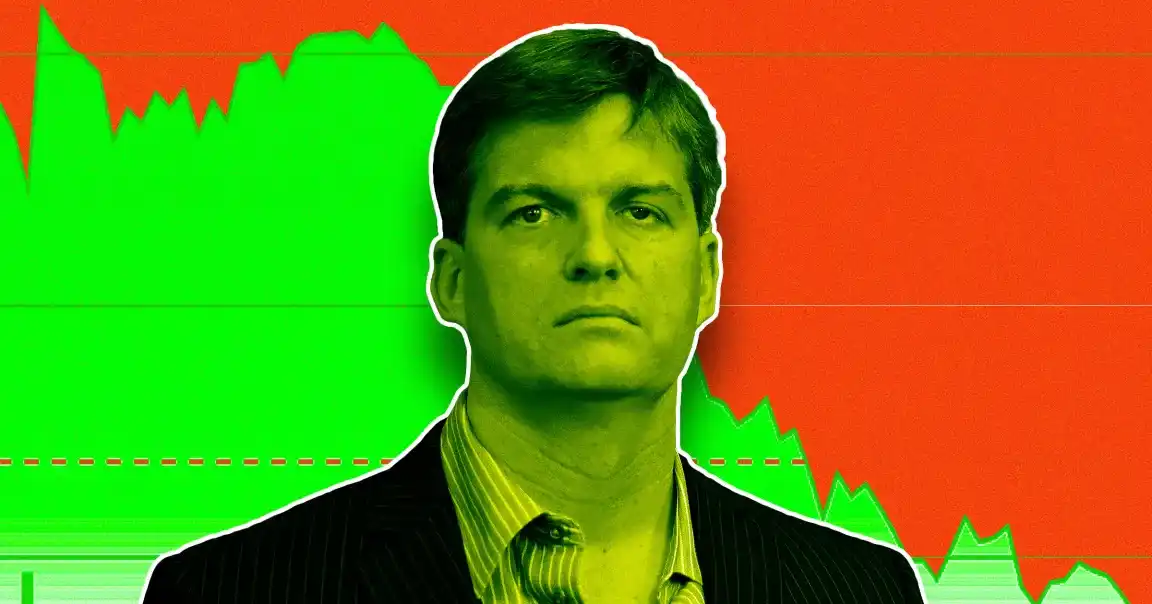
According to a Foreign Policy Journal report on May 7, hedge fund manager Michael Burry, whose prediction of the 2008 crisis was adapted into "The Big Short," disclosed his latest portfolio adjustments in his Substack column "Cassandra Unchained" this week:

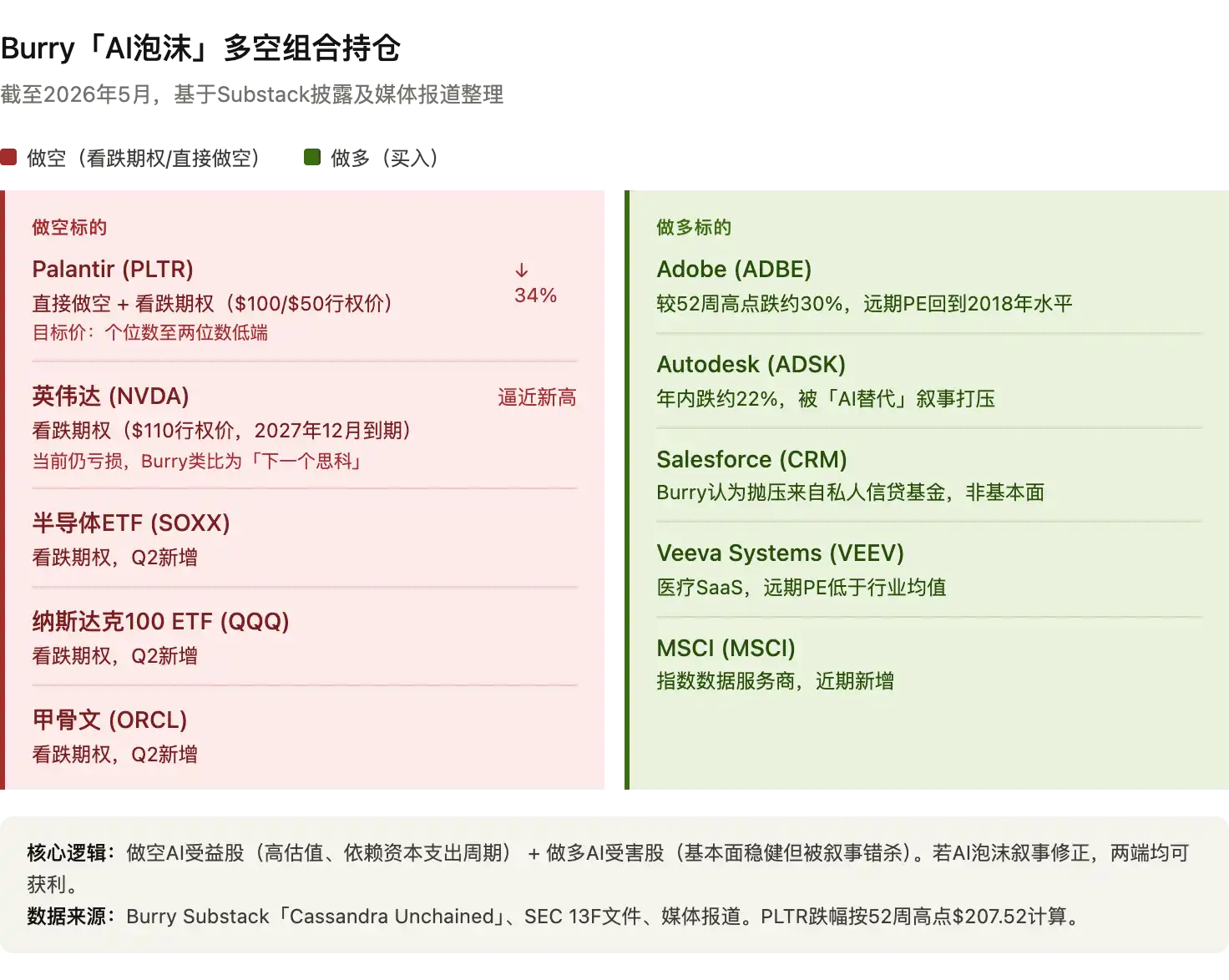
He not only maintained his put options on Nvidia and Palantir but also added a direct short position on Palantir and increased his bearish bets on the semiconductor ETF (SOXX), the Nasdaq 100 ETF (QQQ), and Oracle.

At the same time, he began buying a batch of traditional software companies marginalized by the AI hype, such as Adobe, Autodesk, Salesforce, and Veeva Systems, arguing that their stock price declines stem from panic selling rather than deteriorating fundamentals.

Thus, a complete "Big Short" hedge portfolio has emerged, with a core logic of shorting AI beneficiaries and longing AI casualties.
Starting with the $1.1 Billion Bet Last November

Burry's shorting of the AI sector began in Q3 2025.

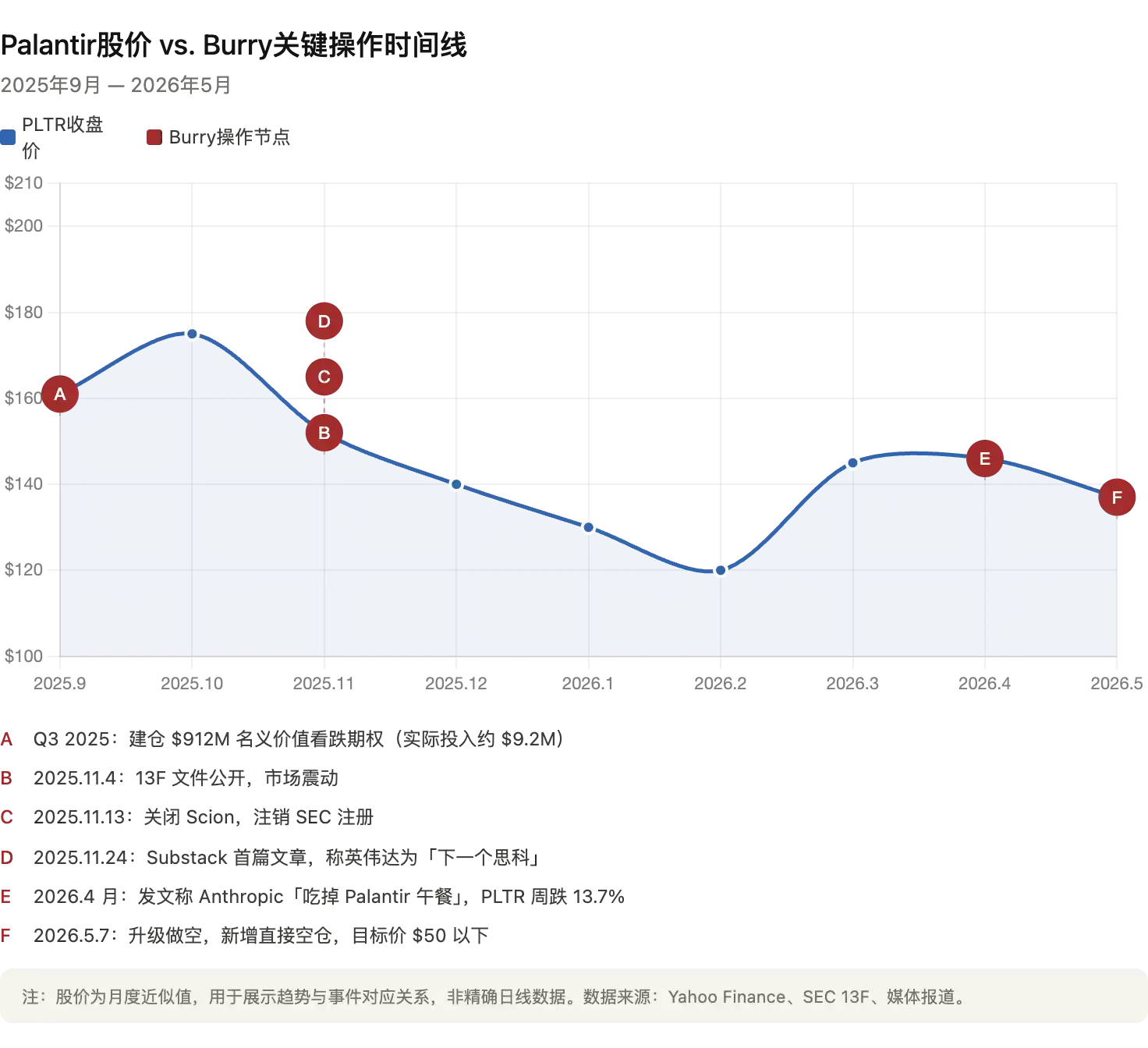
At that time, the 13F filing of his hedge fund, Scion Asset Management, showed he had purchased put options on Palantir with a notional value of about $912 million and on Nvidia with a notional value of about $187 million. When this news was released last November, it shook the market, putting pressure on Palantir and Nvidia's stock prices.

However, Burry later clarified on platform X that his actual capital outlay was about $9.2 million, not the widely reported $912 million—the latter being the notional value of the option contracts, a difference of nearly 100 times. This detail is crucial: the notional value in 13F filings is often misread as the actual invested capital, thereby exaggerating the trade's size.

Shortly after the disclosure, Burry announced the closure of Scion Asset Management and deregistered with the SEC, ending his career of managing external funds.

He subsequently transitioned to being a personal investor and opened a column named "Cassandra Unchained" on Substack (Cassandra being the Greek mythological prophetess who foretold the truth but was never believed), where he continues to publish market analysis.
Palantir Short is Paying Off, But Burry Says "Hasn't Fallen Enough"

In terms of trading results, Burry's Palantir bet is currently profitable. Palantir's stock price has fallen from around $161 when he entered to around $137 currently, down about 34% from its 52-week high of $207. Despite the company recently releasing stellar Q1 2026 earnings (revenue up 85% year-over-year), its stock price actually declined after the report.

Burry has not taken profits. According to his Substack disclosure, he currently holds put options expiring in December 2026 with a strike price of $100, and put options expiring in June 2027 with a strike price of $50, indicating he expects Palantir to fall more than 60% from current levels within the next year. He explicitly stated in a post that Palantir's fair valuation is only in the "single digits to low double digits."

In April this year, Burry posted on Substack stating that Anthropic is "eating Palantir's lunch," noting that this AI safety company's revenue growth rate has exceeded an annualized $300 billion level, and its more user-friendly, lower-cost AI integration tools are replacing Palantir's complex enterprise deployment solutions. After the post, Palantir's stock fell 13.7% in a week, and Burry later deleted it. Wedbush analyst Dan Ives dismissed this view as "fiction," and Palantir CEO Alex Karp had previously publicly stated he "could not understand" Burry's short stance.
Nvidia Short is Still Losing, But Burry Insists "AI is the Bubble"

Compared to the victory with Palantir, Burry's situation with Nvidia is completely different.

Nvidia's stock price closed around $215 on May 8, nearing its all-time high of $217.80, with a market cap of about $5.3 trillion. It is reported that Burry holds Nvidia put options with a strike price of $110, expiring in December 2027, which are currently in deep loss. However, he has not reduced his position; instead, he continued adding to it in his recent portfolio adjustments.

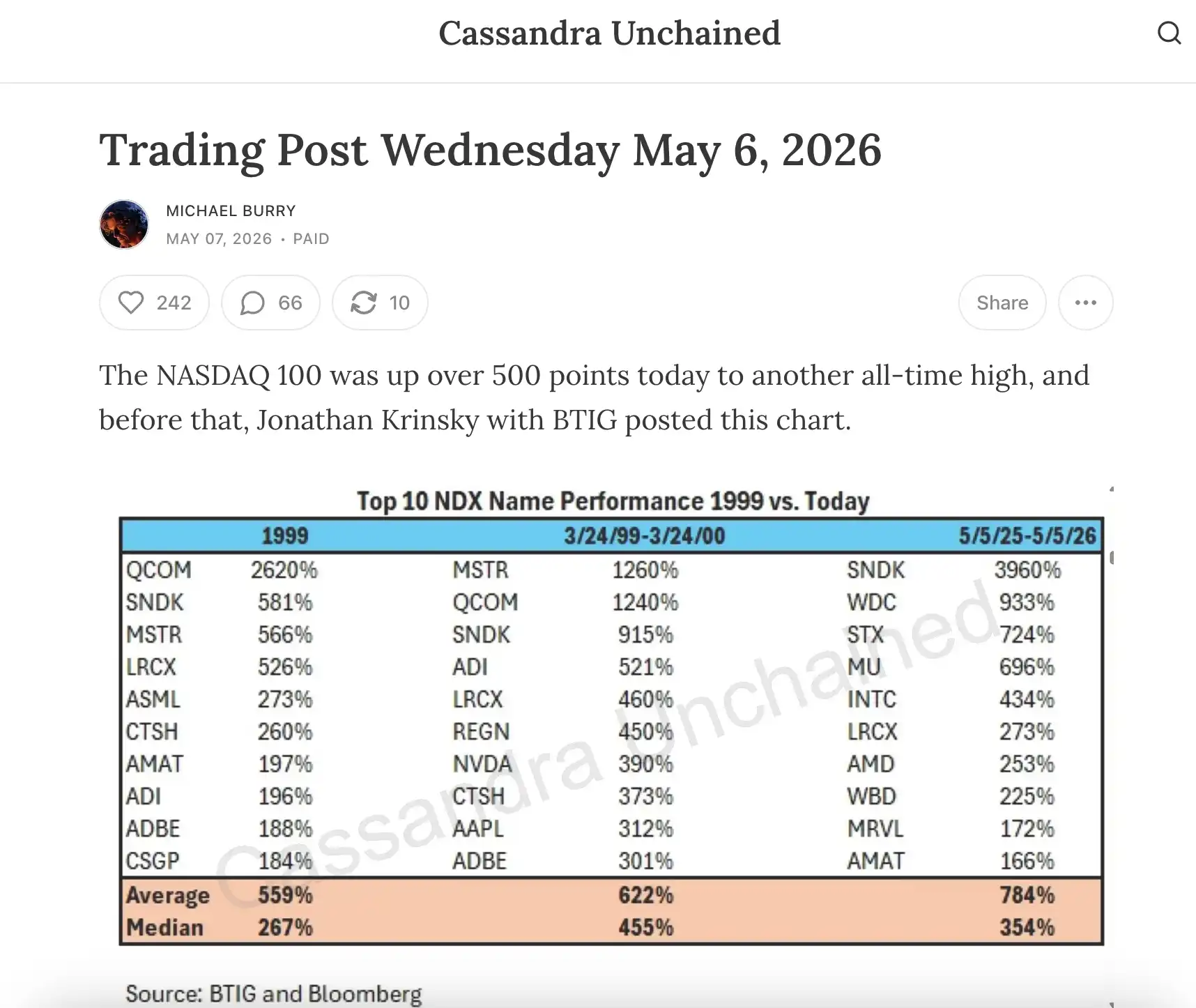
The core logic behind Burry's Nvidia short is "overbuilding of AI infrastructure." In his first Substack article last November, he compared the current AI investment frenzy to the internet bubble of the late 1990s, likening Nvidia to Cisco back then. Cisco's stock rose 3,800% between 1995 and 2000, once becoming the world's most valuable company, before plummeting over 80% during the dot-com bust.

Burry's key arguments include: Hyperscale customers like Microsoft, Google, Meta, Amazon, and Oracle are extending GPU depreciation schedules to beautify their financial reports; he estimates that between 2026 and 2028, these accounting treatments will cumulatively understate approximately $176 billion in depreciation expenses, inflating the entire industry's profits. Furthermore, he argues that the massive capital expenditure on current AI infrastructure is built on overly optimistic demand forecasts, mirroring the situation when telecom companies frantically laid fiber optic cables around 2000.

This viewpoint drew a direct rebuttal from Nvidia. According to CNBC, Nvidia privately distributed a seven-page memo to Wall Street sell-side analysts, responding point-by-point to Burry's allegations, specifically citing Burry's X platform posts as sources of information needing refutation. Nvidia stated in the memo that its customers set GPU depreciation periods at four to six years based on actual useful life, and early products (like the A100 released in 2020) still maintain high utilization rates. Burry responded, "I'm not saying Nvidia is Enron," but stood by his analysis.

Going Long on AI-Pressured Software Stocks: A Complete Bubble Hedge Portfolio

Perhaps the most noteworthy aspect of Burry's portfolio adjustments is not the shorts themselves, but his long positions.

He recently bought stocks like Adobe, Autodesk, Salesforce, Veeva Systems, and MSCI. The common characteristic of these companies is: their business fundamentals remain robust, but their stock prices have suffered significant declines due to the market narrative of "being disrupted by AI" and forced selling by private credit funds.

Adobe is currently down about 30% from its 52-week high, Autodesk is down about 22% year-to-date, and both have seen their forward P/E ratios fall back to 2018-2019 levels.

Burry explained on Substack that he "does not believe the technical selling pressure from private credit and software debt is sufficient to impact these stocks in the long term." In other words, he believes the market is over-penalizing companies labeled "AI losers" and over-praising those labeled "AI winners"—and he is betting on a correction of this mispricing.

Looking at both the short and long sides together, Burry has constructed a typical long/short hedge portfolio: If the AI bubble narrative bursts, high-valuation beneficiaries like Nvidia and Palantir will bear the brunt, while wrongly punished traditional software stocks may see valuation recovery. Even if the overall market declines, this structure could potentially achieve positive returns.

In his letter to investors when closing Scion, Burry admitted: "My judgments on the value of securities have been out of sync with the market for a long time now." This statement is both self-reflection and seems like his consistent manifesto.

At the peak of the AI frenzy, he chooses to stand against the crowd.

İlgili Sorular

QWho is Michael Burry and what is his current investment stance regarding the AI sector?

AMichael Burry is the hedge fund manager famously portrayed in the movie 'The Big Short' for his successful bet against the subprime mortgage market. He is now adopting a contrarian position against the AI sector. His strategy involves shorting AI-beneficiary stocks like Nvidia and Palantir, as well as related ETFs like SOXX and QQQ. Simultaneously, he is buying undervalued traditional software stocks like Adobe, Autodesk, Salesforce, and Veeva Systems, which have been sold off due to the AI narrative. He views the current AI investment surge as a bubble comparable to the dot-com era.

QWhat are the key details of Michael Burry's bearish bets on Palantir?

AMichael Burry's bearish bets on Palantir involve both put options and direct short positions. He holds put options with a strike price of $100 expiring in December 2026 and a strike price of $50 expiring in June 2027. This indicates he expects Palantir's stock to fall significantly from its current price of around $137. He has stated that Palantir's fair valuation is in the 'single digits to low double digits.' Despite Palantir reporting strong Q1 2026 earnings, Burry's position is currently profitable as the stock has declined from his entry point.

QWhat is the core reasoning behind Michael Burry's short position on Nvidia?

AMichael Burry's core argument for shorting Nvidia is his belief in an 'AI infrastructure overbuild' bubble. He compares the current AI investment boom to the dot-com bubble and likens Nvidia to Cisco during that period. His key points include: 1) Major cloud customers (Microsoft, Google, Meta, Amazon, Oracle) are extending the depreciation life of GPUs to artificially boost their earnings, which he estimates could inflate industry profits by $176 billion between 2026-2028. 2) The massive capital expenditure on AI infrastructure is based on overly optimistic demand forecasts, similar to the telecom fiber overbuild in the early 2000s. He believes this will lead to a significant correction.

QWhich companies is Michael Burry buying as part of his 'AI bubble re-pricing' strategy, and why?

AMichael Burry is buying traditional software companies like Adobe, Autodesk, Salesforce, Veeva Systems, and MSCI. He is investing in them because he believes these stocks have been unfairly punished by the market's 'AI disruption' narrative and technical selling pressure from private credit funds, despite their fundamentally sound businesses. Their stock prices and forward P/E ratios have fallen to levels seen in 2018-2019. Burry's thesis is that the market has over-penalized these 'AI losers' and over-hyped the 'AI winners,' creating a mispricing he aims to profit from when the narrative corrects.

QWhat is the overall structure of the portfolio Michael Burry is building, and what is its intended purpose?

AMichael Burry is building a long/short hedge portfolio designed to profit from a potential correction in the AI narrative. The structure is: Short side: Betting against high-valuation AI beneficiary stocks (Nvidia, Palantir) and related ETFs (SOXX, QQQ). Long side: Buying undervalued traditional software stocks (Adobe, Autodesk, Salesforce, Veeva) that have been sold off as 'AI losers.' The intended purpose is that if the AI bubble narrative bursts, the short positions would profit from the decline of overvalued stocks, while the long positions could benefit from a valuation rebound in the oversold stocks. This structure aims to generate positive returns even if the overall market declines.

İlgili Okumalar

Micron Shuts Up the Bears, Makes India's 'Buffett' Regret: Sold Too Early, Missed Out on $2 Billion

Indian value investor Mohnish Pabrai, a disciple of Warren Buffett, revealed his costly mistake of selling shares in Micron Technology too early. He initially invested in 2017, holding it for six years and building a position as large as 77% of his portfolio, based on a thesis that the memory chip industry would consolidate into a stable oligopoly of Samsung, SK Hynix, and Micron. However, he sold his entire stake in September 2023, fearing oversupply after Samsung announced production expansion. Shortly after his exit, demand for high-bandwidth memory (HBM) surged with the rise of AI, and Micron's stock price skyrocketed over 15 times in two years. Pabrai estimates this premature sale cost him roughly $20 billion in potential gains. He expressed similar regret over selling his investment in SK Hynix too soon, stating he violated his own principle of holding companies forever. Reflecting on these errors, Pabrai emphasized his core investment checklist principles: avoiding leverage, focusing on the durability of a company's competitive moat, and assessing management's character. Despite these personal trading missteps, his long-term view on the remaining memory chip leaders remains bullish, advising current holders not to sell as "the party is just getting started." He concluded by sharing his philosophical outlook, prioritizing character over wealth, and his goal to donate his entire fortune before his passing.

marsbit5 dk önce

Micron Shuts Up the Bears, Makes India's 'Buffett' Regret: Sold Too Early, Missed Out on $2 Billion

marsbit5 dk önce

Mihoyo's Next Protagonist Is Her, Who Plays the Piano

Mihoyo, widely recognized for its hit game Genshin Impact, has long harbored a grander ambition: creating a virtual world where one billion people would want to live. While its character design is unparalleled, the company recognizes a fundamental limitation—these beloved virtual characters are not truly "alive." Their dialogue and actions are pre-scripted. This drive for authentic "living" characters has guided Mihoyo's strategic investments in cutting-edge fields like brain-computer interfaces, AI (including an early investment in MiniMax), and nuclear fusion. Following the release of ChatGPT in late 2022, co-founder Cai Haoyu stepped down from management to lead a new overseas AI venture, Anuttacon, focused on creating AI-driven virtual beings. Mihoyo's path has involved experimentation and iteration. Anuttacon's early project, *Whisper of the Stars*, showcased real-time AI conversation but revealed limitations in underlying language models. The team subsequently focused its resources on developing a sophisticated "emotional" large language model, distinct from purely utilitarian AI. Co-founder Liu Wei (Dawei) announced plans to invest up to 100 billion RMB in this AI pursuit. The first tangible product of this vision is *BSide: Olivia Lin*, a free Steam application featuring a piano-playing virtual companion. Unlike typical AI chatbots demanding constant interaction, Olivia Lin operates on a slower, more deliberate rhythm—responding to letters, playing user-submitted melodies, and serving as a desktop presence. This design emphasizes "lifelikeness" over exhaustive conversation, strategically working around current technological constraints while building a sense of authentic connection. The company's journey traces back to its name, "miHoYo," where "mi" pays homage to the virtual singer Hatsune Miku. For nearly two decades, fans have loved Miku, a character unaware of their devotion. Mihoyo's ultimate goal, now backed by massive investment and AI research, is to bridge that gap—to create virtual beings that can truly know they are loved.

marsbit23 dk önce

Mihoyo's Next Protagonist Is Her, Who Plays the Piano

marsbit23 dk önce

Citrini Research: Taking Stock of 5 Major Investment Themes Overshadowed by the AI Trade

Citrini Research identifies five under-the-radar investment themes potentially overshadowed by the dominant AI trade. With capital and analyst attention overwhelmingly focused on AI infrastructure, these overlooked areas present alpha opportunities as market dynamics shift. **Theme 1: Airlines** – Despite strong fundamentals, stocks like Delta and United have been penalized for 18 months due to macro concerns (tariff-inflation, oil prices), not profitability. A rebound is expected as these headwinds fade, aided by trends like premiumization and the 2026 World Cup. **Theme 2: Senior Housing** – A pure demographic play. The U.S. population over 80 is projected to grow 56% in the next decade, drastically outpacing supply. This creates a compelling need for facilities, benefiting REITs like Welltower and operators like Brookdale. **Theme 3: Live Events & Entertainment** – "Being there" is becoming a luxury. This sector has outperformed even tech over the past decade. Companies like TKO Group (WWE/UFC), Cinemark, and IMAX are capitalizing on demand for premium, in-person experiences. **Theme 4: Exchange Competition** – CME Group's ~98% monopoly in U.S. interest rate derivatives faces its first real challenge from FMX Futures Exchange. Backed by major Wall Street banks, FMX offers lower fees and margin savings. While CME's deep liquidity remains an advantage, FMX provides a competitive alternative. **Theme 5: Fintech Recovery** – Heavily sold off in 2026, fintech stocks like SoFi, Robinhood, and Upstart are showing signs of a rebound based on improving fundamentals—SoFi's stablecoin launch, Robinhood's transformation into a "financial super app," and Upstart's renewed AI lending narrative—rather than a change in sector outlook. The report advises maintaining some AI exposure but diversifying into these neglected "small themes" where mispricing exists due to a simple shortage of investor attention.

marsbit59 dk önce

Citrini Research: Taking Stock of 5 Major Investment Themes Overshadowed by the AI Trade

marsbit59 dk önce

21Shares Mid-Year Key Report: Bitcoin's Four-Year Cycle Remains Intact, Stablecoins and Tokenization Emerge as New Growth Engines

21Shares Mid-Year Report 2026: Bitcoin Cycle Intact, Stablecoins & Tokenization Emerge as New Engines This mid-year review assesses progress against 21Shares' ten predictions for 2026. While the overarching shift from narrative to fundamentals holds, performance varies. Key findings show Bitcoin's four-year cycle remains evident despite market maturation. Global crypto ETP AUM has declined to ~$140B, lagging the $400B target, though product innovation continues. Stablecoin supply surpassed $320B, demonstrating non-cyclical demand but falling short of the $1T forecast due to slower regulatory clarity. DeFi TVL, stalled at ~$140B, was hindered by major security incidents. Corporate crypto treasuries hold ~1.28M BTC ($100B), with consolidation pressuring weaker players. Prediction markets are on track, with $57.5B volume already surpassing half the $100B annual target. AI agent infrastructure is ready, but adoption is early. Ethereum L2 consolidation is underway, with the top 5 capturing nearly 90% of activity. Compliant token launches have a platform but lack mainstream volume. Tokenized RWAs total ~$31B on public chains, but institutional pipeline growth is strong. In summary, fundamentals like stablecoins, tokenization, and prediction markets are advancing, but targets require faster adoption or price appreciation. The market is maturing, yet cyclical patterns persist.

marsbit1 saat önce

21Shares Mid-Year Key Report: Bitcoin's Four-Year Cycle Remains Intact, Stablecoins and Tokenization Emerge as New Growth Engines

marsbit1 saat önce

İşlemler

Spot
Futures
活动图片