The Banking Industry's Resistance: The Endless Debate Over Stablecoin Interest Payments

marsbit2026-01-09 tarihinde yayınlandı2026-01-09 tarihinde güncellendi

Özet

The article discusses the ongoing regulatory debate in the U.S. regarding interest payments on stablecoins. The proposed *GENIUS Act* currently prohibits stablecoin *issuers* from paying interest to holders. However, platforms like Coinbase can still offer yields (e.g., 3.35% on USDC) because they act as *distributors*, not issuers. This loophole has sparked a significant political battle. The American Bankers Association (ABA) is leading efforts to expand the interest ban to include distributors in the upcoming *Crypto Market Structure Bill*. Banks argue that stablecoins threaten their deposit base, reduce lending capacity, and lack FDIC insurance, thereby endangering their traditional business model. The crypto industry strongly opposes this expansion. Coinbase's Chief Policy Officer argues stablecoins haven't caused significant bank deposit outflows. Think tank Paradigm suggests that banning interest on stablecoins used for payments would be akin to a "holding tax" on consumers. The article contrasts the U.S. situation with approaches in China and South Korea. China's digital yuan (a CBDC) pays interest to promote adoption, while South Korea's policy mirrors the current U.S. stance—banning issuer interest but not distributor interest. The conclusion warns that if the ABA's lobbying succeeds, it would cripple the crypto industry. It argues that traditional finance should adapt to innovation, citing examples of banks and asset managers (like BNY Mellon, JPMorgan, and Bla...

Written by: 100y.eth

Compiled by: Saoirse, Foresight News

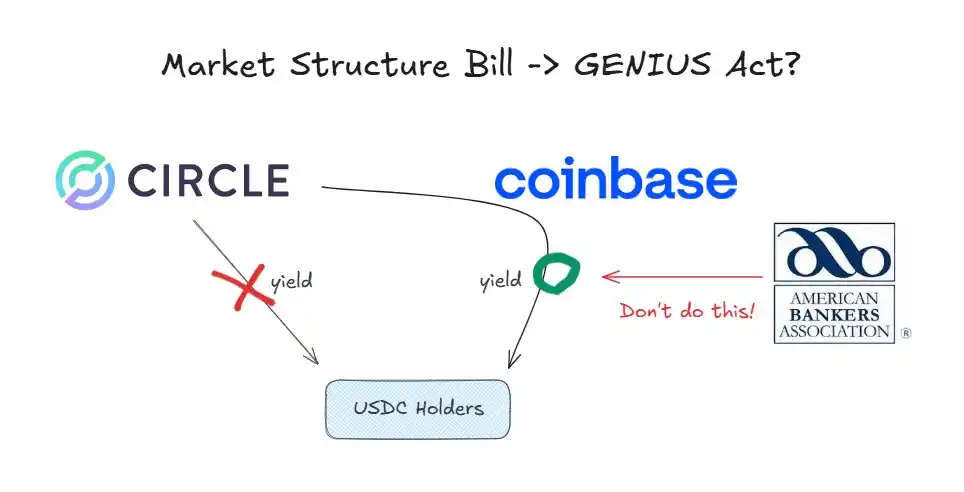
According to the GENIUS Act, stablecoin issuers are prohibited from paying interest to stablecoin holders.

However, Coinbase is currently offering a 3.35% reward to users holding USDC on its platform. This is possible because the GENIUS Act only prohibits issuers from paying interest and does not impose restrictions on distributors.

Yet, ahead of the review of the Crypto Market Structure Act (which aims to systematize cryptocurrency regulation) by the relevant U.S. Senate committee on January 15, a debate over "whether the stablecoin interest payment ban should be extended to the distribution level" has fully erupted.
Strong Opposition from the Banking Industry

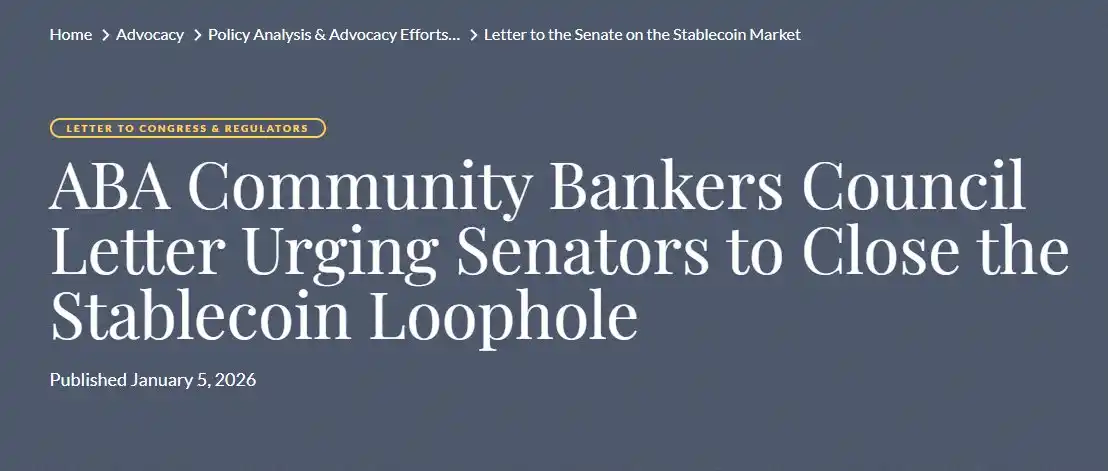
The American Bankers Association (ABA) is the primary group calling for a comprehensive ban on stablecoin interest payments. In a public letter released on January 5, the association argued that the interest payment ban in the GENIUS Act should not only apply to issuers but should also be broadly interpreted to extend to affiliated parties. They are pushing for this interpretation to be explicitly written into the Crypto Market Structure Act.
The Reasons Behind the Banking Industry's Firm Opposition

The banking industry's determination to completely ban stablecoin interest payments is quite simple:

  • Concern over deposit outflows;
  • Reduced deposits mean diminished lending capacity;
  • Stablecoins are not protected by Federal Deposit Insurance Corporation (FDIC) insurance.

Ultimately, stablecoins are threatening the stable and highly profitable business model that the banking industry has relied on for decades.

The Crypto Industry's Counterattack

From the perspective of the crypto industry, this move by the banking sector is a major problem. If the restrictions of the GENIUS Act are expanded through the Crypto Market Structure Act due to banking lobbying pressure, it would effectively rewrite and narrow the scope of this already passed act. Unsurprisingly, this has sparked strong opposition from the crypto industry.

Coinbase's Stance

Coinbase Chief Policy Officer Faryar Shirzad countered, citing relevant research indicating that stablecoins have not caused substantial outflows of bank deposits. He also used news about the digital yuan paying interest as a new argument in this debate.

Paradigm's Perspective

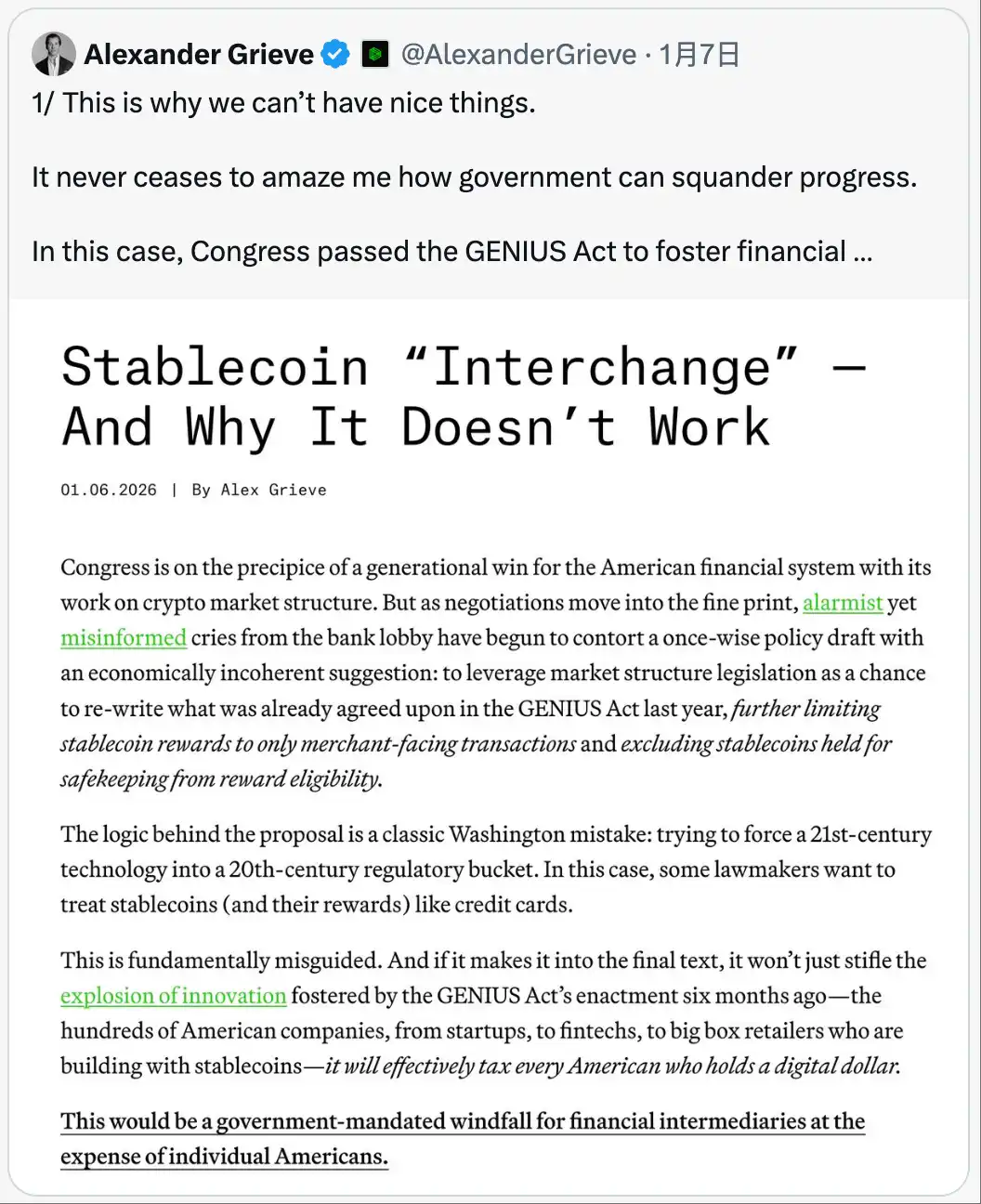
Alexander Grieve, Vice President of Government Affairs at crypto investment firm Paradigm, offered another viewpoint. He argued that even if interest payments are only allowed for stablecoins used in payment scenarios, it would effectively equate to a "holding tax" for consumers.
What About China and South Korea?

Although China and South Korea have not advanced cryptocurrency-related policies as rapidly as some other Asian countries, both have recently introduced a series of new measures surrounding Central Bank Digital Currencies (CBDCs) and stablecoin policies. The differences in their approaches to interest payments are particularly noteworthy:

The People's Bank of China has decided to pay interest on the digital yuan, treating it the same as ordinary bank deposits, to promote its adoption.

South Korea's policy direction is closer to that of the U.S.: it prohibits issuers from paying interest but does not explicitly ban distributors from doing so.

From a macro perspective, China's aggressive policy stance is understandable. The digital yuan is not a private stablecoin but a法定数字货币 (fiat digital currency) issued directly by the central bank. Promoting the digital yuan can both counterbalance the dominance of private platforms like Alipay and WeChat Pay and strengthen the financial system centered around the central bank.

Conclusion

New technologies give rise to new industries, and the rise of new industries often poses a threat to traditional ones.

Traditional financial institutions, represented by banks, are facing the irreversible trend of transitioning to the stablecoin era. At this juncture, resisting change is more harmful than beneficial; embracing change and exploring new opportunities is the wiser choice.

In fact, even for existing market participants, the stablecoin industry holds immense opportunities. Many banks have already begun to actively position themselves:

  • The Bank of New York Mellon is developing its business around stablecoin reserve custody;
  • Cross River Bank acts as an intermediary for Circle's USDC fiat on-ramp channels through Application Programming Interfaces (APIs);
  • JPMorgan Chase is experimenting with tokenized deposits.

Major card networks also have vested interests at stake. As on-chain payment volumes grow, the business of traditional card networks may shrink. However, companies like Visa and Mastercard have chosen not to fight this trend but instead actively support stablecoin payment settlements, seeking new growth opportunities顺势.

Asset management firms are also entering the fray. Funds like BlackRock are actively advancing the tokenization of various investment funds.

If the banking industry's lobbying succeeds and a comprehensive ban on stablecoin interest payments is written into the Crypto Market Structure Act, the crypto industry will suffer a heavy blow.

As a practitioner in the crypto industry, I can only hope that the Crypto Market Structure Act will not include provisions that effectively nullify the GENIUS Act.


İlgili Sorular

QWhat is the main argument of the American Bankers Association (ABA) regarding stablecoin interest payments?

AThe American Bankers Association argues that the interest payment ban in the GENIUS Act should not only apply to issuers but should be broadly interpreted and extended to include associated parties, such as distributors. They are pushing for this interpretation to be explicitly written into the Crypto Market Structure Act.

QWhy are traditional banks strongly opposed to stablecoins paying interest?

ABanks are opposed because they fear it will lead to an outflow of bank deposits, which would reduce their lending capacity. Additionally, stablecoins are not protected by FDIC insurance, and they threaten the stable, high-profit business model that banks have relied on for decades.

QHow does Coinbase currently provide rewards for USDC holders, and what is their defense against the proposed restrictions?

ACoinbase provides a 3.35% reward to users who hold USDC on its platform. They defend this practice by citing research that stablecoins have not caused a substantial outflow of bank deposits. They also reference China's digital yuan, which pays interest, as a counterpoint in the debate.

QWhat is the difference between China's and South Korea's policies on paying interest for their digital currencies?

AChina's central bank pays interest on its digital yuan, treating it similarly to traditional bank deposits to promote adoption. In contrast, South Korea's policy is closer to the U.S. approach: it prohibits issuers from paying interest but does not explicitly ban distributors from doing so.

QWhat potential impact could the Crypto Market Structure Act have on the crypto industry if it includes a broad ban on stablecoin interest payments?

AIf the Crypto Market Structure Act includes a broad ban on stablecoin interest payments, extending it to distributors, it would severely harm the crypto industry. This would effectively nullify the GENIUS Act's provisions and stifle innovation, as it would prevent platforms like Coinbase from offering rewards, limiting the utility and attractiveness of stablecoins for consumers.

İlgili Okumalar

From South Korea to the United States: Blue-Collar Jobs Are Becoming Increasingly Popular, Thanks to AI

AI is reshaping the labor market's value proposition. The traditional four-year college degree is losing its appeal as a guaranteed career path, while skilled blue-collar trades like electricians, welders, and plumbers are experiencing historic demand and wage premiums. This shift is driven by dual pressures: AI's displacement of certain white-collar roles and a booming need for physical infrastructure and data center construction. Data confirms the trend. In the U.S., vocational school revenue surged, and a significant portion of recent layoffs are AI-related. Surveys show a majority of Gen Z adults plan to pursue blue-collar work, citing better job security against AI automation. Vocational education interest has exploded recently. Experts cite a psychological shift as younger generations seek tangible, AI-resistant careers and avoid high student debt. In many cases, salaries for skilled trades now match or exceed those requiring a bachelor's degree. In South Korea, semiconductor vocational high schools boast near-total employment, with graduates securing high-paying roles at companies like Samsung. The shortage is structural, exacerbated by a retiring baby boomer workforce and massive infrastructure projects. Companies like JPMorgan Chase, Meta, and Lowe's are investing heavily in training programs. However, overcoming historical stigma and a "perception gap" around trade careers remains a key challenge to closing the talent gap.

marsbit21 dk önce

From South Korea to the United States: Blue-Collar Jobs Are Becoming Increasingly Popular, Thanks to AI

marsbit21 dk önce

Qualcomm: AI Hype Subsides, When Will Smartphones Emerge from the Gloom?

Qualcomm reported its Q3 FY2026 results (ending June 2026), with revenue of $9.95B, down 4% YoY but above expectations. Gross margin declined to 53.1%, pressured by rising costs across manufacturing and memory. Key business segments showed mixed performance: Handset revenue fell 19.6% YoY to $5.09B, dragged by an 11% decline in non-Apple Android shipments and weaker high-end mix. Conversely, Automotive revenue surged 61% to $1.59B, and IoT grew 9% to $1.83B. Core operating profit dropped 41% YoY due to margin compression and higher expenses. Management's Q4 FY2026 guidance projects revenue of $9.7B-$10.5B, in line with consensus, but Non-GAAP EPS guidance of $2.05-$2.25 fell short of expectations. Amidst persistent weakness in its core handset market, Qualcomm is pursuing growth in AI, focusing on Edge AI (smartphones, PCs, automotive) and Data Center AI. Its data center strategy includes four pillars: AI accelerators (e.g., AI200), commercial CPUs (Dragonfly C1000), custom silicon, and connectivity solutions. While these initiatives initially boosted its stock, concerns over AI capital expenditure sustainability have since erased those gains. The company targets $5B in data center revenue for FY2027 and $15B for FY2029. The report concludes that with the traditional handset business still under pressure, the data center opportunity is currently viewed as a longer-term option, and a more conservative valuation based on core operations may be warranted until AI contributions materialize.

marsbit26 dk önce

Qualcomm: AI Hype Subsides, When Will Smartphones Emerge from the Gloom?

marsbit26 dk önce

From TPU to Self-Evolving Agents: How Jeff Dean Predicts the Next Step in AI

At the 2026 YC Startup School, Jeff Dean outlined his vision for AI's next phase, shifting focus from simply scaling models to building intelligent, autonomous systems. He believes AI's progress is no longer just about creating smarter models, but about integrating them into systems capable of long-term, iterative work, automated experimentation, and continuous learning. This evolution moves the competition from "who has the bigger model" to "who can best organize intelligence." Dean suggests AI capabilities are now comparable to a junior engineer, enabling the automation of complex workflows. However, the true challenge and opportunity lie in managing these AI "workers" at scale. He emphasizes the importance of **context engineering**—structuring tools, memory, and feedback loops—over raw model power. For startups, this means building deep expertise in niche domains where general models currently fail (near 0-1% success rates), leveraging proprietary data, specialized tools, and domain-specific evaluators. A recurring theme is re-examining fundamental constraints. Dean's past work, like moving Google's search index to memory or creating the TPU, stemmed from questioning outdated assumptions about hardware and cost. He sees similar inflection points today, particularly in **specialized inference hardware** to drastically reduce latency and energy consumption for real-time Agent operation. Notably, he points out that in modern AI systems, the dominant cost is often not computation but **data movement**. Reliable, long-running Agents require robust system design, borrowing concepts from distributed computing like checkpointing, state management, and parallel exploration to handle failures and maintain progress over days or weeks. As AI automates execution, the scarcest human skills will shift to **defining clear specifications**, **judging what problems are worth solving** (taste), and designing effective feedback loops. Ultimately, Dean's framework prioritizes understanding the problem deeply, identifying the true bottlenecks, and systematically building closed-loop systems where AI can not only perform tasks but also improve AI itself.

marsbit26 dk önce

From TPU to Self-Evolving Agents: How Jeff Dean Predicts the Next Step in AI

marsbit26 dk önce

İşlemler

Spot
活动图片




