The Ambitions of Kalshi, MTS, and a16z

marsbit2026-06-07 tarihinde yayınlandı2026-06-07 tarihinde güncellendi

Özet

"Kalshi, MTS, and a16z's Ambition" explores prediction markets as a focal point for investors in 2025. The article traces their intellectual evolution from Hayek's ideas on distributed knowledge to Robin Hanson's logarithmic market scoring rule (LMSR), which incentivizes truth-telling. Venture firm Andreessen Horowitz (a16z) invested in prediction market platform Kalshi, valuing it at $220 billion. a16z argues these markets offer "presence"—a way for individuals to actively engage with and influence world events through financial bets, countering modern detachment. This transforms participants into "super observers" and grants the platform authority in defining event truth and importance. The piece positions prediction markets as a key component of a16z's envisioned "new media" empire. This strategy involves rapid, high-intensity content across platforms to "take over the timeline." Media company MTS exemplifies this with its constant news livestreams. Ultimately, Kalshi's value lies in its "reality distortion field"—the power to shape perception through the credibility of real-money markets, making it a potent tool within a16z's broader media and influence architecture.

Authors: Matou, Big Screwing

Prediction markets might be the only area in 2025 that can simultaneously excite the distinguished dollar fund investors, crypto natives, and media practitioners.

There are many reasons to be bullish on it, such as the regulatory arbitrage between state and federal betting laws in the US, the massive transaction fees brought by the extreme extrapolation of 0DTE, and the convergence of the content industry with light betting, and so on.

But today, we won't talk about these. Let's change direction and discuss the spirit behind prediction markets and how this spirit aligns with a16z, which champions the banner of "New Media," becoming one of the most crucial pieces in its new media empire.

The Spiritual Chronology of Prediction Markets

The product of a prediction market is simple (at least on the surface): it turns the object of a binary option bet into any event or information. However, the underlying spiritual core has evolved through several eras.

The earliest discussions about prediction markets actually come from Hayek. In his view, knowledge is unevenly distributed, and the market, as a coordination mechanism, mobilizes information from every corner of society. From vendors to experts, different people's judgments about the future converge into a price on the order book within the prediction market.

This discussion is the most ancient, but also the most frequently cited today. When you see marketing posts talking about "probability aggregation markets," "truth machines," etc., they all stem from Hayek's The Use of Knowledge in Society, published nearly a hundred years ago.

The torch was then passed to Robin Hanson after Hayek. The man still surfs Twitter with high intensity, debating with crypto natives. His main contribution lies in designing a mechanism called the Logarithmic Market Scoring Rule (LMSR), which makes it more beneficial for those who know the truth to tell it. This design basically established the paradigm for current prediction market design.

With such an incentive mechanism in place, information holders in various corners are motivated to contribute their information and participate in the market. Extrapolating further, it seems such markets could also be used for public governance. Opening a market for every future issue, letting people vote with real money, the future scenario would then be constructed in the changing odds on the order book. This utopia is called Futarchy, formed from "future" and the suffix "-archy" meaning governance.
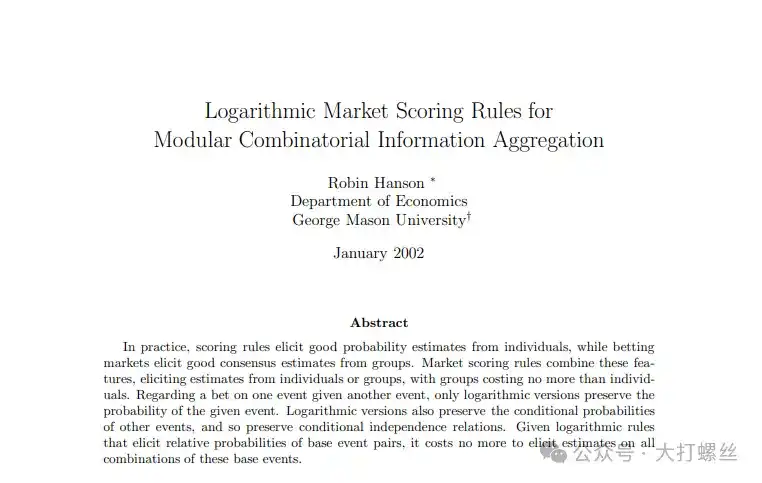
Seminal Work: A Logarithmic Market Scoring Rule for Modular Information Aggregation

The above belongs to the official history, the kind you'd cover in a timeline lecture in a university microeconomics class. However, I believe that metaphysical discussions about prediction markets after this point are largely meaningless until a16z set its sights on this field.

Presence and New Media

a16z came into contact with the prediction market company Kalshi in 2024, then invested in its $5 billion round in August 2025 (the discount, if any, is currently unknown). Kalshi's valuation has now reached a staggering $22 billion, hailed as the fastest-growing company outside of AI (in terms of valuation).

After establishing its position, a16z activated its media machine, writing a series of long articles about why Kalshi is one of the most important companies of our time. Frankly, while the exchange and casino business is enticing, due to potential compliance pressures and moral risks, it never commands high PE multiples in the market. Clearly, a16z's vision extends beyond this.

So, where exactly does Kalshi, or the entire prediction market sector, hold its importance? a16z's answer is "Presence."

At our current juncture, human contact with the world is actually separated by a thin layer of plastic film—somewhat like only being able to browse the front end of a webpage while knowing nothing about its back-end construction. You can consume the front-end's audiovisual experience, narratives, and even "real feelings," but you cannot change or be present.

Not to mention, clearly in the not-too-distant future, even the transformation of the real world will be gradually outsourced to agents. So, what role do humans have in the historical process? It seems we're only left to bury our heads in light-colored sheets and cry after eating and drinking.

However, prediction markets offer a way to intervene, called prediction. It requires you to place bets with real money, then, like buying a ticket to enter a stadium, participate and observe the fluctuation of probabilities throughout the process, willingly bearing theta decay, and even screenshotting the prediction market probabilities, forwarding them in all group chats, loudly declaring your position and the viewpoint behind it.

This feeling is profoundly anti-cynical. In an instant, the infinite distances, the countless people, the selection of the cardinal, the depth of snow in New York, the rise and fall of crude oil within five minutes, and even whether Jesus will return in 2026, all become relevant to you. The uncertainty and powerlessness of postmodernity collapse under your potent predictions. You are no longer a gambler; you are an esteemed super-observer, a prophet of your tribe, a calm bystander of history.

When enough people start using, discussing, and relying on this medium, the authority of the market itself begins to rise. Kalshi will grant the ultimate interpretative power over an event's: 1. Authenticity 2. Significance. This is undoubtedly a key component in the new media empire envisioned by a16z.
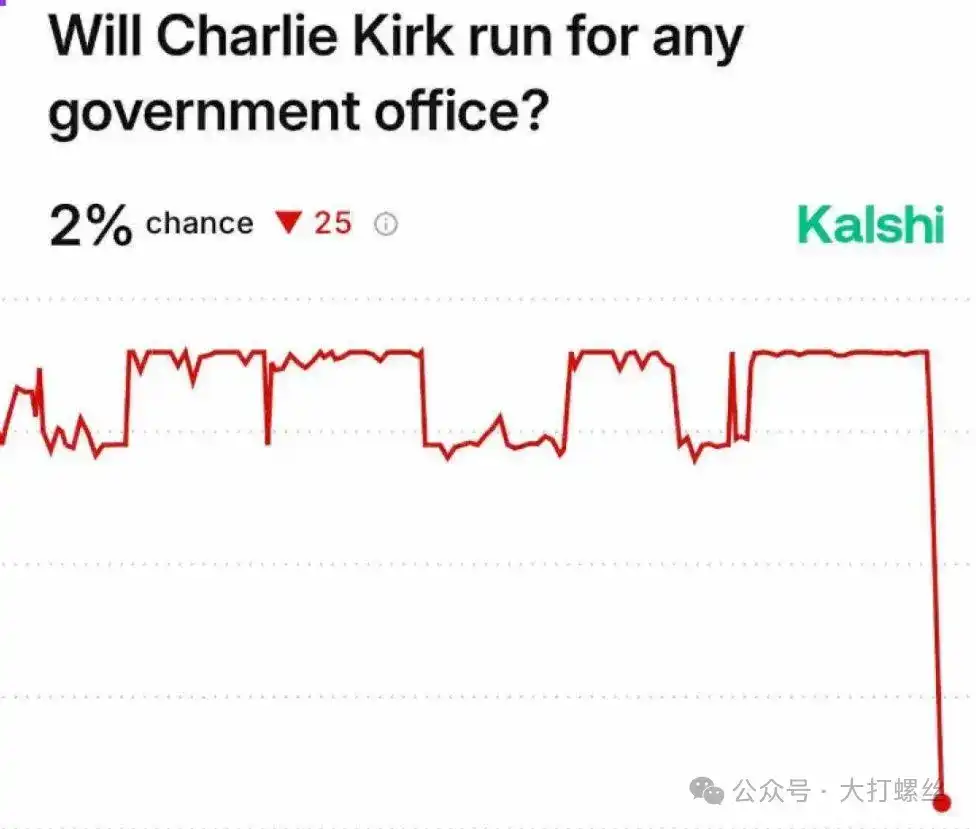
One chart explaining the assassination of Charlie Kirk

Case Study: MTS

Finally, let's talk about this new media as defined by a16z. From the first-generation In-house Media championed by a16z and YC, to the second-generation VCs emerging from media like 20VC and Not Boring Capital, to the final stage where media like TBPN are acquired by companies and institutions, media power has been constantly shifting and decentralizing. The battleground for public opinion has also moved from blogs and TV programs to Twitter and podcasts.

Talking about VCs also needing to do content, build brands, and help founders with distribution is already old news in 2026. The new media a16z talks about is a full-spectrum project, covering upstream narrative setting, midstream product financing and promotion, to downstream customer acquisition—all within its scope, and at a pace far beyond what traditional media and agencies can comprehend.

What previously might have taken 3-6 months to plan, the new media will execute within weeks: founder podcasts, short video clips, AI-generated launch videos, newsletters about the company's spirit and development plans, etc., releasing information with extremely high intensity in an extremely short time. They call this "taking over the timeline."

Perhaps with all the noise from various self-media and AI-generated information, we just have to be even noisier. And our noise is more important than yours.

MTS (full name "Monitoring The Situation") embodies this philosophy, conducting 24/7 live news coverage on Twitter, putting a series of political figures, tech founders, and key figures in hot news stories on mic, then slicing and disseminating the content. They claim to only report on the most important thing happening in the world right now, until the next more important thing happens.

MTS Interviewing Robinhood

Looking back at Kalshi now, everything clicks. Relying solely on volume and a16z's endorsement, media like MTS can certainly survive, but their influence beyond a16z's light cone remains limited, more akin to a fraternity media or campus club publication. But prediction markets are different; the trading volume and positions are real money, seemingly possessing a certain detached, third-party coldness and persuasiveness.

Imagine, if you were a staunch MAGA supporter, seeing on Kalshi that the market for a Republican victory in the midterm elections had reached tens of billions in trading volume, but the price for the YES option for victory had dropped to $0.1, wouldn't you have a moment of doubt—do the Capitol Hill elites already know the result? Has the fair information market already given a picture of the future?

This is perhaps the core reason Kalshi is worth $22 billion. This kind of reality distortion field is not often seen in human history being obtained by a private company.
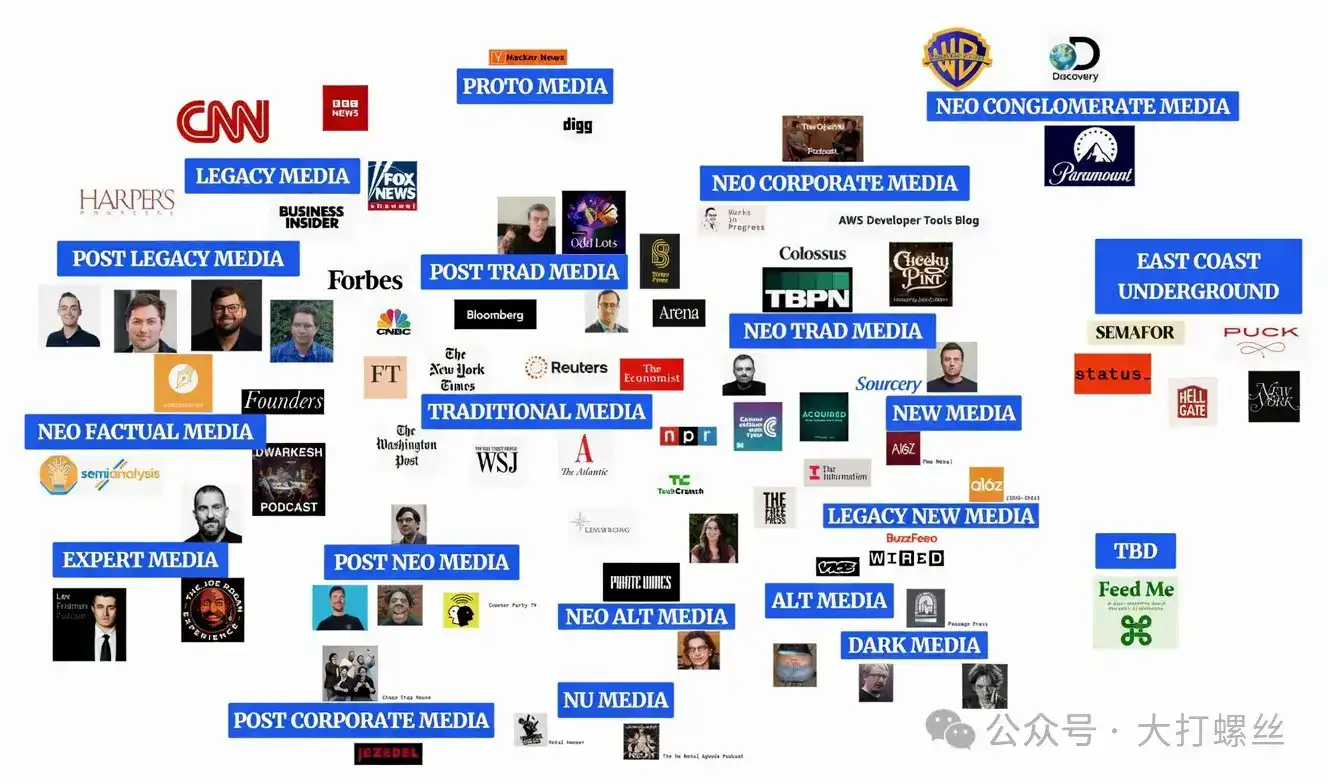
TBPN New Media Landscape

References:

[1] Alex Danco, “Prediction: the successor to postmodernism,” Andreessen Horowitz, October 10, 2025.

[2] Alex Danco, “Prediction Path Screenshots: A New Kind of Meme,” Andreessen Horowitz, October 10, 2025.

[3] F. A. Hayek, “The Use of Knowledge in Society,” The American Economic Review, Vol. 35, No. 4, pp. 519–530, 1945.

[4] Erik Torenberg, Ben Horowitz, and Marc Andreessen, “a16z’s New Media Playbook,” Andreessen Horowitz Podcast, February 27, 2026.


İlgili Sorular

QAccording to the article, what is the core reason why Kalshi is valued at $22 billion?

AThe core reason is that Kalshi possesses a 'reality-distorting force field' or significant influence. As a prediction market, its trading volumes and positions, backed by real money, grant it an authoritative, independent, and persuasive quality. It can shape perceptions of event authenticity and importance, effectively giving a private company a rare level of influence over how reality is interpreted and understood.

QWhat concept does a16z propose as the key value proposition of prediction markets, beyond just being a gambling platform?

Aa16z proposes 'presence' or 'a sense of being present' as the key value proposition. Prediction markets offer a way for individuals to actively engage with and influence world events through prediction and financial stake. This counters postmodern feelings of detachment and powerlessness, transforming users from passive observers into active 'super observers' and 'prophets' who participate in shaping the narrative of history.

QHow does the article describe the evolution of the 'spiritual core' or theoretical foundation of prediction markets?

AThe article describes a spiritual chronology: 1) **Friedrich Hayek**: Viewed markets as mechanisms for aggregating distributed, fragmented knowledge across society. 2) **Robin Hanson**: Designed the Logarithmic Market Scoring Rule (LMSR), creating incentives for truth-telling and establishing the modern design paradigm for prediction markets. He also theorized 'Futarchy,' a governance system based on prediction markets. 3) **a16z Era**: Shifted the discussion from abstract theory to practical application, emphasizing prediction markets as a new media form that provides 'presence' and narrative authority.

QWhat is MTS, and how does it exemplify a16z's vision of 'New Media'?

AMTS (Monitoring The Situation) is a media company that practices 24/7 live news broadcasting on platforms like Twitter, featuring interviews with key figures. It exemplifies a16z's 'New Media' vision through its extreme speed and intensity in information dissemination—a strategy called 'taking over the timeline.' It rapidly produces content across formats (podcasts, video clips, newsletters) to dominate the narrative, asserting that its coverage is more important and louder than the noise of other media.

QWhat role does the article suggest prediction markets like Kalshi play within a16z's envisioned 'New Media Empire'?

AWithin a16z's 'New Media Empire,' prediction markets like Kalshi serve as a crucial component that provides authoritative, objective-seeming validation. While media outlets like MTS generate noise and narrative, Kalshi offers the perceived 'cold, hard truth' of market-based probabilities backed by real money. This combination allows a16z to influence both the narrative (through media) and the perceived factual basis of reality (through prediction markets), creating a powerful system for shaping public perception and discourse.

İlgili Okumalar

As Consensus Accelerates, What Are Young Investors Betting On?

Title: As Consensus Forms Faster, What Are Young Investors Betting On? In the rapid evolution of tech investment, a new generation of young investors is navigating a landscape where AI, robotics, commercial aerospace, and quantum computing are advancing simultaneously. Traditional investment logic based on financial models is giving way to a need for deep technical understanding and the ability to act before industry consensus forms. An analysis of trends from the "WAIC FUTURE TECH" list of young investment leaders reveals key shifts in focus. The first major trend is the movement of AI from the digital screen into the physical world. Investment is shifting from large language models and chatbots towards embodied AI, robotics, AI hardware, and edge computing. While demonstrations generate excitement, the real challenge lies in achieving scalable, reliable, and cost-effective delivery in complex real-world environments like factories and logistics. Success depends not just on algorithms but on the integration of sensors, actuators, and control systems. Second, the competitive focus for large models is moving beyond raw capability toward building an "intelligence flywheel." The goal is to create self-reinforcing systems where user interaction generates data, improving the model, which in turn enhances the user experience and attracts more engagement. Companies that successfully embed AI into workflows to create these closed-loop systems can build lasting value that isn't easily erased by the next model upgrade. Third, facing a potential bottleneck in high-quality human-generated data, investors are looking at new underlying technologies. Reinforcement learning and self-play, as demonstrated by AlphaGo Zero, offer paths for AI to generate its own experience. Scientific foundation models, which aim to build general AI capabilities for fields like life sciences and materials discovery, represent a non-consensus direction that could unlock new frontiers of knowledge and data. Finally, in deep-tech areas like quantum computing, commercial aerospace, and space-based infrastructure, patient capital is essential. These fields have long, uncertain development and validation cycles involving complex engineering, supply chains, and regulations. Investment here requires a long-term view, focusing on foundational team capabilities and the eventual emergence of market demand, even if commercial returns are distant. Collectively, these trends illustrate how young investors are adapting to a new era. They are learning to make earlier, technically-informed judgments, balance hype with real-world viability, and provide the patient capital needed to build the deep-tech foundations of the future.

marsbit6 dk önce

As Consensus Accelerates, What Are Young Investors Betting On?

marsbit6 dk önce

Can Japan Buy Growth with AI? Will the Bond Market Believe It?

Japan's cabinet has introduced the 2026 Basic Policy on Economic and Fiscal Management and Reform, shifting its primary fiscal target. The new framework moves away from the traditional annual primary balance goal and instead prioritizes a stable reduction of the debt-to-GDP ratio. This change is tied to a strategy of increased "responsible proactive fiscal" spending, aiming to boost long-term growth through investments in strategic sectors like AI, semiconductors, energy, and robotics. The government estimates total public and private investment in 62 key technologies could exceed 370 trillion yen by 2040. The market reaction has been mixed and cautious. While equity markets may respond to policy signals, bond markets are focused on fiscal credibility. Concerns center on whether the weakening of the clear primary balance anchor could lead to looser fiscal discipline. If investors doubt that these strategic investments will generate sufficient productivity gains, tax revenue, and nominal growth to outpace rising interest costs, they may demand higher yields on Japanese Government Bonds (JGBs). Recent volatility in the yen and JGB yields, with the 10-year yield briefly reaching 2.9%, reflects this skepticism. The success of this new framework hinges on two factors: whether Japan can achieve a nominal growth rate consistently higher than its long-term interest rates, and whether future budgets demonstrate disciplined control over bond issuance. The government's narrative is that strategic investment is essential to break Japan's cycle of low growth, aging, and labor shortages. However, the bond market will continuously assess the credibility of this plan, pricing the risk that it may represent fiscal expansion rather than a viable growth strategy.

marsbit43 dk önce

Can Japan Buy Growth with AI? Will the Bond Market Believe It?

marsbit43 dk önce

Misjudged A-Shares: Resilience, Expectations, and Confidence

China's A-share market recently faced selling pressure, especially in tech sectors, initially triggered by a global tech sell-off that began in South Korea. However, the article argues this is a case of "mistaken injury" and highlights the market's underlying resilience. This resilience stems from three main pillars: **1) Tech Sector Fundamentals:** Unlike Korea's market dominated by a few memory chip stocks, China's tech sector is diversified across computing, communications, electronics, and semiconductors, supported by dual narratives of global AI supply chains and domestic substitution. Core areas like optical modules and fiber optics continue to show strong earnings growth. **2) "National Team" Support:** State-backed institutions and large corporations have made significant market purchases and announced buybacks, providing liquidity and signaling confidence. This is seen as a stabilizing policy signal, often associated with market bottoms. **3) Broader Market Pillars:** Other major sectors are showing endogenous recovery momentum. Consumer stocks benefit from stabilizing CPI and signs of sector recovery (e.g., liquor price hikes). Cyclical sectors like aluminum have high earnings, potential price increases due to tight supply, and low valuations. The financial sector offers stable dividends and low valuations. The conclusion is that the sell-off was driven by external contagion, not a collapse in fundamentals. With strong policy support and recovering momentum across key sectors, the A-share market possesses the toughness to regain stability.

marsbit1 saat önce

Misjudged A-Shares: Resilience, Expectations, and Confidence

marsbit1 saat önce

İşlemler

Spot
活动图片




