The Advancing MM 3: Statistical Edge and Signal Design

深潮2025-12-28 tarihinde yayınlandı2025-12-28 tarihinde güncellendi

Özet

Title: The Attack of MM 3: Statistical Edge and Signal Design Author: Dave This article, the third in the "Attack of MM" series, explores how market makers (MMs) actively gain a "micro alpha" advantage through statistical edges and signal design, rather than just passively adjusting quotes. Micro alpha refers to a conditional probability shift in predicting short-term price movements (within ~100ms to ~10s), such as the direction of the next price change, mid-price drift, or trade asymmetry. It is not about forecasting trends but detecting probabilistic biases that allow MMs to act preemptively—buying before likely price increases, withdrawing bids before declines, or reducing exposure during risky periods. Key signals discussed include: - **Order Book Imbalance (OBI)**: Measures the normalized volume difference between buy and sell orders near current prices. - **Order Flow Imbalance (OFI)**: Tracks aggressive taker orders that drive price changes. - **Queue Dynamics**: Analyzes order queue behavior, including hidden orders (icebergs) and spoofing (fake large orders to manipulate perception). - **Cancel Ratio (CR)**: Indicates liquidity withdrawal rates, signaling market instability. The article emphasizes that speed is MMs' absolute advantage. Lower latency enables faster reaction to market events, facilitating latency arbitrage by executing orders before competitors. In crypto exchanges, some players even get priority execution rights, highlighting th...

Author: Dave

"The Advancing MM 1: Market Maker Inventory Quoting System"

"The Advancing MM 2: Market Maker Order Book and Order Flow"

The first two parts discussed order flow and inventory quoting, making it sound like market makers can only adjust passively. But do they have proactive methods? The answer is yes. Today, we introduce statistical edge and signal design, which are the "micro alpha" pursued by market makers.

1. Market Maker's Alpha?

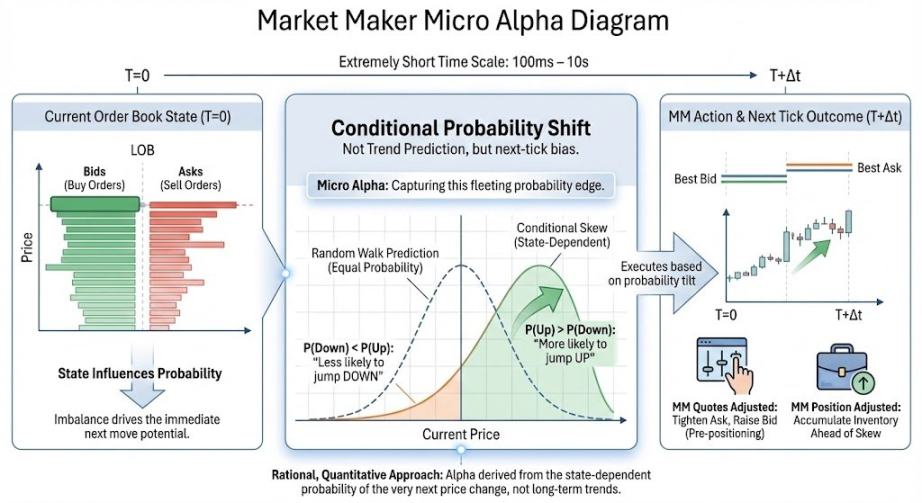
Micro alpha refers to the "conditional probability shift" in the direction of the next price movement / mid-price drift / trade asymmetry on an extremely short time scale (~100ms to ~10s). It's important to note that the alpha in the eyes of market makers is not about trend prediction or guessing price changes; it only requires a probability shift, which is different from the alpha we commonly talk about. Let me explain in simpler terms:

A market maker's statistical edge can be understood as whether, within an extremely short time window, the order book state is "inclined" to move the price in a certain direction first. If a market maker successfully calculates the probability of the next millisecond's price movement using some indicators, they can: 1. Be more willing to buy before a likely price increase. 2. Withdraw buy orders faster before a likely price drop. 3. Reduce exposure during risky moments.

The financial basis for predicting the next price direction is: Due to factors like order flow, order volume, and order book cancellation ratio (which we'll discuss later), the market is not a "random walk" Brownian motion in a short instant but has a direction. The above statement is the financial translation of the mathematical concept of "conditional probability."

With this alpha, market makers can directionally operate on prices. The "market makers" finally earn money from price movements, not just service fees like spreads.
2. Classic Signals Introduction

2.1 Order Book Imbalance: OBI

OBI measures which side has "more people standing" near the current price level. It is a standardized volume differential statistic.
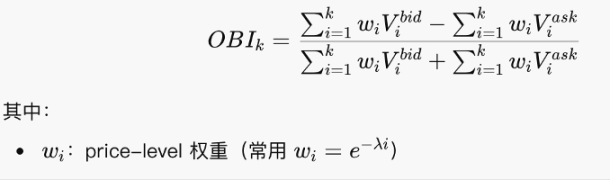
The formula is actually not difficult; it's just a proportional logic of summation. It checks whether there are more buy or sell orders. An OBI approaching 1 indicates almost all are buy orders, with a thick bottom. Approaching -1 indicates a thick top. Approaching 0 suggests a relatively symmetric buy-sell balance.

Note that OBI is a "static snapshot." It's a classic indicator but not very effective alone; it must be used with cancellation ratios, order book slope, etc.

2.2 Order Flow Imbalance (OFI)

OFI measures who has been actively attacking in a recent short period. OFI is the first-order driving factor of price changes because prices are pushed by taker orders, not by placed orders.
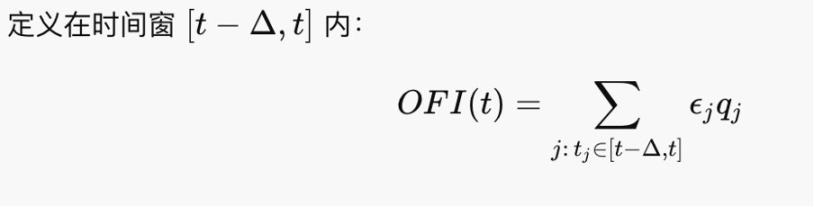
It feels like net buying/selling volume. In the Kyle (1985) framework, ΔP ≈ λ ⋅ OFI, where λ is tick depth. Thus, OFI is the factor driving price changes.

2.3 Queue Dynamics (Queue)

Most exchanges now use continuous auction rules based on best price and first-come-first-served (FCFS) principles, so submitted orders queue up to be filled. The queue represents the order placement situation, which determines the order book state. Abnormal order book states (including order replenishment and cancellation)暗示 directional price changes, i.e., micro alpha.

Two situations to note in the queue:

1. Iceberg: Hidden Orders

Example: Only 10 lots are shown on the surface, but every time they are filled, another 10 lots are immediately replenished. The real intention might be 1,000 lots. The method I introduced in Part 1 for annoying market makers to lower costs is essentially manually creating an iceberg. In practice, some players use iceberg orders to conceal their true volume.

2. Spoof (Fake Orders)

Placing a large order on one side to create a "false pressure illusion" and canceling it quickly before the price approaches. Spoofing pollutes OBI, slope, etc., making the queue artificially thicker and increasing movement risk. Additionally, large spoofs can intimidate the market and potentially manipulate prices. For instance, the London Stock Exchange caught someone manipulating forex in 2015 using spoofing. In crypto, we can also manually spoof to annoy market makers, but if you actually get filled, your exposure becomes significant.

2.4 Order Book Cancellation Ratio (Cancel Ratio)

The cancellation ratio is an estimate of the "disappearance rate" of liquidity:
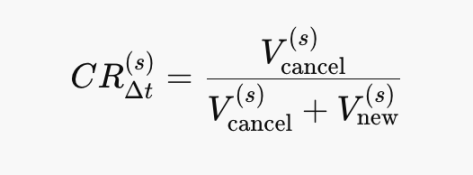
Cancel↑ ⇒ Slope↓ ⇒ λ↑ ⇒ ΔP more sensitive. It is an instability signal领先于 OFI. CR→1: Almost pure cancellations. CR→0: Almost pure order replenishment. The mathematical formulas in this part are very simple; you can interpret them by looking at the diagrams.

CR↑ ⟹ The passive side perceives future risk increasing. CR is also not used alone; it is used together with OFI and other indicators.

The above might just be some old-school order book games. The evolution of market making is rapid, and with stocks moving on-chain, market makers like JS might need to engage in on-chain market making. However, these indicators are still very useful and inspiring.

3. The Absolute Domain of Market Makers: Speed

We often hear in movies that a certain fund has faster internet speed, making it more powerful. Many market makers even move their server rooms closer to exchange servers. Why is that? Finally, let's talk about the advantages of physical equipment and the unique "trading advantages" of crypto exchanges.

Latency Arbitrage is not about predicting future prices but executing buy/sell orders at more favorable prices before others "react." In theoretical models: Prices are continuous, and information is synchronized. But in reality: The market is event-driven, and information arrives asynchronously. Why does information arrive asynchronously? Because receiving price signals from the exchange and sending order instructions to the exchange both take time—a limitation of the physical world. Even in fully compliant markets: Different exchanges, data sources, matching engines, and geographical locations cause delays. Thus, market makers with more advanced equipment have the initiative.

This tests the market maker's own capabilities and has little to do with other players, so I consider it their absolute domain.

A simple example: Suppose you want to sell a certain amount. You quote at the best selling price in the market, which should theoretically get filled. But I also want to sell. Since I see the price and quote faster than you, I get my order filled first. Your inventory cannot be sold, preventing your position from returning to neutral. Real situations are much more complex.

An interesting point: Since there are no regulatory laws yet, almost all crypto exchanges can directly grant priority filling rights to designated accounts. This means allowing certain accounts to jump the queue. This is especially common in smaller exchanges. It seems that being an "insider" in crypto is as important as in research. Whether you can execute trades safely is a crucial step from alpha theory to practice.
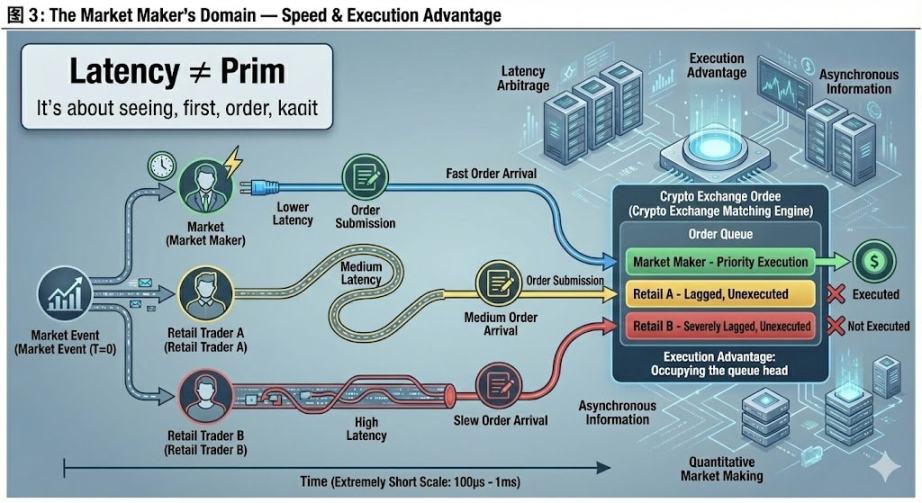
This part attempts to write from the perspective of a market maker. Actual operations are certainly more complex. For example, dynamic queue alone has many details to consider in practice. Welcome for comments from experts.

Postscript: There is a regret with this article. I originally wanted to use the title "Domain Expansion in Market Making" to discuss dynamic hedging and options, as I believe this is the conceptually most challenging part of market making, worthy of the big move "Domain Expansion." But after working on it for a day, I couldn't figure out how to explain it systematically, so I switched to discussing micro alpha. Teacher @agintender has an article mentioning many professional hedging concepts; I encourage everyone to take a look.


İlgili Sorular

QWhat is the concept of 'micro alpha' from a market maker's perspective, and how does it differ from traditional alpha?

AMicro alpha refers to a conditional probability shift in the direction of the next price movement, mid-price drift, or trade asymmetry over extremely short time scales (~100ms to ~10s). It is not about trend prediction or guessing price changes like traditional alpha, but rather about short-term probabilistic advantages derived from order flow, order book state, and cancellation ratios.

QHow does Order Book Imbalance (OBI) function as a signal, and what are its limitations?

AOBI measures the normalized volume difference between buy and sell orders near the current price level, indicating which side has more liquidity. It approaches 1 if buy orders dominate, -1 if sell orders dominate, and 0 if balanced. However, OBI is a static snapshot and is ineffective alone; it must be combined with other metrics like cancellation ratios and order book slope for practical use.

QWhat role does Order Flow Imbalance (OFI) play in price movement, and how is it mathematically related to price changes?

AOFI measures which side is actively attacking by tracking the net flow of taker orders over a short period. It is a primary driver of price changes, as prices are pushed by taker activity rather than passive orders. In the Kyle (1985) framework, the price change ΔP is approximately proportional to OFI multiplied by the tick depth (λ), i.e., ΔP ≈ λ · OFI.

QWhy is speed considered the 'absolute domain' of market makers, and how does latency arbitrage work?

ASpeed is critical because market information arrives asynchronously due to physical constraints like data transmission delays and geographical distances. Market makers with faster infrastructure can execute trades at favorable prices before others react, exploiting latency arbitrage. This involves acting on price signals and submitting orders more quickly than competitors, ensuring priority in trade execution.

QHow do spoofing and iceberg orders affect queue dynamics and market maker strategies?

AIceberg orders hide large order sizes by displaying only a small portion, replenishing after execution, which masks true intent. Spoofing involves placing large fake orders to create false pressure, which are canceled before execution. Both tactics distort signals like OBI and order book slope, increasing movement risk and complicating market makers' ability to gauge true liquidity and direction.

İlgili Okumalar

Strategy's Loss in the Second Quarter Reaches $8.22 Billion Amid Bitcoin Decline

Strategy, the largest corporate holder of Bitcoin, reported a net loss of $8.22 billion for the second quarter. This loss was primarily driven by an $8.32 billion unrealized loss on its Bitcoin holdings due to a decline in the asset's price during the period. Despite these paper losses, the company increased its Bitcoin holdings to 843,775 BTC, a 25% growth since the start of the year. As part of a new monetization strategy, Strategy sold approximately $218.4 million worth of Bitcoin, mainly to fund dividends for preferred shareholders, with $216 million of that sold after Q2 ended. The company also built a $3.75 billion cash reserve, which it claims is sufficient to cover over two years of dividend and interest payments, aiming to insulate itself from Bitcoin's volatility while meeting obligations. Following the earnings release, Strategy's stock (MSTR) rose 4.7% in regular trading but corrected slightly after-hours. This pattern reflects how the company's accounting results are heavily tied to Bitcoin's price swings, even as its long-term strategy remains unchanged. The report indicates that Strategy is maintaining its core strategy of accumulating Bitcoin while building a financial buffer. This quarterly loss follows a recognizable pattern, with the company posting significant unrealized losses in previous quarters (e.g., $12.4 billion in Q4 2025 and ~$12.5 billion in Q1 2026) due to fair-value accounting. A key technical shift is its new monetization program, which introduces periodic selling pressure on the market, transitioning Strategy from a pure accumulator to a participant that occasionally adds supply. A critical question remains: how long can the cash reserve cover dividend obligations if a Bitcoin price downturn persists beyond two years?

cryptonews.ru5 dk önce

Strategy's Loss in the Second Quarter Reaches $8.22 Billion Amid Bitcoin Decline

cryptonews.ru5 dk önce

Will Terrorist Durov Ban Russian Officials?

Telegram founder Pavel Durov publicly reacted to being labeled a "terrorist" by Russian authorities, stating the designation came after he refused demands for mass surveillance and censorship on the platform. In a Telegram post, he highlighted that this status formally bans him from "publishing information online." Durov concluded with a statement widely circulated: Russian officials "clearly don't understand who can ban whom on the internet." This remark suggests Durov could potentially restrict official Russian government and officials' channels on Telegram, which continue to operate on the platform despite its formal blocking in Russia. The situation parallels previous, slow-moving state directives, like switching officials to domestic cars, contrasted with the current push to migrate all government communication to the Russian-made messenger MAX by 2030. However, reports indicate many officials still use Telegram via workarounds, fearing surveillance on MAX, while alternatives like BiP and KakaoTalk recently became inaccessible in Russia without a VPN. Durov has not specified any immediate actions against state channels. His statement is an initial response, with further developments depending on the authorities' reaction. The dynamic differs from 2020 when Russian regulators lifted a block on Telegram; now, Durov implies control from within the platform itself over the official accounts that persisted through that earlier blockade.

cryptonews.ru5 dk önce

Will Terrorist Durov Ban Russian Officials?

cryptonews.ru5 dk önce

DeepSeek V4 Official Version Arrives, New Capabilities Emerge, Value-for-Money King Enters the Fray

On July 31st, DeepSeek officially launched the public API beta for its DeepSeek-V4-Flash model. A key highlight is its performance on multiple Agent benchmark tests, reportedly nearing or even surpassing the level of the V4-Pro preview version from three months ago. Notably, the Flash model achieves this with significantly smaller scale (130B active parameters vs. Pro's 490B), suggesting that post-training optimization and data quality may be as crucial as raw model size. DeepSeek emphasized that the V4-Flash-0731 uses the same model architecture and size as its preview version, with improvements attributed solely to "re-trained post-training." The update also marks the official debut of DeepSeek's self-developed Agent framework, "Harness." The move signals DeepSeek's strategic push to position its cost-effective Flash model as a competitive base for Agent applications—scenarios requiring autonomous planning, tool usage, and complex task execution—where inference speed and cost are critical. By natively supporting OpenAI's Responses API format and adapting for code-generation scenarios, DeepSeek aims not just to be a cheaper alternative but to establish its own ecosystem in the Agent era. This release follows DeepSeek's record-breaking ~$50 billion fundraising round roughly two months prior, underscoring market confidence in its technology and commercialization prospects. The company is reportedly preparing for another funding round at a valuation of approximately $71 billion. The Flash model's advancement represents a step in fulfilling the high expectations that come with this valuation, setting the stage for the impending release of the V4-Pro official version and intensifying competition in the global Agent landscape.

marsbit9 dk önce

DeepSeek V4 Official Version Arrives, New Capabilities Emerge, Value-for-Money King Enters the Fray

marsbit9 dk önce

İşlemler

Spot
活动图片