The $6 Billion Business of Stablecoin Wealth Management: Where Does the Yield Come From, and Where Does the Risk Go?

marsbit2026-01-30 tarihinde yayınlandı2026-01-30 tarihinde güncellendi

Özet

The article examines the resurgence of crypto yield products, specifically "Vaults," which manage over $6 billion in assets and are marketed as transparent, non-custodial alternatives to failed centralized lenders like Celsius and BlockFi. These Vaults use smart contracts to automate lending and trading strategies, offering yields from activities like liquidity provision and stablecoin lending. However, the piece highlights inherent risks: competitive pressure for higher returns can lead to increased leverage and off-platform exposures, as seen in the collapse of Stream Finance, which lost $93 million. While Vaults aim to avoid the opacity of previous models, the article questions whether transparency alone can prevent a shadow banking crisis, especially as stablecoin adoption grows and platforms like Coinbase promote high-yield products. The balance between innovation and risk remains unresolved.

Author:Muyao Shen

Compiled by: Deep Tide TechFlow

Deep Tide Guide: The collapse of BlockFi and Celsius in 2022 plunged the crypto lending industry into a deep freeze, but now, a Vault model touting "transparency and non-custodial" features is making a comeback with $6 billion in assets under management.

This article provides an in-depth analysis of this new format: how it uses smart contracts to avoid the black-box risks of traditional centralized lending, and how, under the pressure to pursue high yields, it might repeat the mistakes of a firm like Stream Finance.

As the "Genius Act" pushes stablecoins into the mainstream, are Vaults the cornerstone of crypto finance's maturation, or the next shadow banking crisis cloaked in transparency?

This article will reveal the old and new logic behind high yields.

Full Text Below:

When the crypto platform Stream Finance collapsed at the end of last year (resulting in the loss of approximately $93 million in user funds), it exposed a familiar breaking point in digital assets: when markets turn, promises of so-called "safe yield" often crumble.

This failure was disturbing not only because of the losses incurred, but also because of the mechanism behind it. Stream had positioned itself as part of a new generation of more transparent crypto yield products, designed to avoid the hidden leverage, opaque counterparty risks, and arbitrary risk decisions that brought down centralized lending institutions like BlockFi and Celsius in the previous cycle.

Instead, it demonstrated how quickly the same dynamics—leverage, off-platform risk exposure, and centralized risk—can return when platforms start chasing yield, even if the underlying infrastructure appears safer or the transparency is more reassuring.

Yet, the broader promise of safer crypto yield remains. According to industry data, Vaults—on-chain pools built around this idea—currently manage over $6 billion in assets. Crypto asset management firm Bitwise predicts that assets in Vaults could double by the end of 2026, driven by growing demand for stablecoin yield.

Cryptocurrency's "Safe" Yield Trade Reaches $6 Billion
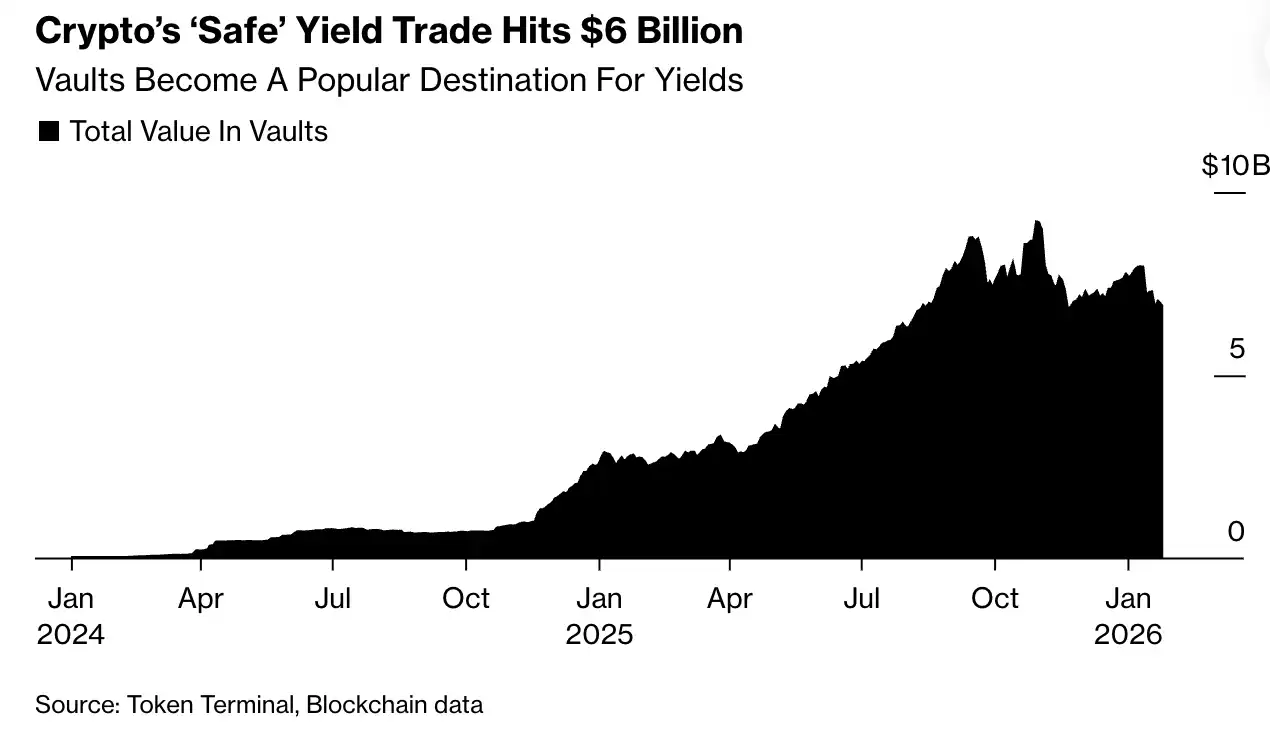
At a basic level, Vaults allow users to deposit cryptocurrency into shared pools, and these funds are deployed into lending or trading strategies designed to generate returns. The difference with Vaults lies in how they are marketed: they are promoted as a clean break from the opaque lending platforms of the past. Deposits are non-custodial, meaning users never hand over their assets to a company. Funds are held in smart contracts that automatically deploy capital according to pre-set rules, with key risk decisions clearly visible on the blockchain. Functionally, Vaults resemble a familiar component of traditional finance: pooled funds converted into yield and providing liquidity.

But their structure is distinctly crypto. This all happens outside the regulated banking system. Risk is not buffered by capital reserves or overseen by regulators—it is embedded in software, where algorithms automatically rebalance positions, liquidate collateral, or unwind trades as markets move, automating losses.

In practice, this structure can produce mixed results, as curators (the companies that design and manage Vault strategies) compete on returns, and users find themselves navigating just how much risk they are willing to bear.

"Some players will do a terrible job," said Paul Frambot, co-founder of Morpho, the infrastructure behind many lending Vaults. "They might not survive."

For developers like Frambot, this churn is less a warning sign and more a feature of an open, permissionless market—where strategies are tested in the open, capital flows quickly, and weaker approaches are replaced over time by stronger ones.

The timing of its growth is no accident. With the passage of the "Genius Act," stablecoins are moving into the financial mainstream. As wallets, fintech apps, and custodians race to distribute digital dollars, platforms face a common problem: how to generate yield without putting their own capital at risk.

Vaults have emerged as a compromise. They offer a way to manufacture yield while technically keeping assets off a company's books. Think of it like a traditional fund—but without handing over custody or waiting for quarterly disclosures. This is how curators pitch the model: users retain control of their assets while gaining access to professionally managed strategies that run automatically on-chain.

"The curator's role is similar to a risk and asset manager, like what BlackRock or Blackstone does for the funds and endowments they manage," said Tarun Chitra, CEO of crypto risk management firm Gauntlet, which also operates Vaults. "But, unlike BlackRock or Blackstone, it's non-custodial, so the asset manager never holds the user's assets; the assets are always in the smart contract."

This structure is designed to correct recurring weaknesses in crypto finance. In previous cycles, products marketed as low-risk often hid borrowed money, reused client funds without disclosure, or relied heavily on a handful of fragile partners. The algorithmic stablecoin TerraUSD offered yields nearing 20% by subsidizing returns. Centralized lenders like Celsius quietly parked deposits in high-risk bets. When markets turned, the damage spread quickly—and without warning.

Most Vault strategies today are more restrained. They typically involve floating-rate lending, market making, or providing liquidity to blockchain protocols, rather than pure speculation. The Steakhouse USDC Vault is one such example, lending stablecoins against what it describes as blue-chip cryptocurrencies and tokenized real-world assets (RWAs), offering a return of about 3.8%. Many Vaults are deliberately designed to be "boring": their appeal lies not in outsized returns, but in the promise of earning yield on digital cash without handing over custody or making users creditors of a single company.
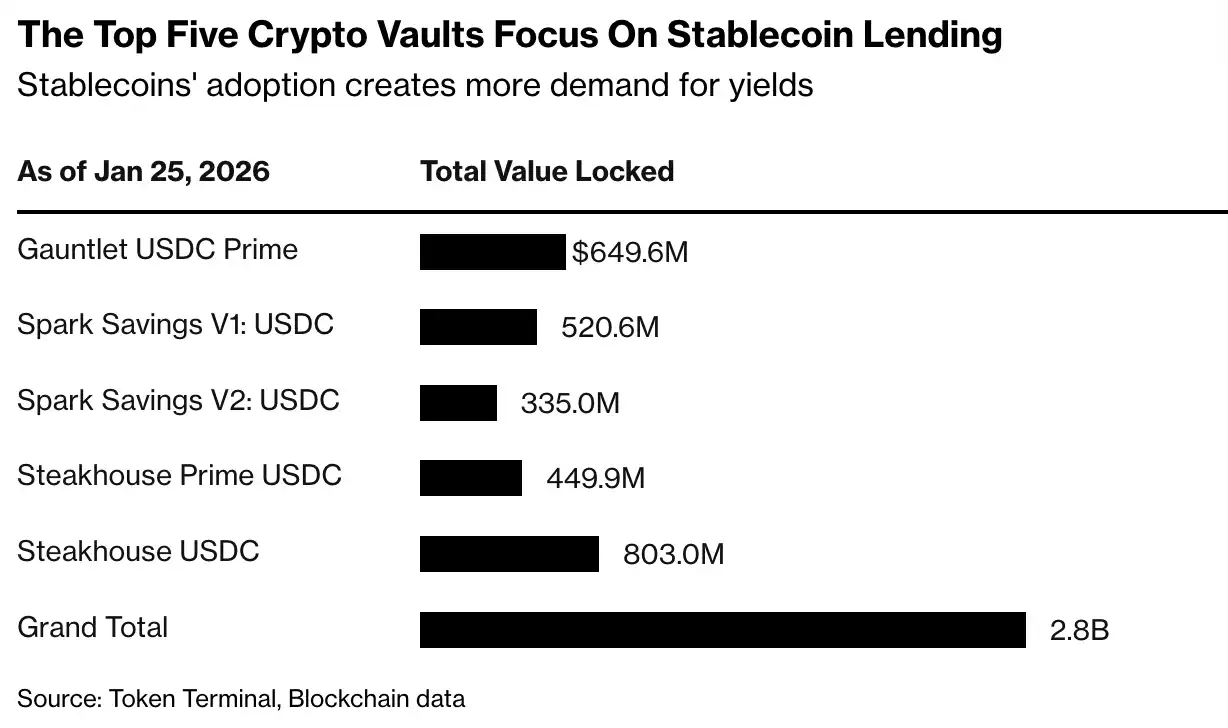
"People want yield," said Jonathan Man, portfolio manager and head of multi-strategy solutions at Bitwise, which just launched its first Vault. "They want their assets to be productive. Vaults are just another way to do that."

Vaults could also gain more momentum if regulators move to ban paying yield directly on stablecoin balances—a suggestion floated in market structure legislation. If that happens, the demand for yield won't disappear; it will just shift.

"Every fintech company, every centralized exchange, every custodian is talking to us," said Sébastien Derivaux, co-founder of Vault curator Steakhouse Financial. "Traditional finance companies too."

But this restraint isn't hard-coded into the system. The pressure shaping the industry comes from competition, not technology. As stablecoins proliferate, yield becomes a primary tool for attracting and retaining deposits. Underperforming curators risk losing capital, while those offering higher returns attract more inflows. Historically, this dynamic has pushed non-bank lenders—both in crypto and elsewhere—to loosen standards, add leverage, or shift risk off-platform. This shift has already touched large consumer-facing platforms. Crypto exchanges Coinbase and Kraken have both launched products giving retail customers access to Vault-like strategies, advertising yields as high as 8%.

Transparency, in sum, can be misleading. Public data tools and visible strategies build confidence—and confidence attracts capital. But once money is in place, curators face pressure to deliver returns, sometimes by reaching into off-chain deals that are difficult for users to assess.

Stream Finance later exposed this breaking point; the platform had advertised returns as high as 18%, then reported significant losses related to an unnamed external fund manager. The event triggered a sharp pullback across the Vault industry, with total assets falling from a peak near $10 billion to around $5.4 billion.

Proponents of the model say Stream was not representative. Stream Finance did not respond to a request for comment sent via X private message.

"Celsius, BlockFi, all of these, even Stream Finance, I kind of lump them all together as failures of disclosure to the end user," said Bitwise's Man. "People in crypto always focus more on what the upside might be and less on what the downside risk is."

That distinction may matter for now. Vaults were built in response to the last wave of failures, with the explicit goal of making risk visible rather than hidden. The open question is whether transparency alone is enough to constrain behavior—or whether, as in previous cases of shadow banking, a clearer structure just makes it easier for investors to tolerate risk until the music stops.

"At the end of the day, it's about embracing transparency, but it's also about having proper disclosures for any type of product—DeFi or non-DeFi," Man said.


İlgili Sorular

QWhat is the Vault model in crypto and how does it claim to be different from previous centralized lending platforms?

AThe Vault model allows users to deposit crypto into shared pools that are invested in lending or trading strategies to generate yield. It is marketed as a break from opaque, centralized lending platforms by being non-custodial (users never hand over assets to a company), using smart contracts with pre-set rules for automatic capital deployment, and making key risk decisions visible on the blockchain.

QAccording to the article, what is the predicted growth for assets under management in Vaults by 2026?

ACrypto asset management firm Bitwise predicts that the assets under management in Vaults could double by the end of 2026, driven by growing demand for stablecoin yield.

QWhat major event caused a significant withdrawal from the Vault industry, and what was the approximate amount involved?

AThe collapse of Stream Finance, which caused approximately $93 million in user losses, triggered a sharp withdrawal from the Vault industry, with total assets falling from a peak of nearly $10 billion to around $5.4 billion.

QHow does the article describe the potential risk or pressure that Vault curators face despite the transparent structure?

AThe pressure comes from competition rather than technology. Curators face the risk of losing capital if they underperform, which can push them to relax standards, increase leverage, or move risk off-platform to deliver higher returns and attract more inflows, similar to dynamics in traditional non-bank lending.

QWhat role does the 'Genius Act' play in the context of the growing Vault model?

AThe passage of the 'Genius Act' is helping to push stablecoins into the financial mainstream. As wallets, fintech apps, and custodians race to distribute digital dollars, Vaults offer a compromise solution for generating yield without taking the platform's own capital onto its balance sheet, thus meeting the demand for yield while technically keeping assets off the company's books.

İlgili Okumalar

7 Months After the Collapse of Huiwang, Southeast Asia's Escrow Platforms Undergo a Major Reshuffle

Following the collapse of Huione Pay—dubbed the "Alipay of Southeast Asia"—seven months ago, the region's underground financial guarantee platform sector is undergoing a significant reshuffle. This power vacuum has been swiftly filled by emerging platforms such as XinBi, Tiger/Navigator, JinBei (renamed JinBo), Dali/Tiancheng, and FullyLight. These platforms, operating largely via Telegram and offering services like escrow for illicit transactions, have absorbed the vast user base and markets left behind by Huione. While positioning themselves as "trust intermediaries," their primary clientele consists of networks involved in online scams, money laundering, illegal gambling, and even human trafficking. For instance, the Tiger/Navigator platform explicitly provides "escrow" services for kidnapping-for-ransom operations ("强押车交易"). Data underscores the immense scale: Huione alone processed over $103 billion in cryptocurrency payments and facilitated over $31 billion through its escrow market before its downfall, linking it to Cambodia's notorious Prince Group. Since its collapse, competitors have seen explosive growth. For example, the XinBi platform has accumulated over $1.6 billion in total USDT revenue, while platforms like NewPay, OkPay (under Dali), and FullyLight Wallet collectively processed over $4.8 billion in USDT in a single year. This ecosystem thrives in regions like Cambodia and Myanmar, where regulatory gaps allow these platforms to act as critical financial infrastructure for sprawling cybercrime industries, from scam compounds to online casinos. The article concludes that the moniker "Southeast Asian Alipay" is a misnomer, obscuring the platforms' fundamental role in enabling serious criminal enterprises rather than representing legitimate financial innovation.

Odaily星球日报38 dk önce

7 Months After the Collapse of Huiwang, Southeast Asia's Escrow Platforms Undergo a Major Reshuffle

Odaily星球日报38 dk önce

The Changing Landscape: What Are Crypto VCs Experiencing?

Title: The Shifting Landscape of Crypto Venture Capital The era of dedicated crypto venture capital funds is undergoing a significant transformation. Once essential for navigating the sector's complexity and high risk, these specialized funds are now facing an identity crisis as the market matures. This shift mirrors historical patterns in other specialized investment classes like cleantech and SPACs, where initial information advantages dissipate as technologies become mainstream and integrated into existing industry frameworks. The article argues that crypto is reaching a critical inflection point, transitioning from a "building phase" to an "integration phase." Major players like Stripe, BlackRock, and Visa now engage with crypto not for its novel mechanics but as a foundational financial infrastructure. Their needs—regulatory compliance, banking partnerships, distribution channels—align with traditional fintech, a domain easily understood by large, generalist funds like Sequoia and Founders Fund. This evolution creates a "barbell effect" within the VC landscape. On one end are massive, diversified platforms that can incorporate crypto as one vertical among many. On the other are small, nimble funds focused on niche, experimental projects. The middle ground—medium-sized dedicated crypto funds—is being squeezed out. Their typical fund size makes it impossible to generate sufficient returns solely from early-stage crypto bets, yet they cannot compete with giants for later-stage deals. Consequently, leading crypto-native firms like Paradigm and Framework Ventures are expanding into AI, robotics, and other sectors, driven partly by LP pressure for better returns amid a broader VC DPI crisis. Others, like Dragonfly and a16z, have narrowed their crypto focus predominantly to financial infrastructure like stablecoins, reframing the sector's core narrative. For crypto entrepreneurs, this consolidation presents challenges. While generalist funds offer larger checks and broader resources, crypto projects now compete fiercely with AI for attention and capital within these firms. Furthermore, the long-term, non-commercial foundational work that built the ecosystem—funded by dedicated crypto VCs—is less likely to attract generalist capital focused on direct returns. The conclusion is that "crypto investor" as a standalone category is becoming obsolete, akin to "internet investor." Crypto is becoming a baseline infrastructure layer. The future will see a barbell structure: large-scale growth financing handled by generalist funds, while pioneering, speculative projects are funded by small, specialized vehicles. The dedicated crypto funds of the 2017-2021 boom, which incubated core infrastructure, are giving way to this new, bifurcated reality.

Foresight News56 dk önce

The Changing Landscape: What Are Crypto VCs Experiencing?

Foresight News56 dk önce

As Consensus Accelerates, What Are Young Investors Betting On?

Title: As Consensus Forms Faster, What Are Young Investors Betting On? In the rapid evolution of tech investment, a new generation of young investors is navigating a landscape where AI, robotics, commercial aerospace, and quantum computing are advancing simultaneously. Traditional investment logic based on financial models is giving way to a need for deep technical understanding and the ability to act before industry consensus forms. An analysis of trends from the "WAIC FUTURE TECH" list of young investment leaders reveals key shifts in focus. The first major trend is the movement of AI from the digital screen into the physical world. Investment is shifting from large language models and chatbots towards embodied AI, robotics, AI hardware, and edge computing. While demonstrations generate excitement, the real challenge lies in achieving scalable, reliable, and cost-effective delivery in complex real-world environments like factories and logistics. Success depends not just on algorithms but on the integration of sensors, actuators, and control systems. Second, the competitive focus for large models is moving beyond raw capability toward building an "intelligence flywheel." The goal is to create self-reinforcing systems where user interaction generates data, improving the model, which in turn enhances the user experience and attracts more engagement. Companies that successfully embed AI into workflows to create these closed-loop systems can build lasting value that isn't easily erased by the next model upgrade. Third, facing a potential bottleneck in high-quality human-generated data, investors are looking at new underlying technologies. Reinforcement learning and self-play, as demonstrated by AlphaGo Zero, offer paths for AI to generate its own experience. Scientific foundation models, which aim to build general AI capabilities for fields like life sciences and materials discovery, represent a non-consensus direction that could unlock new frontiers of knowledge and data. Finally, in deep-tech areas like quantum computing, commercial aerospace, and space-based infrastructure, patient capital is essential. These fields have long, uncertain development and validation cycles involving complex engineering, supply chains, and regulations. Investment here requires a long-term view, focusing on foundational team capabilities and the eventual emergence of market demand, even if commercial returns are distant. Collectively, these trends illustrate how young investors are adapting to a new era. They are learning to make earlier, technically-informed judgments, balance hype with real-world viability, and provide the patient capital needed to build the deep-tech foundations of the future.

marsbit1 saat önce

As Consensus Accelerates, What Are Young Investors Betting On?

marsbit1 saat önce

İşlemler

Spot
活动图片




