Tether’s $23B Gold Hoard Rivals Nation States As Smart Money Pivots To $HYPER

bitcoinist2026-02-09 tarihinde yayınlandı2026-02-09 tarihinde güncellendi

Özet

Tether, the issuer of USDT, has accumulated a massive $23 billion in physical gold, placing it among the world's top 30 holders and surpassing many G20 nations. This signals a defensive move against macroeconomic uncertainty. Meanwhile, sophisticated investors are shifting toward high-utility infrastructure projects like Bitcoin Hyper ($HYPER), a Bitcoin Layer 2 solution integrated with Solana Virtual Machine (SVM). It aims to unlock over $1 trillion in dormant Bitcoin capital by enabling fast, low-cost transactions and decentralized applications. With over $31 million raised from large-scale investors, $HYPER is positioned to redefine Bitcoin's utility beyond a store of value.

The definition of a safe haven is shifting under our feet. According to a recent report from investment bank Jefferies, Tether, issuer of the ubiquitous $USDT, has stockpiled a staggering $23B in physical gold. This hasn’t gone unnoticed, with many commenting about the purchase on social media.

That stash places the crypto firm among the top 30 global holders of bullion, eclipsing the official reserves of many G20 nations.

This isn’t just diversification. It’s a signal. Tether holds at least 148 tonnes of the yellow metal, using commodities to back a digital dollar. The irony is rich: the main on-ramp to the crypto ecosystem is hedging against the very fiat currency it represents. This massive accumulation suggests that even the biggest liquidity providers are bracing for prolonged macroeconomic turbulence.

But while Tether plays defense with physical commodities, a more aggressive rotation is brewing elsewhere. Sophisticated investors are moving beyond passive “store of value” plays. They’re hunting for infrastructure that wakes up dormant liquidity.

Gold sits in a vault. It doesn’t yield. Bitcoin, historically, has suffered the same limitation, functioning as digital gold but offering little utility. That narrative, however, is fracturing. As institutional interest hits fever pitch, the market is aggressively repricing protocols that solve Bitcoin’s scalability bottlenecks.

This search for yield on top of the world’s most secure blockchain has channeled significant volume toward Bitcoin Hyper ($HYPER), a project engineering the first bridge between Bitcoin’s security and high-speed execution.

Bitcoin Hyper ($HYPER) Unlocks The Trillion-Dollar Dormant Economy

For over a decade, Bitcoin has faced one persistent critique: it’s secure, but it’s slow. Transactions are pricey (sometimes painfully so), and programmability is virtually non-existent compared to chains like Ethereum or Solana. The result? Over $1T in capital is essentially ‘stuck’ in digital wallets, sidelined from the DeFi economy.

Bitcoin Hyper tackles this inefficiency head-on by deploying the first-ever Bitcoin Layer 2 integrated with the Solana Virtual Machine (SVM).
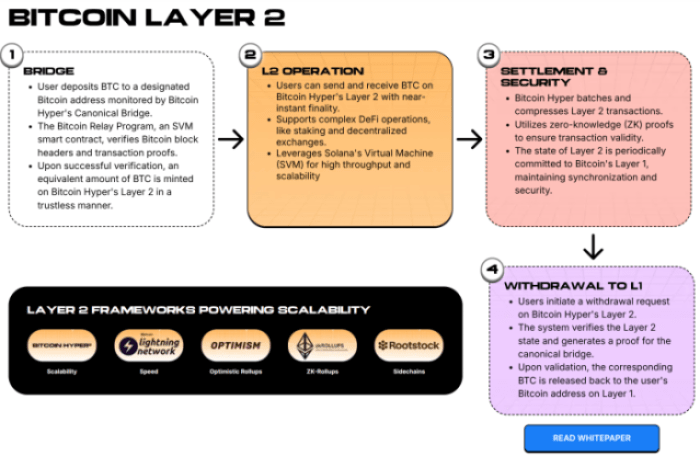
Why does this architecture matter? Because it fundamentally changes the network’s capabilities. By using the SVM for execution while relying on Bitcoin L1 for settlement, $HYPER creates a hybrid environment. Developers can build high-performance dApps using Rust, the standard for high-speed trading systems, while users keep Bitcoin’s immutable security guarantees.

The project uses a decentralized Canonical Bridge for seamless $BTC transfers into the Layer 2 ecosystem. Once bridged, that capital moves with sub-second finality and negligible fees. Suddenly, high-frequency trading, lending markets, and gaming applications, previously impossible on the mainnet, become viable.

For the broader market, this is a pivot point. It’s no longer just about holding an asset that resists inflation (like Gold or $BTC); it’s about owning the rails that power the future financial system.

EXPLORE THE BITCOIN HYPER ($HYPER) ECOSYSTEM

Whales Accumulate $31M As High-Speed Layer 2 Redefines Market Expectations

The market’s appetite for this ‘Bitcoin-on-steroids’ infrastructure shows up clearly in the on-chain flows. While retail investors chase meme coins, smart money seems to be positioning itself in infrastructure plays with tangible utility. Bitcoin Hyper ($HYPER) has already raised an impressive $31M+, signaling strong conviction from early backers.

Whale activity backs this up. Large-scale purchases of $500K, $379.9K, and $274K stand out, not only showing conviction in the project but also the desire to get in early and potentially maximize returns.

With the token currently priced at $0.0136753, these large-scale buys suggest investors see the asset as undervalued relative to its utility. The project’s tokenomics (designed to incentivize the long haul) offer high APY staking rewards immediately after the Token Generation Event (TGE). The structure includes a 7-day vesting period for presale stakers, a classic mechanism to prevent immediate dumping and stabilize price action.

The logic driving these inflows is straightforward. If Bitcoin is the digital equivalent of Tether’s gold stash, then Bitcoin Hyper is the logistical network allowing that gold to be spent, lent, and leveraged at internet speed.

JOIN THE BITCOIN HYPER ($HYPER) PRESALE

The content of this article is for informational purposes only and does not constitute financial advice. Cryptocurrency investments, including presales and Layer 2 tokens, carry inherent risks. Always conduct your own due diligence before making investment decisions.


İlgili Sorular

QHow much physical gold has Tether stockpiled, and what does this make them in terms of global holders?

ATether has stockpiled $23 billion in physical gold, which places the crypto firm among the top 30 global holders of bullion.

QWhat is the primary limitation that Bitcoin Hyper ($HYPER) aims to solve for the Bitcoin network?

ABitcoin Hyper aims to solve Bitcoin's scalability bottlenecks, high transaction fees, and lack of programmability to unlock over $1 trillion in dormant capital for the DeFi economy.

QWhat key technology does Bitcoin Hyper use to integrate with Bitcoin's security while enabling high-speed execution?

ABitcoin Hyper deploys the first-ever Bitcoin Layer 2 integrated with the Solana Virtual Machine (SVM), using it for execution while relying on Bitcoin L1 for settlement.

QHow much funding has Bitcoin Hyper ($HYPER) raised from early backers, according to the article?

ABitcoin Hyper has raised over $31 million from early backers, signaling strong conviction in the project.

QAccording to the article, what is the new investment focus shifting towards, beyond passive 'store of value' assets?

AThe investment focus is shifting towards infrastructure that unlocks dormant liquidity, allowing capital to be used for high-performance dApps, lending markets, and other financial applications, rather than just holding inflation-resistant assets.

İlgili Okumalar

Stuck Polymarket: The Real Test After Riding the Traffic Boom Has Arrived

Polymarket, a leading prediction market platform, is facing significant technical challenges as its growth outpaces its current infrastructure on Polygon. Users are experiencing laggy transactions, unresponsive orders, and delayed confirmations, severely impacting the trading experience. In response, DeFi Engineering VP Josh Stevens outlined a comprehensive engineering overhaul. The plan includes reducing on-chain data delays, fixing order cancellation issues, rebuilding the central limit order book (CLOB), improving website performance, and developing a unified SDK and API. A major revelation was the ongoing "chain migration," indicating a potential move away from Polygon. The core issue is that Polymarket has evolved from a simple prediction market into a high-frequency trading platform, making Polygon's limitations—such as block space, gas fees, and block time—a ceiling for further growth. The migration is not just a simple chain switch but a fundamental rebuild of its trading system to support more complex products like perpetual contracts (Perps). This announcement has sparked competition among chains like Solana, Sui, and Algorand, all vying to host Polymarket. For Polygon, losing this key application, which contributes significantly to its gas fee revenue, would be a major setback. The real test for Polymarket is no longer attracting users but proving it can provide a stable, reliable trading environment that retains them.

Odaily星球日报4 dk önce

Stuck Polymarket: The Real Test After Riding the Traffic Boom Has Arrived

Odaily星球日报4 dk önce

Lowering Expectations for BTC's Next Bull Market

The author, Alex Xu, explains his decision to significantly reduce his Bitcoin holdings (from full to ~30% of his portfolio) during the current bull cycle, citing a lowered long-term outlook for BTC's price appreciation in the next cycle. He outlines six key reasons for this reduced expectation: 1. **Diminished Growth Drivers:** The narrative of exponential user adoption has largely played out with institutional ETF adoption. The next major growth phase—adoption by sovereign national reserves or central banks—seems unlikely in the near future. 2. **Personal Opportunity Cost:** More attractive investment opportunities have emerged in other assets, such as undervalued companies. 3. **Industry-Wide Contraction:** The broader crypto industry is struggling, with most Web3 business models (SocialFi, GameFi, DePIN) failing. This overall萧条 (depression) reduces the fundamental demand and consensus for Bitcoin. 4. **Strain on Major Buyer:** MicroStrategy, a major corporate buyer of BTC, faces rising financing expenses for its debt, which could slow its purchasing rate and create significant marginal pressure on the market. 5. **Increased Competition from Gold:** The emergence of "tokenized gold" has closed the functional gap (portability, divisibility) between physical gold and Bitcoin, offering a strong competitor in the non-sovereign store-of-value space. 6. **Security Budget Concerns:** The block reward halving continues to exacerbate the long-standing issue of funding Bitcoin's network security, with new fee source explorations like Ordinals and L2s largely failing. The author's decision to hold a significant (though reduced) position reflects a cautious, not bearish, outlook. He remains open to increasing his exposure if the fundamental reasons for his skepticism change or if new positive catalysts emerge.

marsbit42 dk önce

Lowering Expectations for BTC's Next Bull Market

marsbit42 dk önce

Can Iran 'Control' the Strait of Hormuz?

Iran has announced a comprehensive plan to assert control over the strategic Strait of Hormuz, a critical global oil shipping chokepoint. The proposed measures include requiring all vessels to obtain Iranian permission for passage, imposing fees for security, environmental protection, and navigation management—preferably paid in Iranian rials—and absolutely banning Israeli ships. Vessels from countries deemed hostile by Iran’s top security bodies may also be barred. Analysts suggest Iran’s motives are multifaceted: increasing pressure on the U.S. and Israel by leveraging control over oil transit to influence global prices and inflation; creating a new revenue stream, potentially exceeding $7.7 billion annually, to counter Western sanctions and support postwar reconstruction; and using transit permissions as bargaining chips in future negotiations, notably with the U.S. However, the plan faces significant practical and diplomatic challenges. Enforcing comprehensive interception and fee collection in the busy waterway, patrolled by international military forces, would be difficult. The U.S. has already countering with a blockade of Iranian ports and threats to intercept any ship paying fees, potentially strangling Iran’s oil exports and fee revenue. Broad international opposition, led by European and Gulf states, and legal controversies further complicate implementation. The proposal may ultimately serve more as a negotiating tactic than a feasible policy, with its execution remaining highly uncertain.

marsbit1 saat önce

Can Iran 'Control' the Strait of Hormuz?

marsbit1 saat önce

İşlemler

Spot
Futures
活动图片