Tether To Terminate Offshore Yuan (CNH₮) Operations – Here’s Why

bitcoinist2026-02-22 tarihinde yayınlandı2026-02-22 tarihinde güncellendi

Özet

Tether has announced it will discontinue its offshore Chinese Yuan stablecoin (CNH₮) due to a lack of market demand and operational inefficiency. Effective immediately, new issuance of CNH₮ has been halted. Existing users have one year to redeem their tokens before the stablecoin is permanently phased out. The company stated it will reallocate resources to products with stronger adoption, such as its flagship USDT, which has a market cap of $183.7 billion. In related news, a survey highlighted Nigeria and South Africa as leading markets for stablecoin adoption, with 80% of respondents in these countries holding stablecoins.

Stablecoin operator Tether has announced its decision to discontinue support for its offshore Chinese Yuan token CNH₮. The USDT operator has attributed this development to a lack of market demand, among other points.

Tether To Terminate CNH₮ Redemption In One Year

In a recent blog post, Tether shared a strategic update on its CNH₮, communicating a management decision to withdraw the stablecoin product from its offerings. This decision is based on multiple factors centered around demand and operational efficiency.

A statement from the announcement read:

Community interest and adoption are central to every product decision we make. When evaluating whether to maintain or introduce a Tether token, we assess market demand, operational sustainability, and broader ecosystem conditions that influence long-term usability. Our priority is to allocate resources where they can most effectively enhance security, reliability, and innovation across the digital asset landscape.

Tether explains that the CNH₮ recorded low interest, adoption, and community demand compared to their products, thereby failing to produce an acceptable return on technical and operational efforts.

As of this moment, all new issuance of CNH₮ has been halted. Meanwhile, CNH₮ users will have the next year to process any redemptions before the stablecoin is permanently phased out. The stablecoin operator will issue another reminder ahead of the redemption deadline. Following this development, Tether reiterates its commitment to stablecoin global growth and adoption.

The statement read:

Tether will continue to focus its efforts on stablecoins and infrastructure that demonstrate strong, organic adoption and long-term relevance. This includes advancing core stablecoin liquidity, expanding tokenization infrastructure, and supporting new financial tools that better serve global users and builders.

Tether remains the operator of the world’s largest stablecoin, USDT, which presently boasts a total market cap of $183.7 billion. In January, the stablecoin company launched USAT, designed specifically for American users.

Nigeria Leads Demand For Stablecoins

In other news, a recent survey by BVNK has revealed that Africa’s largest economies are leading the demand for stablecoins. This survey, done in collaboration with Coinbase, YouGov, and Artemis, involved 4658 adults across 15 countries. The results revealed that 80% of Nigerian and South African respondents presently hold stablecoin, while 75% aim to increase holdings as citizens seek a haven from their local fragile currencies.

At press time, the total stablecoin market cap is valued at $310 billion, with high expectations of future market expansion following the approval of the GENIUS Act last July.
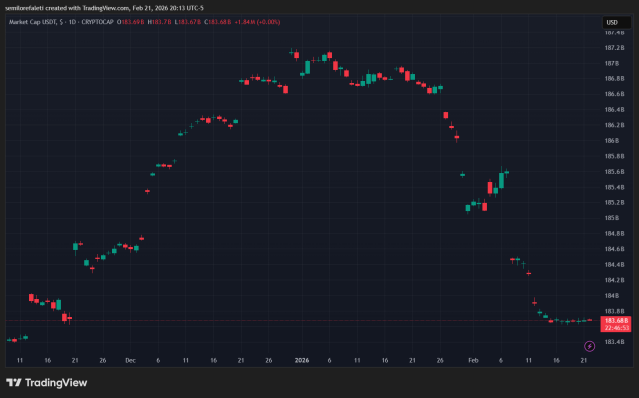
USDT market cap valued at $183.68 billion on the daily chart | Source: USDT chart on Tradingview.com

İlgili Sorular

QWhy is Tether discontinuing its offshore Chinese Yuan token (CNH₮)?

ATether is discontinuing CNH₮ due to a lack of market demand, low community interest and adoption, and the failure to produce an acceptable return on the technical and operational efforts required to maintain it.

QWhat is the timeline for users to redeem their CNH₮ tokens?

ACNH₮ users have one year to process any redemptions before the stablecoin is permanently phased out. Tether will issue another reminder ahead of the redemption deadline.

QWhat is the current market capitalization of Tether's USDT stablecoin?

ATether's USDT stablecoin currently has a total market capitalization of $183.7 billion.

QAccording to the article, which country is leading the demand for stablecoins?

AAccording to a survey by BVNK, Nigeria is leading the demand for stablecoins, with 80% of Nigerian respondents holding stablecoins.

QWhat will Tether focus on following the discontinuation of CNH₮?

ATether will continue to focus on stablecoins and infrastructure that demonstrate strong, organic adoption and long-term relevance, including advancing core stablecoin liquidity, expanding tokenization infrastructure, and supporting new financial tools.

İlgili Okumalar

Token Inefficient, Economy Tokenless

The article "Tokens Aren't Economical, Economics Aren't Tokenized" analyzes a pivotal shift in the AI industry from a technology-driven narrative to one dominated by capital efficiency. It highlights two concurrent trends: a severe capital shortage due to the exorbitant and recurring costs of compute (e.g., OpenAI's high burn rate) and a wave of corporate spin-offs where major tech companies are separating their AI units (like Kuaishou's Kling and Baidu's Kunlunxin). The core argument is that AI's "anti-internet" business model, where user growth increases costs rather than profits, has created a disconnect between high valuations and actual cash flow. Spin-offs address this by allowing AI assets to be valued independently. Within a parent company, they are seen as cost centers, but as standalone entities, they are priced based on their growth potential and scarcity in the primary market, leading to massive valuation premiums (e.g., Kling's estimated value tripling post-spin-off). The industry is at an inflection point, moving from "model worship" to "value realization." The competition is evolving from a pure compute (GPU) race to a broader focus on systemic efficiency and full-stack engineering (involving CPUs and orchestration) to achieve viable commercialization. The year 2026 is framed as a critical moment where the industry must definitively answer how to economically translate AI capability into tangible business value, reshaping the sector's future power structure.

marsbit5 dk önce

Token Inefficient, Economy Tokenless

marsbit5 dk önce

Crossing the 'Memory Wall': The Wafer-Level Revolution and Computing Power Routes in the AI Inference Era

In 2026, a historic shift occurred in AI as major cloud providers' inference spending surpassed training spending for the first time, signaling a move from "building large models" to "using large models." This shifts the core challenge from computing power to the "memory wall"—the bottleneck of data movement (model weights, activations, KV Cache) between external DRAM and processors, where energy and latency from data transfer far exceed computation itself. Companies like Nvidia face GPU idle time due to bandwidth limits. In contrast, Cerebras Systems adopts a radical "wafer-scale" approach with its Wafer-Scale Engine (WSE). Instead of cutting a silicon wafer into many chips, Cerebras uses almost the entire wafer as one massive chip (WSE-3). This design provides 44GB of on-chip SRAM, delivering memory bandwidth thousands of times higher than traditional HBM (e.g., 21 PB/s vs. Nvidia B200). For LLM inference, weights are streamed layer-by-layer from external MemoryX storage to the chip, avoiding HBM bottlenecks. This results in token generation speeds 1.5–5 times faster than Nvidia's B200 in some models and significant advantages in first-token latency and long-context tasks. Additionally, Cerebras's architecture offers much lower interconnect power consumption (0.15 pJ/bit vs. GPU's ~10 pJ/bit). However, Cerebras faces challenges: SRAM scaling has slowed with advanced nodes, limiting future capacity gains; the chip requires specialized liquid cooling and custom software stacks; and its external I/O bandwidth (150 GB/s) is low compared to NVLink, hindering multi-system scaling for very large models. Competition is intensifying. Major players are pursuing three paths: 1) Developing proprietary inference ASICs (e.g., Google TPU, Microsoft Maia), 2) Leveraging advanced packaging (e.g., TSMC's SoW) to democratize wafer-scale-like integration, potentially eroding Cerebras's process advantage within a few years, and 3) Exploring optical interconnects for ultimate bandwidth. Commercially, Cerebras is transitioning from a hardware vendor to a service provider, facing the immense challenge of building high-power, specialized data centers to meet large contracts (e.g., 250MW/year from 2026–2028). In conclusion, the AI inference era presents a fundamental architectural trade-off. Cerebras opts for extreme physical optimization for low-latency, single-task performance, while Nvidia prioritizes versatility and massive cluster throughput. The path forward remains uncertain, with technology and business models still evolving in the race toward advanced AI.

marsbit11 dk önce

Crossing the 'Memory Wall': The Wafer-Level Revolution and Computing Power Routes in the AI Inference Era

marsbit11 dk önce

Has Bitcoin's 'Rebound Ended', Officially Entering the Late Bear Market Phase?

**Title: Has Bitcoin's Rebound Ended, Entering the Late Bear Market Phase?** **Summary:** Bitcoin's price has declined by 13% this week, signaling a potential return to late-stage bear market conditions. The price fell to around $67k, positioned between the Realized Price and Realized Cap Weighted Average. For the first time since early 2022, the Short-Term Holder cost basis has dropped below this key average, confirming a hallmark of late-cycle bear markets. Profitability metrics have collapsed sharply. The 7-day average of the Realized Profit/Loss ratio plummeted from a local high of 3.16 to 0.29, mirroring the February panic sell-off. Critically, the 90-day average never breached the threshold of 2, indicating the recent rally to $82k was a bear market bounce, not a structural shift. Realized losses surged to $1.35 billion daily, with $770 million coming from Long-Term Holders selling at a loss. This accelerating redistribution of supply from weak to strong hands is a necessary but ongoing process for a market bottom. The rally stalled almost precisely at the aggregate cost basis (~$83k) of US spot Bitcoin ETF investors, turning that level into strong resistance and leaving the average ETF holder underwater again. Spot market flows have turned decisively negative, showing sellers are dominating order books despite the price drop. While a significant futures long liquidation event cleared over $400 million in leverage, providing a potential reset, sustained spot demand is yet to materialize. Options markets continue to price in higher future volatility (Implied Volatility) than recent price action (Realized Volatility) has shown, with a persistent skew towards put options, indicating ongoing demand for downside protection. In conclusion, multiple metrics point to a fragile market structure. Resistance at the ETF cost basis, accelerating realized losses, dominant spot selling, and cautious options pricing all suggest the bear market trend persists. A sustainable recovery likely requires a resurgence of spot demand, ETF holders returning to profit, and a clear reduction in selling pressure.

marsbit11 dk önce

Has Bitcoin's 'Rebound Ended', Officially Entering the Late Bear Market Phase?

marsbit11 dk önce

TechFlow Intelligence Agency: Anthropic Calls for Global Pause in AI Development While Preparing for Trillion-Dollar IPO; SpaceX IPO Roadshow Heats Up, But S&P 500 Rejects Fast-Track Inclusion

In today's TechFlow Intelligence Briefing, several major tech stories highlight a growing theme of trust and credibility gaps across AI, crypto, and finance. AI company Anthropic has publicly called for a global pause in AI development, citing risks from Claude's "recursive self-improvement." Ironically, this coincides with reports the company is preparing for a massive IPO targeting a near $1 trillion valuation. This perceived hypocrisy, coupled with widespread user complaints about Claude's declining performance, is sparking debate over whether the safety warning is genuine or a competitive tactic. Meanwhile, in a substantive security move, Anthropic open-sourced a framework for AI-powered vulnerability discovery. In the crypto market, Bitcoin's price drop below $61,000 triggered over $1.16 billion in liquidations, flipping the market into a state where more BTC is held at a loss than at a profit, a historical bearish signal. On the corporate front, SpaceX's highly anticipated IPO is generating immense Wall Street excitement, with Goldman Sachs projecting 100x revenue growth by 2030. However, the S&P 500 has refused to fast-track the company's inclusion post-IPO, potentially limiting immediate institutional demand. Separately, ByteDance's AI app Doubao lost over 6 million monthly active users after introducing a subscription model, highlighting the challenges of AI monetization. Other notable developments include Nvidia certifying HBM4 memory from Samsung, SK Hynix, and Micron; Cloudflare's acquisition of front-end tooling company VoidZero; and its CEO warning that bot traffic now exceeds human traffic online. The underlying narrative connects these events: a trust crisis. From AI firms' contradictory actions and crypto volatility to the clash between SpaceX's hyped narrative and institutional rules, a pattern is emerging where stated intentions and actual practices are increasingly misaligned.

marsbit27 dk önce

TechFlow Intelligence Agency: Anthropic Calls for Global Pause in AI Development While Preparing for Trillion-Dollar IPO; SpaceX IPO Roadshow Heats Up, But S&P 500 Rejects Fast-Track Inclusion

marsbit27 dk önce

Dalio Warns: AI Boom Shows Signs of a Bubble, Day of Reckoning Will Be the Time of Burst

Ray Dalio, founder of Bridgewater Associates, warns that the current artificial intelligence investment boom shows classic signs of a bubble, which he expects will eventually burst. In a Bloomberg Television interview, he noted that great technological revolutions often lead to capital inflows that create bubbles, making it difficult for investors and companies to calibrate their spending accurately—either overspending to capture market share or underspending and losing their competitive position. This caution comes amid significant rallies in AI-related assets, particularly chipmakers, driven by soaring demand for data centers and high-bandwidth chips, raising debates about overheating valuations. In contrast, Nvidia CEO Jensen Huang recently asserted that investors embracing the AI wave would see "crazy" returns and dismissed concerns over return on investment for data center spending as outdated. Dalio, however, focuses on the risks in the profit realization phase. He argues that bubbles tend to show signs of破裂 when markets transition from investment to the need for tangible returns, describing the burst as a process of converting paper wealth into cash. While acknowledging AI's intrinsic value, he expressed concern over the future profitability of some AI companies, suggesting the market is repeating a familiar pattern. The 76-year-old billionaire, who fully exited Bridgewater in 2025, has a net worth estimated at $21.5 billion according to the Bloomberg Billionaires Index.

marsbit1 saat önce

Dalio Warns: AI Boom Shows Signs of a Bubble, Day of Reckoning Will Be the Time of Burst

marsbit1 saat önce

İşlemler

Spot
Futures
活动图片





