Tether may tokenize equity to ensure liquidity for investors: Report

cointelegraph2025-12-12 tarihinde yayınlandı2025-12-12 tarihinde güncellendi

Özet

Tether, the issuer of USDT, is reportedly considering tokenizing equity and share buybacks to provide liquidity for investors as it aims for a $500 billion valuation. The company halted a shareholder’s attempt to sell a $1 billion stake, which would have valued Tether at $280 billion. Instead, Tether plans to offer liquidity solutions through tokenization or buybacks after closing a funding round aimed at raising $20 billion for a 3% stake. Tokenized equity enhances liquidity by enabling easier transfers, fractional ownership, and use as collateral in DeFi. The move aligns with growing regulatory support for onchain finance, including the SEC’s recent approval for DTCC to tokenize traditional assets like stocks and bonds.

Tether, the stablecoin company that issues the USDt (USDT) dollar-pegged token, is considering tokenizing investor equity and share buybacks to offer liquidity for investors as it seeks a $500 billion valuation.

Bloomberg reported on Friday, citing a source familiar with the matter, that Tether recently stopped an existing shareholder from selling their stake as the company is in talks to raise $20 billion for a 3% stake in the stablecoin's issuer business.

The investor sought to sell a $1 billion stake that valued Tether at $280 billion, Bloomberg reported. In response, Tether plans to offer investor liquidity through tokenization or share buybacks after the funding round closes.

Cointelegraph reached out to Tether but had not received a response by the time of publication.

Tokenizing a company’s equity can increase liquidity by making shares easier to transfer, fractionalize and borrow against. Onchain equity allows holders to maintain their positions while using a tokenized representation of their equity as collateral in decentralized finance (DeFi) applications.
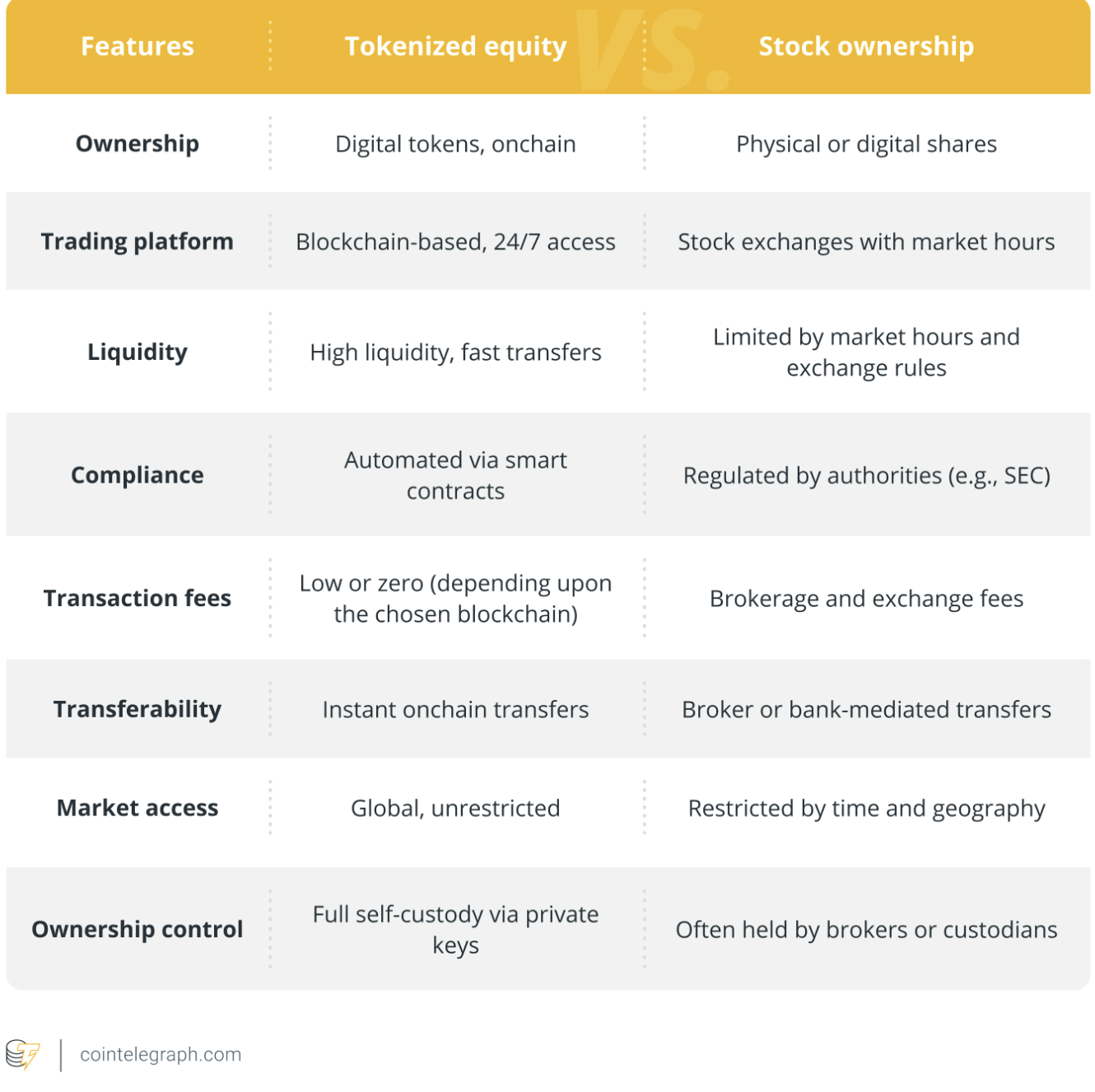
The differences between tokenized equity and shares issued through the traditional financial system. Source: Cointelegraph

Related: Tether solvency fears are ‘misplaced’ as company sits on large surplus: CoinShares

Tokenized finance is gaining steam as US regulators move to overhaul legacy financial tech

On Thursday, the US Securities and Exchange Commission (SEC) gave the green light to the Depository Trust and Clearing Corporation (DTCC), a clearinghouse and settlement company, to tokenize stocks, exchange-traded funds and bonds.

“US financial markets are poised to move onchain,” SEC Chair Paul Atkins said on Thursday, adding, “Onchain markets will bring greater predictability, transparency, and efficiency for investors.”
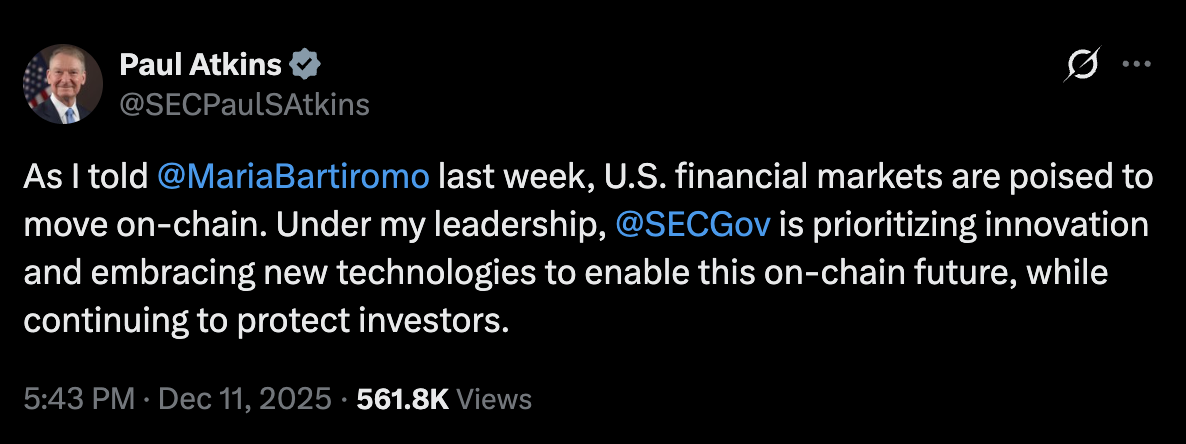
Source: Paul Atkins

Financial services company J.P. Morgan facilitated a $50 million tokenized bond issue for crypto investment company Galaxy Digital Holdings on the same day as Atkins’ announcement.

Crypto exchanges are also looking to expand trading of tokenized products, following the SEC’s nod to the DTCC and Atkins’ comments.

Coinbase, a US-based cryptocurrency exchange, is expected to announce its expansion into tokenized stocks and prediction markets as early as Wednesday.

The company told Cointelegraph that it will host a livestream to showcase new products, but did not specify which products would be unveiled.

Tokenized public stocks are still in the early stages of adoption, with nearly $700 million in public equities tokenized at the time of this writing, according to RWA.xyz data.

Magazine: Bitcoin whale Metaplanet ‘underwater’ but eyeing more BTC: Asia Express
İlgili Okumalar

Mathematicians Refute Open AI's Claim of Proving Connes Rigidity Conjecture Within 24 Hours: 'AI Proved Every Sentence Correct, but They Are No Longer About the Original Conjecture'

Mathematician Refutes OpenAI's Claim of Disproving Connes Rigidity Conjecture in 24 Hours OpenAI claimed its next-generation AI model solved 10 world-class problems, including disproving the Connes Rigidity Conjecture. The next day, mathematician J. L. Nielsen from the University of Kansas published a paper refuting the AI's counterexample. Nielsen meticulously reviewed OpenAI's publicly released 37,000 lines of Lean 4 code, mapping each object back to its mathematical origin. He identified two independent failure paths in the AI's argument. He concluded that one of the two groups constructed by the AI does not satisfy the required conditions (specifically ICC and Kazhdan's property (T)) necessary to serve as a valid counterexample to the original conjecture. This means the AI may have successfully proven something about its constructed objects, but that statement is not equivalent to disproving the Connes Rigidity Conjecture itself. The incident highlights a crucial limitation of formal verification tools like Lean. While Lean's kernel can verify the logical correctness of a proof's steps, it cannot verify whether the formal statement being proven correctly corresponds to the intended mathematical conjecture. Human oversight remains essential to ensure the alignment between the formalized problem and the original research question. This case exemplifies what researchers call "successfully proving the wrong statement." The Connes Rigidity Conjecture, concerning the uniqueness of group von Neumann algebras under certain conditions, remains an open problem.

marsbit6 dk önce

Mathematicians Refute Open AI's Claim of Proving Connes Rigidity Conjecture Within 24 Hours: 'AI Proved Every Sentence Correct, but They Are No Longer About the Original Conjecture'

marsbit6 dk önce

When Crypto Assets Become Mortgage Collateral: The Triangular Dilemma of Regulation, Cost, and Tokenized Equity

When Crypto Assets Become Mortgage Collateral: The Trilemma of Regulation, Cost, and Tokenized Rights Better, in partnership with Coinbase, has launched a mortgage solution allowing borrowers to pledge Bitcoin or USDC as collateral. This facilitates two loans: a primary, Fannie Mae-compliant mortgage and a separate private loan for the down payment, secured by the crypto assets and a second lien on the property. The product targets asset-rich but cash-poor buyers, with high collateral requirements (250% for Bitcoin, 125% for USDC) and no margin calls. The initiative has drawn significant regulatory scrutiny. Seven U.S. Senators, led by Dick Durbin and Elizabeth Warren, sent a letter to the FHFA urging a halt, arguing the high collateral ratio itself acknowledges crypto's risk and that combined loan costs could be 1.5 percentage points higher, potentially burdening taxpayers. Despite criticism and Bitcoin's price volatility, Better's CEO Vishal Garg plans to expand support to tokenized equities (e.g., Tesla, SpaceX) and envisions using retirement accounts to help family members buy homes. A core challenge for tokenized assets is clarifying the legal rights conferred by holding such tokens. To reduce costs, Better partnered with Framework Ventures, aiming to lower capital expenses by over 100 basis points and offer sub-5% rates. While the company posted a loss in Q1 2025, it reports strong demand, with a waitlist representing ~$250M in potential loans. Garg remains committed to the model, viewing it as a key channel for integrating digital assets into the banking system.

marsbit16 dk önce

When Crypto Assets Become Mortgage Collateral: The Triangular Dilemma of Regulation, Cost, and Tokenized Equity

marsbit16 dk önce

İşlemler

Spot
活动图片