Tether-backed Northern Data sold mining firm to Tether execs: FT

cointelegraph2025-12-22 tarihinde yayınlandı2025-12-22 tarihinde güncellendi

Özet

Northern Data, a Tether-backed data center operator, sold its Bitcoin mining business, Peak Mining, for up to $200 million to three companies run by Tether executives, including its co-founder and CEO. The sale occurred just before Rumble, a video-sharing platform in which Tether holds a major stake, agreed to acquire Northern Data. This is the second attempt to sell the mining unit to a Tether-linked entity. Northern Data is under investigation in Europe for suspected tax fraud and has a complex financial relationship with Tether, including a €610 million loan. The sale highlights Tether's expanding interests beyond stablecoins into mining, AI, and other ventures.

The Tether-backed data centre operator Northern Data reportedly sold its Bitcoin mining business, Peak Mining, to three companies run by Tether executives.

Northern Data was sold for up to $200 million to Highland Group Mining, Appalachian Energy, and an Alberta-based company, run by Giancarlo Devasini, Tether co-founder and chair, and its CEO, Paolo Ardoino, the Financial Times reported on Friday.

Filings reportedly show that Highland Group’s directors are Devasini and Ardoino, and the sole director of the Alberta company is Devasini, while it remains unclear who runs Delaware-based Appalachian Energy.

Northern Data initially announced the Peak Mining divestment in November, but did not identify the buyers, as it was not required by German regulators.

The deal also happened just before video-sharing platform Rumble, in which Tether holds nearly a 50% stake, agreed to acquire Northern Data.
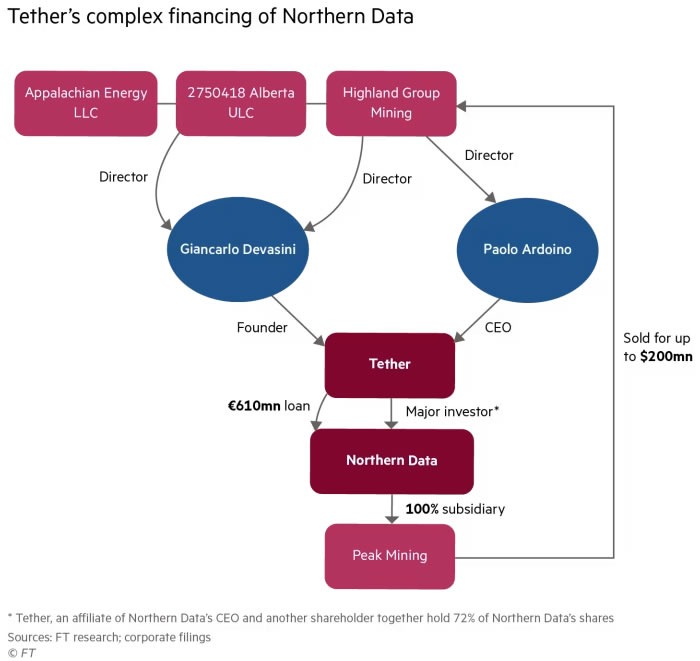
Tether’s complex web of financial ties. Source: The Financial Times

Web of complex financial ties

It is also the second attempt to sell Peak Mining to a Devasini-controlled company. The first deal announced in August was with Elektron Energy for $235 million, but it fell through amid whistleblower allegations.

Northern Data faces investigation by European prosecutors for suspected tax fraud, and its offices were raided in September.

Related: Tether deepens AI bet, backs Italian firm’s humanoid robots

Tether has also agreed on a $100 million advertising deal with Rumble and plans to buy $150 million worth of GPU services from it as it delves deeper into Bitcoin mining.

Northern Data also currently has a 610 million euro ($715 million) loan from Tether.

The stablecoin issuer will receive half of the loan balance in Rumble stock as part of the acquisition, with the rest paid in the form of a new loan from Tether to Rumble, secured against Northern Data assets, the FT reported.

Tether branching out from stablecoins

Tether remains the world’s dominant player in the stablecoin sector with a 60% market share and $187 billion in circulating supply of USDT.

In addition to Bitcoin mining, AI, and video-sharing platforms, it is also eyeing sports teams.

On December 12, Tether launched a $1.1 billion bid to acquire the Italian professional soccer club, Juventus Football Club, but it was rejected by the club’s owners.

Magazine: Big questions: Would Bitcoin survive a 10-year power outage?

İlgili Sorular

QWhat is the name of the Bitcoin mining business sold by Northern Data, and to whom was it sold?

ANorthern Data sold its Bitcoin mining business, Peak Mining, to three companies run by Tether executives: Highland Group Mining, Appalachian Energy, and an Alberta-based company.

QWho are the key Tether executives involved in the purchase of Peak Mining, according to the Financial Times report?

AThe key Tether executives involved are Giancarlo Devasini, Tether's co-founder and chair, and its CEO, Paolo Ardoino. Devasini is a director of Highland Group and the sole director of the Alberta company.

QWhat significant event happened just before Rumble agreed to acquire Northern Data?

AJust before Rumble agreed to acquire Northern Data, the deal to sell Peak Mining to the Tether executives' companies took place.

QBesides stablecoins, what other industries is Tether investing in, as mentioned in the article?

ATether is investing in Bitcoin mining, artificial intelligence (AI), video-sharing platforms (through its stake in Rumble), and has also made a bid to acquire the Italian soccer club Juventus.

QWhat is the nature of the financial relationship between Tether and Northern Data beyond the recent sale?

ANorthern Data currently has a 610 million euro ($715 million) loan from Tether. As part of Rumble's acquisition of Northern Data, Tether will receive half of this loan balance in Rumble stock, with the rest paid as a new loan from Tether to Rumble, secured against Northern Data's assets.

İlgili Okumalar

Google and Amazon Simultaneously Invest Heavily in a Competitor: The Most Absurd Business Logic of the AI Era Is Becoming Reality

In a span of four days, Amazon announced an additional $25 billion investment, and Google pledged up to $40 billion—both direct competitors pouring over $65 billion into the same AI startup, Anthropic. Rather than a typical venture capital move, this signals the latest escalation in the cloud wars. The core of the deal is not equity but compute pre-orders: Anthropic must spend the majority of these funds on AWS and Google Cloud services and chips, effectively locking in massive future compute consumption. This reflects a shift in cloud market dynamics—enterprises now choose cloud providers based on which hosts the best AI models, not just price or stability. With OpenAI deeply tied to Microsoft, Anthropic’s Claude has become the only viable strategic asset for Google and Amazon to remain competitive. Anthropic’s annualized revenue has surged to $30 billion, and it is expanding into verticals like biotech, positioning itself as a cross-industry AI infrastructure layer. However, this funding comes with constraints: Anthropic’s independence is challenged as it balances two rival investors, its safety-first narrative faces pressure from regulatory scrutiny, and its path to IPO introduces new financial pressures. Globally, this accelerates a "tri-polar" closed-loop structure in AI infrastructure, with Microsoft-OpenAI, Google-Anthropic, and Amazon-Anthropic forming exclusive model-cloud alliances. In contrast, China’s landscape differs—investments like Alibaba and Tencent backing open-source model firm DeepSeek reflect a more decoupled approach, though closed-source models from major cloud providers still dominate. The $65 billion bet is ultimately about securing a seat at the table in an AI-defined future—where missing the model layer means losing the cloud war.

marsbit1 saat önce

Google and Amazon Simultaneously Invest Heavily in a Competitor: The Most Absurd Business Logic of the AI Era Is Becoming Reality

marsbit1 saat önce

Computing Power Constrained, Why Did DeepSeek-V4 Open Source?

DeepSeek-V4 has been released as a preview open-source model, featuring 1 million tokens of context length as a baseline capability—previously a premium feature locked behind enterprise paywalls by major overseas AI firms. The official announcement, however, openly acknowledges computational constraints, particularly limited service throughput for the high-end DeepSeek-V4-Pro version due to restricted high-end computing power. Rather than competing on pure scale, DeepSeek adopts a pragmatic approach that balances algorithmic innovation with hardware realities in China’s AI ecosystem. The V4-Pro model uses a highly sparse architecture with 1.6T total parameters but only activates 49B during inference. It performs strongly in agentic coding, knowledge-intensive tasks, and STEM reasoning, competing closely with top-tier closed models like Gemini Pro 3.1 and Claude Opus 4.6 in certain scenarios. A key strategic product is the Flash edition, with 284B total parameters but only 13B activated—making it cost-effective and accessible for mid- and low-tier hardware, including domestic AI chips from Huawei (Ascend), Cambricon, and Hygon. This design supports broader adoption across developers and SMEs while stimulating China's domestic semiconductor ecosystem. Despite facing talent outflow and intense competition in user traffic—with rivals like Doubao and Qianwen leading in monthly active users—DeepSeek has maintained technical momentum. The release also comes amid reports of a new funding round targeting a valuation exceeding $10 billion, potentially setting a new record in China’s LLM sector. Ultimately, DeepSeek-V4 represents a shift toward open yet realistic infrastructure development in the constrained compute landscape of Chinese AI, emphasizing engineering efficiency and domestic hardware compatibility over pure model scale.

marsbit2 saat önce

Computing Power Constrained, Why Did DeepSeek-V4 Open Source?

marsbit2 saat önce

İşlemler

Spot
Futures
活动图片





