Tennessee Regulator Sends Cease-And-Desist Letters To Polymarket, Kalshi, Crypto.com — Details

bitcoinist2026-01-11 tarihinde yayınlandı2026-01-11 tarihinde güncellendi

Özet

The Tennessee Sports Wagering Council (SWC) has issued cease-and-desist letters to prediction market platforms Polymarket, Kalshi, and Crypto.com, accusing them of offering illegal sports betting contracts to state residents without the required licenses. The regulator ordered the firms to void all pending contracts from Tennessee customers and refund their deposits by January 31, 2026. It cited significant consumer protection risks and threatened fines of up to $25,000 per violation, as well as injunctive relief for non-compliance. This action highlights increasing state-level regulatory scrutiny of prediction markets, even though these platforms are registered with the CFTC and permitted to operate nationally. Similar orders were previously issued in Connecticut.

Tennessee’s sports betting regulator has ordered Polymarket, Kalshi, and Crypto.com to cease offering sports betting contracts, bringing focus to the regulatory landscape of event contract exchanges. The agency accused the three major prediction market platforms of violating state gambling laws by operating in Tennessee without the required licenses.

Polymarket, Others Threatened With Fines For Offering Sports Event Contracts

On Friday, January 9, the Tennessee Sports Wagering Council (SWC) issued cease-and-desist letters to Polymarket, Kalshi, and Crypto.com’s Derivatives Exchange. In the letters, the state regulator asked all three prediction market firms to stop offering sports event contracts to the residents of Tennessee.

The state’s SWC also demanded that the three firms void all pending contracts entered into by Tennessee residents, and refund all customer deposits by January 31, 2026.

SWC Executive Director, Mary Beth Thomas, wrote in the letter to Polymarket:

The sports events contracts offered on Polymarket’s exchange are not compliant with these [Tennessee state consumer] protections (and many others) and are an immediate and significant threat to the public interest of Tennessee.

The language in the Tennessee Sports Wagering Council letters to Kalshi and Crypto.com was quite similar to Polymarket’s cease-and-desist letter. This comes despite all three platforms being registered as designated contract markets with the Commodity Futures Trading Commission (CFTC), allowing them to offer event-based derivatives contracts nationwide.
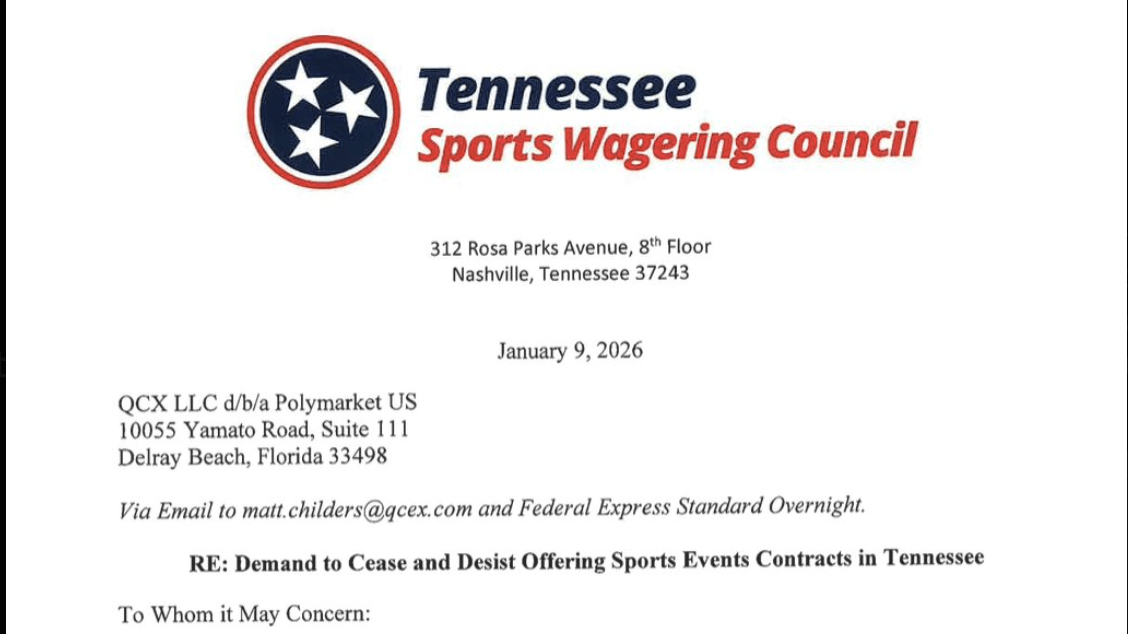
Source: @WALLACHLEGAL on X

Despite this CFTC designation, these prediction market firms have had regulatory run-ins with different states in the US. In December 2025, the state of Connecticut sent a trio of cease-and-desist orders to Robinhood, Kalshi, and Crypto.com. The firms based their defense at the time on receiving the CFTC’s approval to operate in the United States.

This Tennessee cease-and-desist order seems to be the first state-level regulatory issue faced by Polymarket, which currently only offers sports event contracts in the United States. In the letters, the Tennessee Sports Wagering Council threatened a range of penalties for any of the firms’ failure to comply.

One of the letters further read:

Failure to comply with the SWC’s demand will result in the imposition of fines pursuant to the Act, which states that the SWC shall impose a fine against any person offering wagers in Tennessee without a license in the amount of $10,000 for the first offense; $15,000 for a second offense; and $25,000 for a third or subsequent offense. ‘ Moreover, failure to comply with the SWC’s demand will result in the SWC seeking injunctive relief.

Prediction Markets Facing Increased Regulatory Scrutiny

The prediction markets, which gained prominence during the 2024 US elections, have continued to enjoy interest from users and institutional investors. However, the regulatory scrutiny faced by the industry has seen a similar surge lately.

For instance, a Polymarket trader reportedly netted record gains of over $400,000 from predicting the recent US military action in Venezuela, prompting talks of introducing a bill to prevent insider trading. As Bitcoinist reported, Rep. Ritchie Torres (D-N.Y.) plans to introduce a bill that would ban all government-affiliated individuals from participating in state-related events in the prediction market.

The price of BTC on the daily timeframe | Source: BTCUSDT chart on TradingView


İlgili Sorular

QWhich three companies did the Tennessee Sports Wagering Council (SWC) send cease-and-desist letters to?

AThe Tennessee Sports Wagering Council sent cease-and-desist letters to Polymarket, Kalshi, and Crypto.com's Derivatives Exchange.

QWhat is the main reason the Tennessee regulator ordered these platforms to stop operations?

AThe regulator accused them of violating state gambling laws by offering sports betting contracts to Tennessee residents without the required licenses.

QWhat federal regulatory body are these prediction market platforms registered with, and what does that registration allow them to do?

AThey are registered as designated contract markets with the Commodity Futures Trading Commission (CFTC), which allows them to offer event-based derivatives contracts nationwide.

QWhat are the potential financial penalties for these companies if they fail to comply with the SWC's demand?

AFines are $10,000 for the first offense, $15,000 for a second offense, and $25,000 for a third or subsequent offense. The SWC also threatened to seek injunctive relief.

QWhat recent high-profile event was cited as a reason for increased regulatory scrutiny of prediction markets?

AA Polymarket trader netted over $400,000 from predicting recent US military action in Venezuela, which prompted talks of introducing a bill to prevent insider trading.

İlgili Okumalar

Bitwise: Bullish on Bitcoin's Performance in the Second Half of the Year, AI and Regulation Will Spark a New Altcoin Season

Bitwise CIO Matt Hougan and Research Lead Ryan Rasmussen express strong bullish sentiment on Bitcoin's long-term prospects, suggesting that its $1 million price target may be too conservative. They argue Bitcoin serves a dual role: as digital gold and a potential global settlement asset, especially amid declining trust in traditional monetary systems. Despite a weak Q1 2026 where nearly all crypto assets and prices saw double-digit declines, the analysts remain optimistic due to strong forward-looking catalysts, including institutional adoption via Bitcoin ETFs from major firms like Morgan Stanley and Goldman Sachs. Geopolitical instability, such as Iran’s mention of using Bitcoin for international payments, increases the value of Bitcoin’s “out-of-the-money call option” as a non-political, global settlement currency. This enhances its appeal beyond a mere store of value. . Additionally, Hougan highlights that a clearer regulatory token framework under current SEC leadership, combined with AI efficiency gains and high-performance blockchains, could fuel a new “altseason” by late 2026. This may lead to a wave of legitimate, value-capturing token projects, unlike the earlier ICO boom. . Bitwise also announced an Avalanche ETF, citing its unique architecture and rapid growth in real-world asset (RWA) tokenization, which has surged 10x to nearly $30 billion in two years. The firm believes Layer 1 blockchains are still early in their growth cycle, with significant potential ahead.

marsbit7 dk önce

Bitwise: Bullish on Bitcoin's Performance in the Second Half of the Year, AI and Regulation Will Spark a New Altcoin Season

marsbit7 dk önce

İşlemler

Spot
Futures
活动图片