Telegram Takes Direct Control of TON, Social Traffic Rewrites the Public Chain Narrative

marsbit2026-05-11 tarihinde yayınlandı2026-05-11 tarihinde güncellendi

Özet

Telegram founder Pavel Durov announced that Telegram will replace the TON Foundation as the core driver and largest validator of The Open Network (TON). Key initiatives include a sixfold reduction in transaction fees, performance upgrades, and improved developer tools within the next few weeks. This marks a strategic shift from Telegram merely providing user access to deeply integrating TON into its platform's core infrastructure. The goal is to transform Telegram's massive social traffic into sustainable on-chain activity. While viral mini-apps like Notcoin have demonstrated Telegram's ability to drive user adoption, TON aims to support frequent, low-value transactions inherent to social platforms—such as tipping, in-app payments, and game rewards. Ultra-low fees and sub-second finality (0.6 seconds) are crucial to making blockchain interactions seamless and nearly invisible within the Telegram user experience. However, Telegram's increased central role raises questions about network decentralization. Durov argues that Telegram's participation will attract more large validators, thereby enhancing decentralization. TON also offers high annual staking rewards (18.8%), aiming to retain capital within its ecosystem. The fundamental challenge for TON is no longer leveraging Telegram's user base, but becoming an indispensable, seamless infrastructure layer for Telegram's everyday applications—moving from an adjacent chain to an embedded utility.

Author | Asher(@Asher_ 0210)
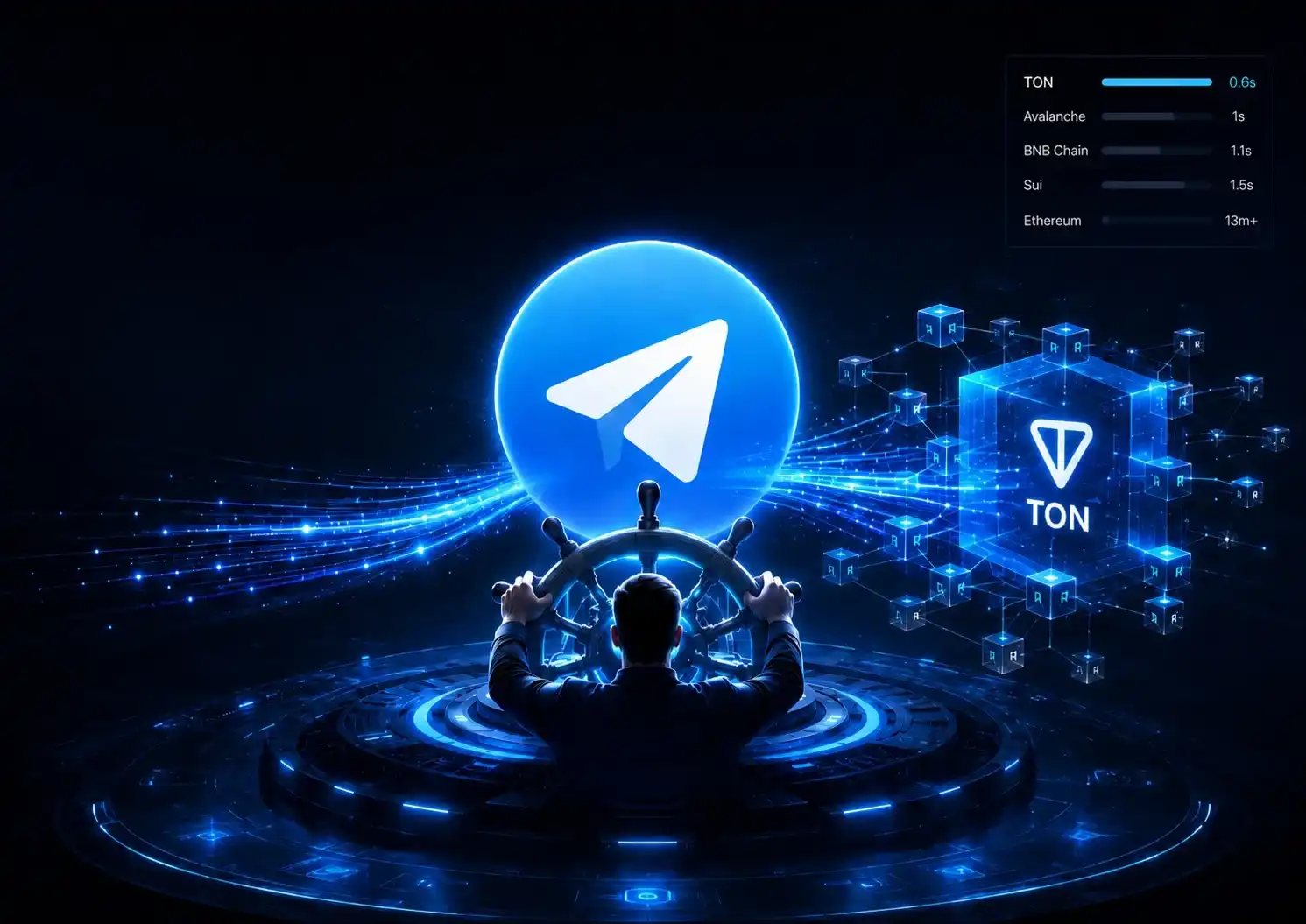
On May 4th, Telegram founder Pavel Durov announced on platform X that TON network transaction fees have been reduced by 6 times, nearing zero. More crucially, he stated that Telegram will replace the TON Foundation, becoming the new core driving force of the TON network and its largest validator. TON's focus will now shift to technological advantages, including a new ton.org, new developer tools, and performance upgrades, with a timeframe of the next 2 to 3 weeks.
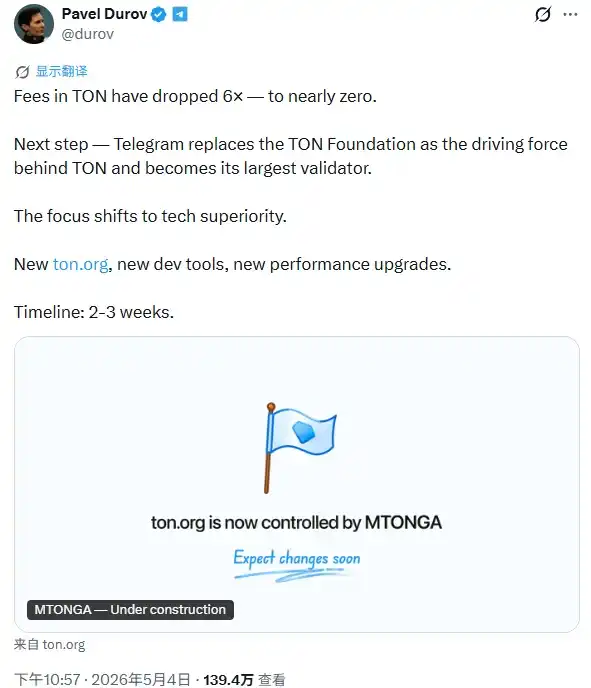
Telegram Founder: TON Fees Reduced by 6x, Telegram to Become Largest Validator

In the past, the relationship between TON and Telegram was more like a strong binding with weak leadership. Telegram provided the gateway, while the Foundation and community were responsible for advancement, with a layer of distance always between them. But this time, Telegram isn't just continuing to bring users to TON; it's beginning to enter more foundational positions such as validator, technical roadmap, and development tools. TON is no longer just a chain adjacent to the Telegram ecosystem but is being reintegrated into Telegram's product system.

TON Doesn't Lack a Gateway; It Lacks Turning the Gateway into Use Cases

Past market discussions about TON often revolved around Telegram's user scale. But for a public chain, having a gateway doesn't equal having an ecosystem, and having user reach doesn't equal having long-term usage. TON's unique aspect is its inherent attachment to a high-frequency social platform, where Mini Apps, wallets, channels, bots, games, and payments already exist within Telegram. This allows TON to avoid having to find users from scratch like most Layer1s. However, if these scenarios cannot solidify into sustained on-chain interactions, Telegram's traffic can only bring waves of short-term hype.

Projects like Notcoin and Dogs have proven that Telegram can quickly generate viral spreads. Simple gameplay combined with social relationship chains can indeed attract a large number of users into crypto applications in a short time. But such explosions come and go quickly. TG mini-games and airdrops can bring attention but can hardly alone sustain a long-term ecosystem.

Therefore, the fee reduction, speed increase, developer tools, and validator role emphasized by Pavel Durov this time point not to a single technological upgrade, but to TON addressing its most critical missing link—transforming Telegram's gateway into sustainable use cases. Only when fees are low enough, confirmation speeds are fast enough, and developer integration is simple enough can scenarios like channel tipping, Mini Apps tasks, game rewards, creator revenue, ad revenue sharing, bot calls, and group micropayments potentially evolve from product features into on-chain activities.

TON no longer needs to repeat the story of "backed by Telegram." What it truly needs to prove is whether the high-frequency behaviors within Telegram can be effectively borne by TON.

Fee Reduction and Speed Increase Aim to Enable Smaller, Higher-Frequency Transactions

The fee reduction by TON this time shouldn't be understood merely as cost optimization typical of public chains. Viewed within the context of Telegram, it actually solves the problem of whether small-amount, high-frequency interactions can become viable.

Most potential on-chain behaviors within Telegram are not large transfers but more fragmented daily operations. Individual transaction amounts are low, but occurrence frequency is high. If users have to perceive fees, wait for confirmations, and repeatedly handle wallet interactions with every button click, these scenarios can hardly truly take off.

Therefore, fee reduction and speed increase must be considered together. Fees approaching zero lower the usage barrier; reducing finality time to 0.6 seconds lowers the perception of waiting. For Telegram, the chain shouldn't become an extra layer perceived by users but should be hidden as much as possible behind product actions like sending messages, clicking buttons, and viewing balance changes.
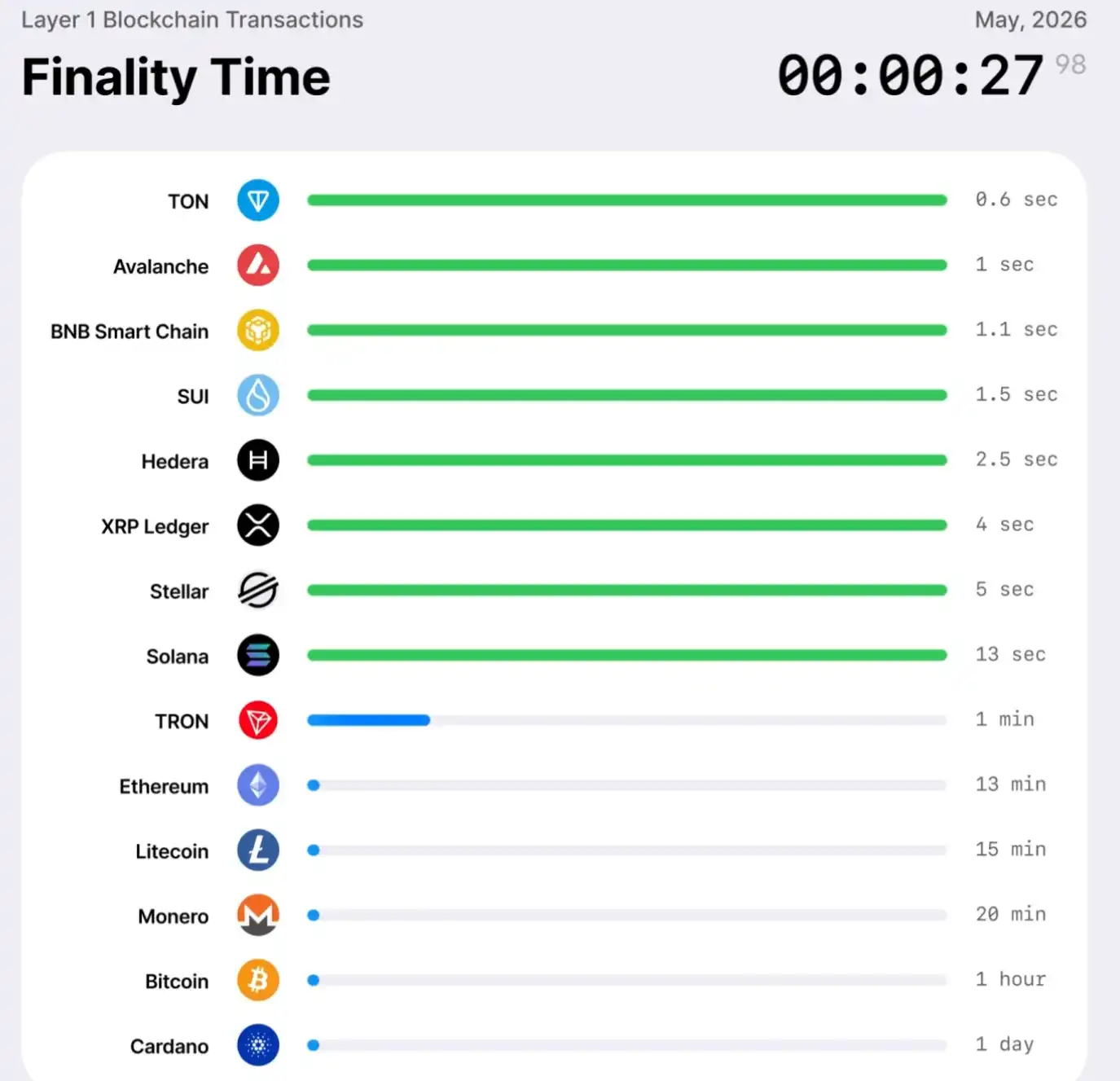
Comparison of "Finality Time" Among Mainstream Public Chains

This also distinguishes TON from many other Layer1s. Its goal isn't solely to make DeFi trades faster or transfers cheaper; it aims to embed the chain into Telegram's daily use. Only when cost, waiting time, and wallet operations are minimized enough can TON potentially evolve from a Telegram-related public chain into the underlying network directly invoked by Telegram's application layer.

From Gateway to Validator, Telegram Begins Penetrating TON's Core

Telegram becoming TON's largest validator is the most significant step in this change. It means Telegram is no longer just providing TON with a gateway and brand endorsement but is entering the network's security and operational mechanisms. Previously, TON was driven by the Foundation and community, which offered greater openness but a relatively decentralized pace. Now, with Telegram directly involved, its products, wallet, Mini Apps, payments, and developer tools have the opportunity to be realigned.

Efficiency may increase, but controversy will also grow. Telegram replacing the TON Foundation as the main driving force and becoming the largest validator will inevitably lead to renewed external discussions about TON's centralization risks. In response, Pavel Durov stated that Telegram's participation would attract more large-scale participants into the validator pool, thereby enhancing decentralization. This logic is not without merit, but the final judgment will depend on results, not statements.

The truly important aspects going forward are whether the validator structure can become more diverse, whether governance information is sufficiently transparent, whether the Foundation and community retain independent space, and whether ecosystem projects can continue developing without relying on Telegram's will.

Therefore, Telegram's return is not a simple positive but a trade-off. For TON to enter the mainstream application layer, it needs Telegram's strong execution capabilities; but the more prominent Telegram's role, the more TON needs to prove it is not merely an internal settlement chain serving Telegram.

High Staking Rewards Retain More Tokens for TON

Pavel Durov subsequently emphasized that TON ranks first in annual staking rewards among the top 50 cryptocurrencies by market cap, with a high rate of 18.8%. Compared to fee reduction and speed increase, high staking rewards are more likely to mobilize capital sentiment and provide TON with another layer of holding rationale in the market's eyes.
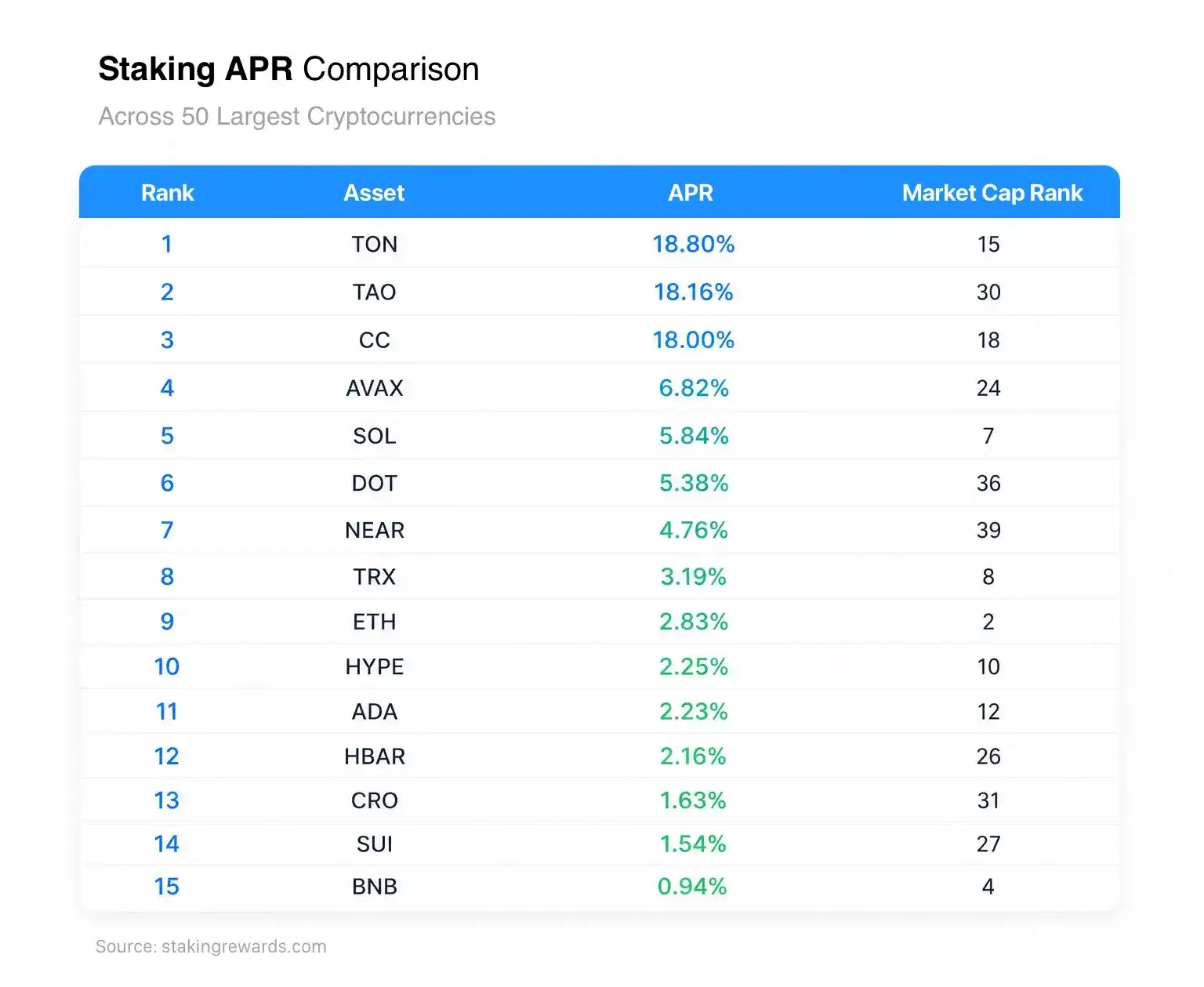
TON Annual Staking Rewards Rank First Among Top 50 Cryptocurrencies

This also makes TON's narrative somewhat more complete. It's not just relying on Telegram's user gateway to attract attention or improving experience through technical upgrades; it's also using staking rewards to keep capital within its ecosystem. The simultaneous presence of gateway, performance, validators, and rewards makes this change more substantial than a single positive factor.

Of course, high yield itself is not the end goal; it's more like buying TON a longer observation period. As long as subsequent developer tools and performance upgrades are delivered, and more capital is locked into the network, a positive feedback loop with real usage may form. For TON, the value of staking rewards isn't just about increasing holding returns but making the market willing to continue waiting for it to truly convert Telegram's gateway advantage.

TON's Return to Telegram Is Not the Finish Line, But a Tougher Challenge

The key for TON going forward is not to continue leveraging Telegram for traffic, but to truly become part of Telegram's application ecosystem. If Telegram's chat, payments, applications, creator economy, and automated interactions are gradually undertaken by TON, then TON's competitors will not just be other Layer1s, but all networks attempting to become the next-generation application infrastructure.

TON isn't just repeating the social traffic story; it's beginning to attempt to turn social traffic into on-chain order. The gateway is just the beginning; usage is the answer. Telegram can push TON to the forefront, but whether it stays there ultimately depends on whether TON can become the layer of infrastructure that operates behind user perception, within the functioning of applications.

If the past TON was still proving how close it is to Telegram, now it must prove how deeply integrated it can be within Telegram's daily use. True mainstream adoption isn't about making users aware they are using a chain, but about making the chain part of the application experience.

TON's opportunity lies here, and so does its pressure.

İlgili Sorular

QAccording to the article, what is the new role that Telegram will assume in the TON network, as announced by Pavel Durov?

ATelegram will become the new core driver of the TON network, replacing the TON Foundation. It will also become the network's largest validator.

QWhat is identified as the key challenge TON needs to overcome, beyond just having access to Telegram's large user base?

ATON needs to transform its access and user reach into sustainable, long-term usage scenarios. It must convert Telegram's high-frequency social interactions into persistent on-chain activities.

QWhy are the reductions in transaction fees and improvements in speed particularly important for TON within the Telegram context?

ALow fees (approaching zero) and fast finality (0.6 seconds) are crucial to enable the small, frequent, and fragmented transactions typical of Telegram's daily use cases. They lower the barrier and reduce user friction, allowing the blockchain to operate seamlessly in the background of the app experience.

QWhat potential downside or concern is raised regarding Telegram becoming the core driver and largest validator of TON?

AThe move raises concerns about increased centralization risk and questions regarding the future independence of the TON Foundation and community projects. It represents a trade-off between stronger execution from Telegram and the need for TON to maintain network decentralization.

QHow does the article frame the high annual staking reward offered by TON, and what purpose does it serve?

AThe high staking reward (18.8% annually, ranked first among top 50 cryptocurrencies) is seen as a mechanism to attract and lock in capital within the TON ecosystem. It provides an additional incentive for holding TON and buys time for the network to realize its potential in converting Telegram's user base into active usage.

İlgili Okumalar

The Value Distribution of Stablecoins

**Summary: The Value Distribution of Stablecoins** The article argues that stablecoins are evolving from mere trading tools into broader channels for dollar access. It divides the stablecoin ecosystem into four layers to analyze how value is distributed: 1. **Issuance Layer:** Mints stablecoins, holds reserve assets, and captures the spread between reserve yield and user costs (e.g., Tether, Circle). This layer currently earns the largest profit margin. 2. **Infrastructure Layer:** Connects stablecoins to the traditional financial system, handling fiat on/off-ramps, banking integration, compliance (KYC/AML), and asset management (e.g., Bridge, BVNK). This is the "unglamorous" but critical work, building the essential bridges between crypto and real-world finance. 3. **Acquiring/Distribution Layer:** Integrates stablecoins into merchant systems, manages payment flows, and provides enterprise financial software (e.g., Stripe, Coinbase). They act as the access point for businesses. 4. **Application Layer:** The end-users and businesses that ultimately use stablecoins for payments, settlements, or as a store of value. They benefit from convenience but have little pricing power. The core thesis is that while the issuance layer currently dominates profits, the often-overlooked **infrastructure layer holds significant long-term potential**. The real challenge and barrier to mass adoption is not the on-chain transfer of stablecoins (which is simple), but the complex "last mile" integration into existing business workflows, banking systems, and regulatory frameworks across different countries. Companies in this layer are currently in a "land grab" phase, investing heavily to build networks, secure bank partnerships, and establish compliance pathways. While their position is currently pressured by the profitable issuers above and distribution platforms below, the article suggests that if stablecoins become a default financial rail for businesses, the infrastructure providers who have done the hard work of integration will ultimately gain strong pricing power and become entrenched, essential players.

marsbit4 saat önce

The Value Distribution of Stablecoins

marsbit4 saat önce

The Value Distribution of Stablecoins

The Value Distribution of Stablecoins The article argues that stablecoins are evolving from a mere trading tool into a broad "dollar channel." It analyzes the industry's value chain through four layers: 1. **Issuance Layer (e.g., Tether, Circle):** The top layer that mints stablecoins, holds reserve assets, and captures the thickest interest rate spread. 2. **Infrastructure Layer (e.g., Bridge, BVNK):** Connects stablecoins to the traditional financial system, handling critical but complex "dirty work" like fiat on/off-ramps, banking integration, compliance (KYC/AML), and cross-border settlement. 3. **Acquiring/Distribution Layer (e.g., Stripe, Coinbase):** Embeds stablecoins into merchant systems, manages payment flows, and integrates with enterprise software. 4. **Application Layer:** End-users and businesses that ultimately use stablecoins for payments, settlement, or storing value. The author posits that while the issuance layer currently captures the most profit, the most overlooked and potentially critical layer is infrastructure. The core challenge for stablecoin adoption isn't the on-chain transfer (which is simple), but bridging the gap between blockchain and the real-world financial system. This involves solving practical problems for businesses: fiat conversion, reconciliation, tax handling, and user onboarding. Infrastructure companies are currently in a difficult "land-grab" phase—building networks, securing banking relationships, and achieving compliance country-by-country. They face pressure from both the profitable issuance layer above and distribution platforms below. However, the author suggests this layer is building a crucial moat. Once stablecoins become a default business rail, the infrastructure players who have done the hard work of integration may gain significant, durable value and pricing power.

链捕手4 saat önce

The Value Distribution of Stablecoins

链捕手4 saat önce

How to Do Research Well: Deliberately Practice the Real Skills That Matter

No one truly teaches you how to do research. You're often given a desk, a pre-selected problem, and vague instructions to "create something new." Consequently, many people reverse-engineer the job based on visible outputs—papers, posts, announcements—learning only how to *appear* like a researcher rather than how to *become* one. True research capability is built from stacking small, trainable skills, nearly all of which can be developed through deliberate practice. **Pick Your Own Problem:** Most researchers absorb problems from advisors or trends, lacking the underlying reasoning. Choosing a problem you genuinely care about, as John Schulman advises, leads to original work. Develop "taste" like a muscle: predict experiment outcomes, guess paper results from methods, and track which findings remain important over time. **Upgrade Your Inputs:** Relying on shared reading lists (arXiv hot lists, filtered group chats) leads to unoriginal conclusions. Undervalued old literature often holds crucial insights (e.g., MoE, LSTM, backpropagation). Richard Sutton's "The Bitter Lesson" or Claude Shannon's 1952 talk on creative thinking are more predictive than lengthy modern surveys. Breadth matters as much as depth: draw from neuroscience, mechanism design, hardware knowledge, and honest statistics. Read papers directly, especially appendices and limitations sections. **Write Everything Down:** As Paul Graham noted, writing exposes flaws in seemingly mature ideas. Writing is the cheapest defense against self-deception. Following Feynman's principle, Darwin programmatically wrote down facts contradicting his theory to combat memory bias. Maintain a detailed log of hypotheses, setups, predictions, results, and updated understandings. Reviewing past logs fosters essential humility.

marsbit6 saat önce

How to Do Research Well: Deliberately Practice the Real Skills That Matter

marsbit6 saat önce

İşlemler

Spot
Futures

Popüler Makaleler

TON Nasıl Satın Alınır

HTX.com’a hoş geldiniz! The Open Network (TON) satın alma işlemlerini basit ve kullanışlı bir hâle getirdik. Adım adım açıkladığımız rehberimizi takip ederek kripto yolculuğunuza başlayın. 1. Adım: HTX Hesabınızı OluşturunHTX'te ücretsiz bir hesap açmak için e-posta adresinizi veya telefon numaranızı kullanın. Sorunsuzca kaydolun ve tüm özelliklerin kilidini açın. Hesabımı Aç2. Adım: Kripto Satın Al Bölümüne Gidin ve Ödeme Yönteminizi SeçinKredi/Banka Kartı: Visa veya Mastercard'ınızı kullanarak anında The Open Network (TON) satın alın.Bakiye: Sorunsuz bir şekilde işlem yapmak için HTX hesap bakiyenizdeki fonları kullanın.Üçüncü Taraflar: Kullanımı kolaylaştırmak için Google Pay ve Apple Pay gibi popüler ödeme yöntemlerini ekledik.P2P: HTX'teki diğer kullanıcılarla doğrudan işlem yapın.Borsa Dışı (OTC): Yatırımcılar için kişiye özel hizmetler ve rekabetçi döviz kurları sunuyoruz.3. Adım: The Open Network (TON) Varlıklarınızı SaklayınThe Open Network (TON) satın aldıktan sonra HTX hesabınızda saklayın. Alternatif olarak, blok zinciri transferi yoluyla başka bir yere gönderebilir veya diğer kripto para birimlerini takas etmek için kullanabilirsiniz.4. Adım: The Open Network (TON) Varlıklarınızla İşlem YapınHTX'in spot piyasasında The Open Network (TON) ile kolayca işlemler yapın.Hesabınıza erişin, işlem çiftinizi seçin, işlemlerinizi gerçekleştirin ve gerçek zamanlı olarak izleyin. Hem yeni başlayanlar hem de deneyimli yatırımcılar için kullanıcı dostu bir deneyim sunuyoruz.

704 Toplam GörüntülenmeYayınlanma 2024.12.10Güncellenme 2026.06.02

TON Nasıl Satın Alınır

Tartışmalar

HTX Topluluğuna hoş geldiniz. Burada, en son platform gelişmeleri hakkında bilgi sahibi olabilir ve profesyonel piyasa görüşlerine erişebilirsiniz. Kullanıcıların TON (TON) fiyatı hakkındaki görüşleri aşağıda sunulmaktadır.

活动图片