Telegram Financial Report Revealed: Main Revenue Actually Comes from Selling Coins!

marsbit2026-01-07 tarihinde yayınlandı2026-01-07 tarihinde güncellendi

Özet

Telegram's unaudited financial report for the first half of 2025 reveals a 65% year-on-year revenue increase to $870 million, up from $525 million in the same period of 2024. However, the company reported a net loss of over $220 million, compared to a net profit of $334 million a year earlier. This loss is attributed to a significant decline in the value of its Toncoin (TON) holdings, leading to asset write-downs. Despite its growth in users—now exceeding 900 million monthly active users—Telegram's financial performance is heavily tied to TON. Approximately one-third of its revenue, around $300 million, comes from TON-related exclusive agreements, including wallet integration and payment services. Moreover, Telegram has sold over $450 million worth of TON in 2025 alone, accounting for about 10% of TON's market capitalization, making cryptocurrency sales a major revenue stream. Telegram's planned IPO has been delayed due to ongoing legal investigations involving its founder, Pavel Durov, in France. The company secured $1.7 billion in convertible bonds from institutions like BlackRock and Mubadala in May 2025. Originally launched in 2017, TON faced regulatory challenges from the SEC but was revived as a community-led blockchain. Despite initial growth, TON's ecosystem has struggled recently, with many projects declining significantly in value.

Author: C Labs Crypto Watch

According to unaudited financial reports disclosed by the Financial Times, Telegram, known as the "dark version of WeChat," achieved revenue of $870 million in the first half of 2025, a 65% year-over-year increase, showing a significant leap compared to $525 million in the same period of 2024.
From a "revenue growth" perspective, this is a quite impressive growth curve.

However, the problem lies in the profit side. Telegram recorded a net loss of over $220 million in the first half of 2025, compared to a net profit of $334 million in the same period last year.
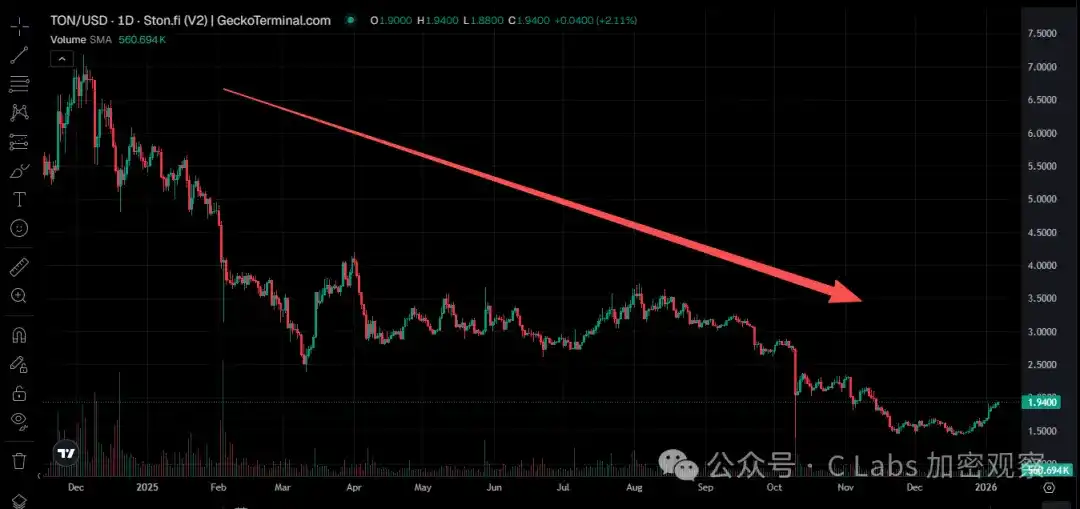
The loss did not stem from a collapse in the main business but was due to a significant decline in the value of Toncoin (TON) held by the company in 2025, leading to a write-down of related assets.

PART 01: Telegram's Development History

Telegram was founded in 2013 and is one of the world's most important instant messaging platforms.

As of 2025, Telegram's monthly active users have exceeded 900 million, covering Europe, the Middle East, South America, and emerging markets, making it one of the fastest-growing social applications globally.
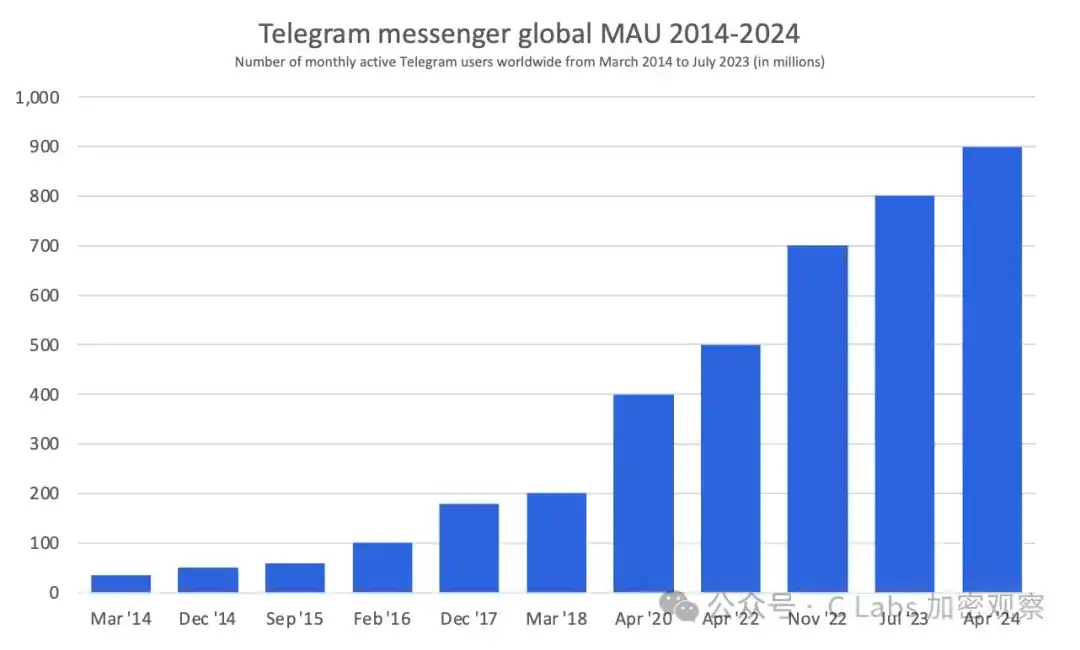
For crypto users, Telegram has become the de facto "public discussion layer" of the crypto industry: a large number of exchange announcements, project governance, airdrop information, OTC trading, and on-chain communities use Telegram as their core platform.

This gives it the dual attributes of a social platform and financial information infrastructure.

PART 02: IPO Plans Shelved

Although Telegram announced preparations for an IPO, the practical obstacle is that its founder, Pavel Durov, is still under investigation in France (Breaking! TG Founder Arrested, TON Price Plummets).

Telegram has clearly stated that it will not proceed with the listing until related compliance issues are clearer.

Fortunately, Telegram is not short of capital support. In May 2025, the company completed a $1.7 billion convertible bond financing, backed by top institutions including BlackRock and Mubadala.
PART 03: Telegram's Relationship with TON

The relationship between Telegram and TON is also complex.

In 2017, Telegram launched the blockchain project TON (Telegram Open Network), aiming to embed a payment system into the messaging app, and raised approximately $1.7 billion in 2018. However, in 2019, it was forced to halt the project after the SEC deemed it an unregistered securities offering. Telegram settled with regulators and exited the project in 2020.

Subsequently, TON was reborn as a community public chain, and Telegram re-engaged with it in a "non-official but deeply integrated" manner, which saw significant growth in 2024.
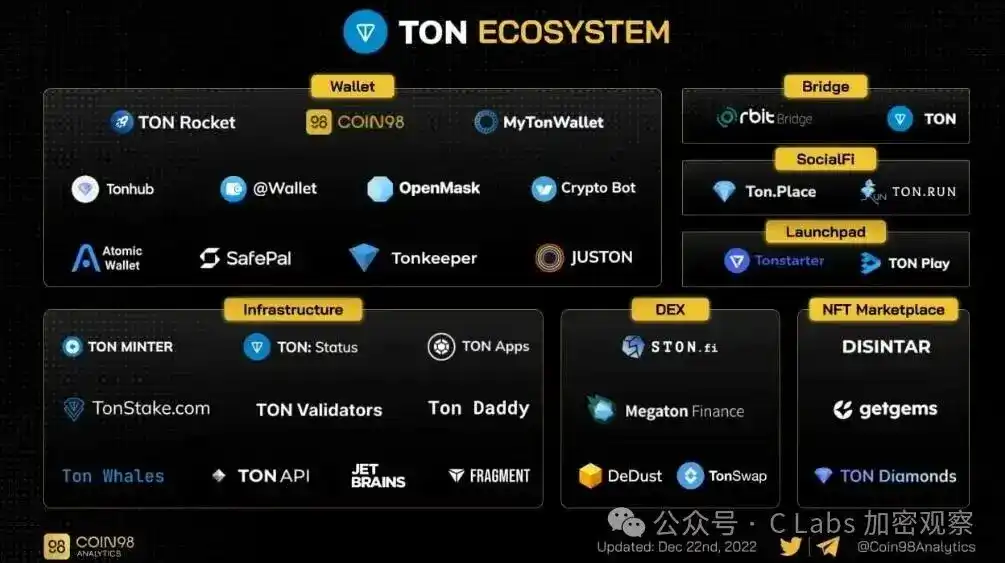
Unfortunately, in 2024, after founder Durov was arrested, the rapid progress came to an abrupt halt (TON Chain Crashed? No New Blocks for a Long Time).

Most of the once-popular TON ecosystem projects have now faded, with token prices generally down over 70%:
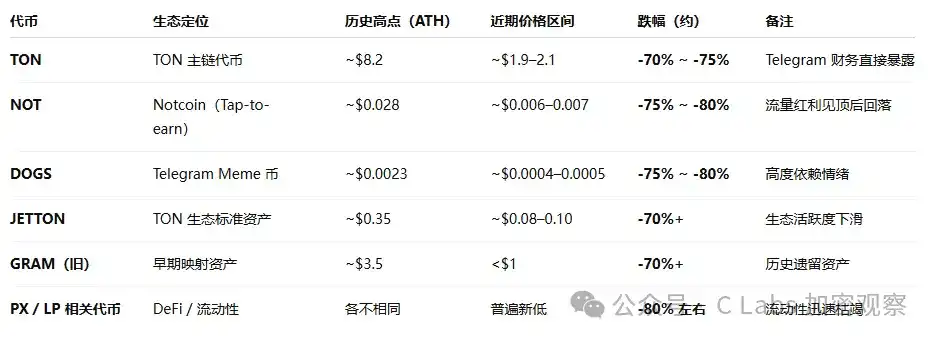
However, according to the latest financial report, the relationship between Telegram and TON has already gone beyond "official support for a public chain."

Significant Proportion of TON-Related Revenue

The financials show that about one-third of Telegram's revenue (approximately $300 million) comes from exclusive agreements related to TON, including wallet integration, payment functions, and ecosystem collaboration.

At the same time, Telegram is also one of the most significant sources of TON circulation, having sold over $450 million worth of TON since 2025, accounting for about 10% of TON's current market value.

This means that selling coins is Telegram's main business, and simultaneously, Telegram is the biggest whale dumping TON!

İlgili Sorular

QWhat was Telegram's revenue in the first half of 2025 and what was the year-over-year growth rate?

ATelegram's revenue in the first half of 2025 was $870 million, representing a 65% year-over-year growth compared to the same period in 2024.

QWhy did Telegram report a net loss in the first half of 2025 despite significant revenue growth?

ATelegram reported a net loss of over $220 million in the first half of 2025 due to a significant decline in the value of the Toncoin (TON) it held, which led to an accounting write-down of these assets.

QWhat is the relationship between Telegram and the TON blockchain project?

ATelegram initially launched the TON blockchain project in 2017 but was forced to abandon it in 2020 after a settlement with the SEC. The project was later revived by the community, and Telegram has since re-engaged with it in a 'non-official but deeply integrated' manner, with TON-related services now contributing significantly to its revenue.

QHow much of Telegram's revenue came from TON-related exclusive agreements in the first half of 2025?

AApproximately one-third of Telegram's revenue, about $300 million, came from TON-related exclusive agreements in the first half of 2025.

QWhat major financing did Telegram secure in May 2025 and which institutions were involved?

AIn May 2025, Telegram completed a $1.7 billion convertible bond financing round with backing from top-tier institutions including BlackRock and Mubadala.

İlgili Okumalar

In Jinjiang, Fujian, a Storage Super Unicorn Lies Quiet

In Fujian's Jinjiang, a city known for sportswear, lies a quiet semiconductor giant: Fujian Jinhua Integrated Circuit Co. (JHICC). Once a promising domestic DRAM manufacturer alongside Yangtze Memory and ChangXin Memory Technologies (CXMT), its journey was derailed in 2018 when the U.S. placed it on an Entity List and filed criminal charges for alleged trade secret theft. This halted production for years. A turning point came in February 2024 when a U.S. federal court found JHICC not guilty. However, it had lost crucial time. While CXMT soared to become a top-valued A-share company in 2024, JHICC, with an estimated valuation of 80 billion RMB, was just restarting. Its current output is primarily customized DDR4 chips, not the advanced DDR5/HBM demanded for AI, but it still benefits from the broader memory chip upcycle. JHICC's story is tied to Chen Zhengkun, a veteran engineer who left Micron to lead the venture. Founded in 2016 with state-backed funding, JHICC partnered with Taiwan's UMC to develop DRAM technology. Rapid progress was cut short by the U.S. actions, which Micron initiated, partly due to its heavy reliance on the Chinese market. Post-sanctions, Chen's team worked to rebuild the production line with reduced reliance on U.S. technology. According to its records, JHICC achieved small-scale production and revenue growth under immense pressure. It now focuses on the stable "niche" DRAM market (e.g., TVs, routers) with a monthly capacity of ~40,000 wafers, aiming for 60,000 by 2026. It holds over 1,000 patents but remains on the Entity List. For Jinjiang, investing in JHICC was a bold industrial leap. The local government provided unwavering financial and logistical support during the crisis, helping the company survive. JHICC has become the anchor for a growing local semiconductor cluster. Though its scale lags behind domestic peers, JHICC's persistence symbolizes a hard-won foothold in a global market long dominated by Samsung, SK Hynix, and Micron. Having missed one boom, it seeks a place in the new AI-driven memory supercycle.

marsbit1 saat önce

In Jinjiang, Fujian, a Storage Super Unicorn Lies Quiet

marsbit1 saat önce

İşlemler

Spot
活动图片





