‘Technologically impossible’: Could Kentucky bill threaten crypto self-custody?

ambcrypto2026-03-20 tarihinde yayınlandı2026-03-20 tarihinde güncellendi

Özet

Kentucky's proposed HB 380 amendment aims to regulate cryptocurrency kiosks but includes a controversial provision requiring hardware wallet providers to reset users' seed phrases upon request. The Bitcoin Policy Institute warns this measure would effectively outlaw self-custody, calling it "technologically impossible" and a violation of Bitcoin’s core security principles. They argue it would push users toward centralized custodians, increasing vulnerability to hacks. The amendment, added last minute, has drawn criticism for potentially infringing on residents' rights to secure their digital assets. Meanwhile, only seven U.S. states have established strategic Bitcoin reserves, with the federal government holding the largest share globally.

Kentucky is under scrutiny ahead of its planned passage of a key crypto legislation that would ban self-custody wallets.

According to the Bitcoin Policy Institute, a research and advocacy group, Kentucky’s HB 380 amendment would harm residents. The firm noted,

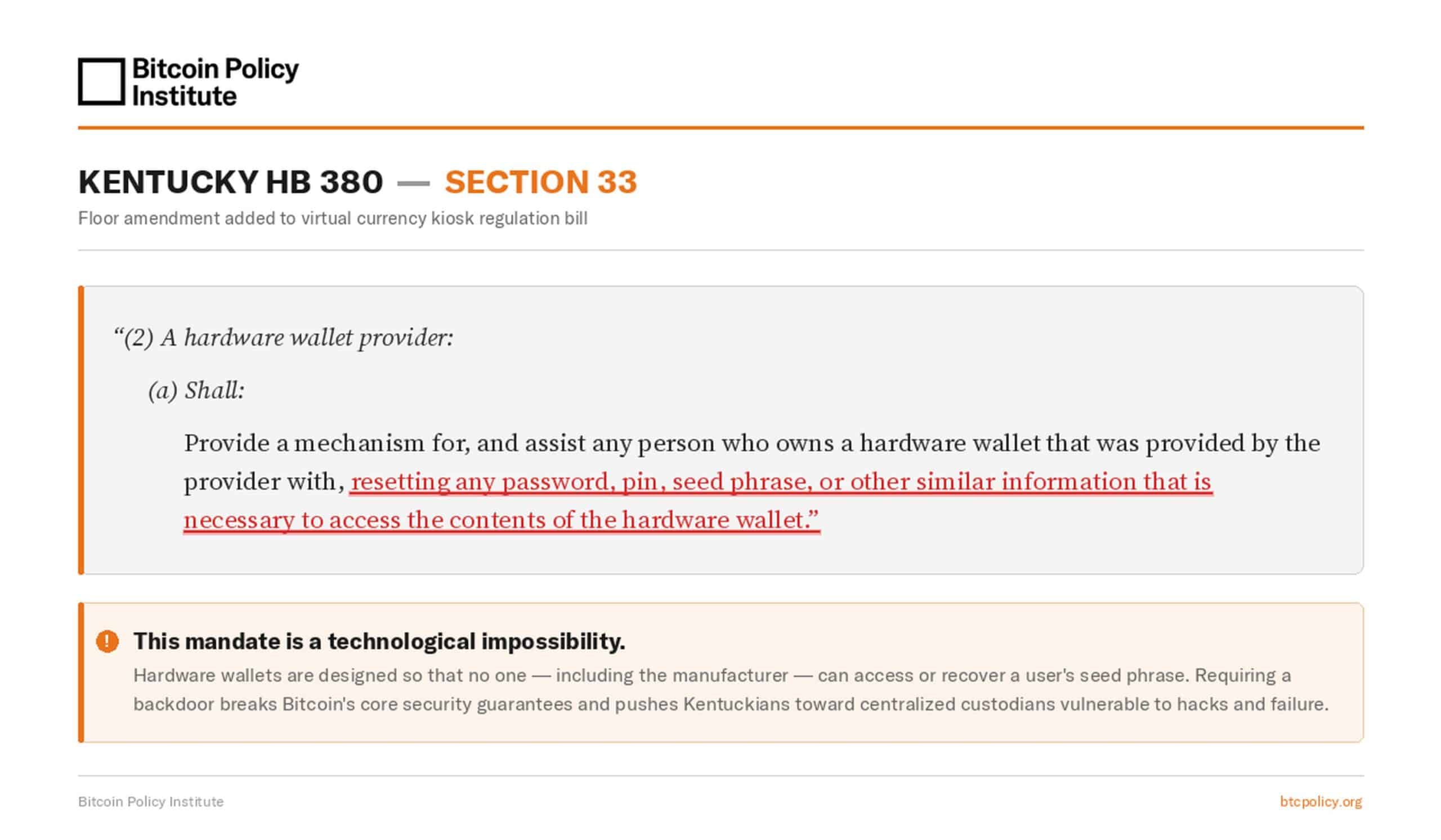
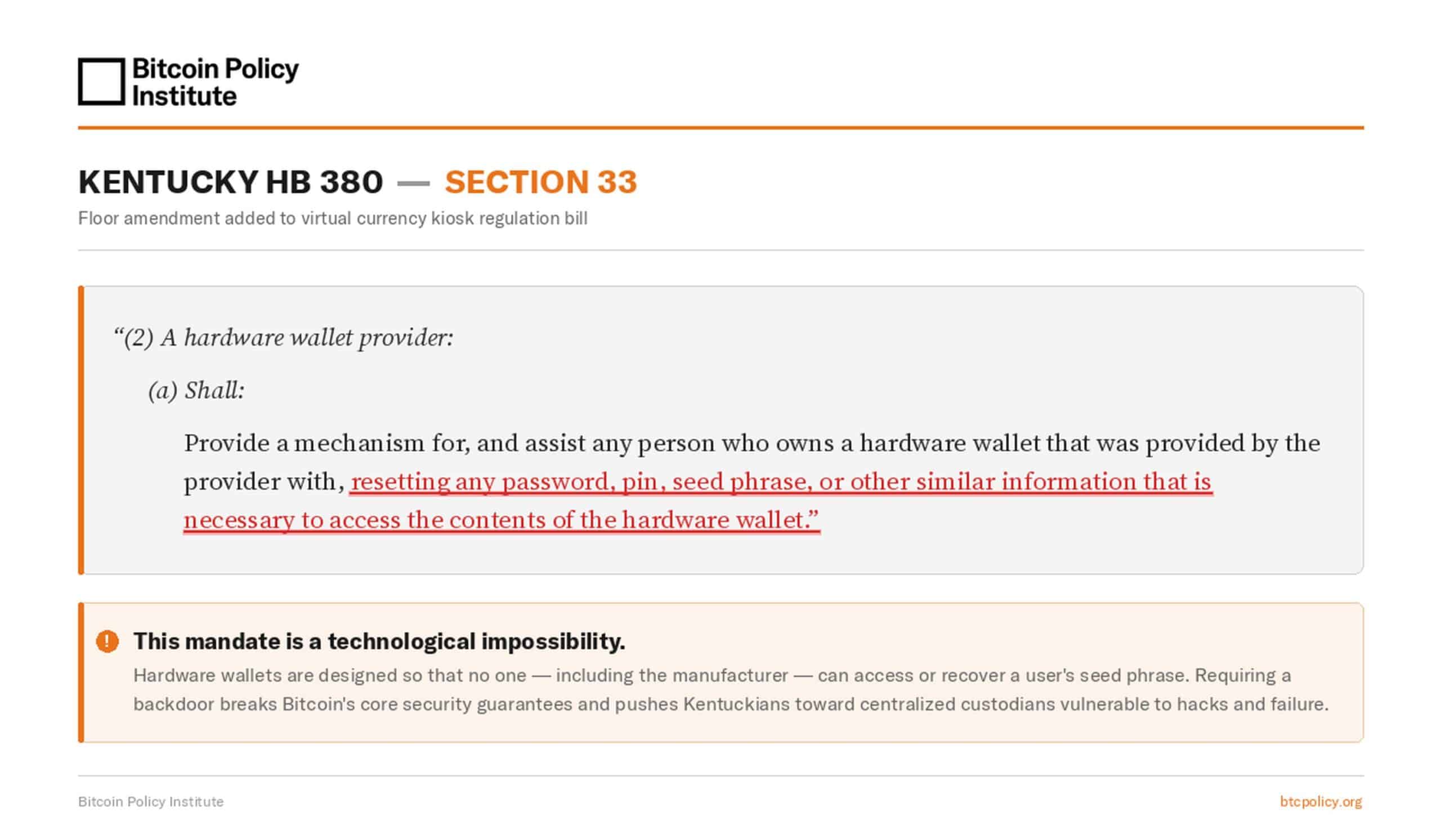
BPI has just learned of an amendment buried in Kentucky HB 380 that would require hardware wallet providers to reset users’ seed phrases on request. This would effectively outlaw self-custody in Kentucky.
Source: BPI

Kentucky crypto plans

The HB 380 is an amendment to the 77-page virtual currency kiosk legislation, part of a broader effort to regulate crypto ATMs, especially those that facilitate BTC transfers.

It was a last-minute amendment added in January. It requires hardware providers to be able to reset and recover users’ hardware wallet passwords and seed phrases, something BPI called ‘technologically impossible.’

The mandate is technologically impossible for non-custodial wallets. Requiring a backdoor for seed phrase recovery breaks Bitcoin’s fundamental security guarantees and pushes users toward centralized custodians that are vulnerable to hacks and failures.

The advocacy group wrote to the Kentucky Senate, informing it of the harmful nature of the amendment’s language. It added that the legislators should “protect Kentucky constituents’ right to secure their property.”

However, one analyst noted that ‘commercial hardware wallets’ are vulnerable to government overreach because their parent firms are legal entities operating in different jurisdictions.

Race for strategic Bitcoin reserve

Last year, at the state level, the race for the strategic Bitcoin reserve (SBR) became hot. But, as of 2026, only a handful of states in the U.S. have managed to codify the plans into law. Currently, only seven states have approved an SBR, including Arizona, Texas, and New Mexico.

At the federal level, however, there’s been little commitment or update on whether the U.S. SBR will be established. Even so, the U.S. now holds 328,272 BTC, about 1.5% of the total supply.

This was nearly half of the total 650,296 BTC held by governments, making the U.S. the top holder, followed by China at 190,000 BTC and the UK at 61,245 BTC.


Final Summary

  • The Bitcoin Policy Institute pressed the Kentucky Senate to reconsider its recent amendment on crypto ATM rules to safeguard self-custody.
  • There are about 7 U.S. states with approved strategic BTC reserve frameworks.

İlgili Sorular

QWhat is the main concern raised by the Bitcoin Policy Institute regarding Kentucky's HB 380 amendment?

AThe Bitcoin Policy Institute is concerned that the amendment would require hardware wallet providers to reset users' seed phrases on request, which they call 'technologically impossible' and argue it would effectively outlaw self-custody in Kentucky.

QWhy does the Bitcoin Policy Institute claim the mandate in HB 380 is 'technologically impossible'?

AThey state it is technologically impossible for non-custodial wallets because requiring a backdoor for seed phrase recovery breaks Bitcoin's fundamental security guarantees.

QWhat is the primary purpose of the broader HB 380 legislation that this amendment is a part of?

AHB 380 is an amendment to virtual currency kiosk legislation, which is part of a broader effort to regulate crypto ATMs, especially those that facilitate BTC transfers.

QHow many U.S. states have approved a strategic Bitcoin reserve (SBR) framework as of 2026, according to the article?

AAs of 2026, seven U.S. states have approved a strategic Bitcoin reserve framework.

QWhich country is the largest government holder of Bitcoin, and how much does it hold?

AThe United States is the largest government holder of Bitcoin, with 328,272 BTC, which is about 1.5% of the total supply.

İlgili Okumalar

In Jinjiang, Fujian, a Storage Super Unicorn Lies Quiet

In Fujian's Jinjiang, a city known for sportswear, lies a quiet semiconductor giant: Fujian Jinhua Integrated Circuit Co. (JHICC). Once a promising domestic DRAM manufacturer alongside Yangtze Memory and ChangXin Memory Technologies (CXMT), its journey was derailed in 2018 when the U.S. placed it on an Entity List and filed criminal charges for alleged trade secret theft. This halted production for years. A turning point came in February 2024 when a U.S. federal court found JHICC not guilty. However, it had lost crucial time. While CXMT soared to become a top-valued A-share company in 2024, JHICC, with an estimated valuation of 80 billion RMB, was just restarting. Its current output is primarily customized DDR4 chips, not the advanced DDR5/HBM demanded for AI, but it still benefits from the broader memory chip upcycle. JHICC's story is tied to Chen Zhengkun, a veteran engineer who left Micron to lead the venture. Founded in 2016 with state-backed funding, JHICC partnered with Taiwan's UMC to develop DRAM technology. Rapid progress was cut short by the U.S. actions, which Micron initiated, partly due to its heavy reliance on the Chinese market. Post-sanctions, Chen's team worked to rebuild the production line with reduced reliance on U.S. technology. According to its records, JHICC achieved small-scale production and revenue growth under immense pressure. It now focuses on the stable "niche" DRAM market (e.g., TVs, routers) with a monthly capacity of ~40,000 wafers, aiming for 60,000 by 2026. It holds over 1,000 patents but remains on the Entity List. For Jinjiang, investing in JHICC was a bold industrial leap. The local government provided unwavering financial and logistical support during the crisis, helping the company survive. JHICC has become the anchor for a growing local semiconductor cluster. Though its scale lags behind domestic peers, JHICC's persistence symbolizes a hard-won foothold in a global market long dominated by Samsung, SK Hynix, and Micron. Having missed one boom, it seeks a place in the new AI-driven memory supercycle.

marsbit42 dk önce

In Jinjiang, Fujian, a Storage Super Unicorn Lies Quiet

marsbit42 dk önce

Must-Watch Events Next Week|CLARITY Act Could Face Senate Vote; SpaceX, Circle to Report Earnings (8.3-8.9)

**Summary: Key Events and Developments to Watch (August 3-9)** The upcoming week is marked by significant financial disclosures, key legislative deadlines, and notable product updates. **Major Financial Events:** Several companies are scheduled to release their Q2 2026 earnings. American Bitcoin (ABTC) will report on August 3, followed by SpaceX and Hut 8 Mining Corp. on August 4, and Circle on August 5. Notably, a significant portion of SpaceX shares (up to 12% of total shares) will be unlocked on August 6 following their earnings release. **Key Legislative Deadline:** The U.S. Senate faces an August 7 deadline to secure 60 votes for the CLARITY Act, a bipartisan bill aiming to establish a federal regulatory framework for cryptocurrencies. The Senate may hold a full vote on the bill during the week. **Economic Data:** The U.S. July Non-Farm Payrolls report will be released on August 7, providing crucial labor market data. **Technology & Product Updates:** * **Shutdowns:** DeFi portfolio tracker Zapper and wallet app Ctrl Wallet will cease operations on August 3. * **Upgrades:** LayerZero will deprecate its v1 relayers on August 3. XRP Ledger's new version 3.3.0, featuring five new functions, is expected next week. * **AI:** Elon Musk announced that the advanced Grok 4.6 AI model is set for release around August 7. * **Bitcoin:** The BIP-110 forced signaling for a potential Bitcoin network change is scheduled to begin around August 8. **Other Notable Events:** Chinese robotics firm Unitree Tech has set its preliminary price inquiry for its IPO for August 5. South Korean exchange Upbit will delist AQT and AERGO tokens on August 3.

marsbit2 saat önce

Must-Watch Events Next Week|CLARITY Act Could Face Senate Vote; SpaceX, Circle to Report Earnings (8.3-8.9)

marsbit2 saat önce

İşlemler

Spot
活动图片





