‘Technologically impossible’: Could Kentucky bill threaten crypto self-custody?

ambcrypto2026-03-20 tarihinde yayınlandı2026-03-20 tarihinde güncellendi

Özet

Kentucky's proposed HB 380 amendment aims to regulate cryptocurrency kiosks but includes a controversial provision requiring hardware wallet providers to reset users' seed phrases upon request. The Bitcoin Policy Institute warns this measure would effectively outlaw self-custody, calling it "technologically impossible" and a violation of Bitcoin’s core security principles. They argue it would push users toward centralized custodians, increasing vulnerability to hacks. The amendment, added last minute, has drawn criticism for potentially infringing on residents' rights to secure their digital assets. Meanwhile, only seven U.S. states have established strategic Bitcoin reserves, with the federal government holding the largest share globally.

Kentucky is under scrutiny ahead of its planned passage of a key crypto legislation that would ban self-custody wallets.

According to the Bitcoin Policy Institute, a research and advocacy group, Kentucky’s HB 380 amendment would harm residents. The firm noted,

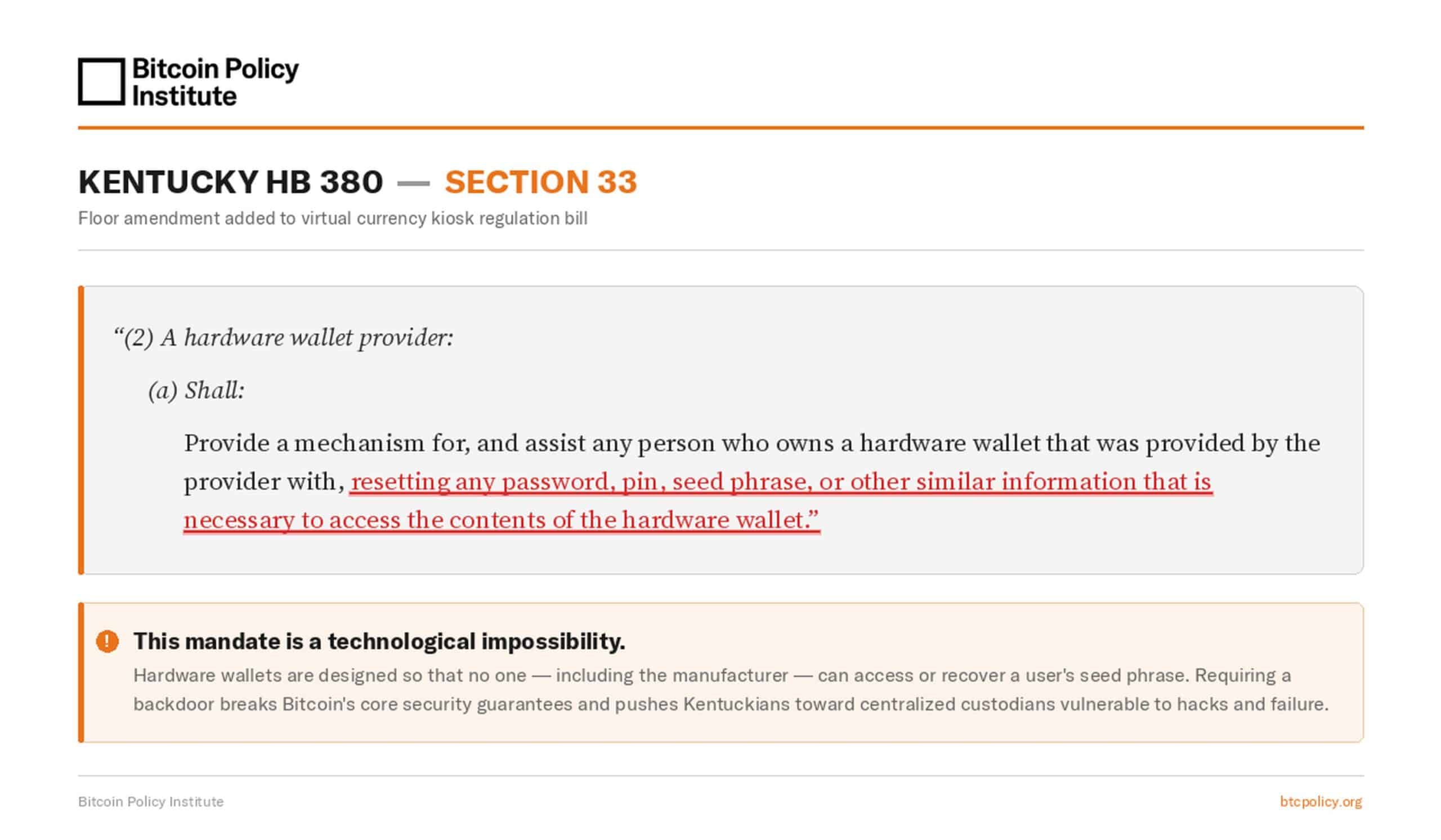
BPI has just learned of an amendment buried in Kentucky HB 380 that would require hardware wallet providers to reset users’ seed phrases on request. This would effectively outlaw self-custody in Kentucky.
Source: BPI

Kentucky crypto plans

The HB 380 is an amendment to the 77-page virtual currency kiosk legislation, part of a broader effort to regulate crypto ATMs, especially those that facilitate BTC transfers.

It was a last-minute amendment added in January. It requires hardware providers to be able to reset and recover users’ hardware wallet passwords and seed phrases, something BPI called ‘technologically impossible.’

The mandate is technologically impossible for non-custodial wallets. Requiring a backdoor for seed phrase recovery breaks Bitcoin’s fundamental security guarantees and pushes users toward centralized custodians that are vulnerable to hacks and failures.

The advocacy group wrote to the Kentucky Senate, informing it of the harmful nature of the amendment’s language. It added that the legislators should “protect Kentucky constituents’ right to secure their property.”

However, one analyst noted that ‘commercial hardware wallets’ are vulnerable to government overreach because their parent firms are legal entities operating in different jurisdictions.

Race for strategic Bitcoin reserve

Last year, at the state level, the race for the strategic Bitcoin reserve (SBR) became hot. But, as of 2026, only a handful of states in the U.S. have managed to codify the plans into law. Currently, only seven states have approved an SBR, including Arizona, Texas, and New Mexico.

At the federal level, however, there’s been little commitment or update on whether the U.S. SBR will be established. Even so, the U.S. now holds 328,272 BTC, about 1.5% of the total supply.

This was nearly half of the total 650,296 BTC held by governments, making the U.S. the top holder, followed by China at 190,000 BTC and the UK at 61,245 BTC.


Final Summary

  • The Bitcoin Policy Institute pressed the Kentucky Senate to reconsider its recent amendment on crypto ATM rules to safeguard self-custody.
  • There are about 7 U.S. states with approved strategic BTC reserve frameworks.

İlgili Sorular

QWhat is the main concern raised by the Bitcoin Policy Institute regarding Kentucky's HB 380 amendment?

AThe Bitcoin Policy Institute is concerned that the amendment would require hardware wallet providers to reset users' seed phrases on request, which they call 'technologically impossible' and argue it would effectively outlaw self-custody in Kentucky.

QWhy does the Bitcoin Policy Institute claim the mandate in HB 380 is 'technologically impossible'?

AThey state it is technologically impossible for non-custodial wallets because requiring a backdoor for seed phrase recovery breaks Bitcoin's fundamental security guarantees.

QWhat is the primary purpose of the broader HB 380 legislation that this amendment is a part of?

AHB 380 is an amendment to virtual currency kiosk legislation, which is part of a broader effort to regulate crypto ATMs, especially those that facilitate BTC transfers.

QHow many U.S. states have approved a strategic Bitcoin reserve (SBR) framework as of 2026, according to the article?

AAs of 2026, seven U.S. states have approved a strategic Bitcoin reserve framework.

QWhich country is the largest government holder of Bitcoin, and how much does it hold?

AThe United States is the largest government holder of Bitcoin, with 328,272 BTC, which is about 1.5% of the total supply.

İlgili Okumalar

Stocks of Companies in Bitcoin Mining and AI Infrastructure Soar, Short Sellers Face Losses

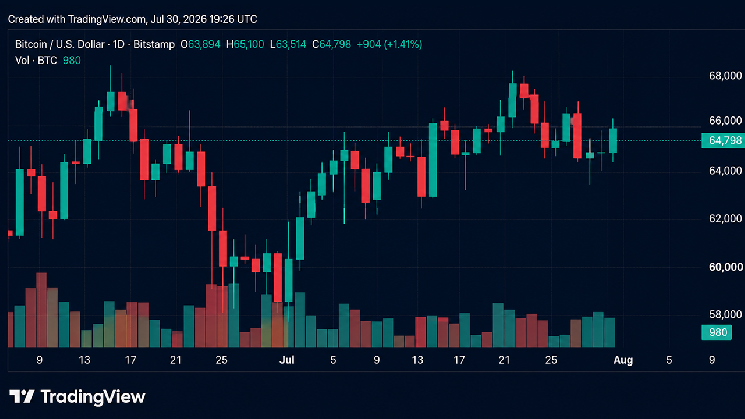
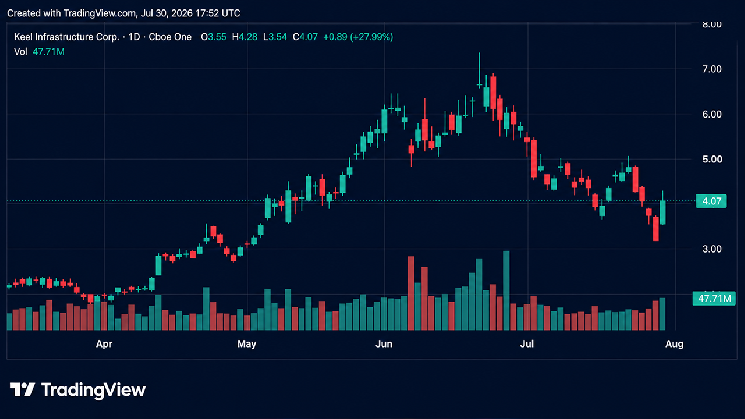
Shares of companies involved in Bitcoin mining and AI infrastructure surged, causing losses for short sellers. On Thursday, July 30, 2026, Keel Infrastructure (formerly Bitfarms) led the gains, rising 29.13%, followed by Nebius Group, Cipher Digital, and IREN Limited with jumps over 27%. Other notable gainers included Riot Platforms, Bitdeer, Core Scientific, Hut 8, and Cleanspark, with increases mostly ranging from 17% to 24%. The rally was attributed to a short squeeze triggered by a hedge fund's forced liquidation of its holdings, which were largely bought by Citadel. Additionally, Bitcoin trading above $64,000 and strong Microsoft earnings, highlighting AI's profitability, boosted market sentiment. Coreweave also announced a deal to provide AI cloud services for U.S. defense and intelligence agencies. This surge reflects a broader, longer-term trend of Bitcoin miners pivoting to AI data centers, leveraging their existing energy infrastructure and land. Recent multi-billion dollar deals by companies like Hut 8, IREN, and Terawulf for AI cloud services underscore this strategic shift. Other gainers, including Sandisk, Micron, Bloom Energy, and Cerebras, are suppliers critical to the AI infrastructure build-out. While the rally provided relief after July's losses, questions remain about capital expenditures, power availability, and long-term AI demand. The sustainability of these gains depends on these companies successfully converting their energy contracts and AI service deals into stable revenue streams.

cryptonews.ru24 dk önce

Stocks of Companies in Bitcoin Mining and AI Infrastructure Soar, Short Sellers Face Losses

cryptonews.ru24 dk önce

İşlemler

Spot
活动图片