TACO Is Outdated, Wall Street Is Betting Heavily on NACHO

marsbit2026-05-10 tarihinde yayınlandı2026-05-10 tarihinde güncellendi

Özet

The article discusses a shift on Wall Street from the "TACO" (Trump Always Chickens Out) trading theme to a new one called "NACHO" (Not A Chance Hormuz Opens). This change reflects the market's adaptation to a prolonged closure of the Strait of Hormuz following U.S.-Israel airstrikes on Iran in late February. Unlike TACO, which bet on former President Trump de-escalating crises, NACHO bets on a protracted stalemate keeping the vital oil chokepoint shut. Key evidence for the NACHO regime includes a fundamental decoupling of oil prices and the S&P 500 since late March. While Brent crude has remained elevated (around $109 in May), the stock index has rallied to new highs. The market is pricing in a long but finite period of high oil prices, as seen in the steep futures curve. This theme is backed by real money in three derivatives markets: soaring war risk insurance for ships, an inverted oil futures structure, and evaporating expectations for Federal Reserve rate cuts in 2026. Within the equity market, the NACHO dynamic has caused a sharp divergence, with the energy sector (XLE) vastly outperforming the transportation sector (IYT), which is highly sensitive to fuel costs. The article notes a concrete deadline for this trade: early June. Analysts warn that global commercial oil inventories could approach critical "operational pressure" levels by then, potentially triggering more severe market disruptions if the Strait remains closed. Prediction markets currently assign a very...

Author: The Block

On Wall Street, the "TACO trade" is outdated. Now everyone is talking about a new trading pattern—"NACHO".

Since the US-Israel airstrikes on Iran on February 28, the Strait of Hormuz has remained closed. Currently, oil prices are up over 50% compared to pre-war levels, and the market's expectation for Fed rate cuts in 2026 has been compressed from 2 pre-war to the current 0. Yet during the same period, the S&P 500 hit a record high, rising for 6 consecutive weeks, marking its longest winning streak since 2024.

Wall Street has named this seemingly contradictory market state NACHO, which stands for "Not A Chance Hormuz Opens." It is the antonym of TACO ("Trump Always Chickens Out"). TACO bets on "people chickening out"—that Trump will back down at critical moments. NACHO bets on "things getting stuck"—that this time, the Strait of Hormuz cannot be reopened with just one Truth Social post.

eToro market analyst Zavier Wong describes this shift: "For most of the crisis, every ceasefire headline caused oil prices to plummet sharply. Traders kept betting on a solution that never arrived. NACHO means the market acknowledges that high oil prices are not a one-time shock but the current market environment itself."

Two Lines in Early April

March 23 was the tipping point for the TACO model's failure. That morning, Trump announced on Truth Social that he had a "very good constructive dialogue" with Iran and ordered the Pentagon to suspend strikes on Iranian energy facilities for 5 days. S&P 500 futures rebounded nearly 4% from the lows in minutes, instantly adding $1.7 trillion in market value. Brent crude fell from $109 intraday to $92.

Then, Iranian officials denied the existence of any dialogue. According to Iranian state media, a "senior security official" called it a market manipulation tactic, stating no dialogue ever took place. Gains were halved within two hours. The S&P closed up only +1.15%, and Brent bounced back to $99.94.

That was the first time in 14 months that Trump's "backing down" no longer worked for the market. The reason is not complicated. Backing down under the TACO model is one-sided, achievable with just one post. The backing down on March 23 required Iran's cooperation. When the opponent doesn't cooperate, backing down becomes a lie.
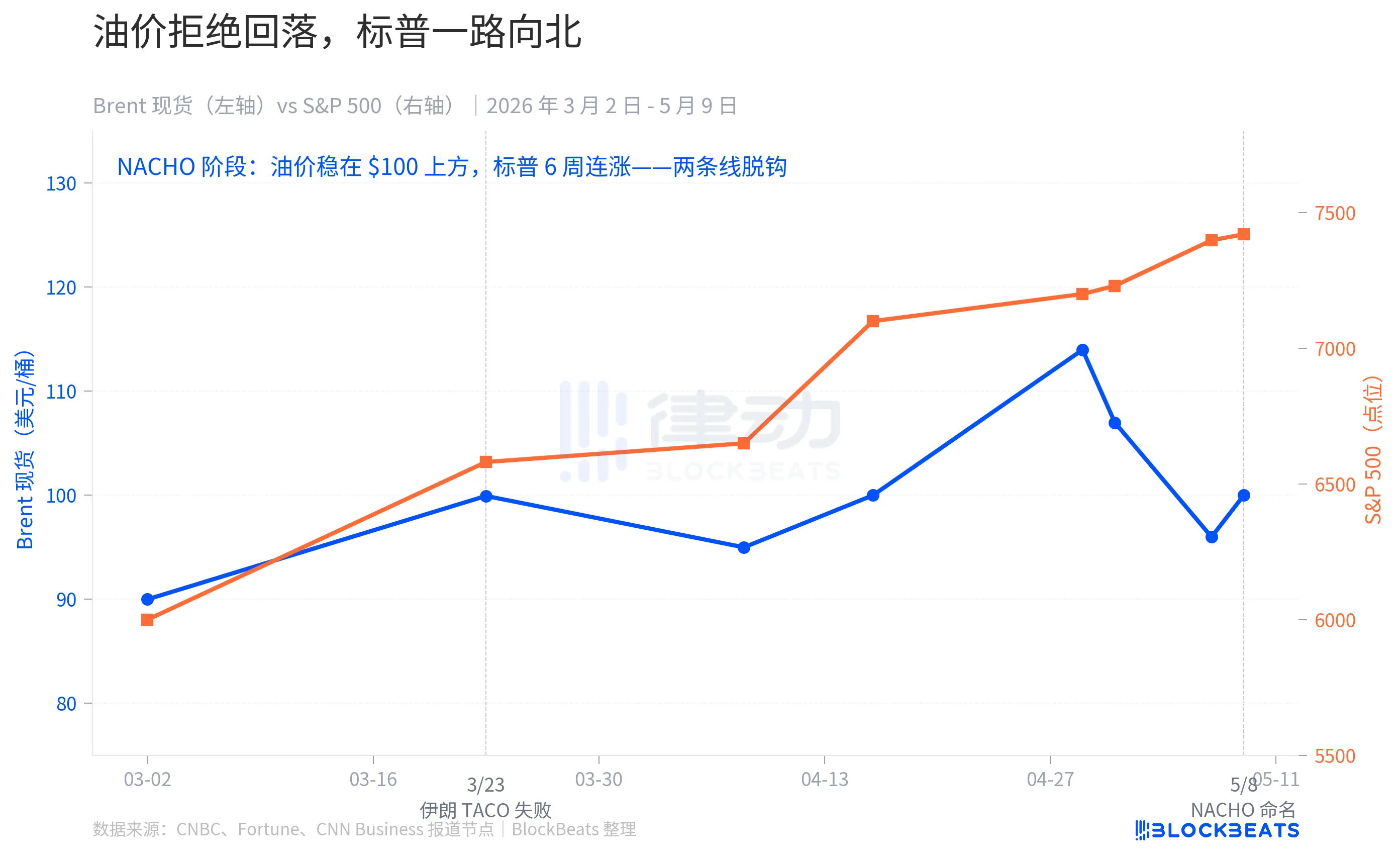
Starting that day, market behavior fundamentally changed. Brent crude never fell back to the pre-war level of $67 in the following 6 weeks, maintaining an average price of $109.57 in May. In between, there were the US-Iran ceasefire agreements on April 7-8, a period on April 17 when oil prices briefly returned to "initial war levels," and news on May 7 that the US and Iran were close to a deal. Each "ceasefire headline" failed to bring oil prices back to the baseline.

But the S&P marched northward. It rose 10% in April alone, its strongest month since November 2020, hitting 7 intraday record highs during the period. On May 1, it broke 7,230 points intraday; on May 7, it closed at 7,398 points.

The two lines completely decoupled in early April. In the TACO era, they moved in sync: threats caused oil and S&P to fall, backing down caused oil and S&P to rebound. In the NACHO era, they speak two different languages: oil says "Hormuz is shut for good," while the S&P says "not my problem."

Three Markets, Three Reactions

NACHO is not just talk; it's the same bet placed with real money across three independent derivatives markets.

The first layer is insurance. According to Strauss Center historical data, the war risk insurance rate for the Strait of Hormuz once soared to 3.5% of hull value during the 2003 US invasion of Iraq and reached 7.5% at the peak of the 1984 "Tanker War" during the Iran-Iraq War after the attack on the Yanbu Pride tanker. The baseline before this crisis was 0.125% to 0.25%. By early May, the rate had entered the 1% range, with some policies spiking to 3% to 8%.

Converted to the insurance cost per single voyage for a Very Large Crude Carrier (VLCC), the fee has jumped from about $250,000 pre-war to the current $800,000 to $8 million. The job of insurance companies is to price risk. The practical implication of this layer is: if insurers simply won't provide coverage, shipowners won't bear the risk of uninsured passage. "Physical opening" and "de facto navigation" of the Strait are two different things.
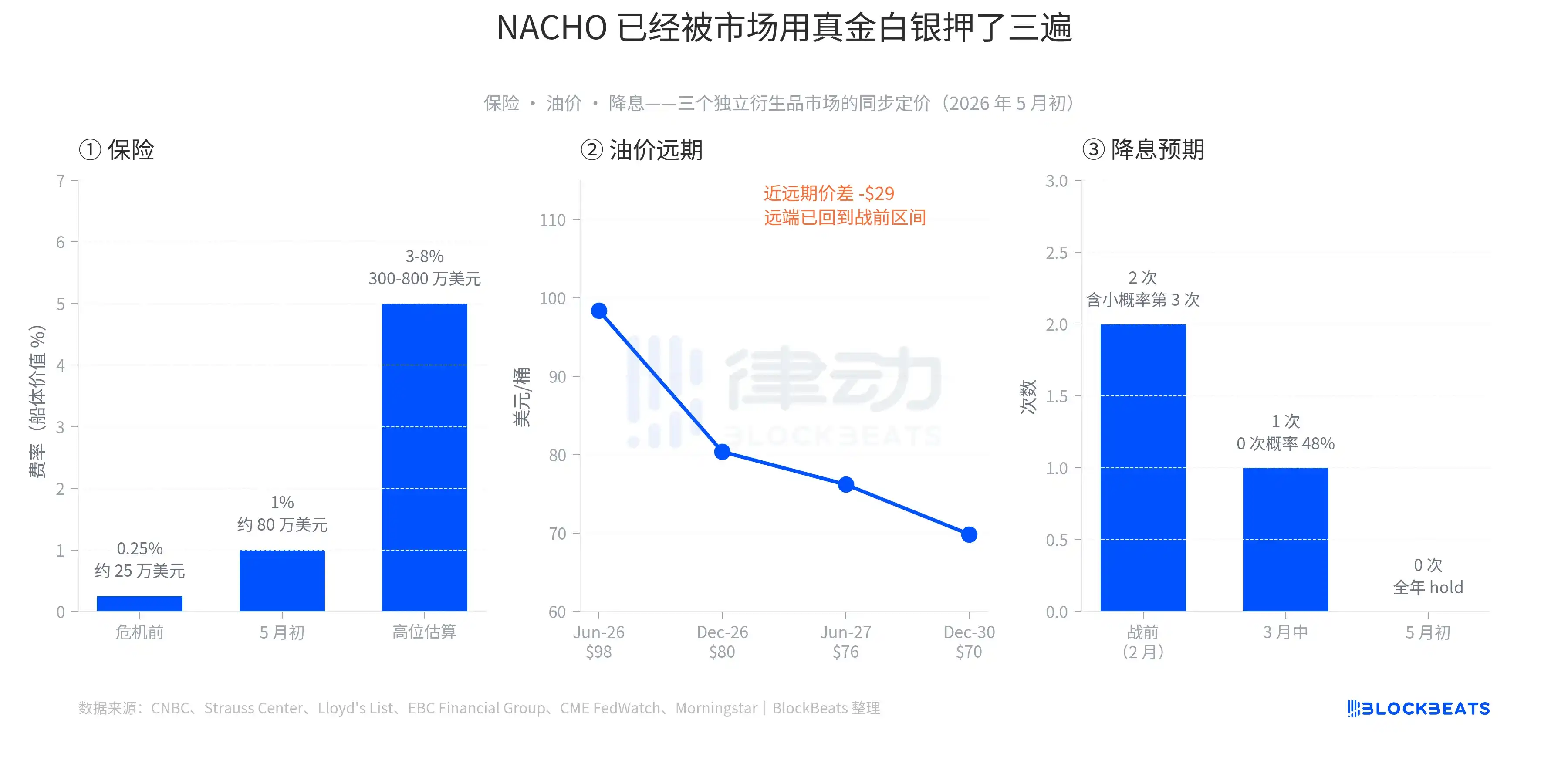
The second layer is oil prices. Early May data shows: Brent Jun-26 contract at $98.41, Dec-26 at $80.39, Jun-27 at $76.20, Dec-30 at $69.85. The spread between the front-month and Dec-30 is about $28.5, one of the steepest backwardation (near high, far low) structures in the past 5 years. This curve tells a very specific story: the market believes spot supply is tight but will eventually ease, with long-term prices returning to the pre-war range of $60-$70. In other words, high oil prices are not the final outcome but a bounded window. However, this window is long enough that traders don't bet on it ending suddenly.

The third layer is interest rate cuts. In early February 2026, the market expected the Fed to cut twice for the year, with a small chance of a third cut. By mid-March, after oil prices surged, it was compressed to one cut, with a 48% probability of 0 cuts. On April 29, the Fed held rates at 3.50% to 3.75%. On May 6, CME FedWatch showed a 70% probability of a continued hold at the June meeting. For all of 2026, the market is now pricing in 0 rate cuts. Hedge fund legend Paul Tudor Jones even said in a May 7 CNBC interview, "Not even Wash (likely meaning current Fed Chair) has a chance to make the Fed cut."

All three layers have left their mark in the derivatives markets—not just narrative, but real money.

The Differentiated Broad Market

The second subtle detail of NACHO is that it has already priced differentiation within the broad market.

As of the close on May 7, the Energy sector ETF (XLE, State Street's Energy Select Sector Fund) is up 31.63% year-to-date, the only major sector positive for all of 2026. Over the same period, the S&P 500 is up about 24%. The Transportation sector ETF (IYT, iShares U.S. Transportation ETF) is up only 8.79% year-to-date, underperforming the broader market by over 15 percentage points.
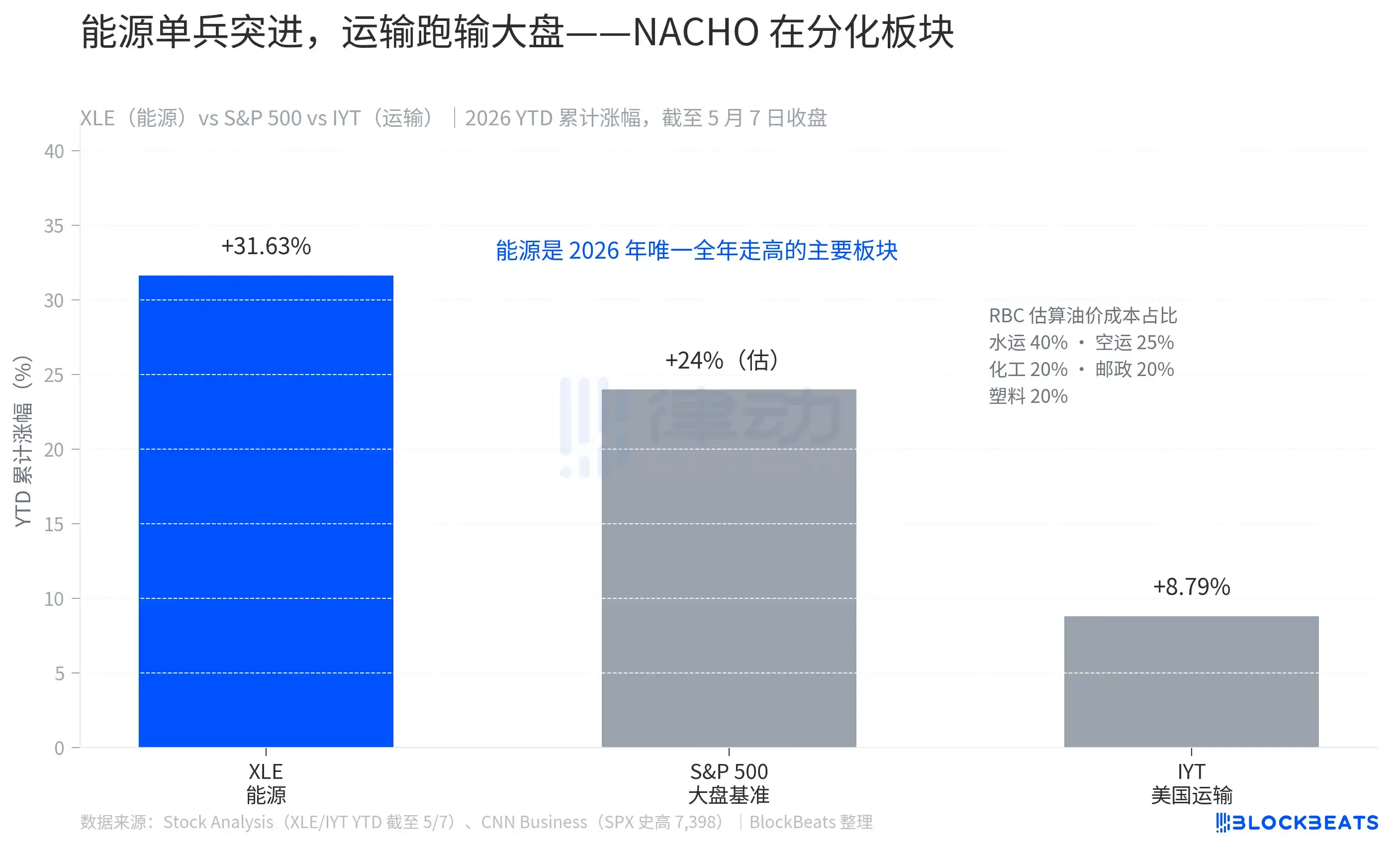
This gap is not random. According to RBC Capital Markets estimates, fuel costs account for 40% of operating costs in the water transport industry, 25% in air transport, and 20% each in chemicals, postal/courier services, and rubber/plastics. If fuel is a major item on your business's cost sheet, NACHO is a direct hit to your face.

XLE's 31.63% gain is not a short-term rebound; it's the result of 8 consecutive weeks of outperformance. IYT's 8.79% is not weakness; it's rising with the broad market while having its gains eroded by oil prices. The market has clearly shown readers how to calculate NACHO's odds—just look at the magnitude by which the Transportation ETF underperforms the market.

But NACHO is not a bet for an indefinite period; it has a very specific deadline: June 1.

According to JPMorgan's commodity research team estimates, global commercial crude oil inventories were about 8.4 billion barrels at the start of 2026, but only around 800 million barrels of that was "practically usable." The rest consists of pipeline fill, tank bottoms, minimum terminal stocks—maintaining the daily operation of the system. Since this crisis began, 280 million barrels have been drawn down, leaving about 520 million barrels of usable inventory remaining. JPMorgan's exact words: "Commercial inventories are expected to approach operational stress levels in early June."

"Operational stress level" is a specific physical concept. JPMorgan explains: "The system won't collapse because oil disappears; it will collapse because the distribution network no longer has sufficient working inventory." Once this line is breached, the only choices for businesses and governments are: either squeeze the minimum inventory necessary to maintain operations (which damages the infrastructure itself), or wait for new supply. If Hormuz remains closed until September, OECD commercial inventories could fall to the so-called "operational floor." According to a Fortune report, European aviation fuel inventories are expected to fall below the 23-day supply threshold in June, a key industry red line.
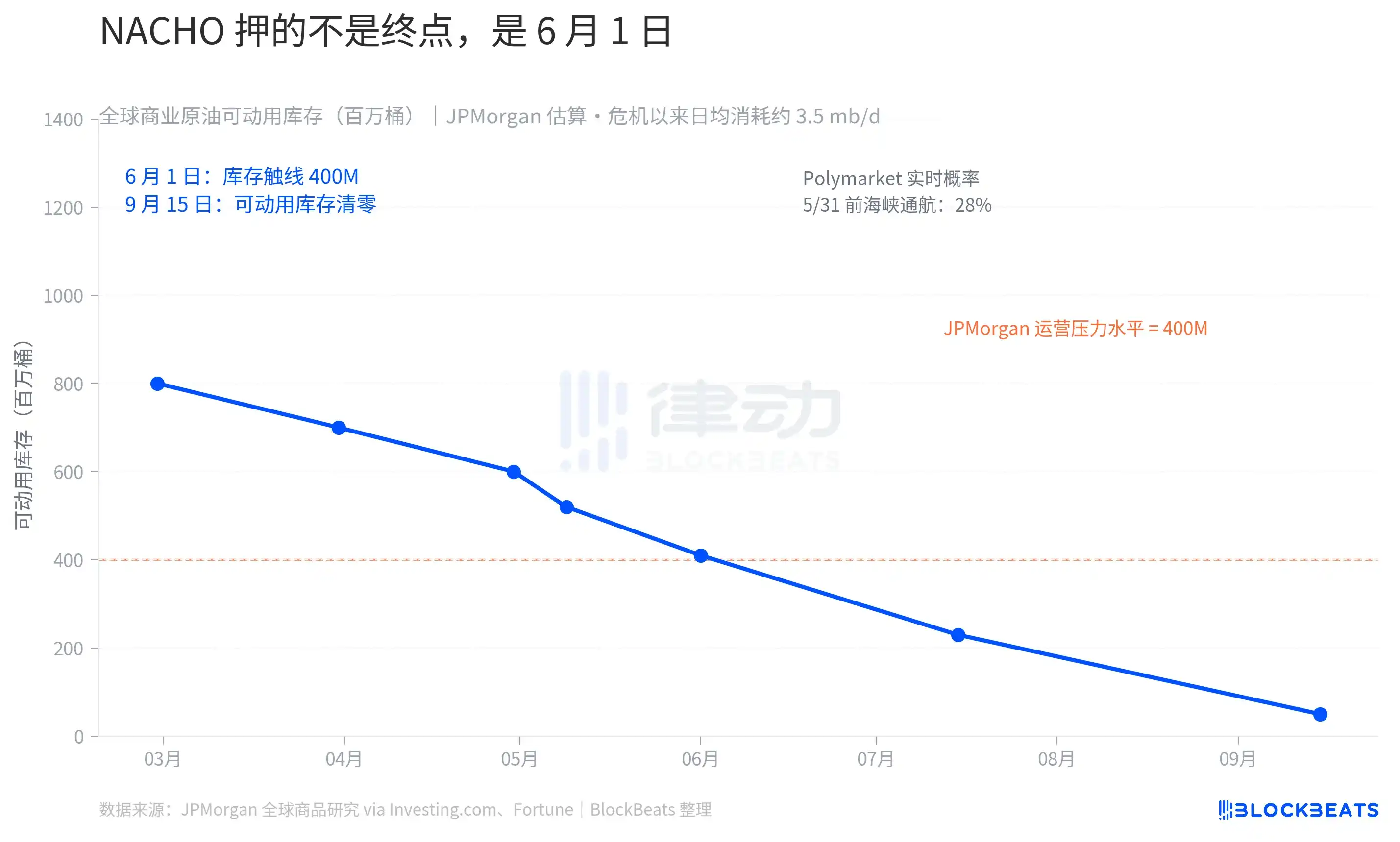
The market's prediction of odds is synchronized with the physical clock. According to Polymarket data on May 9, the probability of "Strait of Hormuz open for normal traffic by May 31" is 28%, and the probability before May 15 is only 2%. $9.92 million in active positions on that market are betting that NACHO will not fail, at least through May.

The market is no longer trading Trump's next Truth Social post; it's trading the early June inventory data for the Strait of Hormuz.


İlgili Sorular

QWhat does the acronym NACHO stand for, and what market trend does it represent?

ANACHO stands for 'Not A Chance Hormuz Opens'. It represents a market trend where traders assume the Strait of Hormuz will remain closed for an extended period, leading to sustained high oil prices and a decoupling of oil and equity market movements.

QWhy did the TACO trading pattern fail around March 23rd according to the article?

AThe TACO ('Trump Always Chickens Out') pattern failed because Trump's claim of constructive dialogue with Iran on March 23rd, which initially calmed markets, was denied by Iran. This showed that a one-sided 'chicken out' was no longer effective when the opposing party did not cooperate, turning the retreat into a perceived market manipulation.

QHow are the oil futures market and the Federal Reserve interest rate market pricing in the NACHO scenario?

AThe oil futures market shows a steeply inverted curve with near-term prices (e.g., Jun-26 at ~$98) much higher than long-term futures (e.g., Dec-30 at ~$70), pricing in a prolonged but ultimately temporary supply disruption. Simultaneously, the interest rate market has priced out all expected Federal Reserve rate cuts for 2026, reflecting expectations that high energy prices will keep inflationary pressure persistent.

QWhich sectors are winning and losing under the NACHO market regime, and why?

AThe energy sector (ETF: XLE) is a clear winner, up over 31% year-to-date, benefiting directly from high oil prices. The transportation sector (ETF: IYT) is a significant loser, up only about 8.7%, as its operating costs are heavily tied to fuel prices, which erodes profits despite the broader market rally.

QWhat is the key physical constraint or deadline that defines the NACHO trade's timeframe?

AThe key physical constraint is global commercial oil inventory levels. According to the article, JPMorgan estimates that 'operationally available' crude stocks could approach critical 'operational pressure levels' by early June. If the Strait of Hormuz remains closed, the system risks breaching its minimum operational inventory floor, making the NACHO trade's viability closely tied to this inventory clock.

İlgili Okumalar

AI PC Battle: Bet on the Toll Booth, Not the Camp

**Title:** The AI PC Battle: Don't Bet on Sides, Bet on the Tollbooth **Summary:** The AI PC competition is moving beyond simple "x86 vs. Arm" narratives. The core investment thesis should focus on identifying which players can sustain margins, cash flow, and pricing power throughout the upgrade cycle, rather than backing a particular architecture. The opportunity is analyzed in three layers: 1. **The Advanced Foundry Tollbooth:** TSMC is positioned to collect "tolls" regardless of which chip designer wins, due to its dominant ~70% share in advanced semiconductor manufacturing, which is essential for high-end AI PC chips. 2. **Compute & Platform Spillover:** AMD represents an offensive in the x86 CPU+GPU space, while NVIDIA leverages its GPU and CUDA software stack dominance. Both benefit from the demand for increased local AI compute. 3. **Architecture Diffusion & Turnaround Plays:** ARM and Intel offer potential for significant upside (elasticity), but investments here require stricter discipline due to higher execution risks and competitive challenges. The industry is transitioning from concept to shipment validation. While short-term forecasts for AI PC adoption have been revised down slightly due to tariffs and procurement delays, the long-term trend towards AI becoming a standard PC feature remains intact. The key driver for upgrade cycles will be whether compelling enterprise applications (e.g., privacy-sensitive computing, low-latency inference) emerge beyond consumer-focused features like meeting summarization. Investment strategy should prioritize companies with platform-level advantages and recurring revenue streams. TSMC offers high certainty as the foundational tollbooth. AMD presents a strong offensive play within the established ecosystem. ARM and Intel are higher-risk, higher-potential-reward turnaround bets. The report cautions against chasing short-term hype and emphasizes a disciplined, long-term approach focused on buying ecosystem strength and cash-flow certainty after market enthusiasm subsides. **Key Risks:** Underwhelming AI PC applications slowing upgrade cycles; slow improvement in Windows on Arm compatibility; macro/tariff impacts on PC demand; potential advanced node supply-demand mismatches affecting TSMC; high overall AI sector valuations making stocks vulnerable to a risk-off shift in markets.

marsbit11 dk önce

AI PC Battle: Bet on the Toll Booth, Not the Camp

marsbit11 dk önce

Ten-Thousand-Word Analysis: From $10 to $290, MRVL Wins the Entire AI Era by 'Not Making GPUs'

Marvell Technology's stock price surged from under $10 in 2016 to a record $290 in June 2026, fueled not by making GPUs, but by dominating AI infrastructure connectivity. This analysis argues the market misvalues MRVL as merely a smaller Broadcom in custom AI chips, overlooking its true, unique position. Marvell's core strength lies in enabling high-speed data flow for AI clusters through three interconnected businesses. First, it holds a commanding ~70% market share in high-speed optical DSPs (essential for data center light modules), a deep-moat business with accelerating growth. Second, its custom AI chip design business serves hyperscalers like AWS, Microsoft, and Google, with a significant revenue pipeline despite lower margins. Third, stable cash flows come from Ethernet switch chips and enterprise storage controllers. Together, they form a full-stack "AI data movement" platform. CEO Matt Murphy's transformative leadership since 2016, involving strategic divestments, key acquisitions (like Inphi for optical DSPs), and securing long-term agreements with major cloud providers, repositioned the company. A pivotal $2 billion strategic investment from NVIDIA in 2026 underscored Marvell's critical role in the AI ecosystem, particularly through collaborations like NVLink Fusion. While Marvell faces risks—including client concentration (losing the Amazon Trainium3 design), lower-margin business mix, competitive threats, insider selling, and complex supply chains—its fundamentals remain strong. The optical interconnect moat is widening with the acquisition of Celestial AI (photonics fabric), and financial metrics show accelerating revenue growth and operating leverage. With a PEG ratio suggesting undervaluation relative to its growth, the thesis is that the market undervalues Marvell's monopolistic position in AI "plumbing" while overemphasizing its competitive custom chip segment. The story transcends investing, symbolizing how in any complex system—from the internet to AI—the value of "connection" ultimately surpasses that of individual "nodes."

marsbit41 dk önce

Ten-Thousand-Word Analysis: From $10 to $290, MRVL Wins the Entire AI Era by 'Not Making GPUs'

marsbit41 dk önce

AI Relay Stations Spark Heated Debate on Zhihu: Behind Cheap Tokens, What Are Users Really Worried About?

A discussion on Zhihu about "AI relay stations" shifted the niche developer topic of "cheap tokens" into broader user awareness. Users moved beyond simply questioning the legitimacy of these services to focus on practical concerns: Where do cheap tokens truly come from? Is the model being accessed the real one? Can relay stations see prompts, code, and API keys? For occasional users, are the risks worth it? The core debate centered less on price and more on trust. A primary worry is model authenticity—the risk of "model swapping," where users paying for a premium model might be routed to a cheaper one, creating an information asymmetry. Others argued that cost comparisons matter; while cheaper than official pay-as-you-go APIs, relay stations may not be the lowest-cost option versus subscriptions, domestic models, or free tiers, making user needs assessment crucial. Speculation about token sources ranged from legitimate bulk discounts to gray-area methods like account sharing or exploiting regional pricing. This opacity makes risk assessment difficult for users. Data security emerged as a critical concern, especially for enterprise use. When processing sensitive information like code, contracts, or client data, the inability to verify a relay station's data handling, retention, or access policies poses significant compliance and confidentiality risks. The evolving consensus suggests relay stations can be used cautiously for low-sensitivity, disposable tasks (e.g., summarizing public info, simple translation). However, they should not be the default for sensitive, professional, or production workflows involving proprietary data, Agents, or automated systems. Recommendations include avoiding large prepayments, not relying on a single service, using test prompts to monitor quality, anonymizing data where possible, and keeping official channels as backups. Ultimately, the discussion framed tokens not just as a billing unit but as a measure of real cost encompassing price, model integrity, data security, and service stability. The popularity of relay stations highlights user demand for affordable access, but the debate underscores a key trade-off: the savings from cheap tokens may come at the price of trust, transparency, and control over one's data and AI experience.

marsbit1 saat önce

AI Relay Stations Spark Heated Debate on Zhihu: Behind Cheap Tokens, What Are Users Really Worried About?

marsbit1 saat önce

In-Depth Research Report on TradFi: The Convergence Wave of Crypto and Traditional Finance

In 2026, the crypto industry is undergoing a profound infrastructure-level transformation—TradFi assets are migrating on-chain at an unprecedented pace. According to CoinGecko's Q1 2026 report, the total value locked (TVL) of tokenized real-world assets (RWA) has surpassed $31 billion, a nearly 4x increase from $7.8 billion at the beginning of 2025, with the sector’s aggregate market capitalization reaching $19.3 billion. Among these, the market cap of tokenized stocks surged from $2 million to $486 million, with Q1 spot trading volume reaching $15.1 billion—a single quarter already surpassing the entire second half of 2025. RWA perpetual contract Q1 trading volume reached a staggering $524.8 billion, far exceeding the $313 billion for all of 2025. Meanwhile, BlackRock's BUIDL fund has reached $2.3 billion in scale and has filed for two new tokenized funds, signaling that the world's largest asset manager's tokenization strategy is evolving from pilot to product suite expansion. HTX, as a core participant in the crypto exchange sector, officially launched TradFi perpetual futures products including NVDA, AAPL, MSFT, META, and SPY in 2026, enabling crypto users to gain 24/7 trading access to core U.S. equities. Boston Consulting Group predicts that global tokenized asset scale could reach $16 trillion by 2030, while McKinsey offers a conservative estimate of approximately $2 trillion. The on-chain migration of TradFi assets is no longer a "future narrative" but a structural transformation unfolding in real time, as crypto exchanges evolve from single crypto asset trading platforms toward "multi-asset-class trading infrastructure."

HTX Learn1 saat önce

In-Depth Research Report on TradFi: The Convergence Wave of Crypto and Traditional Finance

HTX Learn1 saat önce

İşlemler

Spot
Futures
活动图片




