Study Shows Cryptocurrency Usage in Switzerland Twice as High as in Germany

cryptonews.ru2026-08-03 tarihinde yayınlandı2026-08-03 tarihinde güncellendi

Özet

A study by Bearingpoint reveals Switzerland's cryptocurrency adoption rate is double that of Germany, with 28% of Swiss adults using crypto compared to 14% in Germany. The survey of over 4,000 adults also shows Switzerland leads in viewing crypto as a worthwhile investment (37%) and being open to CBDCs (44%). Experts attribute Switzerland's lead to its early regulatory clarity, notably the DLT Act of 2021, which fostered a mature ecosystem like "Crypto Valley," home to 1,749 blockchain firms. While crypto remains most popular among youth, it complements, rather than replaces, traditional finance. Germany, lagging in retail adoption, is now leveraging its massive banking network—serving tens of millions—to integrate crypto services and potentially close the gap. The future will show if Germany's scale can match Switzerland's head start.

In a Bearingpoint survey, the results of which were published on July 30, more than 4,000 adults in Germany, Austria, and Switzerland were interviewed. Austria was in the middle: 18% of respondents reported using cryptocurrency at least occasionally, confirming that the gap is not just about interest in digital assets, but also how each market has evolved over time.

YouGov conducted an online poll between June 18 and 29, which involved 2,031 people in Germany, 1,003 in Austria, and 1,001 in Switzerland. The sample was weighted by age, gender, and region, providing a representative picture of the adult population in each country.
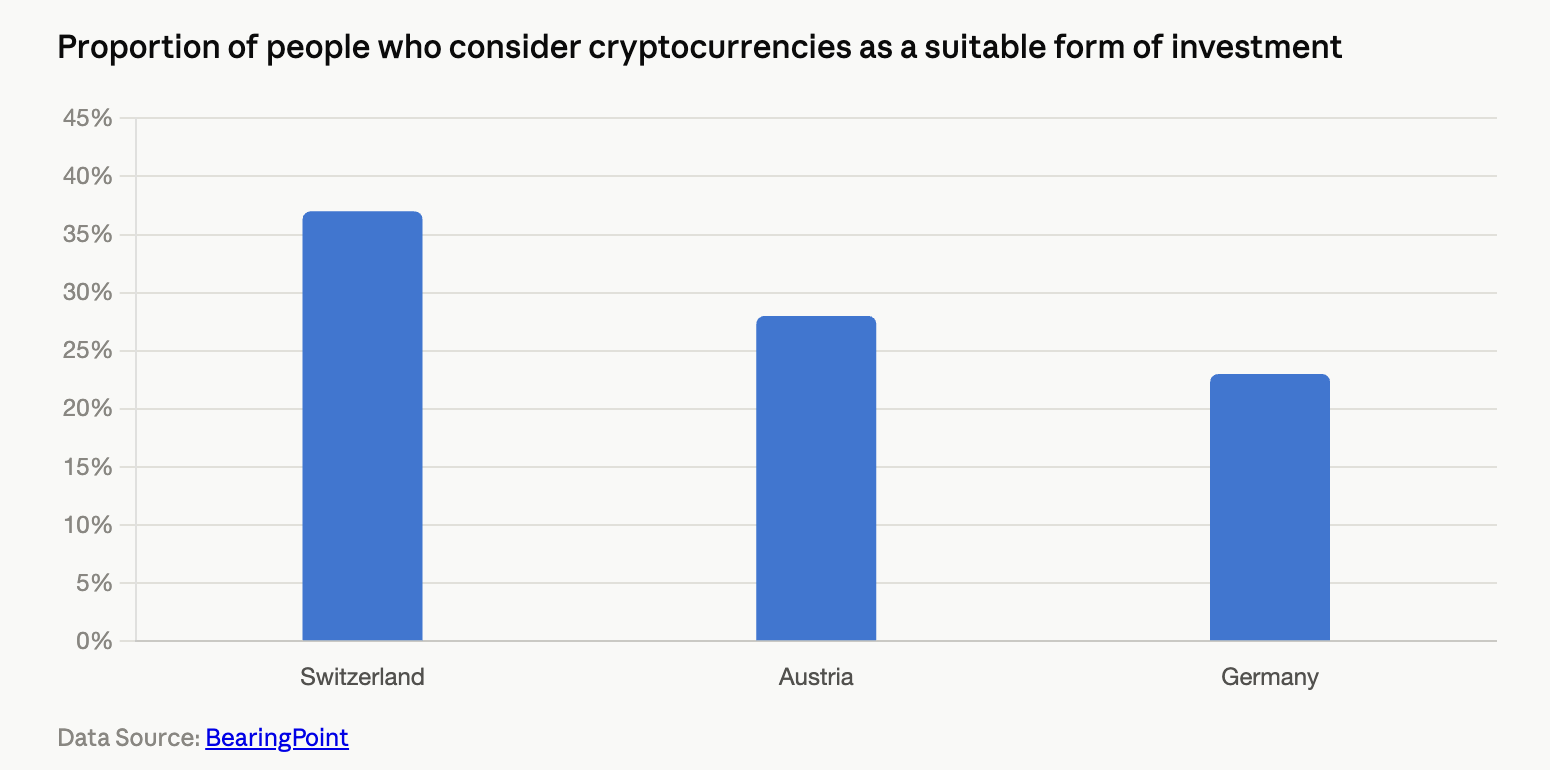
The differences go beyond simple cryptocurrency ownership. In Switzerland, 37% of respondents consider cryptocurrency a profitable investment, compared to 28% in Austria and 23% in Germany. Swiss respondents were also more likely to consider using digital assets as currencies for international trade or reserve currencies: 45% of those surveyed expressed this view compared to 36% in Austria and 32% in Germany. Such metrics typically only appear after people master the technology, not just know of its existence.

Switzerland also led in openness to state-issued digital money. 44% of respondents said they would consider using a central bank digital currency (CBDC), such as a digital franc, in everyday life, compared to 38% in Austria and 29% in Germany. A central bank digital currency is simply a digital version of state-issued money, not a privately issued cryptocurrency.

Dr. Robert Bosch, Global Head of Financial Services at Bearingpoint, stated that the survey results show Switzerland is not just more favorable towards cryptocurrencies, but also more generally ready to adopt digital money. Bosch noted:

"In Germany, they discuss the risks, while neighbors are already actively using digital money and investing more in it."

Early Regulations Laid the Groundwork for Switzerland

Switzerland's leadership reflects decisions made years before today's adoption data. In September 2020, parliament approved the Distributed Ledger Technology (DLT) Act, and this regulatory framework came into full force on August 1, 2021. Distributed ledger technology (DLT) is a shared record-keeping system that allows blockchain networks to securely record and verify transactions.

Instead of developing a completely new crypto law, Switzerland updated existing financial and civil legislation. The amendments clarified how tokenized assets fit into established legal frameworks, settled issues related to bankruptcy proceedings, and introduced licensing for specialized DLT-based trading venues. Such legal clarity tends to attract companies long before it is reflected in consumer surveys.

The timing was crucial. While most of Europe was still figuring out its regulatory framework, Swiss companies were already operating under clear rules. This gave founders, investors, and financial institutions time to build businesses, refine products, and gain practical experience before broader European regulations came into effect.
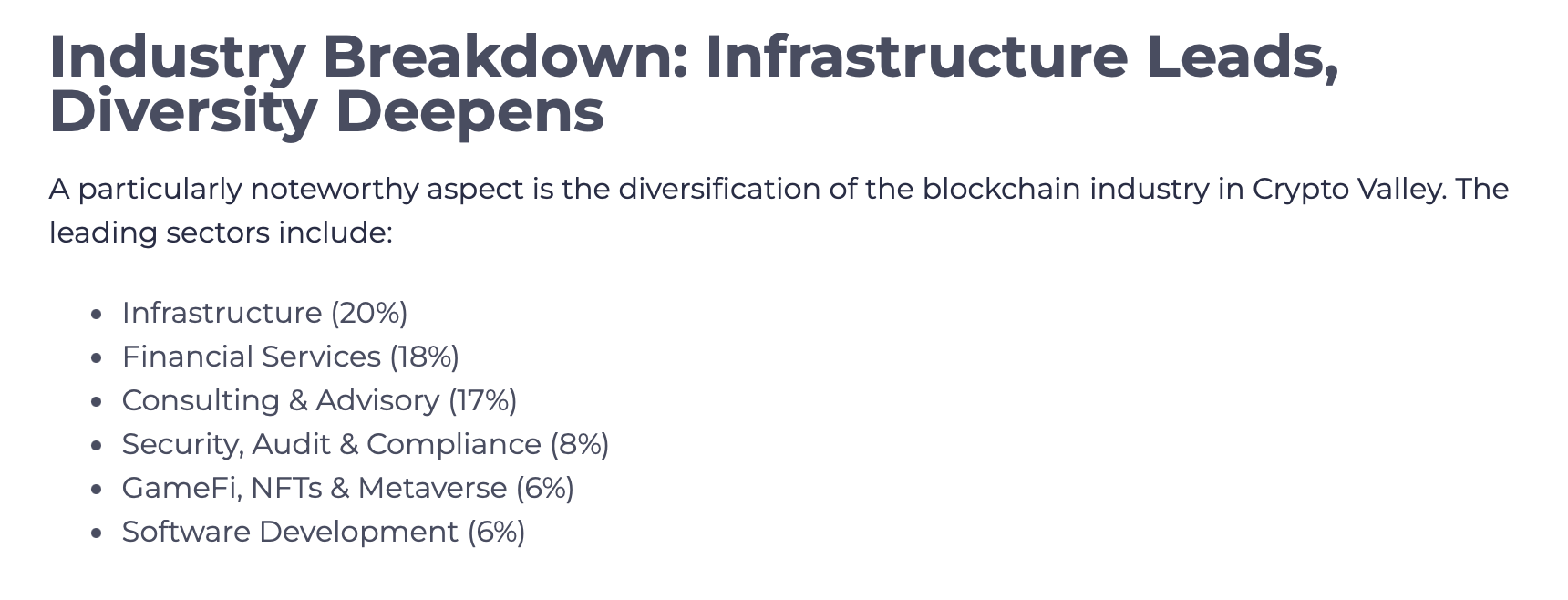
Screenshot from CV VC's "Crypto Valley Company & Industry Report" published in May 2025.

These early decisions also fostered the growth of "Crypto Valley," which spans Switzerland and Liechtenstein. According to a 2024 industry report, the ecosystem comprised 1,749 active blockchain and DLT companies, representing annual growth of 14% and an increase of 132% since 2020.

"Crypto Valley" Creates Its Own Momentum

Zug remains the center of "Crypto Valley," home to approximately 719 companies, or 41% of the ecosystem, while Zurich accounts for about 15%. Additional clusters have expanded in Geneva, Ticino, Lucerne, Neuchâtel, and Liechtenstein, giving blockchain companies access to lawyers, banks, developers, venture funds, and technical specialists without leaving the region.

This concentration creates an advantage that is hard to replicate. As more companies set up offices here, specialized financial services, compliance expertise, and investment capital tend to follow. Switzerland has become home to organizations linked to Ethereum, Cardano, Solana, Polkadot, Tezos, Sygnum Bank, Amina Bank, and Bitcoin Suisse, reinforcing this cycle.
The survey also showed that cryptocurrencies remain most popular among young people, and their usage continues to vary by gender, education level, and income. In Switzerland, 36% of respondents aged 18-24 reported using cryptocurrency, while Austria and Germany showed similar patterns but with lower participation rates. These demographic trends help explain who adopts cryptocurrency first, but they do not explain Switzerland's broader national-level leadership.

Cryptocurrencies Evolve Alongside Traditional Finance

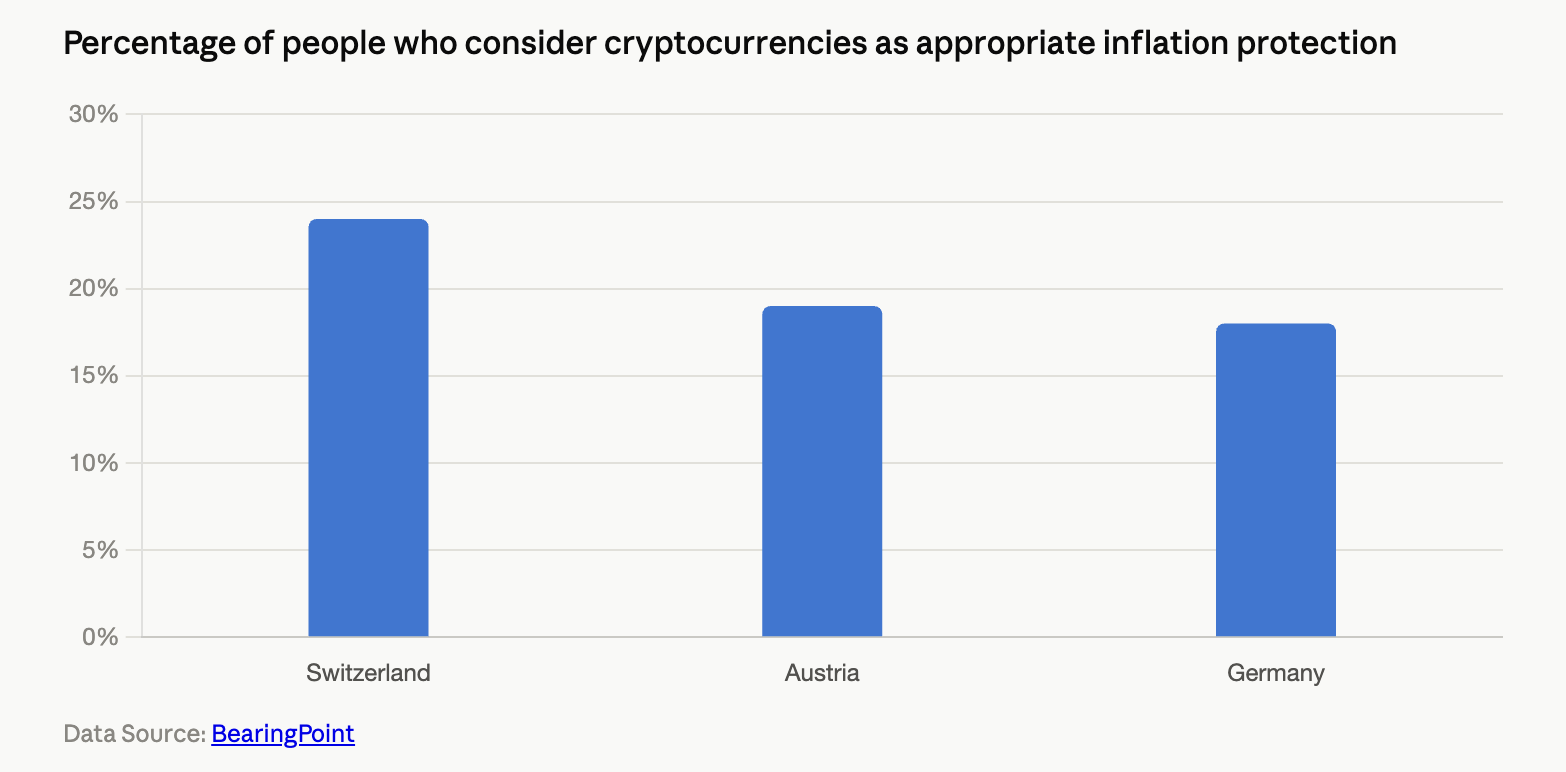
The survey results indicate that digital assets complement traditional financial system (TradFi) habits rather than replace them. From 80% to 87% of respondents in the three countries still consider state-issued currencies effective payment tools, while about 64% of Swiss respondents continue to prefer gold as a hedge against inflation.

This combination is becoming more common. People often view cryptocurrency as just another financial instrument, not an alternative to traditional money, allowing banks and policymakers to expand digital offerings without displacing established financial products.

Germany Counts on Banks to Close the Gap

Germany still lags behind Switzerland in retail cryptocurrency adoption, but its banking sector could change that picture. Cooperative banks linked to DZ Bank and savings banks linked to Dekabank collectively serve around 80 million clients, giving them reach that few crypto platforms can match.

At the end of December 2025, DZ Bank received approval to launch its "meinkrypto" platform, which integrates into the VR Banking app. The service launched with support for Bitcoin, Ether, Litecoin, and Cardano, with asset custody provided by Börse Stuttgart Digital. Individual cooperative banks still have to decide whether to activate this feature.

Dekabank is developing a similar platform for the German Sparkassen network, which serves about 50 million clients. Rollout is expected to continue into 2026, with initial support for Bitcoin and Ether. Integrating cryptocurrencies into familiar banking apps removes one of the biggest hurdles for newcomers, eliminating the need to open accounts on separate digital asset platforms.

Scale of Germany's Banking System Matches Switzerland's Early Lead

Switzerland gained its advantage through regulatory certainty and years of ecosystem development. Germany is pursuing a different strategy, leveraging established banks and existing client relationships to expand access within the European regulatory framework.

This approach gives Germany enormous distribution potential, yet Switzerland still benefits from years of experience, infrastructure, and business concentration. Future Bearingpoint surveys, as well as data on client numbers using German banking platforms, should give a clearer picture of whether the gap will begin to close or Switzerland will continue to solidify its leadership.

end-content

Trend Kriptolar

İlgili Sorular

QAccording to the article, what are the two main reasons for Switzerland's significantly higher cryptocurrency adoption rate compared to Germany?

AThe article cites two main reasons: 1) Early and clear regulatory actions, such as the 2020 DLT Act, providing legal certainty years before other European nations. 2) The development of the 'Crypto Valley' ecosystem, which created a self-reinforcing hub for blockchain companies, talent, and capital.

QHow does Germany plan to potentially close the gap in cryptocurrency adoption with Switzerland?

AGermany is relying on its established banking sector. Major cooperative banks like DZ Bank and savings banks via Dekabank are integrating cryptocurrency buying/selling services directly into their existing banking apps used by tens of millions of customers, making access easier for the average person.

QBeyond simple ownership, what other key differences in perception does the survey reveal between Swiss, Austrian, and German respondents?

AThe survey shows Swiss respondents are more likely to view cryptocurrency as a profitable investment (37% vs 23% in Germany) and to consider using digital assets for international trade or as reserve currencies (45% vs 32% in Germany). They also show more openness to central bank digital currencies (CBDCs).

QWhat is the article's assessment of how digital assets relate to traditional finance based on the survey results?

AThe article concludes that digital assets are largely complementing traditional finance (TradFi) rather than replacing it. Most respondents still see state-issued currencies as effective payment tools and value gold for inflation hedging. Cryptocurrency is often seen as another financial instrument to be used alongside traditional ones.

QWhat demographic group shows the highest rate of cryptocurrency use across all three countries surveyed, and what does this suggest?

AYoung adults aged 18-24 show the highest cryptocurrency use (e.g., 36% in Switzerland). This suggests that younger demographics are the earliest adopters, but the article notes this alone does not explain Switzerland's broader national-level leadership in adoption.

İlgili Okumalar

In-depth: The Foreign Guest Genspark

The article "The Foreign Guest: Genspark" investigates the identity and business practices of AI startup Genspark, which presents itself as a Palo Alto-based "AI Costco" offering a subscription bundle of over 70 models and numerous AI agent tools. Despite its official Silicon Valley narrative, Genspark's founding team has deep roots in Chinese tech giant Baidu, a history systematically downplayed in its branding. The company actively cultivates an image as an elite US firm, heavily publicizing partnerships and endorsements from OpenAI, Anthropic, and Microsoft, while distancing itself from the Chinese AI community and obscuring its connections to Chinese investors and open-weight models (like those from DeepSeek, Moonshot AI, and MiniMax) that power its services. Genspark's core strategy involves rapidly cloning and integrating successful AI product concepts (e.g., from Perplexity, Manus, Plaud) into its unified platform, supported by aggressive marketing, including Super Bowl ads and paid native content in publications like The Wall Street Journal. Critically, the article suggests a significant portion of its engineering and product development is conducted by a team in Beijing, operating outside its official US corporate structure. This duality allows Genspark to leverage Chinese talent and models for efficiency and cost reduction while constructing a public facade as a purely American success story. The piece concludes that Genspark's most effective agent is its own corporate identity, meticulously engineered to obscure its Chinese underpinnings and be perceived solely as a Silicon Valley company.

marsbit7 dk önce

In-depth: The Foreign Guest Genspark

marsbit7 dk önce

Debate: Korean Workers Fear Unemployment, While Musk Envisions a Society 'Without Work'?

While South Korean auto workers fear job losses from robotics, Elon Musk envisions a future where AI and robots render most work optional. This article explores the growing tension between immediate anxieties over automation and long-term visions of a post-work society. The piece begins with recent strikes at Hyundai's Korean plants, where unions, amid standard wage negotiations, also sought job guarantees against advancing robotics—specifically mentioning Boston Dynamics' Atlas. This reflects how anxiety about technological displacement is emerging even before robots are fully capable of replacing skilled labor on assembly lines. The author argues that while current robotics still struggle with the nuanced, experiential knowledge of veteran workers, the *perception* of imminent replacement is fueling social conflict prematurely. This modern "Luddite" sentiment is compared to the 19th-century English textile workers who smashed machines. Historically, Luddites weren't simply anti-technology; they were protesting the rapid devaluation of their skills and the unequal distribution of productivity gains. Similarly, today's workers ask who will bear the cost of transition and share in the new wealth created by machines. In contrast, figures like Elon Musk propose an optimistic endpoint: with AI and robotics driving extreme abundance, the link between work and survival could break. He suggests concepts like "Universal High Income" could allow society to share the technological bounty, transforming work from a necessity into a choice. The core challenge, however, lies in the transition. The author notes that technology's benefits diffuse slowly, while its disruptive costs—job losses, skill obsolescence—can be concentrated and immediate. The risk is a painful interim period where productivity gains are captured by a few before new social contracts, safety nets, and retraining systems are established. The conclusion calls for proactive governance. Just as past industrial revolutions gave rise to labor standards and social safety nets, the robotics era needs its own frameworks. These should address job transition support, distribution of productivity gains, safety liability, and ethical deployment. Embracing such "constraints" is not opposition to progress but a necessary step to ensure technology benefits society broadly. The discussion sparked by Hyundai's workers, therefore, is not premature but essential.

marsbit20 dk önce

Debate: Korean Workers Fear Unemployment, While Musk Envisions a Society 'Without Work'?

marsbit20 dk önce

CATL Invests in a 00s Graduate from Harbin Institute of Technology

Contemporary Amperex Technology Co., Limited (CATL) has exclusively invested in the Pre-A round of RoboParty, a company founded by 22-year-old Huang Yi. A former student at Harbin Institute of Technology, Huang built a bipedal humanoid robot in his dorm room and later dropped out to launch RoboParty in Shanghai. The company focuses on developing a fully open-source platform for humanoid robots, combining self-developed hardware, operating systems (Party OS), and foundational models. RoboParty's strategy emphasizes open-source collaboration to accelerate development and build a developer ecosystem, positioning itself as foundational infrastructure for embodied AI. Since its 2025 founding, the team—composed largely of top-tier university graduates—has secured six funding rounds in eight months, with investors including Matrix Partners, Xiaomi, and now CATL. This investment by CATL's corporate venture arm signals strong industry confidence in RoboParty's potential for real-world manufacturing and complex scenarios. Huang Yi prioritizes technological excellence and developer community growth over rapid commercialization. The company has already garnered significant interest from developers and research institutions globally. With a focus on continuous, rapid iteration and open innovation, RoboParty aims to prove the versatility of humanoid robots and drive the field toward an open-source future.

marsbit23 dk önce

CATL Invests in a 00s Graduate from Harbin Institute of Technology

marsbit23 dk önce

Will SpaceX's First Quarterly Report Rescue Its Stock Price Under the Pressure of 1.2 Billion Shares Unlocking?

SpaceX is set to release its first quarterly earnings report since going public, a key test for its stock which has declined 20% from its IPO price. Approximately 9.12 billion shares are set to unlock on August 6, with an additional 3.19 billion following a week later, creating potential selling pressure from early investors. A strong report may be the only catalyst to reverse the downtrend. The report will cover three segments: Space, Connectivity (Starlink), and AI. The AI business, centered on the merged xAI, is the biggest uncertainty. While it generated $818 million in revenue last quarter, it also reported a $2.5 billion operating loss and $7.7 billion in capital expenditures. New data center rental agreements with Anthropic and Google, particularly the substantial $1.25 billion monthly deal with Anthropic, add significant revenue variability this quarter. Investors await guidance on AI's future outlook and the timeline for launching AI computing satellites via Starship. Starlink remains the stable profit driver, ending last quarter with 10.3 million subscribers. Key metrics will be user growth, average revenue per user (ARPU), and enterprise/government contract backlogs. The Space segment, which posted a $657 million operating loss last quarter, will be scrutinized for updates on Starship development following its 13th test flight and the pace of Falcon 9 launches, many of which support internal Starlink deployment. Wall Street expects Q2 revenue of around $6.9 billion and EBITDA of $2.1 billion. However, as this is the first earnings report, analyst forecasts lack a historical baseline and could see significant variance. With a current market cap of ~$1.4 trillion and a high valuation, the market's reaction post-earnings will hinge on the report's strength, the magnitude of post-lockup selling, and ongoing investor concerns.

marsbit24 dk önce

Will SpaceX's First Quarterly Report Rescue Its Stock Price Under the Pressure of 1.2 Billion Shares Unlocking?

marsbit24 dk önce

İşlemler

Spot

Popüler Makaleler

T Nasıl Satın Alınır

HTX.com’a hoş geldiniz! Threshold Network Token (T) satın alma işlemlerini basit ve kullanışlı bir hâle getirdik. Adım adım açıkladığımız rehberimizi takip ederek kripto yolculuğunuza başlayın. 1. Adım: HTX Hesabınızı OluşturunHTX'te ücretsiz bir hesap açmak için e-posta adresinizi veya telefon numaranızı kullanın. Sorunsuzca kaydolun ve tüm özelliklerin kilidini açın. Hesabımı Aç2. Adım: Kripto Satın Al Bölümüne Gidin ve Ödeme Yönteminizi SeçinKredi/Banka Kartı: Visa veya Mastercard'ınızı kullanarak anında Threshold Network Token (T) satın alın.Bakiye: Sorunsuz bir şekilde işlem yapmak için HTX hesap bakiyenizdeki fonları kullanın.Üçüncü Taraflar: Kullanımı kolaylaştırmak için Google Pay ve Apple Pay gibi popüler ödeme yöntemlerini ekledik.P2P: HTX'teki diğer kullanıcılarla doğrudan işlem yapın.Borsa Dışı (OTC): Yatırımcılar için kişiye özel hizmetler ve rekabetçi döviz kurları sunuyoruz.3. Adım: Threshold Network Token (T) Varlıklarınızı SaklayınThreshold Network Token (T) satın aldıktan sonra HTX hesabınızda saklayın. Alternatif olarak, blok zinciri transferi yoluyla başka bir yere gönderebilir veya diğer kripto para birimlerini takas etmek için kullanabilirsiniz.4. Adım: Threshold Network Token (T) Varlıklarınızla İşlem YapınHTX'in spot piyasasında Threshold Network Token (T) ile kolayca işlemler yapın.Hesabınıza erişin, işlem çiftinizi seçin, işlemlerinizi gerçekleştirin ve gerçek zamanlı olarak izleyin. Hem yeni başlayanlar hem de deneyimli yatırımcılar için kullanıcı dostu bir deneyim sunuyoruz.

703 Toplam GörüntülenmeYayınlanma 2024.12.10Güncellenme 2026.06.02

T Nasıl Satın Alınır

Tartışmalar

HTX Topluluğuna hoş geldiniz. Burada, en son platform gelişmeleri hakkında bilgi sahibi olabilir ve profesyonel piyasa görüşlerine erişebilirsiniz. Kullanıcıların T (T) fiyatı hakkındaki görüşleri aşağıda sunulmaktadır.

活动图片