Strongest Earnings Report in 15 Years Fails to Mask Trillion-Dollar Debt; Oracle Rumored to Lay Off 30,000 in 'AI Replacement' Move—Can It Fill the Computing Power Pit?

marsbit2026-03-11 tarihinde yayınlandı2026-03-11 tarihinde güncellendi

Özet

Oracle reported its strongest financial results in 15 years, with Q3 revenue reaching $17.2 billion, a 22% year-over-year increase, and cloud revenue surging 44%. The company's remaining performance obligations (RPO) grew 325% to $553 billion. Despite these gains, Oracle faces significant financial challenges, including negative free cash flow of -$13.18 billion over the past 12 months and total debt exceeding $100 billion, with an additional $248 billion in off-balance-sheet lease commitments. To fund its aggressive data center expansion—with capital expenditures projected to reach $50 billion this year—Oracle is reportedly planning to lay off up to 30,000 employees. Analysts estimate these cuts could save the company $8–10 billion in free cash flow. The shift toward an asset-light “AI infrastructure management” model, where clients prepay or supply their own GPUs, reduces balance sheet pressure but also transforms Oracle into a lower-margin service operator. Competitive pressures are mounting: key clients like OpenAI have canceled expansion plans due to rapid chip obsolescence, as NVIDIA’s new Vera Rubin chips offer significantly better performance. This reflects a broader industry trend where tech giants are cutting jobs to fund AI investments, transferring the cost of technological advancement onto their workforce.

Author: C Labs Crypto Watch

Today (March 10), Oracle released an earnings report that drew applause from Wall Street.
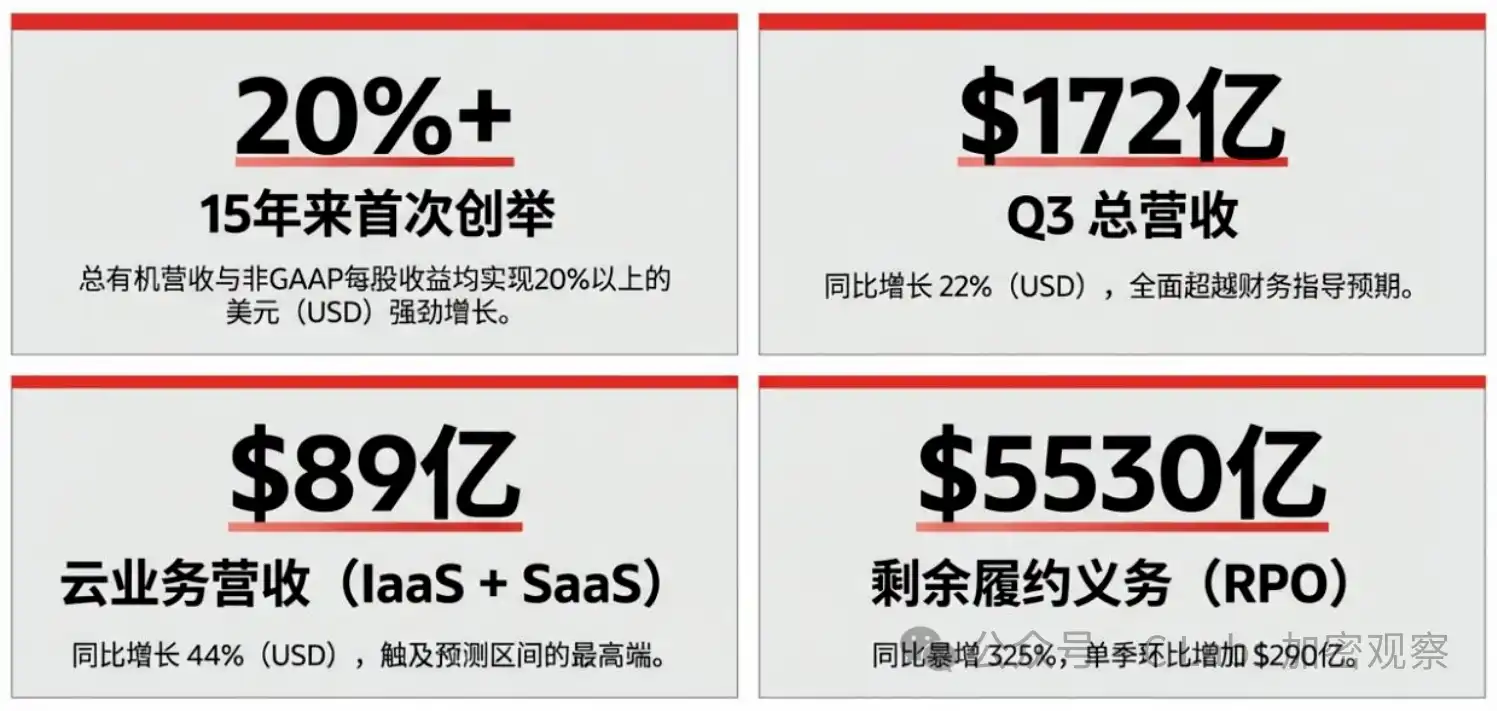
Total revenue reached $17.2 billion, a 22% year-over-year increase. Cloud business grew by 44%. The remaining performance obligation (RPO) surged to $553 billion, up 325% year-over-year. Oracle claimed this was the first time in 15 years that both revenue and profit achieved over 20% growth simultaneously. The stock price rose over 10% in after-hours trading.
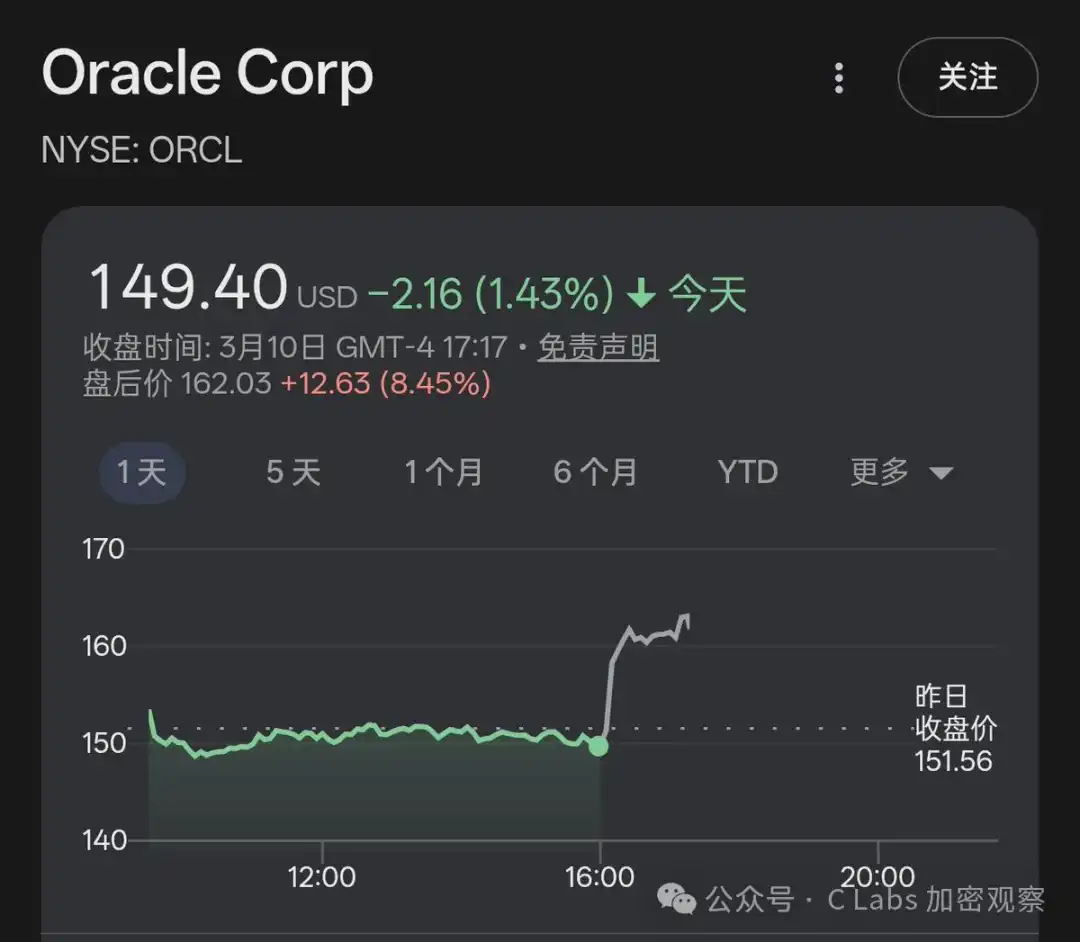
But in the same week, other news was also circulating:

  • Several banks are quietly withdrawing from Oracle's data center projects;

  • A private credit institution refused to finance Oracle's $10 billion data center;

  • Oracle is preparing to lay off tens of thousands of employees.

These two sets of news come from the same company and occurred during the same period.

01. Oracle's Financial Problems
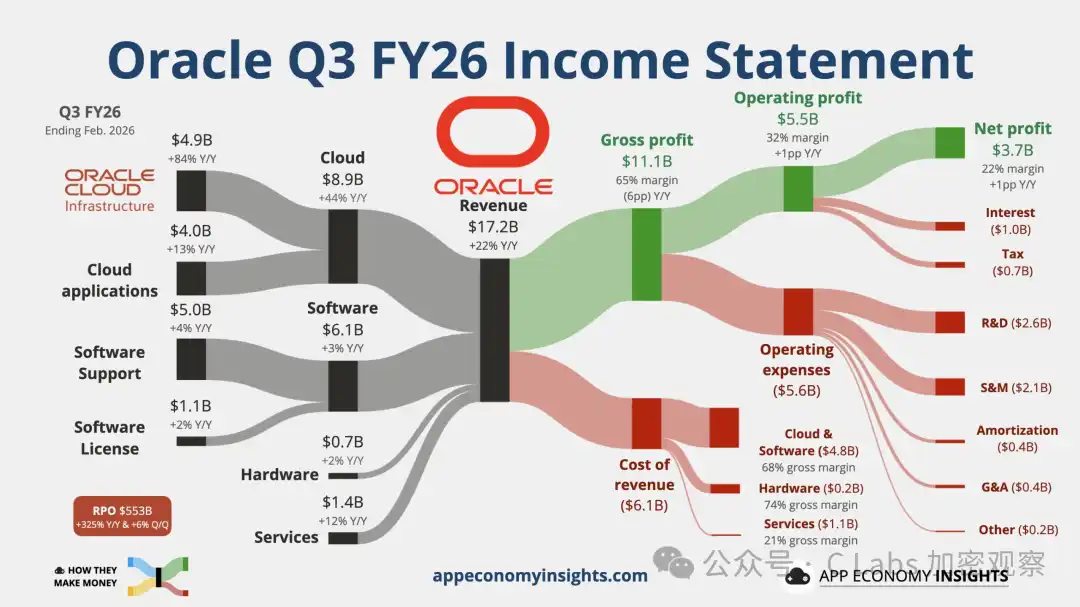
First, free cash flow is negative, and significantly so

Over the past 12 months, Oracle's free cash flow was negative $13.18 billion. Operating cash flow was positive at $23.5 billion, but capital expenditures consumed even more—the full-year capital expenditure guidance for this year is $50 billion, more than seven times that of two years ago. Revenue is growing, but so is accelerating.

Second, debt continues to expand

This quarter, Oracle raised an additional $30 billion through investment-grade bonds and convertible preferred stock, bringing total debt to over $100 billion. Hidden in the footnotes of the earnings report is an even larger number: $248 billion in off-balance-sheet lease commitments. This means Oracle currently owes over $100 billion in loans and has signed long-term leases totaling $248 billion over more than a decade—this money hasn't been paid yet, but it's already owed.

Oracle promised during the earnings call not to issue new debt in the 2026 calendar year. Publicly committing to "not borrowing new money this year"—this speaks volumes: creditors are becoming uneasy, and Oracle had to step in to reassure them.

Third, data centers become obsolete as soon as they're built!

The $553 billion RPO is the most attractive number in the entire earnings report, up 325% year-over-year. But Oracle explained the source of these contracts during the call: most of the equipment is either prepaid by customers or brought by customers themselves for Oracle to operate.
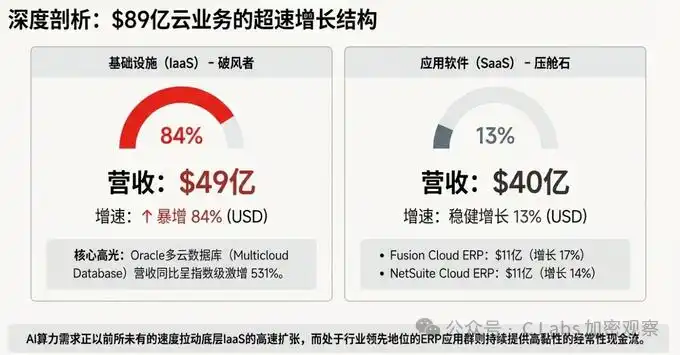
In plain terms: Oracle is increasingly playing the role of an "operator" rather than using its own money to build data centers and then leasing them out. This shift in business model reduces balance sheet pressure but also means Oracle is no longer a capital-intensive, high-margin computing power landlord; instead, it has become a computing power property management company. It's akin to the digital center version of "Wanda Commercial Management." Meanwhile, Oracle's largest customer, OpenAI, has canceled the expansion contract for its Texas data center.
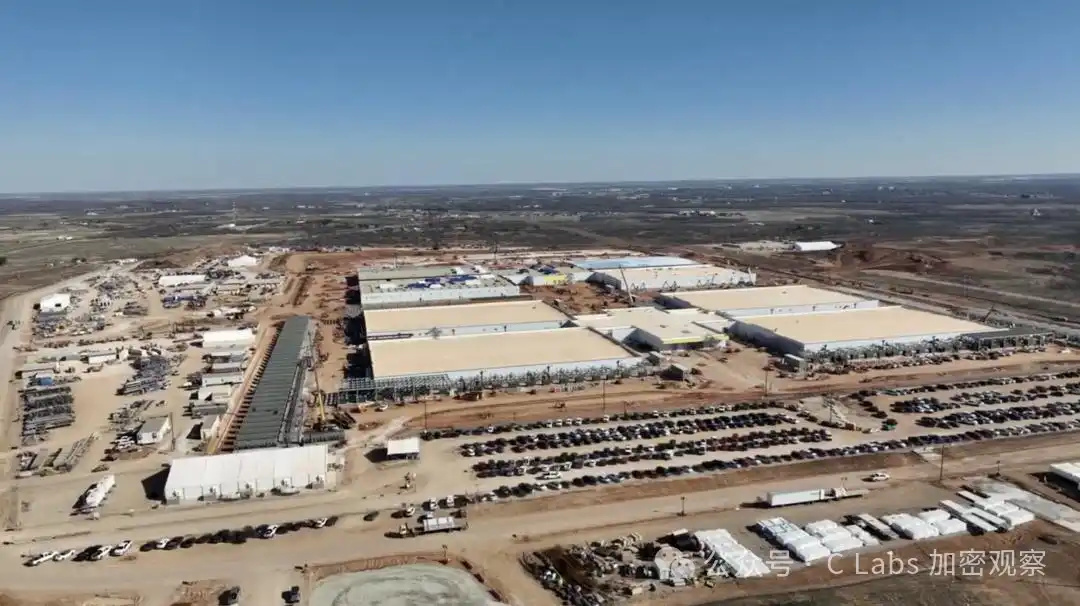
The reason is that Oracle's data centers are equipped with Blackwell chips, while Nvidia's next-generation Vera Rubin offers five times the inference performance of Blackwell. OpenAI doesn't want to be tied to an infrastructure that is about to become outdated. Data center construction cycles take 12 to 24 months, but chip update cycles have been compressed to 12 months by Jensen Huang—building a data center only for it to become obsolete upon completion is a contradiction with no simple solution. This is a significant pitfall for Oracle, which focuses on data center business but does not control chip production.

02. "Replacing Humans with AI": Oracle's Financial Self-Rescue Strategy

How to fill the financial gap? Oracle has found a politically correct answer for the current times: layoffs, justified by AI replacement.

Oracle currently has about 162,000 employees. A TD Cowen research report estimates that Oracle will lay off 30,000 employees, which could free up $8 to $10 billion in free cash flow for Oracle—specifically to fill the funding gap caused by data center expansion.

The logic is very clear: lay off workers and use the saved money to build data centers that run AI.

03. Tech Giants Rushing to Emulate Layoffs

Oracle is not an isolated case. Any tech company that has over-invested in the AI arms race and is under cash flow pressure faces the same bill. "Replacing humans with AI" provides a financially reasonable, narratively legitimate, and shareholder-acceptable way out.

Currently, North American giants like Amazon and Meta are adopting this strategy, and the capital market has welcomed it.

The bill for the AI arms race ultimately has to be paid by someone.

It's just that, once again, it's the employees who are footing the bill.

Related reading: Block Lays Off Nearly Half, Soars 24%! CEO: AI Improves Efficiency, Most Companies Will Make Similar Adjustments in the Next Year


Trend Kriptolar

İlgili Sorular

QWhat were the key financial highlights from Oracle's recent earnings report?

AOracle reported total revenue of $17.2 billion, a 22% year-over-year increase. Its cloud business grew by 44%, and its Remaining Performance Obligations (RPO) surged 325% to $553 billion. The company stated it was the first time in 15 years that both revenue and profit grew by over 20% simultaneously, leading to a more than 10% increase in its stock price after hours.

QWhat major financial challenges does Oracle face despite its strong revenue growth?

AOracle faces significant financial challenges, including negative free cash flow of -$13.18 billion over the past 12 months. Its total debt has exceeded $100 billion, and it has an additional $248 billion in off-balance-sheet lease commitments. Capital expenditures are projected to be $50 billion for the year, which is seven times higher than two years ago.

QWhat is the reported reason behind Oracle's potential plan to lay off 30,000 employees?

AAccording to a TD Cowen research report, Oracle plans to lay off approximately 30,000 employees to free up $8 to $10 billion in free cash flow. This financial strategy, framed as 'AI replacement,' aims to cover the funding gap created by the massive expansion of its data centers.

QHow is Oracle's business model for its data centers changing, as mentioned in the article?

AOracle's business model is shifting from building and renting out its own data centers to acting more as a 'operator' or 'property management' company for compute power. A significant portion of its $553 billion RPO comes from contracts where equipment is either pre-paid by customers or where customers provide their own GPUs for Oracle to operate, reducing pressure on its balance sheet but also transforming it into a lower-margin service provider.

QWhy did OpenAI cancel its data center expansion contract with Oracle in Texas?

AOpenAI canceled its data center expansion contract with Oracle because the facility was equipped with Blackwell chips. Nvidia's next-generation Vera Rubin chips, which offer five times the inference performance of Blackwell, made OpenAI reluctant to be locked into an infrastructure that would soon become outdated, highlighting the rapid pace of chip innovation in the AI industry.

İlgili Okumalar

Will the Fed Definitely Raise Interest Rates in September? How Will Crypto and U.S. Stocks Withstand the Pressure?

The market's expectation for a September Fed rate hike surged dramatically in early August, jumping from under 50% to over 80% within a week. This shift followed a contentious July FOMC meeting, where a 9-3 vote to hold rates revealed growing dissent from hawkish members advocating for an immediate hike to combat persistent inflation. The primary catalyst for this repricing is rising oil prices, driven by renewed geopolitical tensions around the Strait of Hormuz, which threaten global supply. Energy costs directly influence inflation metrics, making the upcoming July CPI report (due August 12th) a critical data point. If it shows inflation reaccelerating, the probability of a September hike will solidify. For Bitcoin and crypto assets, this is typically bearish news. Bitcoin continues to behave as a high-beta, liquidity-sensitive risk asset. A rate hike raises the opportunity cost of holding non-yielding assets and could drive capital toward money markets, pressuring crypto prices in the short term. However, historical patterns suggest that if a hike is perceived as the end of a tightening cycle rather than the start, any negative price impact may be brief. U.S. stocks, particularly crypto-linked equities like Coinbase and growth-oriented tech stocks, are also vulnerable. Higher rates increase discount rates in valuation models, putting pressure on high-multiple companies. This coincides with a pivotal tech earnings season where investor focus has shifted from massive AI capital expenditure to tangible revenue and cash flow generation. Companies with negative cash flow and weak growth narratives could face heightened volatility if borrowing costs rise in September. In summary, a September Fed hike has evolved into a mainstream market scenario. Key factors to watch are oil prices, the July CPI report, and Fed communications, which will determine the final decision and its impact on volatile crypto and equity markets.

marsbit10 dk önce

Will the Fed Definitely Raise Interest Rates in September? How Will Crypto and U.S. Stocks Withstand the Pressure?

marsbit10 dk önce

A 'Overlooked' Market Event: Joint US-Japan-South Korea Intervention, Rare US Treasury Involvement, and Bessent's Quiet 'Market Rescue'?

Summary: The United States, Japan, and South Korea executed their largest coordinated foreign exchange intervention in nearly 30 years. The action targeted depreciation pressure on the Japanese yen and South Korean won. This move is seen as a significant effort by the US to stabilize the financial markets of its key allies and prevent the spillover of risks. Key details: * Japan reportedly intervened on July 30 using approximately 8.45 trillion yen (about $52.8 billion). South Korean authorities also intervened that day, selling dollars to support the won. * Notably, the US Treasury Department intervened directly in yen markets for the first time in roughly 30 years. The New York Fed, reportedly acting on behalf of the Treasury, sold euros to buy yen via Goldman Sachs and Morgan Stanley on July 31. Analysts view the use of the euro-yen pair as a way to alleviate yen pressure without adding selling pressure to the US dollar. * Prior to the action, the New York Fed conducted "rate checks" on both USD/JPY and EUR/JPY, a newer signaling tool that falls between verbal and physical intervention. The intervention is interpreted as going beyond traditional currency stabilization. Analysts, such as Michael Hartnett of Bank of America, suggest it resembles a "Price Keeping Operation" for the AI era. The core US objectives are perceived to be: 1. Preventing rapid yen depreciation from triggering a sharp rise in Japanese government bond yields. 2. Containing financial stress from spreading across Asian markets like South Korea and Japan. 3. Reducing the risk of disorderly capital flows impacting the US bond market. This coordinated action underscores the importance of Japan and South Korea as critical partners in the US semiconductor and AI supply chain. Stabilizing their financial markets is seen as vital to mitigating risks to the broader tech industry and the US market itself. The intervention coincides with market pressures, including the KOSDAQ index hitting a low since October 2022. While seen as a move to control volatility, some analysts caution it may not fundamentally reverse existing market trends.

marsbit14 dk önce

A 'Overlooked' Market Event: Joint US-Japan-South Korea Intervention, Rare US Treasury Involvement, and Bessent's Quiet 'Market Rescue'?

marsbit14 dk önce

Will the Federal Reserve Definitely Raise Interest Rates in September? How Will Cryptocurrencies and US Stocks Bear the Pressure?

In early August 2024, market expectations for a September Federal Reserve rate hike surged dramatically, from below 50% to over 80%, driven by renewed inflation concerns. This shift followed a contentious July FOMC meeting where a 9-3 vote to hold rates revealed a growing hawkish faction advocating for an immediate hike, citing prolonged above-target inflation. The key catalyst is escalating conflict near the Strait of Hormuz, which has pushed oil prices up approximately 20% in July, threatening to reignite inflation. The next critical data point is the July CPI report on August 12th; a hot reading could solidify hike expectations. For crypto assets, particularly Bitcoin, this represents near-term pressure. Bitcoin continues to exhibit high-beta, risk-on characteristics, making it sensitive to tightening liquidity and higher opportunity costs. However, historical precedent suggests that if a hike is perceived as the cycle's end rather than its start, the negative impact may be brief, with markets quickly pivoting to anticipate future rate cuts. U.S. stocks, especially crypto-linked equities like Coinbase and high-valuation tech stocks, face amplified volatility. Higher rates increase discount rates in valuation models, pressuring growth stocks. This coincides with a pivotal tech earnings season where investor focus has shifted from massive AI capital expenditures to demonstrable revenue and cash flow generation. Companies with negative cash flows and weak growth narratives could see severe pressure if a September hike materializes, as financing costs would rise. Key indicators to watch include oil prices, upcoming inflation data, and Fed commentary at events like the Jackson Hole symposium.

Odaily星球日报14 dk önce

Will the Federal Reserve Definitely Raise Interest Rates in September? How Will Cryptocurrencies and US Stocks Bear the Pressure?

Odaily星球日报14 dk önce

İşlemler

Spot

Popüler Makaleler

MOVE Nasıl Satın Alınır

HTX.com’a hoş geldiniz! Movement (MOVE) satın alma işlemlerini basit ve kullanışlı bir hâle getirdik. Adım adım açıkladığımız rehberimizi takip ederek kripto yolculuğunuza başlayın. 1. Adım: HTX Hesabınızı OluşturunHTX'te ücretsiz bir hesap açmak için e-posta adresinizi veya telefon numaranızı kullanın. Sorunsuzca kaydolun ve tüm özelliklerin kilidini açın. Hesabımı Aç2. Adım: Kripto Satın Al Bölümüne Gidin ve Ödeme Yönteminizi SeçinKredi/Banka Kartı: Visa veya Mastercard'ınızı kullanarak anında Movement (MOVE) satın alın.Bakiye: Sorunsuz bir şekilde işlem yapmak için HTX hesap bakiyenizdeki fonları kullanın.Üçüncü Taraflar: Kullanımı kolaylaştırmak için Google Pay ve Apple Pay gibi popüler ödeme yöntemlerini ekledik.P2P: HTX'teki diğer kullanıcılarla doğrudan işlem yapın.Borsa Dışı (OTC): Yatırımcılar için kişiye özel hizmetler ve rekabetçi döviz kurları sunuyoruz.3. Adım: Movement (MOVE) Varlıklarınızı SaklayınMovement (MOVE) satın aldıktan sonra HTX hesabınızda saklayın. Alternatif olarak, blok zinciri transferi yoluyla başka bir yere gönderebilir veya diğer kripto para birimlerini takas etmek için kullanabilirsiniz.4. Adım: Movement (MOVE) Varlıklarınızla İşlem YapınHTX'in spot piyasasında Movement (MOVE) ile kolayca işlemler yapın.Hesabınıza erişin, işlem çiftinizi seçin, işlemlerinizi gerçekleştirin ve gerçek zamanlı olarak izleyin. Hem yeni başlayanlar hem de deneyimli yatırımcılar için kullanıcı dostu bir deneyim sunuyoruz.

402 Toplam GörüntülenmeYayınlanma 2024.12.13Güncellenme 2026.06.02

MOVE Nasıl Satın Alınır

Tartışmalar

HTX Topluluğuna hoş geldiniz. Burada, en son platform gelişmeleri hakkında bilgi sahibi olabilir ve profesyonel piyasa görüşlerine erişebilirsiniz. Kullanıcıların MOVE (MOVE) fiyatı hakkındaki görüşleri aşağıda sunulmaktadır.

活动图片