Strongest Earnings Report in 15 Years Fails to Mask Trillion-Dollar Debt; Oracle Rumored to Lay Off 30,000 in 'AI Replacement' Move—Can It Fill the Computing Power Pit?

marsbit2026-03-11 tarihinde yayınlandı2026-03-11 tarihinde güncellendi

Özet

Oracle reported its strongest financial results in 15 years, with Q3 revenue reaching $17.2 billion, a 22% year-over-year increase, and cloud revenue surging 44%. The company's remaining performance obligations (RPO) grew 325% to $553 billion. Despite these gains, Oracle faces significant financial challenges, including negative free cash flow of -$13.18 billion over the past 12 months and total debt exceeding $100 billion, with an additional $248 billion in off-balance-sheet lease commitments. To fund its aggressive data center expansion—with capital expenditures projected to reach $50 billion this year—Oracle is reportedly planning to lay off up to 30,000 employees. Analysts estimate these cuts could save the company $8–10 billion in free cash flow. The shift toward an asset-light “AI infrastructure management” model, where clients prepay or supply their own GPUs, reduces balance sheet pressure but also transforms Oracle into a lower-margin service operator. Competitive pressures are mounting: key clients like OpenAI have canceled expansion plans due to rapid chip obsolescence, as NVIDIA’s new Vera Rubin chips offer significantly better performance. This reflects a broader industry trend where tech giants are cutting jobs to fund AI investments, transferring the cost of technological advancement onto their workforce.

Author: C Labs Crypto Watch

Today (March 10), Oracle released an earnings report that drew applause from Wall Street.
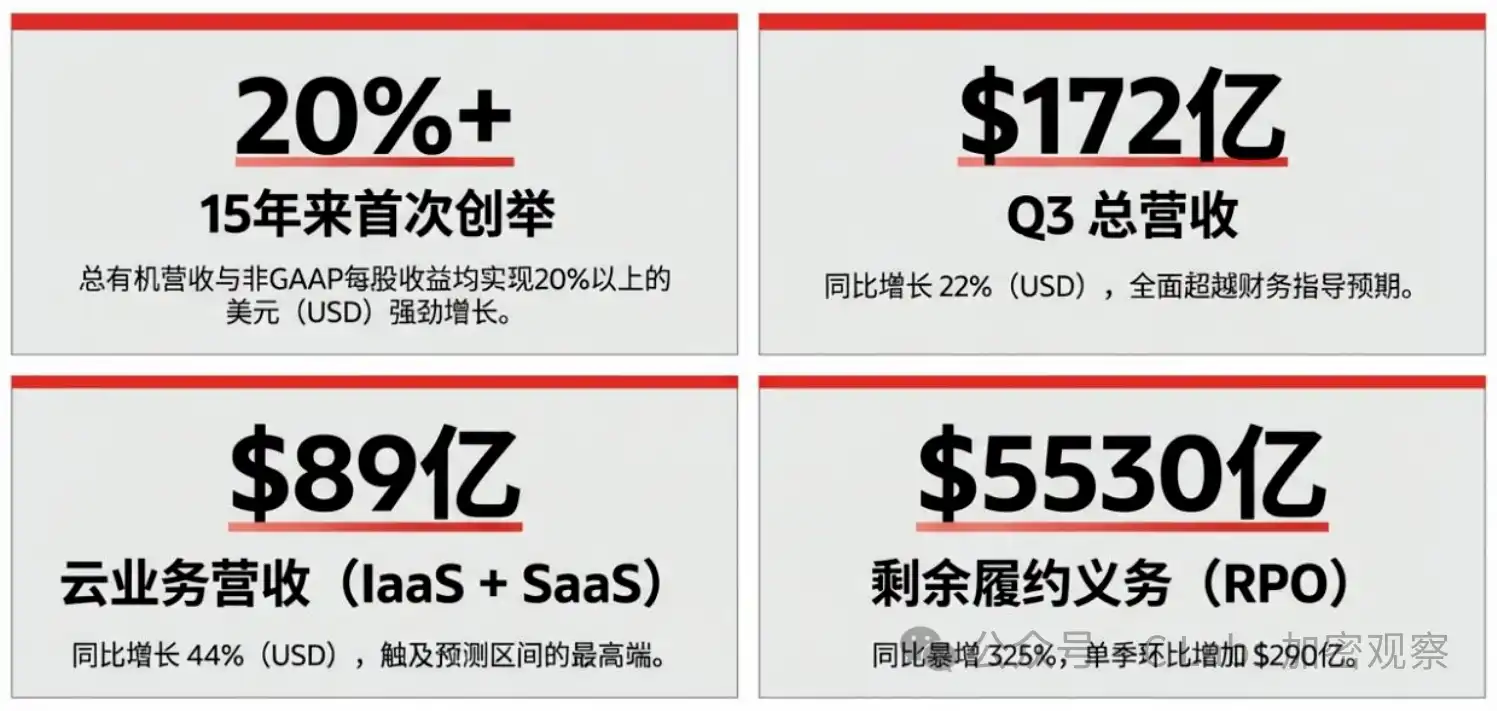
Total revenue reached $17.2 billion, a 22% year-over-year increase. Cloud business grew by 44%. The remaining performance obligation (RPO) surged to $553 billion, up 325% year-over-year. Oracle claimed this was the first time in 15 years that both revenue and profit achieved over 20% growth simultaneously. The stock price rose over 10% in after-hours trading.
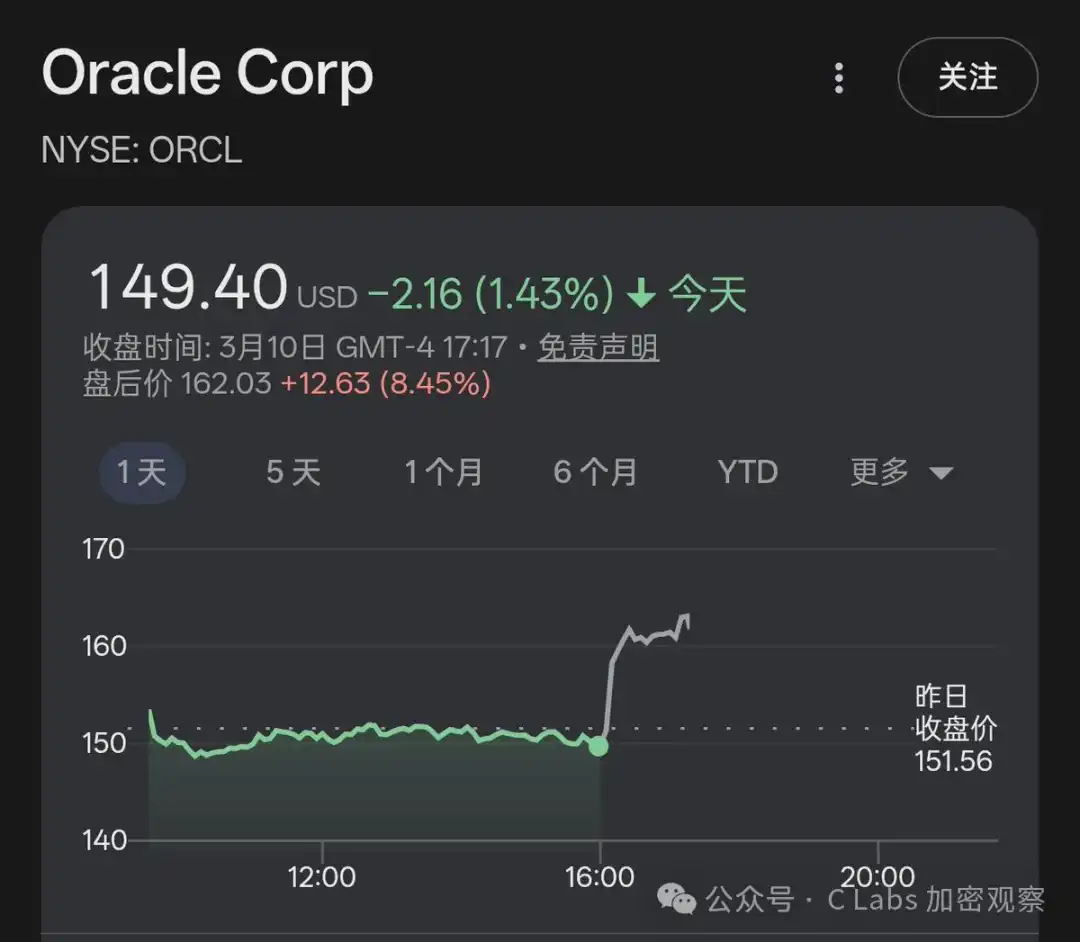
But in the same week, other news was also circulating:

  • Several banks are quietly withdrawing from Oracle's data center projects;

  • A private credit institution refused to finance Oracle's $10 billion data center;

  • Oracle is preparing to lay off tens of thousands of employees.

These two sets of news come from the same company and occurred during the same period.

01. Oracle's Financial Problems
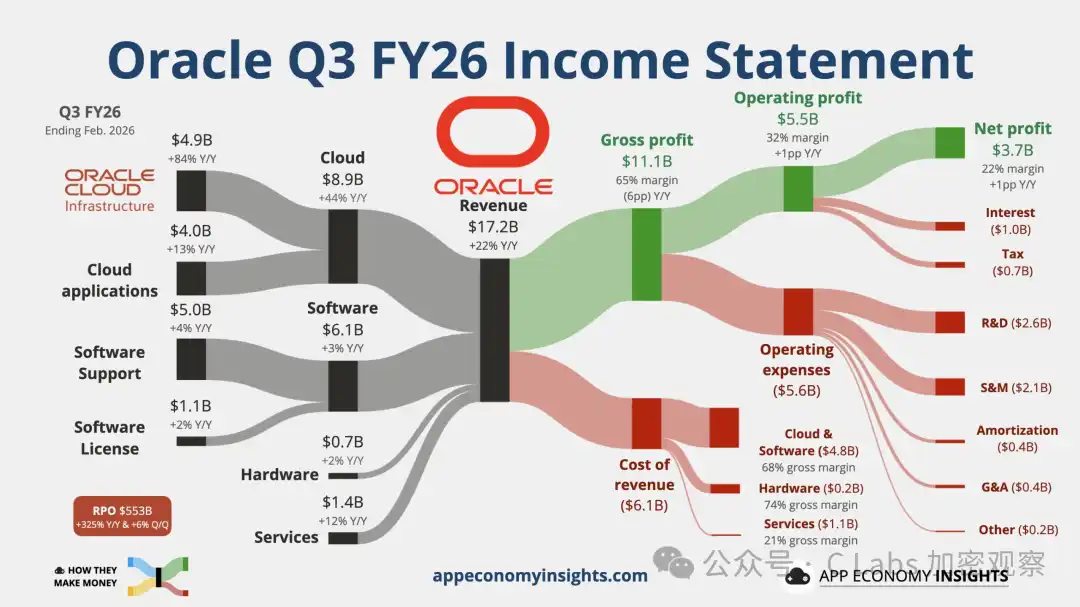
First, free cash flow is negative, and significantly so

Over the past 12 months, Oracle's free cash flow was negative $13.18 billion. Operating cash flow was positive at $23.5 billion, but capital expenditures consumed even more—the full-year capital expenditure guidance for this year is $50 billion, more than seven times that of two years ago. Revenue is growing, but so is accelerating.

Second, debt continues to expand

This quarter, Oracle raised an additional $30 billion through investment-grade bonds and convertible preferred stock, bringing total debt to over $100 billion. Hidden in the footnotes of the earnings report is an even larger number: $248 billion in off-balance-sheet lease commitments. This means Oracle currently owes over $100 billion in loans and has signed long-term leases totaling $248 billion over more than a decade—this money hasn't been paid yet, but it's already owed.
Oracle promised during the earnings call not to issue new debt in the 2026 calendar year. Publicly committing to "not borrowing new money this year"—this speaks volumes: creditors are becoming uneasy, and Oracle had to step in to reassure them.

Third, data centers become obsolete as soon as they're built!

The $553 billion RPO is the most attractive number in the entire earnings report, up 325% year-over-year. But Oracle explained the source of these contracts during the call: most of the equipment is either prepaid by customers or brought by customers themselves for Oracle to operate.
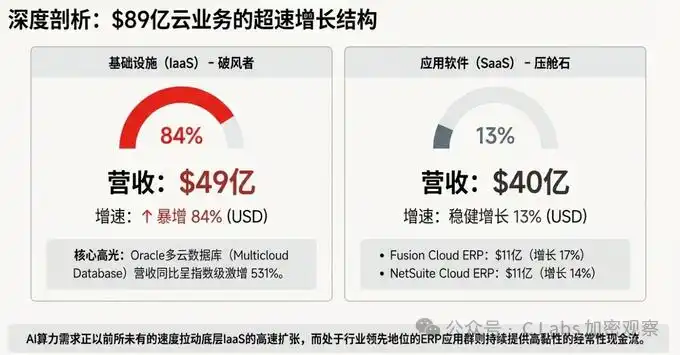
In plain terms: Oracle is increasingly playing the role of an "operator" rather than using its own money to build data centers and then leasing them out. This shift in business model reduces balance sheet pressure but also means Oracle is no longer a capital-intensive, high-margin computing power landlord; instead, it has become a computing power property management company. It's akin to the digital center version of "Wanda Commercial Management." Meanwhile, Oracle's largest customer, OpenAI, has canceled the expansion contract for its Texas data center.
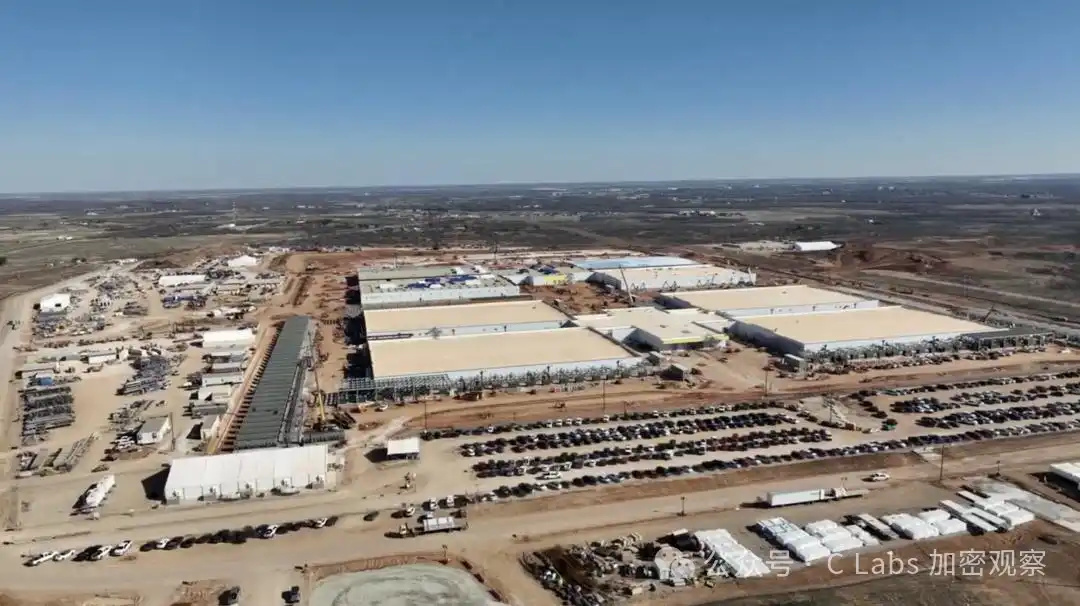
The reason is that Oracle's data centers are equipped with Blackwell chips, while Nvidia's next-generation Vera Rubin offers five times the inference performance of Blackwell. OpenAI doesn't want to be tied to an infrastructure that is about to become outdated. Data center construction cycles take 12 to 24 months, but chip update cycles have been compressed to 12 months by Jensen Huang—building a data center only for it to become obsolete upon completion is a contradiction with no simple solution. This is a significant pitfall for Oracle, which focuses on data center business but does not control chip production.

02. "Replacing Humans with AI": Oracle's Financial Self-Rescue Strategy

How to fill the financial gap? Oracle has found a politically correct answer for the current times: layoffs, justified by AI replacement.

Oracle currently has about 162,000 employees. A TD Cowen research report estimates that Oracle will lay off 30,000 employees, which could free up $8 to $10 billion in free cash flow for Oracle—specifically to fill the funding gap caused by data center expansion.

The logic is very clear: lay off workers and use the saved money to build data centers that run AI.

03. Tech Giants Rushing to Emulate Layoffs

Oracle is not an isolated case. Any tech company that has over-invested in the AI arms race and is under cash flow pressure faces the same bill. "Replacing humans with AI" provides a financially reasonable, narratively legitimate, and shareholder-acceptable way out.

Currently, North American giants like Amazon and Meta are adopting this strategy, and the capital market has welcomed it.

The bill for the AI arms race ultimately has to be paid by someone.

It's just that, once again, it's the employees who are footing the bill.

Related reading: Block Lays Off Nearly Half, Soars 24%! CEO: AI Improves Efficiency, Most Companies Will Make Similar Adjustments in the Next Year


İlgili Sorular

QWhat were the key financial highlights from Oracle's recent earnings report?

AOracle reported total revenue of $17.2 billion, a 22% year-over-year increase. Its cloud business grew by 44%, and its Remaining Performance Obligations (RPO) surged 325% to $553 billion. The company stated it was the first time in 15 years that both revenue and profit grew by over 20% simultaneously, leading to a more than 10% increase in its stock price after hours.

QWhat major financial challenges does Oracle face despite its strong revenue growth?

AOracle faces significant financial challenges, including negative free cash flow of -$13.18 billion over the past 12 months. Its total debt has exceeded $100 billion, and it has an additional $248 billion in off-balance-sheet lease commitments. Capital expenditures are projected to be $50 billion for the year, which is seven times higher than two years ago.

QWhat is the reported reason behind Oracle's potential plan to lay off 30,000 employees?

AAccording to a TD Cowen research report, Oracle plans to lay off approximately 30,000 employees to free up $8 to $10 billion in free cash flow. This financial strategy, framed as 'AI replacement,' aims to cover the funding gap created by the massive expansion of its data centers.

QHow is Oracle's business model for its data centers changing, as mentioned in the article?

AOracle's business model is shifting from building and renting out its own data centers to acting more as a 'operator' or 'property management' company for compute power. A significant portion of its $553 billion RPO comes from contracts where equipment is either pre-paid by customers or where customers provide their own GPUs for Oracle to operate, reducing pressure on its balance sheet but also transforming it into a lower-margin service provider.

QWhy did OpenAI cancel its data center expansion contract with Oracle in Texas?

AOpenAI canceled its data center expansion contract with Oracle because the facility was equipped with Blackwell chips. Nvidia's next-generation Vera Rubin chips, which offer five times the inference performance of Blackwell, made OpenAI reluctant to be locked into an infrastructure that would soon become outdated, highlighting the rapid pace of chip innovation in the AI industry.

İlgili Okumalar

What's the Connection Between Pinduoduo's Huang Zheng and Blockchain?

This text explores the unexpected connection between Pinduoduo founder Colin Huang and blockchain, as suggested in his article *Turning Capitalism Upside Down*. Huang argues Pinduoduo's core business is about managing "uncertainty." He posits that wealth flows to the rich because they absorb life's uncertainties (e.g., illness, job loss) that devastate the poor, who pay a premium for certainty through insurance or stable prices. Pinduoduo's model attempts a "reverse insurance": by aggregating consumer demand via group-buying and flash sales, it creates a large, predictable order for manufacturers. This certainty allows factories to remove risk premiums, passing savings back as lower prices, thus partially reversing the wealth flow. The key obstacle, Huang notes, is that an individual's buying intent is an unreliable promise. He then asks if blockchain is the natural solution for this "reverse insurance." The text elaborates that blockchain, through smart contracts with binding deposits, could transform casual intent into a costly-to-break, enforceable commitment. This replaces interpersonal trust with coded rules, making promises credible, pricable, and resistant to fraud. Finally, the author draws a parallel to Bitcoin, framing two paths to creating certainty: the "Pinduoduo path" of aggregating decentralized will into scale, and the "Bitcoin path" of locking rules into immutable code. Both sacrifice something—personal freedom or system flexibility—to manufacture trust and predictability.

链捕手40 dk önce

What's the Connection Between Pinduoduo's Huang Zheng and Blockchain?

链捕手40 dk önce

The Storage Magnate Who Conquered a Trillion-Dollar Kingdom, Yet Ultimately Could Not Become the Richest

**Summary:** "The Memory Magnate Who Built a Trillion-Dollar Empire, Yet Never Became the Richest" explores the journey of Zhu Yiming, founder of GigaDevice (603986) and co-founder of the soon-to-IPO ChangXin Memory Technologies (CXMT). The article positions GigaDevice, a fabless chip designer now valued at ~¥340 billion, as a prequel to the massive IDM (Integrated Device Manufacturer) venture, CXMT. Starting in 2005 with minimal capital, Zhu strategically "picked up the pieces" by focusing on niche markets like NOR Flash and microcontrollers (MCUs), areas major players were exiting. This allowed GigaDevice to grow into a diversified semiconductor company, maintaining robust profitability even during industry downturns by controlling costs. However, the piece argues that in the highly cyclical and capital-intensive memory chip industry, the fabless model has limits. True resilience and scale require the ability for "counter-cyclical expansion" – investing heavily during downturns – a tactic only possible for IDMs like Samsung or SK Hynix. This insight led Zhu to partner with the Hefei city government in 2016 to establish CXMT, an IDM focused on DRAM. Zhu's symbolic moves, like forfeiting salary and diluting his equity, were crucial in securing the massive state and bank funding needed. CXMT's equipment base is now valued even higher than that of BYD's vast auto manufacturing empire. Despite the potential for CXMT to reach a market cap of ¥1-2 trillion upon its IPO, Zhu's indirect stake in both companies is estimated below 3%, placing his personal wealth far below that of China's top billionaires. The article concludes that his strategic vision built a trillion-yuan memory landscape, but the capital structure necessary to achieve it precluded a personal fortune of similar scale.

marsbit47 dk önce

The Storage Magnate Who Conquered a Trillion-Dollar Kingdom, Yet Ultimately Could Not Become the Richest

marsbit47 dk önce

XRP Ledger Daily Fees Drop Below $400 As Network Activity Question Returns

The XRP Ledger is drawing attention as daily network fees have fallen below $400. While low fees align with XRPL's design for affordable transactions and are often seen as a strength, the metric can also serve as an indicator of network demand and paid transaction volume. This data point of around $3,100 in weekly fee burn highlights the stark contrast with higher-fee chains like Ethereum and Bitcoin. The development fuels an ongoing debate. Proponents view low fees as a sign of efficiency and accessibility, while critics may question if the network is generating sufficient high-value activity relative to its market cap and payments-focused narrative. The article cautions against overstating the finding, noting a single low-fee day does not signify network failure. It instead adds context to discussions about XRPL's usage, especially alongside Ripple's broader initiatives in stablecoins (RLUSD), AI payments, and enterprise infrastructure. The report recommends monitoring for a fee rebound, checking transaction counts for a fuller picture, and confirming the trend via native explorers like Bithomp. It frames the story within a larger market shift where on-chain data, protocol updates, and infrastructure developments are becoming crucial alongside price action. The editorial stance is to present the verified data, explain its significance for assessing network activity, and avoid hype, positioning it as part of the daily crypto conversation.

bitcoinist5 saat önce

XRP Ledger Daily Fees Drop Below $400 As Network Activity Question Returns

bitcoinist5 saat önce

İşlemler

Spot
Futures

Popüler Makaleler

MOVE Nasıl Satın Alınır

HTX.com’a hoş geldiniz! Movement (MOVE) satın alma işlemlerini basit ve kullanışlı bir hâle getirdik. Adım adım açıkladığımız rehberimizi takip ederek kripto yolculuğunuza başlayın. 1. Adım: HTX Hesabınızı OluşturunHTX'te ücretsiz bir hesap açmak için e-posta adresinizi veya telefon numaranızı kullanın. Sorunsuzca kaydolun ve tüm özelliklerin kilidini açın. Hesabımı Aç2. Adım: Kripto Satın Al Bölümüne Gidin ve Ödeme Yönteminizi SeçinKredi/Banka Kartı: Visa veya Mastercard'ınızı kullanarak anında Movement (MOVE) satın alın.Bakiye: Sorunsuz bir şekilde işlem yapmak için HTX hesap bakiyenizdeki fonları kullanın.Üçüncü Taraflar: Kullanımı kolaylaştırmak için Google Pay ve Apple Pay gibi popüler ödeme yöntemlerini ekledik.P2P: HTX'teki diğer kullanıcılarla doğrudan işlem yapın.Borsa Dışı (OTC): Yatırımcılar için kişiye özel hizmetler ve rekabetçi döviz kurları sunuyoruz.3. Adım: Movement (MOVE) Varlıklarınızı SaklayınMovement (MOVE) satın aldıktan sonra HTX hesabınızda saklayın. Alternatif olarak, blok zinciri transferi yoluyla başka bir yere gönderebilir veya diğer kripto para birimlerini takas etmek için kullanabilirsiniz.4. Adım: Movement (MOVE) Varlıklarınızla İşlem YapınHTX'in spot piyasasında Movement (MOVE) ile kolayca işlemler yapın.Hesabınıza erişin, işlem çiftinizi seçin, işlemlerinizi gerçekleştirin ve gerçek zamanlı olarak izleyin. Hem yeni başlayanlar hem de deneyimli yatırımcılar için kullanıcı dostu bir deneyim sunuyoruz.

288 Toplam GörüntülenmeYayınlanma 2024.12.13Güncellenme 2026.06.02

MOVE Nasıl Satın Alınır

Tartışmalar

HTX Topluluğuna hoş geldiniz. Burada, en son platform gelişmeleri hakkında bilgi sahibi olabilir ve profesyonel piyasa görüşlerine erişebilirsiniz. Kullanıcıların MOVE (MOVE) fiyatı hakkındaki görüşleri aşağıda sunulmaktadır.

活动图片












