STRC Must Re-Anchor for a BTC Bull Market to Happen

marsbit2026-06-26 tarihinde yayınlandı2026-06-26 tarihinde güncellendi

Özet

Title: STRC's Depegging Threatens MicroStrategy's Bitcoin-Buying Machine, and Thus the BTC Bull Run Summary: The sustained depegging of MicroStrategy's priority share STRC (trading ~25% below its $100 target) is severely disrupting the company's core business model and poses a major risk to Bitcoin (BTC) price support. STRC was MicroStrategy's most efficient and low-cost funding tool, designed to allow continuous capital raises near its $100 par value to fuel relentless BTC accumulation. Its depegging has effectively blocked this primary funding channel. The situation creates a severe cash flow crisis. STRC and other priority shares now obligate MicroStrategy to pay approximately $1.7 billion in annual cash dividends, while the company's cash reserves are only about $1.4 billion — insufficient to cover one year of payments. To raise cash, MicroStrategy is increasingly resorting to issuing common stock (MSTR) through ATM offerings. However, recent raises show most proceeds (around 90% in one week) are now used to bolster cash reserves rather than buy Bitcoin. This dilutes the key metric of Bitcoin per MSTR share, eroding the fundamental value proposition for equity investors. The company faces grim alternatives: issuing high-cost debt or selling its massive Bitcoin holdings. The latter, though hinted at, would likely trigger significant negative market reactions. Conclusion: As BTC's largest corporate holder and a major marginal buyer, MicroStrategy's funding woes mean ...

Author|Azuma(@azuma_eth)

The "de-anchoring" of Strategy's preferred stock STRC continues to intensify.

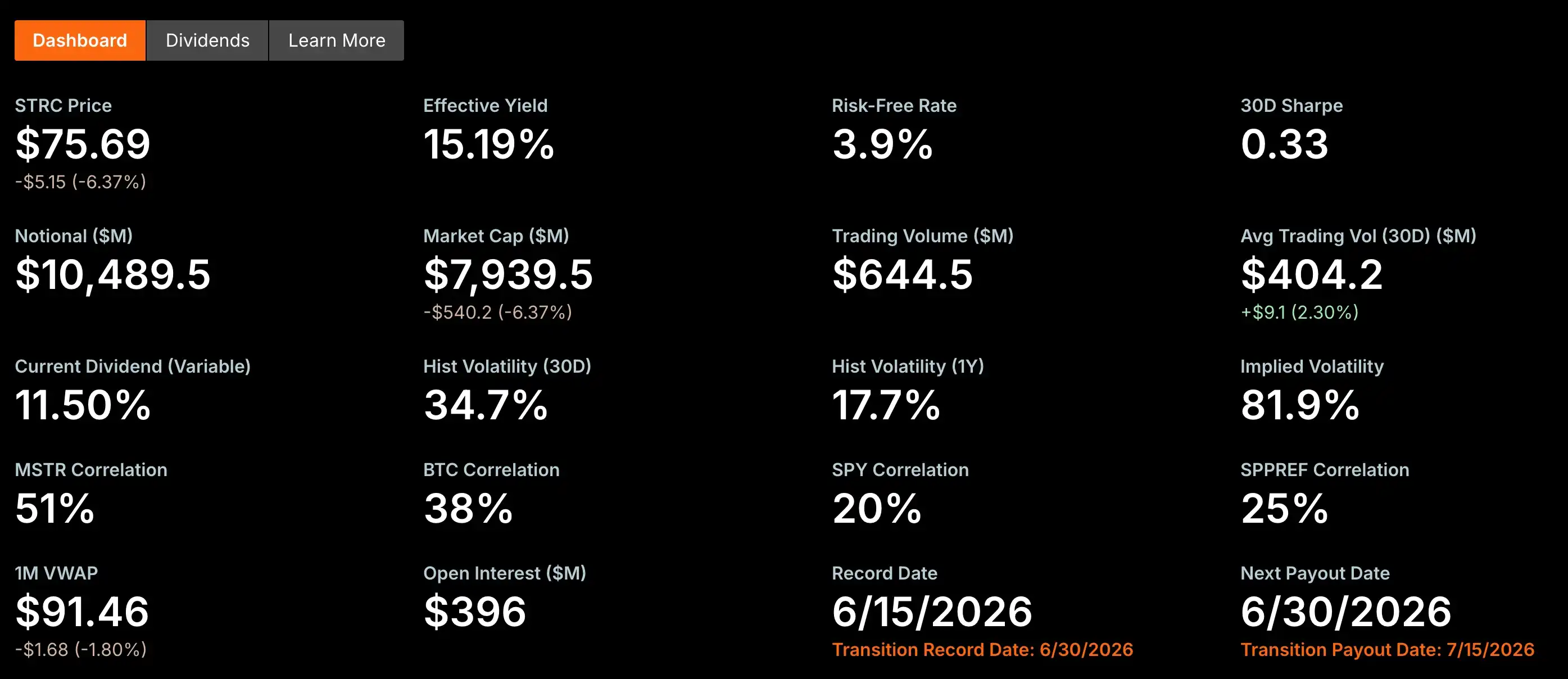
During yesterday's U.S. stock market session, STRC fell below the 80 mark for the first time, touching a low of $73.62 at one point. Although it rebounded slightly by the close, the price remained at only $75.69, nearly 25% "de-anchored" from its target face value of $100.

Last week, we wrote an article titled "STRC De-anchored by 11%, Can Strategy's Perpetual Motion Machine Keep Running?" focusing on the reasons for STRC's de-anchoring and briefly outlining its potential future impacts.

However, judging from community discussions, it seems many readers still do not fully grasp just how dire the consequences of STRC's persistent de-anchoring are, so we decided to write another article to break down this issue.

Strategy's Most Important Fundraising Channel Has Failed

What exactly is STRC? In a nutshell, it is Strategy's cheapest and most efficient fundraising channel.

The essence of Strategy's business model is to continuously raise funds from the market to acquire more BTC, then raise more funds and acquire even more BTC. This is a cycle that must keep turning. Strategy's high valuation is largely based on the market's belief in its ability to persistently raise funds and buy BTC. As long as its fundraising capability remains, it can keep expanding its BTC holdings; and the ever-growing BTC holdings, in turn, further support the market's expectations for its future fundraising ability.

Over the past few years, Strategy has tried almost every fundraising method—issuing common stock, convertible bonds, and various types of preferred stock—and continuously invested the raised funds into BTC. Among all its fundraising tools, STRC was once considered by the market as the one closest to "perfect," and is Michael Saylor's proudest creation. Saylor once boasted, "STRC is a product designed by AI, humans couldn't have designed this."

As a preferred stock, STRC's advantages are very clear. Issuing common stock could dilute existing shareholders' equity; issuing convertible bonds means the company bears future debt repayment pressure; but STRC, as a perpetual preferred stock, has no maturity date, does not dilute common shareholders, and only requires fixed dividend payments. For Strategy and Saylor, this was almost the lowest-cost, highest-efficiency fundraising method.

From its inception, STRC was designed as a product anchored to $100. Strategy envisioned that by dynamically adjusting its dividend yield, STRC would trade long-term around $100 (sound familiar, like algorithmic stablecoins?). As long as the secondary market could maintain this price, the company could continuously issue new STRC at prices close to face value, raise new funds, and continue buying Bitcoin.

In other words, STRC's core value lies in its endless fundraising ability, but this ability is predicated on its price remaining near the target face value. As STRC continues to de-anchor, this fundraising channel is effectively blocked. Because for any investor, if buying the same STRC in the secondary market only costs $75, there is no incentive to participate in the company's new preferred stock issuance at a price close to $100.

For Strategy, the options are either to keep raising the dividend yield to attract funds (which has proven to have limited appeal) or to accept the reduced fundraising efficiency from discounted issuance (which actively breaks the original target face value). Either way, it means this fundraising machine is developing increasingly significant friction.

The Fundraising Tool Has Become a Cash Flow Burden

If it were just a temporary failure of fundraising ability, it might be manageable. The bigger problem is that STRC requires Strategy to make continuous, substantial cash dividend payments.

According to Strategy's latest official disclosure, the current issuance size of STRC is approximately $10.49 billion, with a current dividend yield of 11.5%. This means that for STRC alone, Strategy has an annual cash dividend payment obligation exceeding $1.2 billion. Adding other preferred stocks like STRD, STRK, STRF issued by Strategy, this figure climbs to about $1.7 billion.
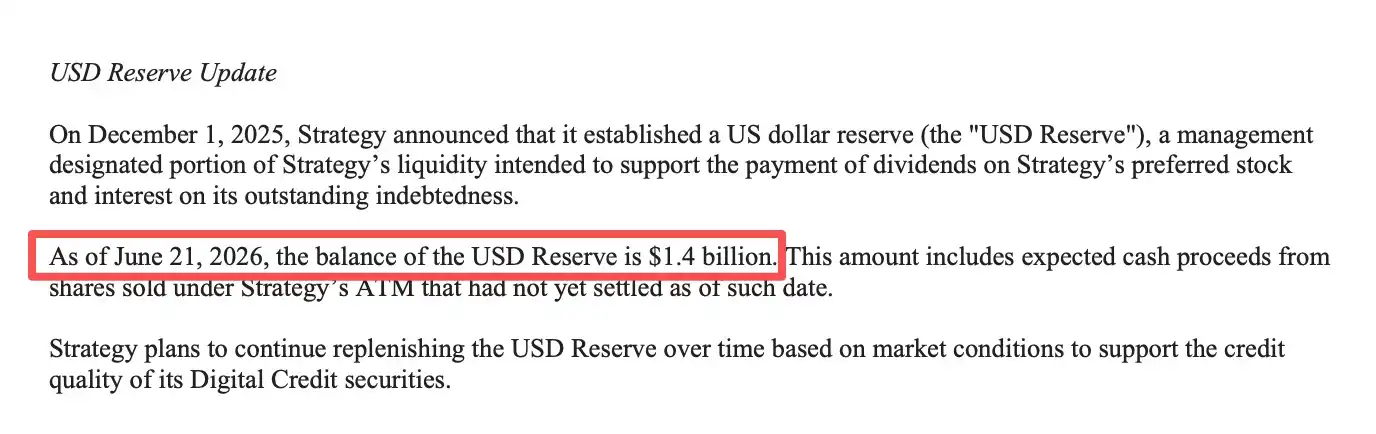
In the common stock issuance filing on June 21st (note: common stock, details below), Strategy disclosed that its cash reserves are approximately $1.4 billion. At this cash reserve level, Strategy's on-book cash can cover less than one year of preferred stock dividend payments.
Resolving the Situation Requires Money, But Where Will It Come From?

Whether to sustain its own business model or to escape its current severe cash flow situation and avoid dividend payment default (the more urgent issue), Strategy needs more money. Theoretically, Strategy now has only three viable paths to "get money."

First, issuing common stock.

This is currently the most direct and mature financing method. Through its ATM (At-the-Market Offering) program, Strategy can continuously sell MSTR common shares to the market to raise funds.

But common stock financing is not without cost. Continuous issuance means the number of outstanding shares keeps increasing. If the growth rate of BTC purchased with newly raised funds cannot outpace the share expansion rate, the BTC per share growth will slow down, and common shareholders will face continuous dilution—note this point, it's important for what follows.

Second, issuing more debt.

Over the past few years, Strategy has repeatedly raised funds through debt instruments like convertible bonds, which were a crucial source of funds for its early large-scale BTC acquisitions.

However, as the scale of preferred stock has continued to expand and fixed cash outflows have persisted, the market has started paying closer attention to Strategy's liquidity and debt repayment capacity. In the current financing environment, if the company issues bonds again, investors are likely to demand higher risk premiums, meaning financing costs will be significantly higher than in the past.

More importantly, bonds differ from preferred or common stock; their interest payments and principal repayments are rigid obligations. Against a backdrop of declining cash reserves and increasing dividend payments, further expanding debt would undoubtedly加重 the company's financial burden and compress its future financing space.

Third, selling BTC.

From a financial perspective, this is the fastest way to replenish cash reserves. Strategy has certainly considered this path. The company stated on its official X account regarding dividend payment pressure: "When considering its massive Bitcoin reserves, they are sufficient to cover 32 years of dividend payments."

But for Strategy, this is also an extremely dangerous choice. Earlier this month, Strategy sold some of its Bitcoin holdings for the first time. Although the sale was only for 32 BTC, and the official presentation framed it as "active market desensitization testing" and mentioned "will buy back more later," it still caused a short-term market dip.

As the largest single holder of Bitcoin in the market, Strategy's actions can easily trigger market chain reactions. If it increases sales volume in the future, it will undoubtedly place huge pressure on the already fragile BTC price. If BTC declines further, Strategy's so-called "reserves" would also quickly shrink.

In summary, in the current situation, every viable fundraising channel for Strategy comes at a higher cost than in the past.

Has Strategy Made Its Choice?

Based on Strategy's latest moves, aside from hinting at possibly selling BTC, the company seems to have already chosen its path.

Since June, Strategy has relied on its common stock ATM (At-the-Market Offering) program for fundraising for three consecutive weeks, with the latest round (June 22nd) being particularly typical.
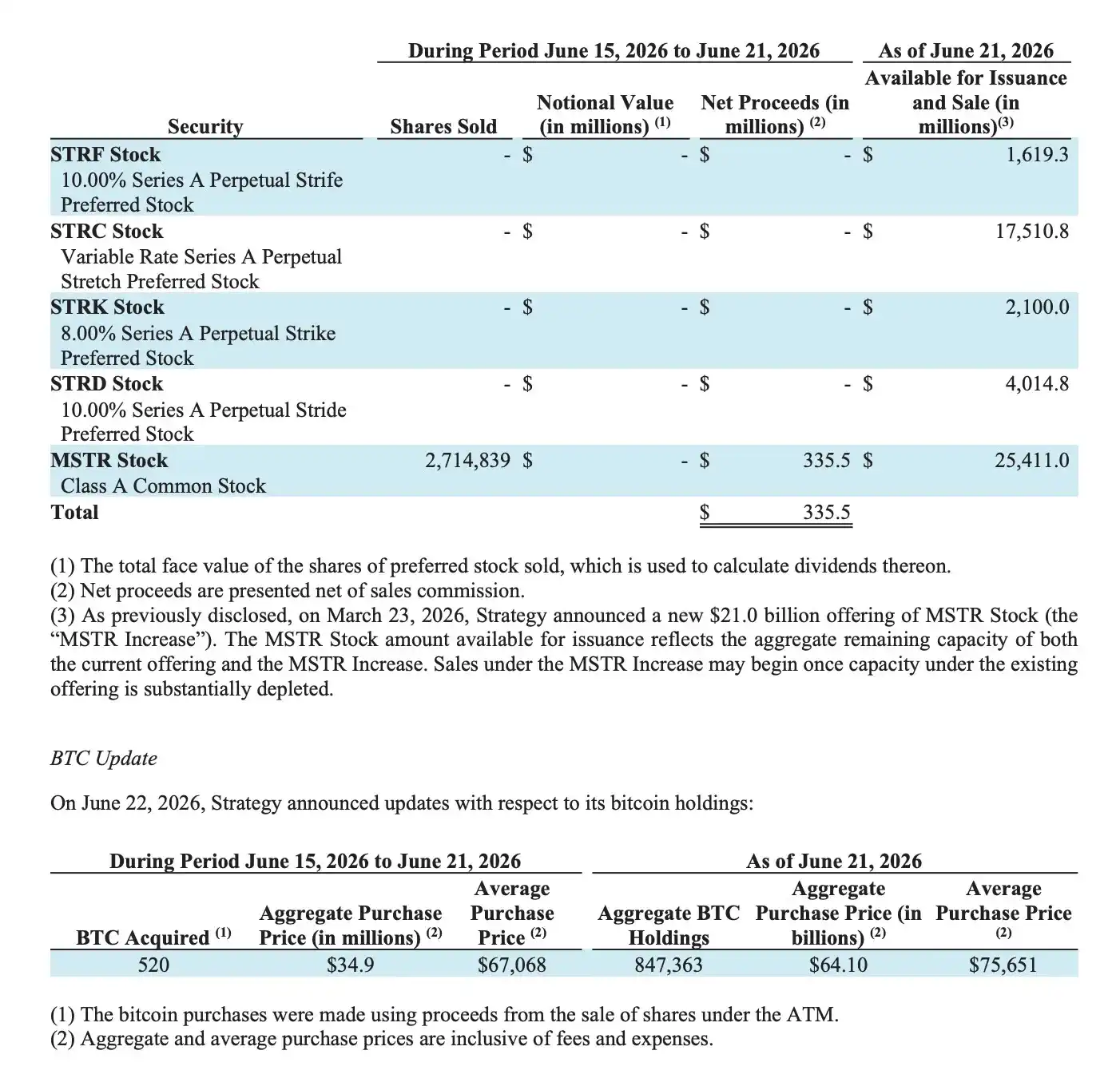
According to Strategy's latest 8-K filing, the company sold a total of 2,714,839 MSTR common shares in one week, raising $335.5 million. However, that same week, Strategy only purchased 520 BTC, spending a total of $34.9 million, with an average purchase price of around $67,068. In other words, of the $335.5 million raised, only about 10% was actually used to continue acquiring BTC. The remaining funds were primarily used to replenish the company's cash flow reserves, increasing cash from about $1.1 billion previously to the current ~$1.4 billion.

This might seem quite effective? But there's another trap here.

For MSTR common shareholders, the most critical information is: for each new common share issued, how much BTC can the raised funds ultimately buy back? Is it enough to cover the BTC equity corresponding to this new share? If the new financing can buy back more BTC than the share originally corresponded to, then common shareholders' equity is actually enhanced. Conversely, if the raised funds buy back insufficient BTC to cover the new share's corresponding BTC equity, then common shareholders suffer dilution.

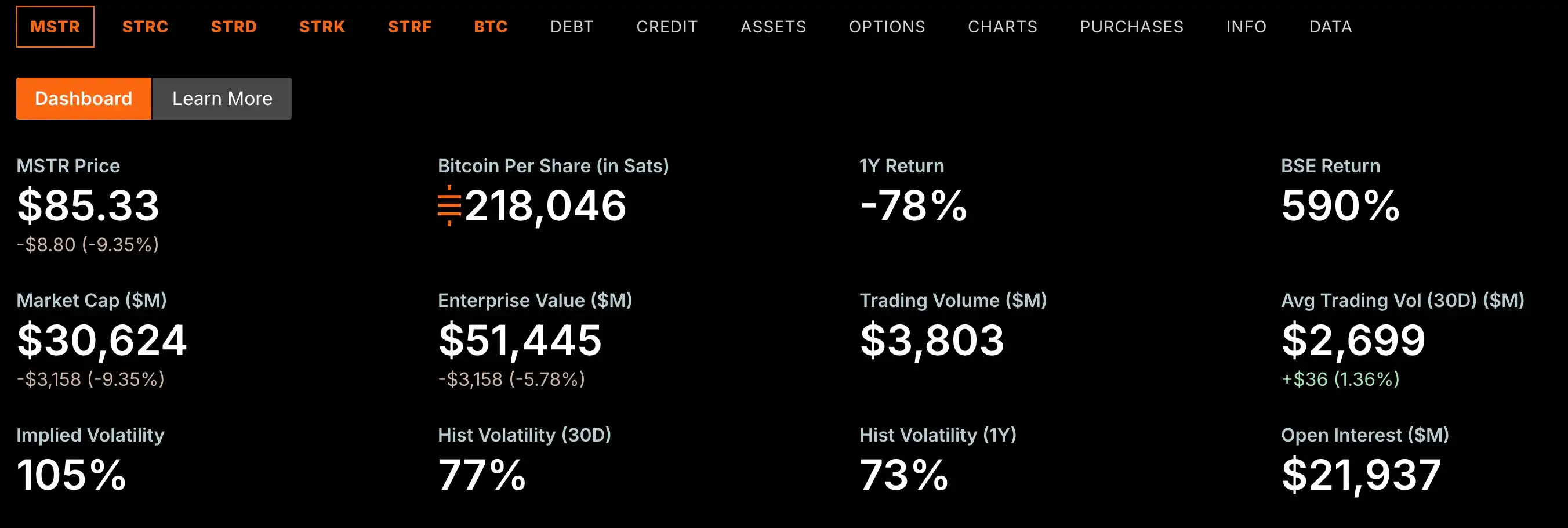
Clearly, Strategy's recent common stock issuance has come at the cost of diluting common shareholder equity. Strategy's official data also shows that MSTR's BTC per share has decreased from a peak of 220,900 Sats to 218,046 Sats.
This is the biggest limitation of common stock financing. For the vast majority of public companies, issuing common stock is just one of many financing methods; but for Strategy, common stock itself is part of its business model.

Over the past few years, Strategy's growth has essentially relied on the continuous operation of the "fundraise ➡️ buy coins ➡️ solidify market expectations ➡️ fundraise again ➡️ buy coins again..." flywheel. The market's core expectation for Strategy lies in its ability to continuously create more BTC equity for common shareholders, not dilute it.

However, when Strategy is forced to rely increasingly on common stock financing to replenish cash reserves rather than continue acquiring BTC, the operating logic of this flywheel changes. While common stock financing can indeed alleviate Strategy's cash pressure in the short term, it is difficult to become a long-term substitute for STRC.

Once common stock financing persistently erodes BTC per share, the foundation upon which MSTR's high premium relies may also be challenged, and this is precisely the core competitive advantage of Strategy's entire business model.

What About BTC?

Over the past few years, Strategy has become the most important marginal buyer in the BTC market (arguably without "one of"). To date, Strategy has accumulated holdings of 847,363 BTC, accounting for about 4% of BTC's current circulating supply, valued at over $50.7 billion. The market has long grown accustomed to Saylor's massive, unwavering weekly purchases.

But now, this situation is changing. Strategy can still raise funds through common stock, but most of the funds are no longer flowing into BTC; they are prioritized for replenishing cash reserves. This means that under the same fundraising scale, the actual new buying power entering the BTC market is diminishing.

More detrimentally, this situation may persist. If STRC fails to re-anchor long-term, and preferred stock financing remains blocked, Strategy will be forced to rely on common stock financing long-term to maintain cash flow, potentially further reducing the proportion of funds used for BTC accumulation. For the BTC market, this means the most stable and certain institutional buying power of the past few years will no longer grow as consistently as before.

But even more concerning is that if excessive common stock issuance overly dilutes MSTR shareholder equity, Strategy may have to consider another financing channel—selling coins.

From weakened new buying power to the emergence of potential selling pressure, today's Strategy is no longer BTC's largest marginal buyer, but a giant sword hanging over BTC.


Trend Kriptolar

İlgili Sorular

QWhat is the core function of STRC within Strategy's business model, and why is its 'de-pegging' a critical issue?

ASTRC serves as Strategy's most efficient and low-cost financing channel. Its design aims to trade around a $100 par value, enabling Strategy to continuously issue new shares near that price to raise funds for buying more Bitcoin. The ongoing de-pegging, with the price dropping significantly below $100, has effectively blocked this crucial financing channel. Investors are unwilling to pay near par value for new issues when they can buy cheaper on the secondary market, undermining Strategy's core mechanism for growth.

QAccording to the article, what major financial burden does the STRC de-pegging create for Strategy beyond just hampering fundraising?

ABeyond hindering new fundraising, the de-pegged STRC imposes a massive ongoing cash dividend obligation on Strategy. With approximately $10.49 billion of STRC issued and an 11.5% dividend rate, Strategy must pay over $1.2 billion in cash dividends annually for STRC alone. Combined with other preferred shares, the total annual dividend burden rises to around $1.7 billion, which threatens to deplete its reported $1.4 billion cash reserve in less than a year.

QWhat are the three main paths for Strategy to raise more capital as outlined in the article, and what are the downsides of each?

AThe three main paths are: 1) Issuing common stock (MSTR): This dilutes existing shareholders if the new capital doesn't buy enough Bitcoin to cover the increased share count, eroding the key metric of BTC per share. 2) Issuing more debt (e.g., convertible notes): This increases rigid financial obligations (interest and principal) in an environment where investors would demand higher risk premiums, worsening Strategy's liquidity and debt burden. 3) Selling Bitcoin (BTC): While quickly boosting cash, this risks triggering a market downturn due to Strategy's status as a major holder, which could conversely devalue its own massive BTC reserves.

QHow has Strategy's recent use of common stock (MSTR) ATM offerings changed, and what concerning trend does this reveal?

AStrategy's recent common stock ATM offerings reveal a shift in fund allocation. For example, a late June offering raised $335.5 million, but only about $34.9 million (roughly 10%) was used to buy more Bitcoin. The majority was used to bolster the company's cash reserves. This indicates that new equity financing is increasingly being used not for growth (buying BTC) but for survival (covering cash needs like dividend payments), leading to a dilution of BTC per share for common stockholders.

QWhy does the article argue that 'If STRC doesn't re-peg, BTC has no bull market,' and what is the new risk Strategy poses to Bitcoin?

AThe article argues this because Strategy has been the most significant marginal buyer in the Bitcoin market, with its constant, large-scale purchases driven by efficient financing (like STRC). If STRC remains de-pegged, Strategy loses its primary funding tool and must rely on less efficient methods (common stock sales) that funnel less new money into BTC. This weakens a major source of buy-side pressure. Furthermore, if cash pressures mount, Strategy might be forced to sell Bitcoin, transforming it from the market's biggest steady buyer into a potential large-scale seller—a 'giant blade' hanging over the Bitcoin market.

İlgili Okumalar

How to Detect AI-Generated Videos? A Review of Dynamic, Traceable, and Explainable Detection Systems

**How to Detect AI-Generated Videos: A Survey on Dynamic, Traceable, and Explainable Detection Systems** With rapid advances in AI video generation (e.g., Sora, Veo), creating highly realistic, multi-minute videos is now possible, widening the gap with detection research. Current AI video detection, often limited to unreliable binary classifications, is insufficient. This survey, accepted at ACL 2026, reframes the goal as **"factual fidelity verification"**—checking if a video's content (who, when, where, what) aligns with the real world perceptually and cognitively. It categorizes AI-generated videos into three paradigms: **Local Manipulation Videos (LMV**, e.g., face swaps), **Audio-Visual Editing (AVE**, e.g., lip-syncing), and **Generative Video Synthesis (GVS**, fully synthetic videos like Sora's). Detection challenges evolve from visual artifacts in LMV to multi-modal inconsistencies in AVE and higher-level world knowledge violations in GVS. The core proposal is a **Vision-Language Dual-View framework** with four hierarchical layers: 1. **Layer 1 (Intrinsic Visual Cues):** Analyzes low-level signal statistics, noise patterns, and physiological signals. 2. **Layer 2 (Spatiotemporal Consistency):** Checks for temporal coherence in object motion and scene dynamics. 3. **Layer 3 (Cross-Modal Consistency):** Verifies alignment between video, audio, and text within the video. 4. **Layer 4 (Language-Guided World-Level Reasoning):** Uses external knowledge, facts, and physical laws to judge semantic plausibility and factual correctness. The survey traces a shift in detection focus from lower layers (1 & 2) toward higher, language-involved layers (3 & 4). It also reviews evolving evaluation metrics and datasets tailored for each video paradigm. The conclusion advocates for a **dynamic, evidence-first detection system** that moves beyond simple classification. Future trustworthy detection requires combining visual evidence (from CV) with semantic reasoning and explanation (from NLP & multimodal AI), ultimately creating traceable and explainable judgments about a video's adherence to real-world constraints.

marsbit13 dk önce

How to Detect AI-Generated Videos? A Review of Dynamic, Traceable, and Explainable Detection Systems

marsbit13 dk önce

It Turns Out the First Real-World Application of AI x Crypto is in Security Auditing

The article explores the surprising trend where AI's first major impact on crypto has been in security auditing, not in areas like trading or analytics. It details how AI-powered tools are dramatically lowering the barrier to finding smart contract vulnerabilities, enabling attackers to scan thousands of contracts and execute exploits within minutes. This has rendered traditional, manually-produced audit reports with their month-long validity periods increasingly obsolete, creating a critical "structural crack" in the old security model. Cases like Drift Protocol and KelpDAO show that even extensively audited protocols can be hacked through social engineering, operational flaws, or infrastructure misconfigurations beyond pure code review. Attackers are also using AI to find and exploit vulnerabilities in years-old, deployed contracts. Notably, OpenZeppelin's co-founder has expressed a grim view that "all DeFi is insecure" due to AI's asymmetric advantage. In response, the audit industry is undergoing a fundamental shift. While there's a short-term spike in defensive re-audits, the long-term business model is changing. Firms are developing AI-assisted systems and moving from one-time report deliveries towards embedded, continuous services like real-time monitoring and formal verification. Examples include AI tools uncovering critical, previously missed vulnerabilities in heavily audited protocols like Curve Finance and Zcash. The conclusion is that security must become a continuous investment, not a one-time checkbox, and audit firms must rapidly evolve their tools and service models to survive.

marsbit19 dk önce

It Turns Out the First Real-World Application of AI x Crypto is in Security Auditing

marsbit19 dk önce

Never expected that the first tangible application of AI x Crypto is in security auditing

Unexpectedly, the initial major application of AI in the Crypto sphere has turned out to be security auditing. In 2026, DeFi has faced significant security challenges, with 121 hacking incidents resulting in approximately $942 million in losses. While AI was expected to first impact areas like quantitative trading, its initial breakthrough has instead transformed security auditing by drastically lowering the cost and skill barrier for finding smart contract vulnerabilities. The traditional audit model is facing obsolescence. Advanced AI models, such as Claude Mythos, enable attackers to scan thousands of contracts and identify vulnerability patterns at scale, compressing the time from discovery to execution to mere minutes. This renders the month-long validity of traditional audit reports ineffective. Notably, attacks now frequently target well-audited, established protocols by exploiting business logic flaws, operational security weaknesses, and even years-old historical contracts, demonstrating that old audit reports offer zero protection. This pressure is forcing a fundamental shift in the industry. In the short term, a wave of defensive re-auditing is occurring, driven by projects seeking to meet new AI-era security standards and regulatory requirements. In the long run, audit firms' business models are diverging. The one-time report delivery model is declining in value, as evidenced by platforms like Code4rena shutting down. Leading firms are now pivoting towards AI-powered defense, integrating continuous monitoring, real-time on-chain risk detection, and embedding security directly into the development phase, as seen with tools like OpenZeppelin's Skills system. Ultimately, the era of "audit once, secure forever" is over. Security must become a continuous, embedded infrastructure investment for projects. For audit companies, survival depends on proactively transforming from traditional service providers into platforms offering AI-native, ongoing security solutions.

链捕手27 dk önce

Never expected that the first tangible application of AI x Crypto is in security auditing

链捕手27 dk önce

İşlemler

Spot

Popüler Makaleler

$S$ Nedir

SPERO'yu Anlamak: Kapsamlı Bir Genel Bakış SPERO'ya Giriş İnovasyonun manzarası gelişmeye devam ederken, web3 teknolojilerinin ve kripto para projelerinin ortaya çıkışı dijital geleceği şekillendirmede önemli bir rol oynamaktadır. Bu dinamik alanda dikkat çeken projelerden biri SPERO, $$s$$ olarak adlandırılmaktadır. Bu makale, SPERO hakkında ayrıntılı bilgi toplamak ve sunmak amacıyla, meraklılar ve yatırımcıların web3 ve kripto alanlarındaki temellerini, hedeflerini ve yeniliklerini anlamalarına yardımcı olmayı amaçlamaktadır. SPERO,$$s$$ Nedir? SPERO,$$s$$, kripto alanında merkeziyetsizlik ve blok zinciri teknolojisi ilkelerini kullanarak etkileşimi, faydayı ve finansal kapsayıcılığı teşvik eden bir ekosistem yaratmayı amaçlayan benzersiz bir projedir. Proje, kullanıcıların yenilikçi finansal çözümler ve hizmetler sunarak eşler arası etkileşimleri yeni yollarla kolaylaştırmayı hedeflemektedir. SPERO,$$s$$'nin temel amacı, bireyleri güçlendirmek ve kripto para alanındaki kullanıcı deneyimini artıran araçlar ve platformlar sağlamaktır. Bu, daha esnek işlem yöntemlerini mümkün kılmayı, topluluk odaklı girişimleri teşvik etmeyi ve merkeziyetsiz uygulamalar (dApp'ler) aracılığıyla finansal fırsatlar yaratmayı içermektedir. SPERO,$$s$$'nin temel vizyonu kapsayıcılık etrafında dönmekte olup, geleneksel finansal sistemlerdeki boşlukları kapatmayı ve blok zinciri teknolojisinin faydalarından yararlanmayı hedeflemektedir. SPERO,$$s$$'nin Yaratıcısı Kimdir? SPERO,$$s$$'nin yaratıcısının kimliği bir miktar belirsizdir, çünkü kurucusu(ları) hakkında ayrıntılı arka plan bilgisi sağlayan sınırlı kamuya açık kaynaklar bulunmaktadır. Bu şeffaflık eksikliği, projenin merkeziyetsizlik taahhüdünden kaynaklanabilir—birçok web3 projesinin paylaştığı bir etik anlayışı, bireysel tanınmanın yerine kolektif katkıları önceliklendirmektedir. Topluluk ve onun kolektif hedefleri etrafında tartışmaları merkezileştirerek, SPERO,$$s$$, belirli bireyleri öne çıkarmadan güçlendirme özünü taşımaktadır. Bu nedenle, SPERO'nun etik anlayışını ve misyonunu anlamak, tek bir yaratıcının kimliğini belirlemekten daha önemlidir. SPERO,$$s$$'nin Yatırımcıları Kimlerdir? SPERO,$$s$$, kripto sektöründe yeniliği teşvik etmeye adanmış girişim sermayedarlarından melek yatırımcılara kadar çeşitli yatırımcılar tarafından desteklenmektedir. Bu yatırımcıların odak noktası genellikle SPERO'nun misyonuyla uyumlu olup, toplumsal teknolojik ilerlemeyi, finansal kapsayıcılığı ve merkeziyetsiz yönetimi vaat eden projeleri önceliklendirmektedir. Bu yatırımcı temelleri, yalnızca yenilikçi ürünler sunan projelere değil, aynı zamanda blok zinciri topluluğuna ve ekosistemlerine olumlu katkılarda bulunan projelere de ilgi duymaktadır. Bu yatırımcıların desteği, SPERO,$$s$$'yi hızla gelişen kripto projeleri alanında dikkate değer bir rakip haline getirmektedir. SPERO,$$s$$ Nasıl Çalışır? SPERO,$$s$$, onu geleneksel kripto para projelerinden ayıran çok yönlü bir çerçeve kullanmaktadır. İşte benzersizliğini ve yeniliğini vurgulayan bazı temel özellikler: Merkeziyetsiz Yönetim: SPERO,$$s$$, kullanıcıların projenin geleceğiyle ilgili karar alma süreçlerine aktif olarak katılmalarını sağlayan merkeziyetsiz yönetim modellerini entegre etmektedir. Bu yaklaşım, topluluk üyeleri arasında sahiplik ve hesap verebilirlik duygusunu teşvik etmektedir. Token Kullanımı: SPERO,$$s$$, ekosistem içinde çeşitli işlevler sunmak üzere tasarlanmış kendi kripto para token'ını kullanmaktadır. Bu token'lar, işlemleri, ödülleri ve platformda sunulan hizmetlerin kolaylaştırılmasını sağlayarak genel etkileşimi ve faydayı artırmaktadır. Katmanlı Mimari: SPERO,$$s$$'nin teknik mimarisi, modülerlik ve ölçeklenebilirliği destekleyerek projenin evrimi sırasında ek özelliklerin ve uygulamaların sorunsuz bir şekilde entegrasyonuna olanak tanımaktadır. Bu uyum sağlama yeteneği, sürekli değişen kripto manzarasında geçerliliği sürdürmek için hayati öneme sahiptir. Topluluk Katılımı: Proje, işbirliği ve geri bildirim teşvik eden mekanizmalar kullanarak topluluk odaklı girişimlere vurgu yapmaktadır. Güçlü bir topluluk oluşturarak, SPERO,$$s$$, kullanıcı ihtiyaçlarını daha iyi karşılayabilir ve piyasa trendlerine uyum sağlayabilir. Kapsayıcılığa Odaklanma: Düşük işlem ücretleri ve kullanıcı dostu arayüzler sunarak, SPERO,$$s$$, daha önce kripto alanında yer almamış bireyler de dahil olmak üzere çeşitli bir kullanıcı tabanını çekmeyi hedeflemektedir. Bu kapsayıcılık taahhüdü, erişilebilirlik yoluyla güçlendirme misyonuyla uyumludur. SPERO,$$s$$ Zaman Çizelgesi Bir projenin tarihini anlamak, gelişim yolculuğu ve kilometre taşları hakkında kritik bilgiler sağlar. Aşağıda, SPERO,$$s$$'nin evriminde önemli olayları haritalayan önerilen bir zaman çizelgesi bulunmaktadır: Kavram Geliştirme ve Fikir Aşaması: SPERO,$$s$$'nin temelini oluşturan ilk fikirler, blok zinciri endüstrisindeki merkeziyetsizlik ve topluluk odaklılık ilkeleriyle yakından uyumlu olarak geliştirildi. Proje Beyaz Kağıdının Yayınlanması: Kavramsal aşamayı takiben, SPERO,$$s$$'nin vizyonunu, hedeflerini ve teknolojik altyapısını ayrıntılı bir şekilde açıklayan kapsamlı bir beyaz kağıt yayımlandı ve topluluk ilgisini ve geri bildirimini toplamak amacıyla sunuldu. Topluluk Oluşturma ve Erken Katılımlar: Projenin hedefleri etrafında tartışmalar yürüterek destek toplamak ve erken benimseyenler ile potansiyel yatırımcılar için bir topluluk oluşturmak amacıyla aktif iletişim çabaları gerçekleştirildi. Token Üretim Etkinliği: SPERO,$$s$$, yerel token'larını erken destekçilere dağıtmak ve ekosistem içinde başlangıç likiditesini sağlamak amacıyla bir token üretim etkinliği (TGE) gerçekleştirdi. İlk dApp'in Yayınlanması: SPERO,$$s$$ ile ilişkili ilk merkeziyetsiz uygulama (dApp) faaliyete geçti ve kullanıcıların platformun temel işlevleriyle etkileşimde bulunmalarını sağladı. Sürekli Gelişim ve Ortaklıklar: Projenin tekliflerine sürekli güncellemeler ve iyileştirmeler yapılmakta olup, blok zinciri alanındaki diğer oyuncularla stratejik ortaklıklar, SPERO,$$s$$'yi rekabetçi ve gelişen bir oyuncu haline getirmiştir. Sonuç SPERO,$$s$$, web3 ve kripto paranın finansal sistemleri devrim niteliğinde dönüştürme ve bireyleri güçlendirme potansiyelinin bir kanıtıdır. Merkeziyetsiz yönetime, topluluk katılımına ve yenilikçi tasarlanmış işlevselliğe olan bağlılığıyla, daha kapsayıcı bir finansal manzaraya doğru bir yol açmaktadır. Hızla gelişen kripto alanındaki herhangi bir yatırımda olduğu gibi, potansiyel yatırımcılar ve kullanıcılar, SPERO,$$s$$ içindeki devam eden gelişmelerle ilgili olarak kapsamlı bir araştırma yapmaları ve düşünceli bir şekilde katılmaları teşvik edilmektedir. Proje, kripto endüstrisinin yenilikçi ruhunu sergileyerek, sayısız olasılığını keşfetmeye davet etmektedir. SPERO,$$s$$'nin yolculuğu hala devam ederken, temel ilkeleri, teknoloji, finans ve birbirimizle etkileşim biçimimizi etkileyebilir.

128 Toplam GörüntülenmeYayınlanma 2024.12.17Güncellenme 2024.12.17

$S$ Nedir

AGENT S Nedir

Agent S: Web3'te Otonom Etkileşimin Geleceği Giriş Web3 ve kripto para dünyasında sürekli gelişen manzarada, yenilikler bireylerin dijital platformlarla etkileşim biçimlerini sürekli olarak yeniden tanımlıyor. Bu tür öncü projelerden biri olan Agent S, açık ajans çerçevesi aracılığıyla insan-bilgisayar etkileşimini devrim niteliğinde değiştirmeyi vaat ediyor. Otonom etkileşimlerin yolunu açarak, Agent S karmaşık görevleri basitleştirmeyi ve yapay zeka (AI) alanında dönüştürücü uygulamalar sunmayı hedefliyor. Bu detaylı inceleme, projenin karmaşıklıklarına, benzersiz özelliklerine ve kripto para alanındaki etkilerine dalacaktır. Agent S Nedir? Agent S, bilgisayar görevlerinin otomasyonunda üç temel zorluğu ele almak üzere özel olarak tasarlanmış çığır açıcı bir açık ajans çerçevesidir: Alan Spesifik Bilgi Edinimi: Çerçeve, çeşitli dış bilgi kaynaklarından ve iç deneyimlerden akıllıca öğrenir. Bu çift yönlü yaklaşım, alan spesifik bilgi açısından zengin bir veri havuzu oluşturmasını sağlar ve görev yürütmedeki performansını artırır. Uzun Görev Ufukları Üzerinde Planlama: Agent S, karmaşık görevlerin verimli bir şekilde parçalanmasını ve yürütülmesini kolaylaştıran deneyim artırımlı hiyerarşik planlama kullanır. Bu özellik, çoklu alt görevleri etkili ve verimli bir şekilde yönetme yeteneğini önemli ölçüde artırır. Dinamik, Homojen Olmayan Arayüzlerle Başlama: Proje, ajanlar ve kullanıcılar arasındaki etkileşimi geliştiren yenilikçi bir çözüm olan Ajan-Bilgisayar Arayüzü'ni (ACI) tanıtmaktadır. Çok Modlu Büyük Dil Modellerini (MLLM'ler) kullanarak, Agent S çeşitli grafik kullanıcı arayüzlerini sorunsuz bir şekilde gezinebilir ve manipüle edebilir. Bu öncü özellikler aracılığıyla, Agent S, makinelerle insan etkileşimini otomatikleştirmede karşılaşılan karmaşıklıkları ele alan sağlam bir çerçeve sunarak, AI ve ötesinde birçok uygulama için zemin hazırlıyor. Agent S'nin Yaratıcısı Kimdir? Agent S'nin kavramı temelde yenilikçi olsa da, yaratıcısı hakkında spesifik bilgiler belirsizliğini koruyor. Yaratıcı şu anda bilinmiyor, bu da projenin yeni aşamasını veya kurucu üyeleri gizli tutma stratejik tercihini vurguluyor. Anonimlikten bağımsız olarak, odak çerçevenin yetenekleri ve potansiyeli üzerinde kalıyor. Agent S'nin Yatırımcıları Kimlerdir? Agent S, kriptografik ekosistemde oldukça yeni olduğundan, yatırımcıları ve finansal destekçileri hakkında ayrıntılı bilgiler açıkça belgelenmemiştir. Projeyi destekleyen yatırım temelleri veya organizasyonları hakkında kamuya açık bilgilerdeki eksiklik, finansman yapısı ve gelişim yol haritası hakkında sorular doğuruyor. Destekleyicilerin anlaşılması, projenin sürdürülebilirliğini ve potansiyel pazar etkisini değerlendirmek için kritik öneme sahiptir. Agent S Nasıl Çalışır? Agent S'nin temelinde, çeşitli ortamlarda etkili bir şekilde çalışmasını sağlayan son teknoloji bir sistem yatmaktadır. İşleyiş modeli birkaç ana özellik etrafında inşa edilmiştir: İnsan Benzeri Bilgisayar Etkileşimi: Çerçeve, bilgisayarlarla etkileşimleri daha sezgisel hale getirmeyi amaçlayan gelişmiş AI planlaması sunar. Görev yürütmedeki insan davranışını taklit ederek, kullanıcı deneyimlerini yükseltmeyi vaat eder. Anlatı Belleği: Yüksek düzeyde deneyimlerden yararlanmak için kullanılan Agent S, görev geçmişlerini takip etmek amacıyla anlatı belleğini kullanarak karar verme süreçlerini geliştirir. Episodik Bellek: Bu özellik, kullanıcılara adım adım rehberlik sağlayarak, çerçevenin görevler gelişirken bağlamsal destek sunmasına olanak tanır. OpenACI Desteği: Yerel olarak çalışabilme yeteneği ile Agent S, kullanıcıların etkileşimleri ve iş akışları üzerinde kontrol sağlamasına olanak tanır ve Web3'ün merkeziyetsiz felsefesiyle uyumlu hale gelir. Dış API'lerle Kolay Entegrasyon: Çeşitli AI platformlarıyla uyumluluğu ve çok yönlülüğü, Agent S'nin mevcut teknolojik ekosistemlere sorunsuz bir şekilde entegre olmasını sağlar ve geliştiriciler ile organizasyonlar için cazip bir seçenek haline getirir. Bu işlevsellikler, Agent S'nin kripto alanındaki benzersiz konumuna katkıda bulunarak, karmaşık, çok aşamalı görevleri minimum insan müdahalesi ile otomatikleştirir. Proje geliştikçe, Web3'teki potansiyel uygulamaları dijital etkileşimlerin nasıl gelişeceğini yeniden tanımlayabilir. Agent S'nin Zaman Çizelgesi Agent S'nin gelişimi ve kilometre taşları, önemli olaylarını vurgulayan bir zaman çizelgesinde özetlenebilir: 27 Eylül 2024: Agent S'nin kavramı, “Bilgisayarları İnsan Gibi Kullanan Açık Bir Ajans Çerçevesi” başlıklı kapsamlı bir araştırma makalesi ile tanıtıldı ve projenin temelini sergiledi. 10 Ekim 2024: Araştırma makalesi arXiv'de kamuya açık olarak yayınlandı ve çerçevenin derinlemesine bir incelemesini ve OSWorld benchmark'ına dayalı performans değerlendirmesini sundu. 12 Ekim 2024: Agent S'nin yetenekleri ve özellikleri hakkında görsel bir içgörü sağlayan bir video sunumu yayımlandı ve potansiyel kullanıcılar ve yatırımcılarla daha fazla etkileşim sağlandı. Bu zaman çizelgesindeki işaretler, sadece Agent S'nin ilerlemesini değil, aynı zamanda şeffaflık ve topluluk katılımına olan bağlılığını da göstermektedir. Agent S Hakkında Ana Noktalar Agent S çerçevesi gelişmeye devam ederken, birkaç ana özellik öne çıkmakta ve yenilikçi doğasını ve potansiyelini vurgulamaktadır: Yenilikçi Çerçeve: İnsan etkileşimine benzer bir bilgisayar kullanımı sağlamak üzere tasarlanan Agent S, görev otomasyonuna yeni bir yaklaşım getiriyor. Otonom Etkileşim: GUI aracılığıyla bilgisayarlarla otonom olarak etkileşim kurabilme yeteneği, daha akıllı ve verimli hesaplama çözümlerine doğru bir sıçrama anlamına geliyor. Karmaşık Görev Otomasyonu: Sağlam metodolojisi ile karmaşık, çok aşamalı görevleri otomatikleştirerek süreçleri daha hızlı ve daha az hata payı ile gerçekleştirebilir. Sürekli İyileştirme: Öğrenme mekanizmaları, Agent S'nin geçmiş deneyimlerden öğrenmesini sağlar ve sürekli olarak performansını ve etkinliğini artırır. Çok Yönlülük: OSWorld ve WindowsAgentArena gibi farklı işletim ortamlarında uyumlu olması, geniş bir uygulama yelpazesine hizmet edebilmesini sağlar. Agent S, Web3 ve kripto alanında kendini konumlandırırken, etkileşim yeteneklerini artırma ve süreçleri otomatikleştirme potansiyeli, AI teknolojilerinde önemli bir ilerlemeyi temsil etmektedir. Yenilikçi çerçevesi aracılığıyla, Agent S dijital etkileşimlerin geleceğini örneklemekte ve çeşitli sektörlerde kullanıcılar için daha sorunsuz ve verimli bir deneyim vaat etmektedir. Sonuç Agent S, AI ve Web3'ün birleşiminde cesur bir sıçramayı temsil ediyor ve teknoloji ile etkileşim biçimimizi yeniden tanımlama kapasitesine sahip. Henüz erken aşamalarında olmasına rağmen, uygulama olanakları geniş ve çekici. Kritik zorlukları ele alan kapsamlı çerçevesi ile Agent S, otonom etkileşimleri dijital deneyimin ön plana çıkmasına taşımayı hedefliyor. Kripto para ve merkeziyetsizlik alanlarına daha derinlemesine girdikçe, Agent S gibi projelerin teknoloji ve insan-bilgisayar işbirliğinin geleceğini şekillendirmede önemli bir rol oynayacağı kesin.

622 Toplam GörüntülenmeYayınlanma 2025.01.14Güncellenme 2025.01.14

AGENT S Nedir

S Nasıl Satın Alınır

HTX.com’a hoş geldiniz! Sonic (S) satın alma işlemlerini basit ve kullanışlı bir hâle getirdik. Adım adım açıkladığımız rehberimizi takip ederek kripto yolculuğunuza başlayın. 1. Adım: HTX Hesabınızı OluşturunHTX'te ücretsiz bir hesap açmak için e-posta adresinizi veya telefon numaranızı kullanın. Sorunsuzca kaydolun ve tüm özelliklerin kilidini açın. Hesabımı Aç2. Adım: Kripto Satın Al Bölümüne Gidin ve Ödeme Yönteminizi SeçinKredi/Banka Kartı: Visa veya Mastercard'ınızı kullanarak anında Sonic (S) satın alın.Bakiye: Sorunsuz bir şekilde işlem yapmak için HTX hesap bakiyenizdeki fonları kullanın.Üçüncü Taraflar: Kullanımı kolaylaştırmak için Google Pay ve Apple Pay gibi popüler ödeme yöntemlerini ekledik.P2P: HTX'teki diğer kullanıcılarla doğrudan işlem yapın.Borsa Dışı (OTC): Yatırımcılar için kişiye özel hizmetler ve rekabetçi döviz kurları sunuyoruz.3. Adım: Sonic (S) Varlıklarınızı SaklayınSonic (S) satın aldıktan sonra HTX hesabınızda saklayın. Alternatif olarak, blok zinciri transferi yoluyla başka bir yere gönderebilir veya diğer kripto para birimlerini takas etmek için kullanabilirsiniz.4. Adım: Sonic (S) Varlıklarınızla İşlem YapınHTX'in spot piyasasında Sonic (S) ile kolayca işlemler yapın.Hesabınıza erişin, işlem çiftinizi seçin, işlemlerinizi gerçekleştirin ve gerçek zamanlı olarak izleyin. Hem yeni başlayanlar hem de deneyimli yatırımcılar için kullanıcı dostu bir deneyim sunuyoruz.

1.7k Toplam GörüntülenmeYayınlanma 2025.01.15Güncellenme 2026.06.02

S Nasıl Satın Alınır

Tartışmalar

HTX Topluluğuna hoş geldiniz. Burada, en son platform gelişmeleri hakkında bilgi sahibi olabilir ve profesyonel piyasa görüşlerine erişebilirsiniz. Kullanıcıların S (S) fiyatı hakkındaki görüşleri aşağıda sunulmaktadır.

活动图片