Strategy’s Bitcoin treasury swells past 660,000 BTC after fresh $962M buy

cointelegraph2025-12-08 tarihinde yayınlandı2025-12-08 tarihinde güncellendi

Özet

Michael Saylor's company, MicroStrategy, has purchased an additional 10,624 Bitcoin (BTC) for approximately $962.7 million, increasing its total holdings to 660,624 BTC. The company's average purchase price is $74,696 per coin, and its holdings are now worth about $60 billion, representing an unrealized gain of over 22%. This acquisition occurs despite a 51% drop in MicroStrategy's stock price over the past year. Saylor continues to promote Bitcoin as "digital capital" and "digital gold" to sovereign wealth funds and other major investors. The purchase also contrasts with a broader slowdown in digital asset treasury (DAT) inflows, which hit a monthly low of $1.32 billion in November.

Michael Saylor’s Strategy has expanded its Bitcoin treasury again, buying nearly $1 billion in BTC even as digital asset treasury inflows cool and its own stock trades sharply lower on the year.

Strategy chairman Michael Saylor announced on X that the company bought 10,624 Bitcoin (BTC) for roughly $962.7 million at an average price of $90,615 per coin last week. The move brings Strategy’s total holdings to 660,624 BTC, acquired for approximately $49.35 billion at an average price of $74,696.

The move comes during a rough stretch for Strategy’s equity. According to Google Finance, Strategy shares recently traded around $178.99, down 51% over the past 12 months.

Despite this, the company has billions in unrealized gains on its BTC holdings. According to BitcoinTreasuries.NET, Strategy’s current BTC holdings are worth about $60 billion, more than 22% above the firm’s aggregate cost basis.
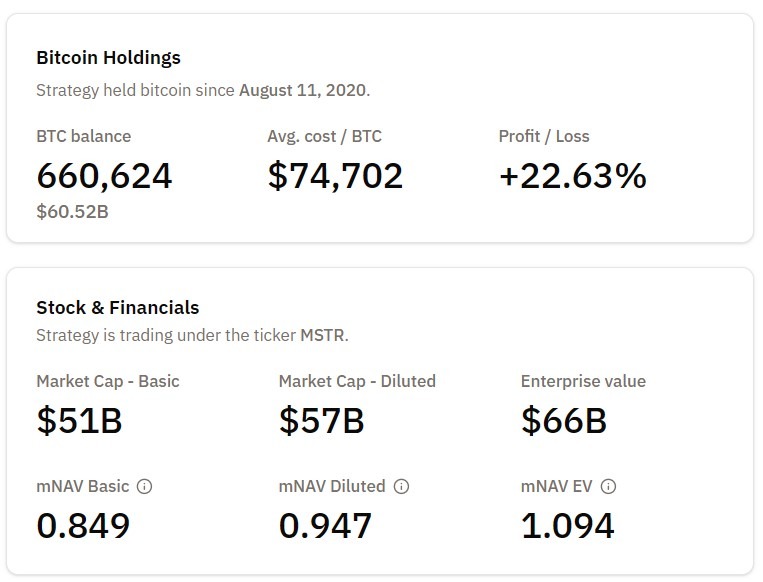
Strategy is up 22% on its Bitcoin holdings. Source: BitcoinTreasuries.NET

Saylor pushes Bitcoin to wealth funds as digital capital

At the Bitcoin MENA event in Abu Dhabi on Monday, Saylor said he had been meeting with sovereign wealth funds and a diverse range of investors, including people who run banks and family offices, to discuss Bitcoin.

“My message by the way is very straightforward. My message is: We now have digital capital. Bitcoin is digital capital. It’s digital gold,” Saylor said. “On top of digital capital, we have a new asset class called digital credit. Digital credit strips the volatility from the capital and provides yield.”

Despite a downturn in Strategy stock prices, the company’s chairman consistently reaffirms their belief in the asset, saying recently on social media that they “won’t back down” from their Bitcoin bet.

Strategy also recently raised $1.44 billion to dispel fear, uncertainty and doubt, or FUD. According to Strategy CEO Phong Le, there were concerns about whether the company could continue to service its debts and payment obligations should the stock’s price fall too far.

“There was FUD that was put out there that we wouldn’t be able to meet our dividend obligations, which causes people to pile into a short Bitcoin bet,” he said.

Related: Cantor slashes Strategy target by 60%, tells clients forced-sale fears are overblown

DAT inflows in November drop to lowest in 2025

Strategy’s latest Bitcoin purchase comes amid digital asset treasuries (DATs) having their slowest month in November. DefiLlama data showed that DATs only had $1.32 billion in inflows during the month, down 34% from October.

Bitcoin-focused firms led the month with over a billion in inflows driven by Strategy’s $835 million buy on Nov. 17. Ether-focused DATs flipped negative with $37 million in outflows.

Magazine: Koreans ‘pump’ alts after Upbit hack, China BTC mining surge: Asia Express
İlgili Okumalar

Farcaster Is Not a Pivot, It's Evolution: The True Ambition from Social to Wallet

Recently, Farcaster co-founder Dan Romero announced a shift in the project’s focus from "social-first" to "wallet-first," sparking widespread discussion. While some interpreted this as Farcaster abandoning social features or even signaling the failure of Web3 social networks, the move is better understood as a strategic evolution rather than a pivot. Farcaster’s integration of a built-in wallet is not a replacement for social functionality but an upgrade to improve user experience. It enables seamless on-chain interactions, especially as Frames evolve into more powerful Mini Apps. This enhancement allows users to mint NFTs, execute trades, and engage with decentralized applications without leaving the app—reducing friction and supporting richer crypto-native experiences. The shift reflects a broader trend: social apps are integrating wallets, and wallet apps are adding social features. This convergence is becoming the natural direction for consumer crypto applications. By combining social graphs with built-in wallets and Mini Apps, Farcaster enables closed-loop scenarios for asset creation, discovery, trading, and community interaction—all within a unified experience. Other platforms like Telegram, Zapper, Base App, and Binance are also exploring similar integrations, highlighting the growing importance of blending social context with financial activity. Farcaster’s open and composable social protocol allows developers to build diverse clients and applications, further expanding its ecosystem. In summary, Farcaster is not moving away from social—it is enhancing it. The integration of wallet functionality aims to drive growth, improve utility, and solidify its unique value proposition in the crypto space.

marsbit37 dk önce

Farcaster Is Not a Pivot, It's Evolution: The True Ambition from Social to Wallet

marsbit37 dk önce

İşlemler

Spot
Futures
活动图片