Strategy sells MSTR shares, buys back $25M in STRC preferred stock

cointelegraph2026-07-27 tarihinde yayınlandı2026-07-27 tarihinde güncellendi

Özet

Strategy, the business intelligence firm and corporate Bitcoin leader, adjusted its capital structure last week by selling 5.43 million shares of its Class A common stock (MSTR) for $544.5 million in net proceeds. Concurrently, it repurchased $25 million worth of its STRC preferred stock. These moves increased the company's US dollar reserve to $3.75 billion. Strategy reported no Bitcoin purchases or sales during the period, leaving its holdings unchanged at 843,775 BTC. The update followed executive chairman Michael Saylor's social media post hinting at strategic moves, which also reignited debate over Bitcoin's relationship with traditional banks, highlighting a divide within the crypto community.

Strategy, the business intelligence firm that has built the largest corporate Bitcoin treasury, continued adjusting its capital structure last week through a combination of stock sales and preferred share repurchases.

Strategy sold 5,429,160 shares of its Class A common stock (MSTR) through its at-the-market (ATM) offering program between July 20 and July 26, generating $544.5 million in net proceeds.

The MSTR share price was up more than 2% in Monday’s premarket activity, according to Yahoo Finance. The STRC preferred shares were up 2.3% to $88.90 ahead of the Nasdaq open.

The company also repurchased 288,930 shares of its STRC preferred stock for $25 million, according to a Form 8-K filed with the US Securities and Exchange Commission on Monday.

The update comes after Strategy executive chairman Michael Saylor sparked speculation on Sunday with his “We’re gonna need another color” post on X, which some market observers interpreted as a hint at a new move involving the company’s preferred stock strategy.
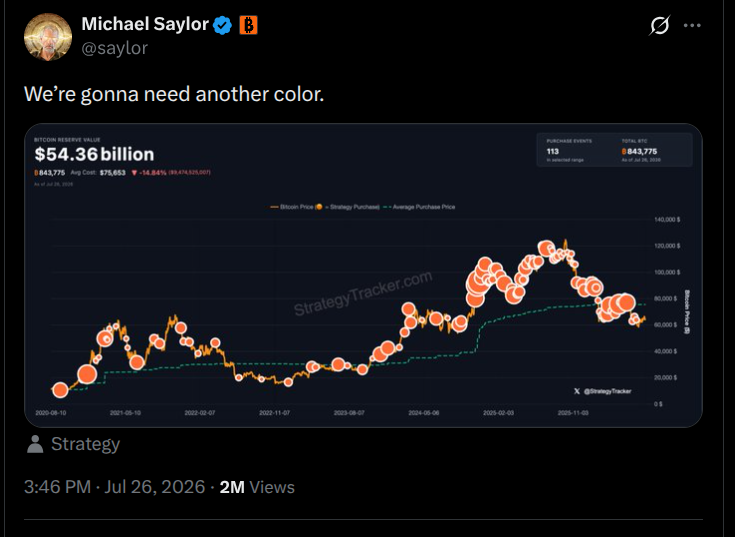
Source: Michael Saylor on X.com

Stock sales boost dollar reserve $3.75B

Following additional capital raised through its ATM stock offering program, Strategy increased its US dollar reserve to $3.75 billion as of July 26, up from $3.225 billion the previous week.

However, Strategy reported no Bitcoin purchases or sales during the July 20-26 period, leaving its holdings unchanged at 843,775 BTC, acquired at an average purchase price of $75,476 per Bitcoin, or $63.69 billion in aggregate. The biggest crypto was last trading hands at roughly $64,971 at time of publication.

Related: Strive’s SATA recovers most of June decline, trades within 3% of par

Strategy’s growing cash reserve highlights management’s efforts to maintain liquidity as it expands its capital markets activity through common stock offerings and preferred stock instruments. The reserve is intended to support dividend payments on preferred stock and interest payments on the company’s outstanding debt.

Saylor sparks debate over BTC future role for banks

The update came shortly after Saylor reignited a debate over whether banks have a place in Bitcoin’s future after arguing that the crypto asset’s growth depends on integration with traditional financial institutions.

Saylor wrote on X on Sunday that rejecting Bitcoin’s links to financial infrastructure would deny access to most potential users. His comments drew criticism from some BTC supporters, who contend that greater involvement from banks conflicts with the network’s original goal of enabling transactions without intermediaries.

Several users pushed back against Saylor’s argument by citing Bitcoin’s white paper, which introduced the asset as a peer-to-peer electronic cash system designed to remove the need for financial institutions. The exchange highlighted a growing divide between advocates who view banks as necessary gateways for mainstream adoption and those who see them as a threat to Bitcoin’s decentralized foundation.

Magazine: Strategy became a symbol of the dot-com crash: Could history repeat?

İlgili Sorular

QWhat actions did Strategy take to adjust its capital structure last week, as detailed in the article?

AStrategy sold 5,429,160 shares of its Class A common stock (MSTR) through its ATM offering program, generating $544.5 million in net proceeds. It also repurchased 288,930 shares of its STRC preferred stock for $25 million.

QAccording to the article, what is Strategy's current Bitcoin (BTC) holding and its average purchase price?

AStrategy's Bitcoin holdings remain unchanged at 843,775 BTC, acquired at an average price of $75,476 per Bitcoin, for an aggregate cost of $63.69 billion.

QHow did Strategy's US dollar reserve change following its recent stock sales, and what is the stated purpose of this reserve?

AFollowing the stock sales, Strategy's US dollar reserve increased to $3.75 billion as of July 26, up from $3.225 billion. The reserve is intended to support dividend payments on preferred stock and interest payments on the company's outstanding debt.

QWhat was the market speculation triggered by Michael Saylor's post on X, and what debate did his subsequent comments reignite?

ASaylor's 'We're gonna need another color' post on X sparked speculation about a new move involving the company's preferred stock strategy. His later comments reignited a debate over whether banks have a place in Bitcoin's future, with critics arguing that bank integration conflicts with Bitcoin's original decentralized, peer-to-peer vision.

QWhat were the price movements for MSTR and STRC preferred shares mentioned in the article?

AThe MSTR share price was up more than 2% in Monday's premarket activity. The STRC preferred shares were up 2.3% to $88.90 ahead of the Nasdaq open.

İlgili Okumalar

Bitcoin Withdrawals Continue: 8 Years of Storage in a Coldcard Cold Wallet Ended in Zero

Coldcard Hardware Wallet Hacked: Losses Mount Due to Vulnerable Seed Generation A critical vulnerability in Coldcard hardware wallets has led to a continued wave of fund thefts. According to Galaxy Research, the total stolen has reached 1,367.05 BTC (approx. $88.6 million) from 4,585 addresses, a significant increase from the initial 594.5 BTC reported on July 30, 2026. Most of the stolen funds remain on the attackers' addresses. The issue is not with the current firmware, which Coinkite has updated, but with seed phrases generated on vulnerable devices between March 2021 and the release of fixed firmware versions. Due to a programmer error, devices switched from using a hardware random number generator to the software-based Yasmarang generator, which was initialized with publicly accessible data like the chip's serial number. This made the seed phrases predictable through offline brute-force attacks, meaning wallets remain at risk until funds are moved to a new wallet generated with the patched firmware. Affected devices include Mk2/Mk3 with firmware 4.0.1–4.1.9 (and up to 5.0.3), Mk4/Mk5 up to version 5.6.0, and Q models up to 1.5.0Q. The only exceptions are seeds created with a high-entropy method like at least 50 independent dice rolls or a strong unique BIP-39 passphrase. All other owners must generate a new seed on the fixed firmware and transfer their assets. A case highlighting the human impact involves a 39-year-old long-term investor who lost 2 BTC (approx. $130,000) in minutes. He had accumulated the Bitcoin over eight years through physical labor, viewing it as a financial lifeline and a retirement plan in a country suffering from hyperinflation. His story underscores that even conservative "buy and hold in cold storage" strategies can be compromised by such underlying technical flaws. From a technical perspective, this incident echoes historical failures where weak random number generators undermined cryptographic security, challenging the assumption that offline storage is automatically foolproof.

cryptonews.ru58 dk önce

Bitcoin Withdrawals Continue: 8 Years of Storage in a Coldcard Cold Wallet Ended in Zero

cryptonews.ru58 dk önce

İşlemler

Spot
活动图片





