Strategy Scoops Up 10,000 BTC in a Single Week: How Much Is Left to Buy on the Market?

Odaily星球日报2025-12-17 tarihinde yayınlandı2025-12-17 tarihinde güncellendi

Özet

Strategy, a major long-term Bitcoin holder, has significantly increased its BTC holdings by over 10,000 BTC (worth $900 million) in a single week, despite a declining market and its mNAV falling below 1. This brings its total holdings to approximately 671,000 BTC, valued at over $50 billion, reinforcing its position as one of the world's largest institutional Bitcoin holders. This aggressive accumulation raises questions about the actual available supply of Bitcoin on the market. While 19.96 million BTC have been mined (95% of the total 21 million cap), the truly liquid supply is far smaller. An estimated 30% of Bitcoin is held long-term in "dormant" wallets, and around 20% is presumed permanently lost. Furthermore, institutional ownership from public companies, ETFs, and national funds is rapidly growing, and exchange balances have hit multi-year lows, indicating a shrinking pool of immediately sellable "float." Key data points on illiquid supply: - Long-term holders possess ~14.35 million BTC (over 70% of circulating supply). - 153 corporations hold BTC, with 29 public companies accounting for 1.082 million BTC. Strategy alone holds 671,000 BTC, representing 62% of that corporate total. - Spot Bitcoin ETFs hold ~1.311 million BTC, led by BlackRock (777,000 BTC) and Fidelity (202,000 BTC). - Governments hold ~615,000 BTC, with the U.S. (325,000 BTC) and China (190,000 BTC, per Glassnode) as the largest holders. - ~3.409 million BTC haven't moved in over a decade, with at l...

Original | Odaily Planet Daily (@OdailyChina)

Author | Ding Dang (@XiaMiPP)
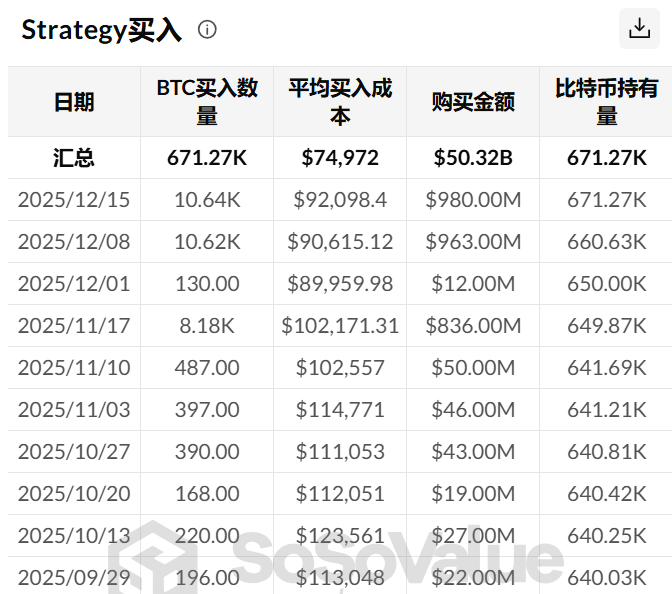
Over the past two weeks, Strategy has once again significantly increased its Bitcoin holdings: adding over 10,000 BTC in a single week, valued at more than $900 million.

As a well-known long-term holder in the market, against the backdrop of Bitcoin's continued price decline and its own mNAV falling below 1, Strategy has not sold off as the market feared, but instead provided a completely opposite answer—firmly buying. To date, Strategy holds approximately 671,000 BTC in total, with a total value exceeding $50 billion, continuously solidifying its position as one of the world's largest Bitcoin-holding institutions.
This move has also sparked deeper market reflection: With such large-scale continuous buying, how much Bitcoin is truly available for trading on the market?

The theoretical maximum supply of Bitcoin is 21 million, but the actual circulating supply is far less. Approximately 19.96 million have been mined so far, accounting for 95% of the total, with only about 1.04 million yet to be produced. The current block reward is 3.125 BTC, with about 450 new coins added daily, and it will halve again in 2028. At this pace, the last Bitcoin is expected to be mined around 2140.

However, what truly determines market supply is not the unmined new coins, but the liquid portion of the existing supply.

According to statistics, over 30% of Bitcoin has not moved for a long time and is considered "dormant holdings"; another approximately 20% is suspected to be permanently lost. Additionally, institutional and public holdings, including listed companies, ETFs, and national funds, continue to rise, with most of these BTC exiting high-frequency circulation. Furthermore, Bitcoin reserves on exchanges have dropped to multi-year lows, meaning the "floating supply" available for immediate sale is rapidly contracting. Against the backdrop of whales quietly accumulating and long-term holders holding firm, market liquidity is facing structural tightening.

Regarding the issue of Bitcoin's true circulating supply, crypto analyst Murphy has conducted a systematic review. Odaily Planet Daily has further integrated data and perspectives on this basis, attempting to present the full picture of data behind this scarcity narrative—as buying power persists and available supply shrinks, the market structure may be quietly shifting.

Long-Term Holders' "Institutionalized Hoarding" is Taking Over Circulating Supply

Long-term holders have now become the most important structural force in the Bitcoin market. According to Glassnode statistics, this group collectively holds approximately 14.35 million BTC, accounting for over 70% of the circulating supply.

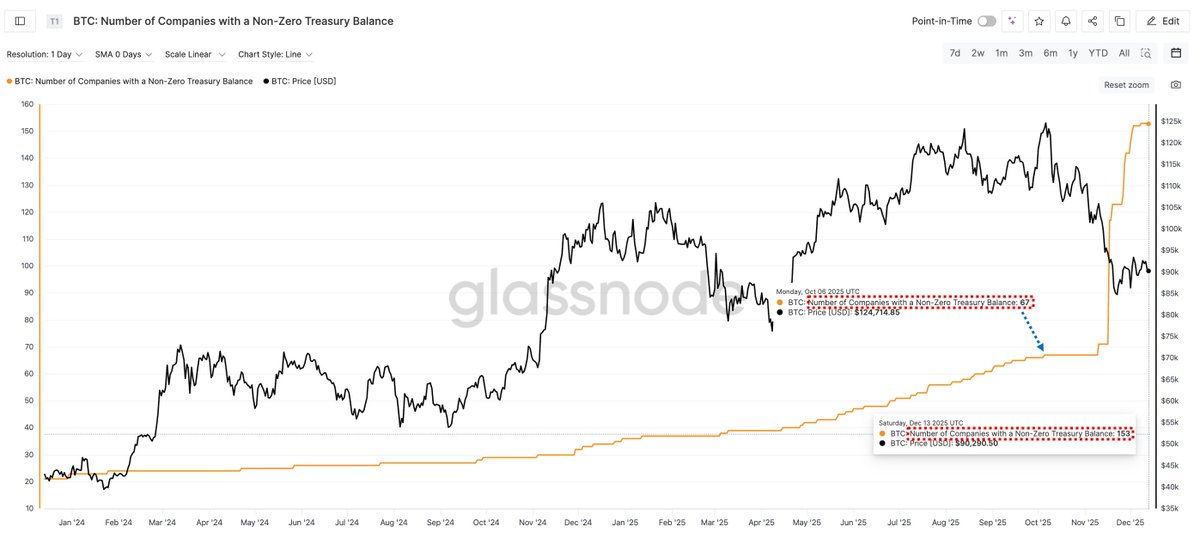
A further breakdown. There are currently 153 enterprises holding BTC with "non-zero balances," the core of which are 29 listed companies, collectively holding 1.082 million Bitcoin (including Other holding 54,331). Among these 29 listed companies, Strategy alone holds 671,000 BTC, accounting for a high 62%.

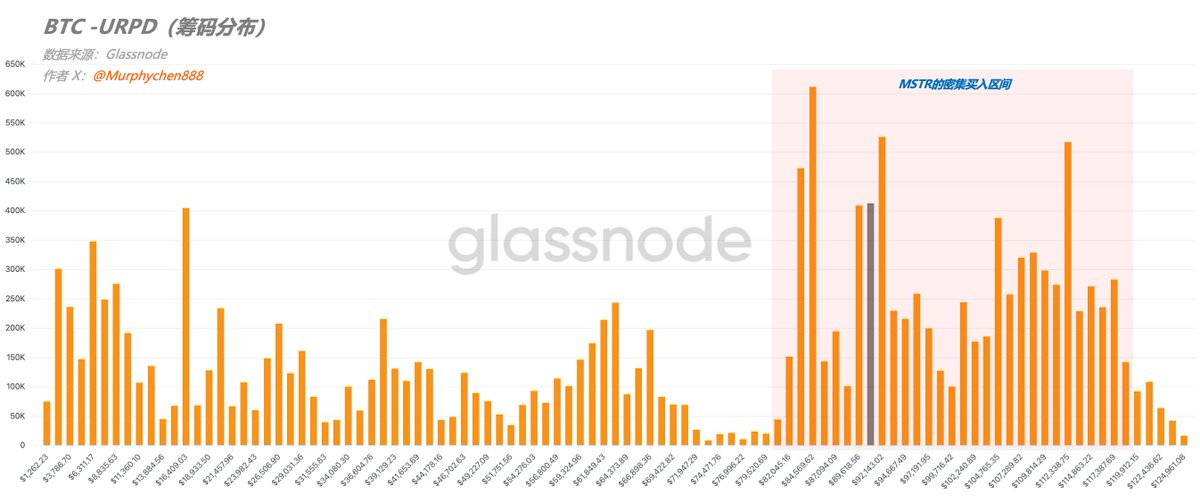
If combined with URPD (UTXO Realized Price Distribution) data, Strategy's intensive buying range coincides precisely with the most densely stacked area in BTC's chip structure, roughly concentrated between $80,000 and $118,000. This means that Strategy indeed played a significant role in the large amount of chip exchange in the high-price range. This is also why MSTR and ETFs are considered the driving force behind this bull cycle.
It is important to note that on October 6, there were only 67 enterprises holding "BTC non-zero balances." However, as BTC experienced a deep correction, this number suddenly surged, and there are now 153. Does this mean that new enterprise-level players are quietly entering the market during the price decline?
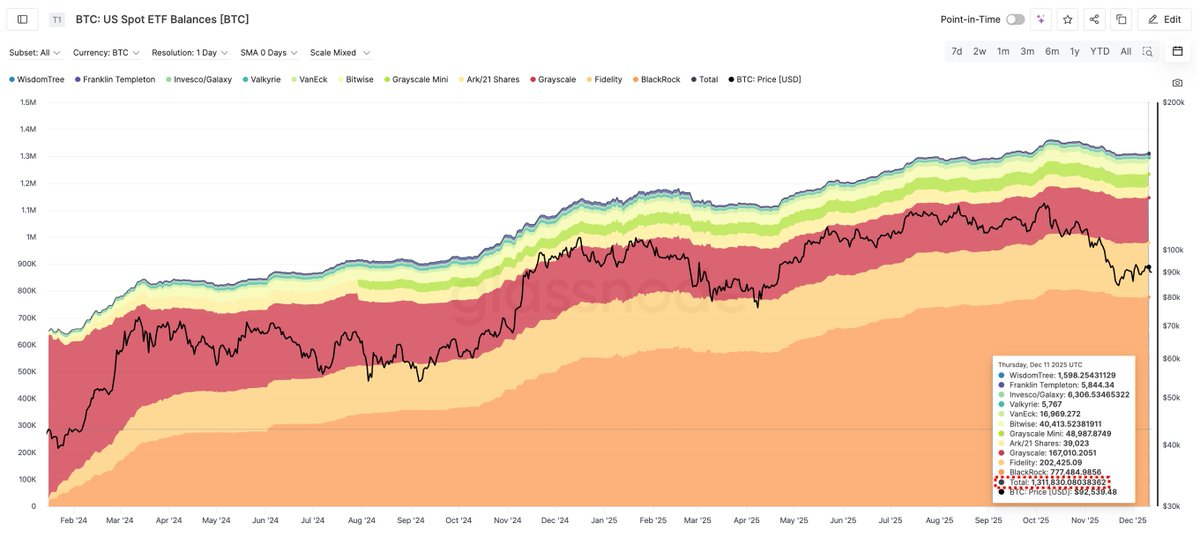
In addition to BTC reserves held by实体企业 (实体企业 - physical/real enterprises), spot Bitcoin ETFs currently hold approximately 1.311 million BTC in total. The top three are: BlackRock with about 777,000, Fidelity with about 202,000, and Grayscale with about 167,000.
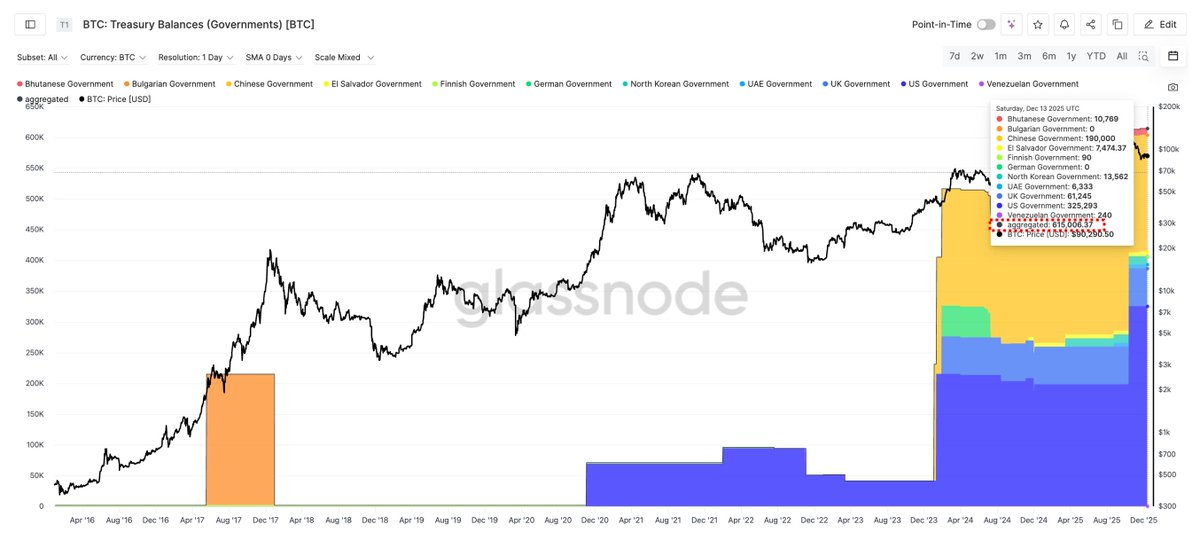
Furthermore, governments worldwide hold approximately 615,000 BTC in total. The U.S. government leads with 325,000; ranking second is the Chinese government, holding about 190,000 BTC. It should be noted that the Chinese government has never officially disclosed related holdings. This data primarily comes from Glassnode, and its statistical caliber still has uncertainties compared to the actual situation.
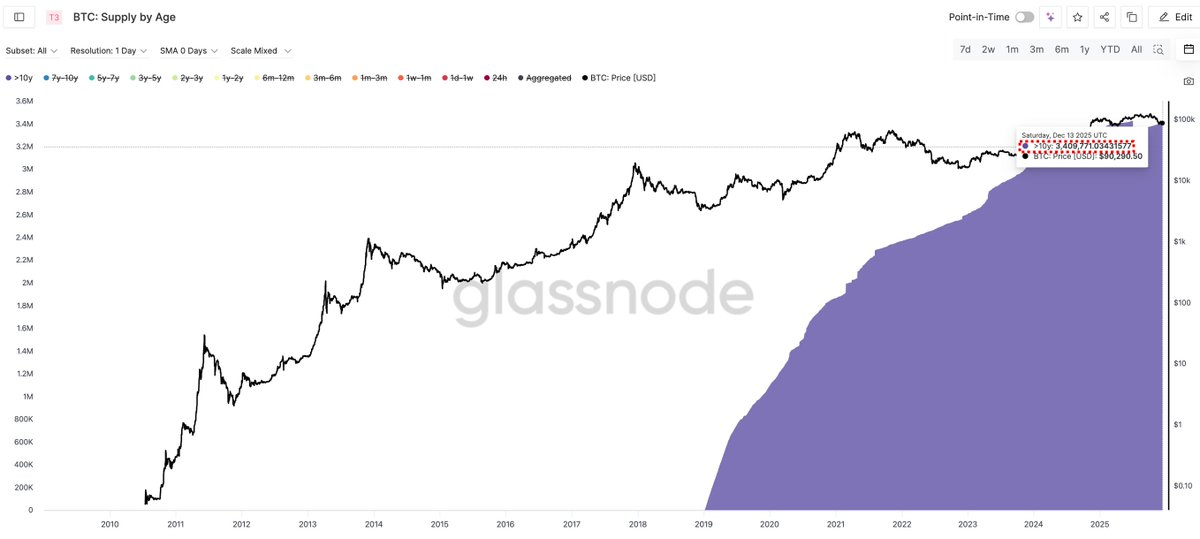
Additionally, the number of Bitcoins that have not moved for over 10 years is approximately 3.409 million. These assets consist of cold wallets from early exchanges and truly "faith-based OGs"; but it is also important not to overlook that a significant portion of these have likely exited the circulation system de facto due to reasons such as lost private keys or the holder's death. This includes the approximately 1 million BTC widely believed to belong to Satoshi Nakamoto.
How Much of the Mined BTC Is Actually "Unbuyable"?

Murphy subsequently provided a more detailed梳理 (sorting out) of this data. Unlike traditional bank accounts which have a "forgot password recovery" function, Bitcoin relies entirely on private keys to prove ownership. Once a private key is lost or becomes inaccessible, the corresponding Bitcoin can never be moved or spent again. Although they are still recorded on the blockchain, economically, they are equivalent to being permanently destroyed.

If we细分 (break down) the circulating supply by date range, where each date range refers to the creation date of the UTXO. Then we can see that the cumulative peak for BTC "born" from 2010-2014 occurred in December 2014, after which it declined rapidly (as they were spent); it has shown almost no significant change since around January 2019 to the present.
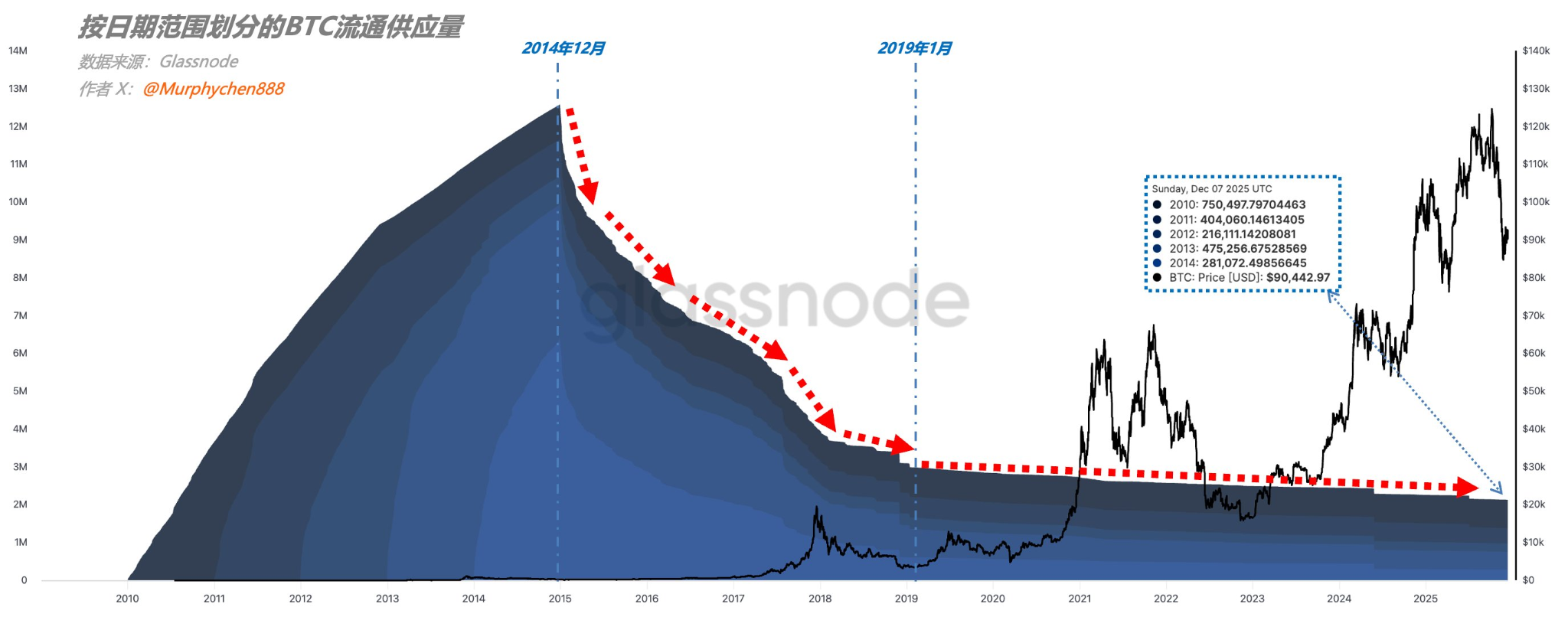
These ancient BTC that remain today, apart from those held by absolutely faithful holders, should mostly be lost. According to Murphy's estimate, this proportion is at least 50% or more, meaning at least 1.06 million or more.

There is another set of "supreme king" coins, with UTXO creation dates in 2009. They have hardly moved since after December 2011, and to this day, this address group holds 1.08 million BTC.

This means that at least approximately 2.14 million BTC may be permanently immovable in practice.

The Truly Liquid Supply

Looking at the most direct indicator—exchange balances—the Bitcoin held in exchange wallets is currently about 2.49 million, and this trend is continuously declining, having hit a new low since 2023.
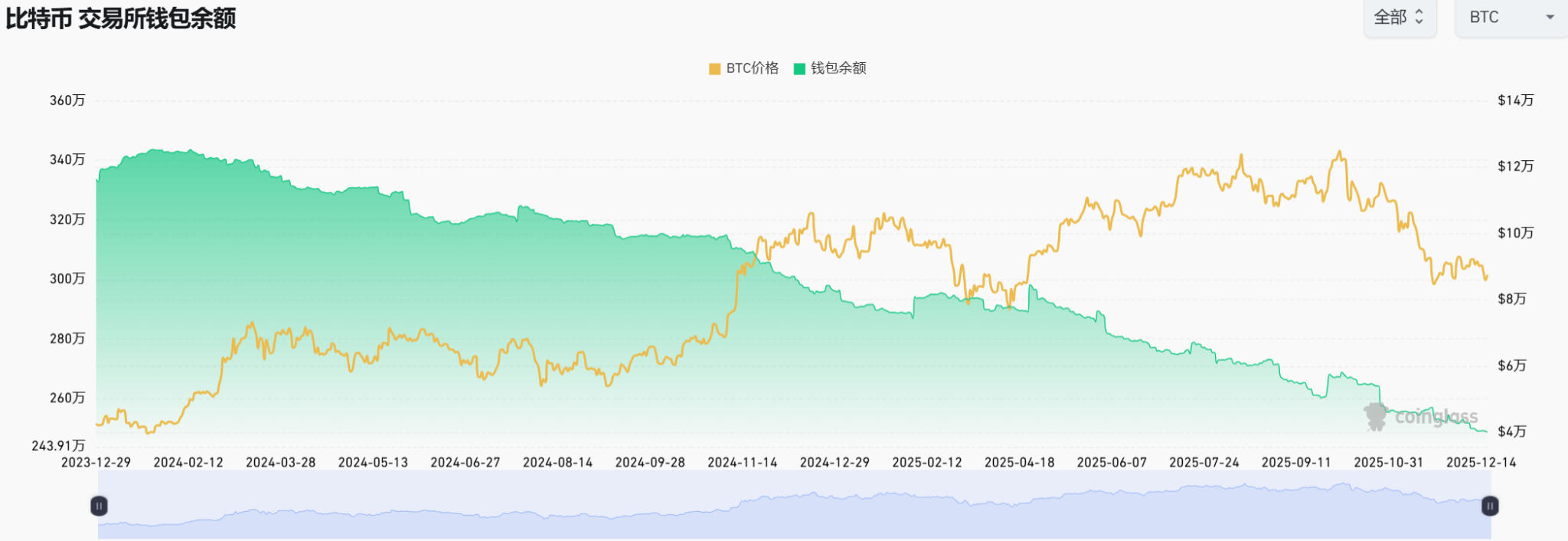
In other words, while demand continues to become "institutionalized," supply is continuously contracting. The pool of Bitcoin available for trading is getting smaller and smaller.


İlgili Sorular

QHow many bitcoins did Strategy purchase in a single week, and what was the total value?

AStrategy purchased over 10,000 bitcoins in a single week, with a total value exceeding $900 million.

QWhat is the total number of bitcoins that Strategy currently holds, and what is its total value?

AStrategy currently holds approximately 671,000 bitcoins, with a total value exceeding $50 billion.

QWhat percentage of the total Bitcoin supply has already been mined, and how many remain to be produced?

AApproximately 95% of the total Bitcoin supply has been mined, with about 19.96 million bitcoins already in existence. Only about 1.04 million remain to be produced.

QAccording to the article, what is the estimated amount of bitcoins that are permanently lost or otherwise unable to be moved?

AThe article estimates that at least 2.14 million bitcoins, including those from 2009 and 2010-2014, are likely permanently lost or unable to be moved due to lost private keys.

QHow many bitcoins are currently held on exchanges, and what does this trend indicate about market liquidity?

AThere are currently about 2.49 million bitcoins held on exchanges, a number that is trending downward and is at a multi-year low, indicating a contraction in immediately available supply and market liquidity.

İlgili Okumalar

From Theft to Re-entry: How Was $292 Million "Laundered"?

A sophisticated crypto laundering operation was executed following the $292 million hack of Kelp DAO on April 18. The attack, attributed to the North Korean Lazarus group, began with anonymous infrastructure preparation using Tornado Cash to fund wallets untraceably. The hacker exploited a vulnerability in Kelp’s cross-chain bridge, stealing 116,500 rsETH. To avoid crashing the market, the attacker used Aave and Compound as laundering tools—depositing the stolen rsETH as collateral to borrow $190 million in clean, liquid ETH. This move triggered a bank run on Aave, causing an $8 billion drop in TVL. After consolidating funds, the attacker fragmented them across hundreds of wallets to evade detection. A major breakpoint was THORChain, where over $460 million in volume—30 times its usual activity—was processed in 24 hours, converting ETH into Bitcoin. This shift to Bitcoin’s UTXO model exponentially increased tracing complexity by shattering funds into countless untraceable fragments. The final destination was Tron-based USDT, the primary channel for illicit crypto flows. From there, funds were cashed out via OTC brokers in China and Southeast Asia, using unlicensed underground banks and UnionPay networks outside Western sanctions scope. Ultimately, the laundered money supports North Korea’s weapons programs, which rely heavily on crypto hacking for foreign currency. The incident underscores structural challenges in DeFi: its openness, composability, and lack of central control make such laundering not just possible, but inherently difficult to prevent.

marsbit1 saat önce

From Theft to Re-entry: How Was $292 Million "Laundered"?

marsbit1 saat önce

Google and Amazon Simultaneously Invest Heavily in a Competitor: The Most Absurd Business Logic of the AI Era Is Becoming Reality

In a span of four days, Amazon announced an additional $25 billion investment, and Google pledged up to $40 billion—both direct competitors pouring over $65 billion into the same AI startup, Anthropic. Rather than a typical venture capital move, this signals the latest escalation in the cloud wars. The core of the deal is not equity but compute pre-orders: Anthropic must spend the majority of these funds on AWS and Google Cloud services and chips, effectively locking in massive future compute consumption. This reflects a shift in cloud market dynamics—enterprises now choose cloud providers based on which hosts the best AI models, not just price or stability. With OpenAI deeply tied to Microsoft, Anthropic’s Claude has become the only viable strategic asset for Google and Amazon to remain competitive. Anthropic’s annualized revenue has surged to $30 billion, and it is expanding into verticals like biotech, positioning itself as a cross-industry AI infrastructure layer. However, this funding comes with constraints: Anthropic’s independence is challenged as it balances two rival investors, its safety-first narrative faces pressure from regulatory scrutiny, and its path to IPO introduces new financial pressures. Globally, this accelerates a "tri-polar" closed-loop structure in AI infrastructure, with Microsoft-OpenAI, Google-Anthropic, and Amazon-Anthropic forming exclusive model-cloud alliances. In contrast, China’s landscape differs—investments like Alibaba and Tencent backing open-source model firm DeepSeek reflect a more decoupled approach, though closed-source models from major cloud providers still dominate. The $65 billion bet is ultimately about securing a seat at the table in an AI-defined future—where missing the model layer means losing the cloud war.

marsbit7 saat önce

Google and Amazon Simultaneously Invest Heavily in a Competitor: The Most Absurd Business Logic of the AI Era Is Becoming Reality

marsbit7 saat önce

İşlemler

Spot
Futures

Popüler Makaleler

WL Nedir

I. Proje TanıtımıWorldLand, Ethereum ekosistemini geliştirmek için tasarlanmış, Ethereum'un L2 veya yan zinciridir.II. Token Bilgileri1) Temel BilgilerToken adı: WL (WorldLand)III. İlgili BağlantılarWeb sitesi:https://worldland.foundation/Keşif Araçları:https://bscscan.com/address/0x8aaB31fbc69C92fa53f600910Cf0f215531F8239Sosyal Medya:https://x.com/WorldLand_space Not: Proje tanıtımı, resmi proje ekibi tarafından yayımlanan veya sağlanan materyallerden gelmektedir, yalnızca referans amaçlıdır ve yatırım tavsiyesi niteliği taşımaz. HTX, ortaya çıkan doğrudan veya dolaylı kayıplardan sorumluluk kabul etmez.

166 Toplam GörüntülenmeYayınlanma 2026.03.28Güncellenme 2026.03.28

WL Nedir

WL Nasıl Satın Alınır

HTX.com’a hoş geldiniz! WorldLand (WL) satın alma işlemlerini basit ve kullanışlı bir hâle getirdik. Adım adım açıkladığımız rehberimizi takip ederek kripto yolculuğunuza başlayın. 1. Adım: HTX Hesabınızı OluşturunHTX'te ücretsiz bir hesap açmak için e-posta adresinizi veya telefon numaranızı kullanın. Sorunsuzca kaydolun ve tüm özelliklerin kilidini açın. Hesabımı Aç2. Adım: Kripto Satın Al Bölümüne Gidin ve Ödeme Yönteminizi SeçinKredi/Banka Kartı: Visa veya Mastercard'ınızı kullanarak anında WorldLand (WL) satın alın.Bakiye: Sorunsuz bir şekilde işlem yapmak için HTX hesap bakiyenizdeki fonları kullanın.Üçüncü Taraflar: Kullanımı kolaylaştırmak için Google Pay ve Apple Pay gibi popüler ödeme yöntemlerini ekledik.P2P: HTX'teki diğer kullanıcılarla doğrudan işlem yapın.Borsa Dışı (OTC): Yatırımcılar için kişiye özel hizmetler ve rekabetçi döviz kurları sunuyoruz.3. Adım: WorldLand (WL) Varlıklarınızı SaklayınWorldLand (WL) satın aldıktan sonra HTX hesabınızda saklayın. Alternatif olarak, blok zinciri transferi yoluyla başka bir yere gönderebilir veya diğer kripto para birimlerini takas etmek için kullanabilirsiniz.4. Adım: WorldLand (WL) Varlıklarınızla İşlem YapınHTX'in spot piyasasında WorldLand (WL) ile kolayca işlemler yapın.Hesabınıza erişin, işlem çiftinizi seçin, işlemlerinizi gerçekleştirin ve gerçek zamanlı olarak izleyin. Hem yeni başlayanlar hem de deneyimli yatırımcılar için kullanıcı dostu bir deneyim sunuyoruz.

211 Toplam GörüntülenmeYayınlanma 2026.03.28Güncellenme 2026.03.28

WL Nasıl Satın Alınır

BASED Nasıl Satın Alınır

HTX.com’a hoş geldiniz! Based (BASED) satın alma işlemlerini basit ve kullanışlı bir hâle getirdik. Adım adım açıkladığımız rehberimizi takip ederek kripto yolculuğunuza başlayın. 1. Adım: HTX Hesabınızı OluşturunHTX'te ücretsiz bir hesap açmak için e-posta adresinizi veya telefon numaranızı kullanın. Sorunsuzca kaydolun ve tüm özelliklerin kilidini açın. Hesabımı Aç2. Adım: Kripto Satın Al Bölümüne Gidin ve Ödeme Yönteminizi SeçinKredi/Banka Kartı: Visa veya Mastercard'ınızı kullanarak anında Based (BASED) satın alın.Bakiye: Sorunsuz bir şekilde işlem yapmak için HTX hesap bakiyenizdeki fonları kullanın.Üçüncü Taraflar: Kullanımı kolaylaştırmak için Google Pay ve Apple Pay gibi popüler ödeme yöntemlerini ekledik.P2P: HTX'teki diğer kullanıcılarla doğrudan işlem yapın.Borsa Dışı (OTC): Yatırımcılar için kişiye özel hizmetler ve rekabetçi döviz kurları sunuyoruz.3. Adım: Based (BASED) Varlıklarınızı SaklayınBased (BASED) satın aldıktan sonra HTX hesabınızda saklayın. Alternatif olarak, blok zinciri transferi yoluyla başka bir yere gönderebilir veya diğer kripto para birimlerini takas etmek için kullanabilirsiniz.4. Adım: Based (BASED) Varlıklarınızla İşlem YapınHTX'in spot piyasasında Based (BASED) ile kolayca işlemler yapın.Hesabınıza erişin, işlem çiftinizi seçin, işlemlerinizi gerçekleştirin ve gerçek zamanlı olarak izleyin. Hem yeni başlayanlar hem de deneyimli yatırımcılar için kullanıcı dostu bir deneyim sunuyoruz.

228 Toplam GörüntülenmeYayınlanma 2026.03.30Güncellenme 2026.03.30

BASED Nasıl Satın Alınır

Tartışmalar

HTX Topluluğuna hoş geldiniz. Burada, en son platform gelişmeleri hakkında bilgi sahibi olabilir ve profesyonel piyasa görüşlerine erişebilirsiniz. Kullanıcıların A (A) fiyatı hakkındaki görüşleri aşağıda sunulmaktadır.

活动图片