Strategy Extends Bitcoin Accumulation With New 2,932 BTC Purchase

bitcoinist2026-01-27 tarihinde yayınlandı2026-01-27 tarihinde güncellendi

Özet

Strategy, a leading Bitcoin treasury company, has expanded its holdings with a new purchase of 2,932 BTC, valued at approximately $264.1 million. This acquisition, funded through stock offerings, brings the company's total Bitcoin reserves to 712,647 BTC, representing about 3.57% of the circulating supply. These holdings are currently valued at $62.23 billion, reflecting an unrealized gain. In related news, Bitmine, another major corporate holder, added 40,302 ETH to its treasury and has staked over 2 million ETH, claiming to be the world's largest staker. Meanwhile, Bitcoin spot ETFs experienced significant net outflows of $1.33 billion last week, the highest since February 2025, nearly erasing the previous week's gains. Bitcoin's price has declined over 5% in the past week, trading around $88,000.

Bitcoin treasury company Strategy has unveiled its latest purchase of the cryptocurrency, this time tokens worth a total of $264.1 million.

Strategy Has Expanded Its Bitcoin Treasury By 2,932 BTC

In a new post on X, Strategy co-founder and chairman has shared the details related to the latest Bitcoin acquisition from the company. In total, the new purchase has added 2,932 tokens to the firm’s treasury at an average price of $90,061 per token.

According to the filing with the US Securities and Exchange Commission (SEC), the buy took place between January 20th and 25th. Strategy funded the $264.1 million acquisition using proceeds from its STRC and MSTR at-the-market (ATM) stock offerings.

In the last two weeks, the company has made purchases involving a substantial size. Last week, the company added Bitcoin worth $2.13 billion, while the week before that, it spent $1.25 billion on the cryptocurrency. Compared to these, the latest buy isn’t too big, but nonetheless showcases continued resolve for accumulation from Saylor’s firm.

Following the latest purchase, Strategy’s Bitcoin reserves have grown to 712,647 BTC, equivalent to about 3.57% of the asset’s total circulating supply. Currently, these holdings are worth around $62.23 billion, up nearly 15% over the company’s investment of $54.19 billion.

Strategy is the largest digital asset corporate holder in the world, with its closest competition being Bitmine, a BTC mining company that pivoted to an Ethereum treasury strategy last year.

According to a Monday press release, Bitmine has also participated in accumulation during the past week, adding 40,302 ETH ($116.5 million) to its holdings. The firm’s total treasury reserve has now risen to 4,243,338 ETH ($12.24 billion), corresponding to a supply share of 3.52%.

Recently, Bitmine has been putting its Ethereum toward staking to earn a passive interest on its holdings. In the past week, the company has increased its locked stake by 171,264 ETH, taking total staked supply to more than 2 million tokens. “Bitmine has staked more ETH than other entities in the world,” said Tom Lee, Bitmine chairman.

In some other news, Bitcoin spot exchange-traded funds (ETFs) saw a high amount of net outflows in the past week, according to data from SoSoValue.
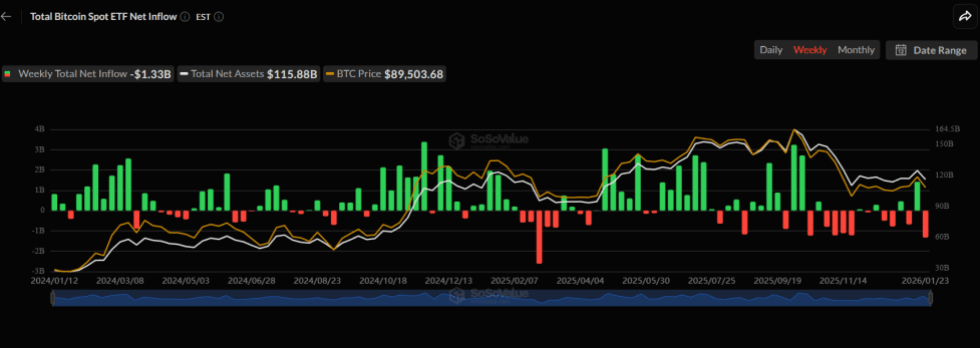
The trend in the BTC spot ETF netflow over the last couple of years | Source: SoSoValue

As displayed in the above graph, the weekly Bitcoin spot ETF netflow measured at -$1.33 billion last week. This is the highest outflow that these investment vehicles have witnessed since the end of February 2025.

Just a week prior, the market situation was the complete reverse, as spot ETFs saw net inflows amounting to $1.42 billion. The latest streak of outflows, however, have nearly entirely retraced this growth.

BTC Price

At the time of writing, Bitcoin is floating around $88,000, down more than 5% in the last seven days.

The price of the coin seems to have plunged recently | Source: BTCUSDT on TradingView


İlgili Sorular

QHow many Bitcoins did Strategy purchase in its latest acquisition, and what was the total value?

AStrategy purchased 2,932 BTC at a total value of $264.1 million.

QWhat is the primary source of funding for Strategy's latest Bitcoin purchase?

AThe purchase was funded using proceeds from its STRC and MSTR at-the-market (ATM) stock offerings.

QWhat percentage of Bitcoin's total circulating supply does Strategy now hold after this purchase?

AStrategy now holds 712,647 BTC, which is equivalent to about 3.57% of the asset's total circulating supply.

QHow did the net flow for Bitcoin spot ETFs perform last week according to the article?

ABitcoin spot ETFs saw net outflows of $1.33 billion last week, the highest since the end of February 2025.

QWhat significant action has Bitmine taken with its Ethereum holdings recently?

ABitmine has been staking its Ethereum to earn passive interest and has staked more than 2 million tokens, which it claims is more than any other entity in the world.

İlgili Okumalar

In Jinjiang, Fujian, a Storage Super Unicorn Lies Quiet

In Fujian's Jinjiang, a city known for sportswear, lies a quiet semiconductor giant: Fujian Jinhua Integrated Circuit Co. (JHICC). Once a promising domestic DRAM manufacturer alongside Yangtze Memory and ChangXin Memory Technologies (CXMT), its journey was derailed in 2018 when the U.S. placed it on an Entity List and filed criminal charges for alleged trade secret theft. This halted production for years. A turning point came in February 2024 when a U.S. federal court found JHICC not guilty. However, it had lost crucial time. While CXMT soared to become a top-valued A-share company in 2024, JHICC, with an estimated valuation of 80 billion RMB, was just restarting. Its current output is primarily customized DDR4 chips, not the advanced DDR5/HBM demanded for AI, but it still benefits from the broader memory chip upcycle. JHICC's story is tied to Chen Zhengkun, a veteran engineer who left Micron to lead the venture. Founded in 2016 with state-backed funding, JHICC partnered with Taiwan's UMC to develop DRAM technology. Rapid progress was cut short by the U.S. actions, which Micron initiated, partly due to its heavy reliance on the Chinese market. Post-sanctions, Chen's team worked to rebuild the production line with reduced reliance on U.S. technology. According to its records, JHICC achieved small-scale production and revenue growth under immense pressure. It now focuses on the stable "niche" DRAM market (e.g., TVs, routers) with a monthly capacity of ~40,000 wafers, aiming for 60,000 by 2026. It holds over 1,000 patents but remains on the Entity List. For Jinjiang, investing in JHICC was a bold industrial leap. The local government provided unwavering financial and logistical support during the crisis, helping the company survive. JHICC has become the anchor for a growing local semiconductor cluster. Though its scale lags behind domestic peers, JHICC's persistence symbolizes a hard-won foothold in a global market long dominated by Samsung, SK Hynix, and Micron. Having missed one boom, it seeks a place in the new AI-driven memory supercycle.

marsbit2 saat önce

In Jinjiang, Fujian, a Storage Super Unicorn Lies Quiet

marsbit2 saat önce

İşlemler

Spot
活动图片




