Strategy Extends Bitcoin Accumulation With New 2,932 BTC Purchase

bitcoinist2026-01-27 tarihinde yayınlandı2026-01-27 tarihinde güncellendi

Özet

Strategy, a leading Bitcoin treasury company, has expanded its holdings with a new purchase of 2,932 BTC, valued at approximately $264.1 million. This acquisition, funded through stock offerings, brings the company's total Bitcoin reserves to 712,647 BTC, representing about 3.57% of the circulating supply. These holdings are currently valued at $62.23 billion, reflecting an unrealized gain. In related news, Bitmine, another major corporate holder, added 40,302 ETH to its treasury and has staked over 2 million ETH, claiming to be the world's largest staker. Meanwhile, Bitcoin spot ETFs experienced significant net outflows of $1.33 billion last week, the highest since February 2025, nearly erasing the previous week's gains. Bitcoin's price has declined over 5% in the past week, trading around $88,000.

Bitcoin treasury company Strategy has unveiled its latest purchase of the cryptocurrency, this time tokens worth a total of $264.1 million.

Strategy Has Expanded Its Bitcoin Treasury By 2,932 BTC

In a new post on X, Strategy co-founder and chairman has shared the details related to the latest Bitcoin acquisition from the company. In total, the new purchase has added 2,932 tokens to the firm’s treasury at an average price of $90,061 per token.

According to the filing with the US Securities and Exchange Commission (SEC), the buy took place between January 20th and 25th. Strategy funded the $264.1 million acquisition using proceeds from its STRC and MSTR at-the-market (ATM) stock offerings.

In the last two weeks, the company has made purchases involving a substantial size. Last week, the company added Bitcoin worth $2.13 billion, while the week before that, it spent $1.25 billion on the cryptocurrency. Compared to these, the latest buy isn’t too big, but nonetheless showcases continued resolve for accumulation from Saylor’s firm.

Following the latest purchase, Strategy’s Bitcoin reserves have grown to 712,647 BTC, equivalent to about 3.57% of the asset’s total circulating supply. Currently, these holdings are worth around $62.23 billion, up nearly 15% over the company’s investment of $54.19 billion.

Strategy is the largest digital asset corporate holder in the world, with its closest competition being Bitmine, a BTC mining company that pivoted to an Ethereum treasury strategy last year.

According to a Monday press release, Bitmine has also participated in accumulation during the past week, adding 40,302 ETH ($116.5 million) to its holdings. The firm’s total treasury reserve has now risen to 4,243,338 ETH ($12.24 billion), corresponding to a supply share of 3.52%.

Recently, Bitmine has been putting its Ethereum toward staking to earn a passive interest on its holdings. In the past week, the company has increased its locked stake by 171,264 ETH, taking total staked supply to more than 2 million tokens. “Bitmine has staked more ETH than other entities in the world,” said Tom Lee, Bitmine chairman.

In some other news, Bitcoin spot exchange-traded funds (ETFs) saw a high amount of net outflows in the past week, according to data from SoSoValue.
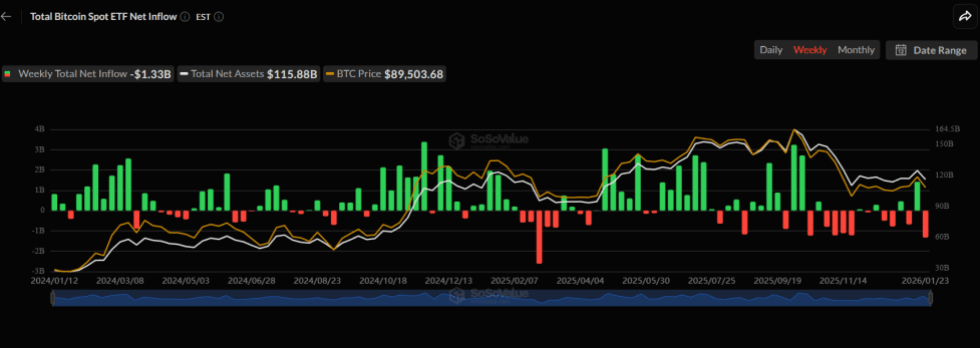
The trend in the BTC spot ETF netflow over the last couple of years | Source: SoSoValue

As displayed in the above graph, the weekly Bitcoin spot ETF netflow measured at -$1.33 billion last week. This is the highest outflow that these investment vehicles have witnessed since the end of February 2025.

Just a week prior, the market situation was the complete reverse, as spot ETFs saw net inflows amounting to $1.42 billion. The latest streak of outflows, however, have nearly entirely retraced this growth.

BTC Price

At the time of writing, Bitcoin is floating around $88,000, down more than 5% in the last seven days.

The price of the coin seems to have plunged recently | Source: BTCUSDT on TradingView


İlgili Sorular

QHow many Bitcoins did Strategy purchase in its latest acquisition, and what was the total value?

AStrategy purchased 2,932 BTC at a total value of $264.1 million.

QWhat is the primary source of funding for Strategy's latest Bitcoin purchase?

AThe purchase was funded using proceeds from its STRC and MSTR at-the-market (ATM) stock offerings.

QWhat percentage of Bitcoin's total circulating supply does Strategy now hold after this purchase?

AStrategy now holds 712,647 BTC, which is equivalent to about 3.57% of the asset's total circulating supply.

QHow did the net flow for Bitcoin spot ETFs perform last week according to the article?

ABitcoin spot ETFs saw net outflows of $1.33 billion last week, the highest since the end of February 2025.

QWhat significant action has Bitmine taken with its Ethereum holdings recently?

ABitmine has been staking its Ethereum to earn passive interest and has staked more than 2 million tokens, which it claims is more than any other entity in the world.

İlgili Okumalar

Apple's Desired On-Device AI Sees a Dark Horse Emerge: The First Cognitive Model is Born, 4B Matches GPT-5.4

A Chinese company, Tomorrow's Journey (Nextie), has introduced what it is calling the industry's first "cognitive model" for edge devices. Named New Journey Alpha, this 4-billion-parameter model reportedly matches the performance of trillion-parameter giants like GPT-5.4 in group intelligence tasks such as debate and collective decision-making. The development follows Andrej Karpathy's vision of stripping vast factual knowledge from large language models to retain only a smaller "cognitive core" capable of reasoning, planning, and knowing its own limits. This approach directly addresses the soaring computational costs and token expenses hindering AI's widespread deployment, as highlighted by incidents like Amazon shutting down an internal AI tool due to prohibitive costs. Trained via reinforcement learning on a corpus of academic papers from 1800-2020 to enhance generalization, the model enables three key advancements: 1) Improved decision quality in multi-agent systems, 2) Drastically reduced compute costs, allowing for cost-effective cloud or on-device (e.g., MacBook) deployment, and 3) The feasibility of "proactive" AI agents that act autonomously without user prompts, unlocking new commercial possibilities beyond today's reactive models. Built by the former Microsoft Xiaoice team—known for creating a 3.6B model that outperformed a 65B Llama model—the company is now focusing on the multi-agent systems sector, a field gaining significant investor interest. The model's economic impact is profound; by achieving high-level performance with minimal parameters, it fundamentally alters the cost structure of AI services, challenging the prevailing model of ever-larger parameter counts.

marsbit2 saat önce

Apple's Desired On-Device AI Sees a Dark Horse Emerge: The First Cognitive Model is Born, 4B Matches GPT-5.4

marsbit2 saat önce

OpenAI's 'Blueprint for the Future': Making AI Beneficial for Every Person on the Planet

A new transformative technology emerges every few generations. OpenAI draws a parallel with the advent of electricity in the 1920s, which initially brought convenience but ultimately enabled unprecedented progress in medicine, engineering, and living standards by empowering people to create new possibilities. AI is poised to recreate this phenomenon. Its true significance lies not in the technology itself, but in what people can achieve with it—from understanding a medical bill or starting a business to aiding scientific discovery. OpenAI believes AI should be universally accessible, allowing everyone to use it according to their own needs. This future, however, is not guaranteed. While transformative tech can centralize power, OpenAI's philosophy is that AI must serve humanity, augmenting human capabilities and broadly distributing its benefits. The company's first commitment is to build AI for human service, aiming to empower the many rather than concentrate power in a few. Safety, alignment with human intent, and oversight are paramount. OpenAI is optimistic about AI's potential to expand human welfare but remains clear-eyed about risks. The goal is to help people achieve more, not to replace them. Full automation is not the desired future; human judgment, values, and direction will become even more critical. OpenAI outlines three core goals: 1. Build automated AI researchers to accelerate and increasingly automate the research process itself, maintaining close human collaboration. The internal projection is that by March 2028, a significant portion of their research will be conducted by AI systems working alongside human researchers. 2. Accelerate economic development by advancing science, boosting productivity, and fostering growth, while ensuring the fruits are widely shared. 3. Provide a personal AGI for everyone on Earth, allowing individuals to benefit from this transformative technology in their own way. The company is entering its third phase, moving from foundational AGI research (Phase 1) to product deployment and learning from real-world use (Phase 2). The current challenge is making advanced AI abundant, affordable, safe, practical, and usable for all individuals and organizations. OpenAI concludes that a widely distributed power structure leads to a more resilient, adaptable, and free society. A positive AI future should not be controlled by a handful of entities but built, benefited from, and owned by many. If realized correctly, AI can become a cornerstone for enhancing global productivity, creativity, scientific advancement, and economic opportunity, fulfilling the mission to ensure AGI benefits all of humanity.

marsbit3 saat önce

OpenAI's 'Blueprint for the Future': Making AI Beneficial for Every Person on the Planet

marsbit3 saat önce

İşlemler

Spot
Futures
活动图片