Stop Grinding Mindlessly, the Best Airdrops Are Often 'Unexpected Encounters'

marsbit2026-01-20 tarihinde yayınlandı2026-01-20 tarihinde güncellendi

Özet

The article argues that the most valuable crypto airdrops are often "unexpected" and not the result of grinding tedious, predefined tasks. Instead, the best strategy is to build a genuine on-chain footprint by actively using protocols you believe in. Past examples like TIA, DYM, and Monad rewarded active users on various chains and in top protocols, not just those who farmed points. Publicized criteria for points programs are often exploited by Sybil attackers, diluting rewards and leading to burnout and disappointment when expectations aren't met. In contrast, retroactive airdrops with hidden criteria have less competition, as incentive-chasers avoid uncertain rewards. The core logic is that projects value real, high-value on-chain activity over low-value, repetitive Sybil behavior. By focusing on authentic engagement rather than farming, users can build a strong on-chain reputation, avoid being filtered out as a Sybil, and be pleasantly surprised by future airdrops.

Author: FIP Crypto

Compiled by: Deep Tide TechFlow

Deep Tide Intro: In the current landscape of airdrop frenzy and rampant points systems, many investors are experiencing "grinding fatigue." This article proposes a counterintuitive airdrop strategy: the best airdrops aren't "grinded" for; they are encountered unexpectedly through genuine on-chain interactions.

By analyzing cases like Monad, ZKsync, and Base, the author reveals the core logic behind retrospective airdrops—project teams value on-chain footprints that generate real value more than mechanical Sybil behavior. If you feel your airdrop returns are being diluted, this article will teach you how to build a genuine on-chain reputation for efficient, low-pressure earning.

Main Text:

Not all airdrops require endless "grinding," and the ones that don't are often the highest quality.

I've tried various types of airdrops, and many left me utterly exhausted.

But I realized the smartest way to get airdrops is actually not to deliberately "farm" them.

Here is the strategy I currently employ, aimed at "accidentally" getting the highest rewards with minimal effort:

We Get Rewarded for Being Active On-Chain

Not every project does this, but some projects distribute airdrops to active on-chain users.

Here are some examples of past retrospective airdrops:

  • TIA and DYM: Rewarded stakers in the Cosmos ecosystem and active L2 users.
  • AVAIL: Rewarded active L2 users, including Starknet users.
  • PENGU: Rewarded wallets with strong activity records on Ethereum and Solana.
  • MegaETH: SBT eligibility was based on our on-chain contributions.
  • Monad: Rewarded significant traders and depositors in top Ethereum and Solana protocols (they defined this as users who provided substantial value on-chain).

Following @Zeneca's airdrop philosophy, as long as we keep an open mind and explore new things on-chain, airdrops will come naturally.
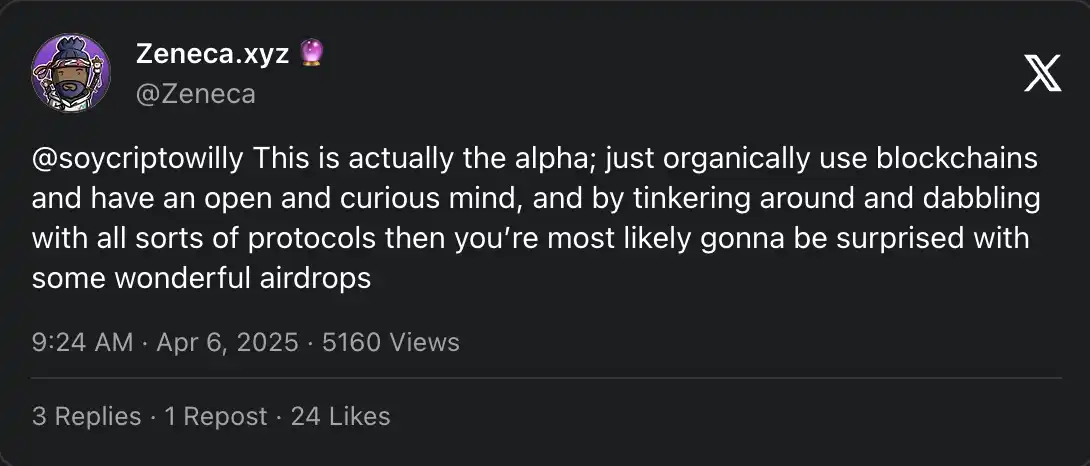
Our footprint makes us eligible for various airdrops simply by interacting with protocols we like.
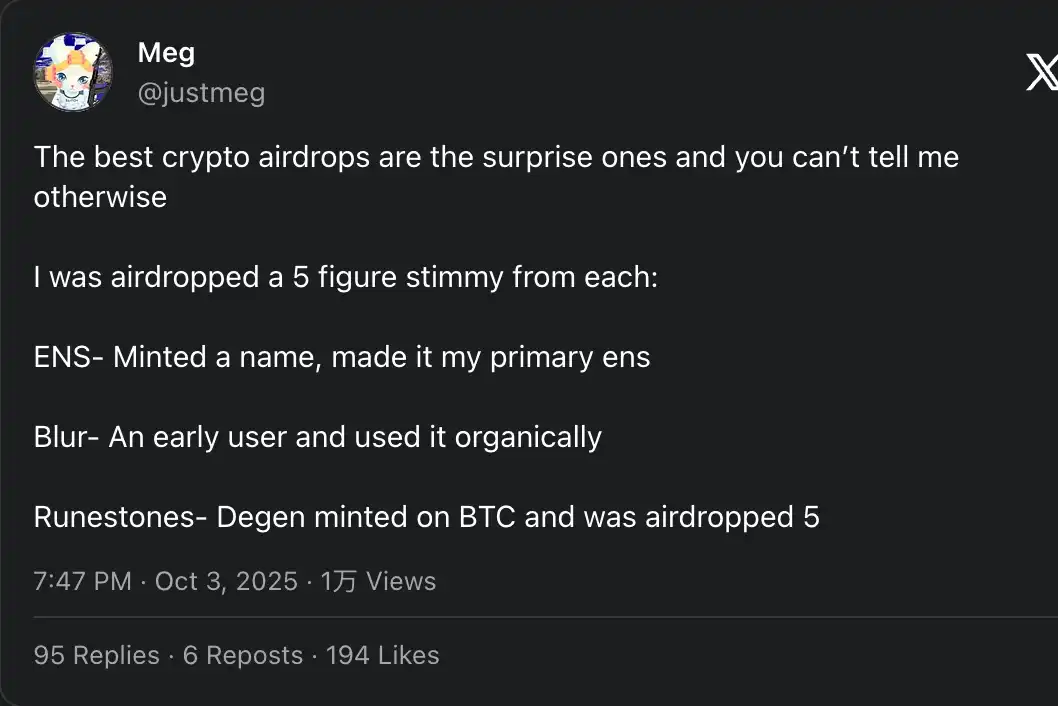
No One Knows the Criteria

Points programs with clear criteria are boring because the project team directly tells you how to grind them.

One of the most "notorious" projects is MarginFi, which ran a points program for months (or even years?) without ever revealing any token details.

But this is the trap of any points program:

No one promises you anything, and the activity can go on forever.

They can change the rules at any time; that's the game we're playing.

If the sole purpose is to hard-grind a project for an airdrop, many people get frustrated.

When our expectations for airdrop returns are too high:

We are setting ourselves up for massive disappointment.

These programs are also heavily manipulated by Sybils, which further dilutes the allocation.

Meanwhile, retrospective airdrops do not publicly share their criteria.

We can compare the criteria used by two different L2s:

  • ZKsync used Time-Weighted Average Balance (TWAB), but only announced it after the snapshot.
  • Scroll used Marks points across multiple campaigns.

Both used similar factors (liquidity) to determine eligibility.

But Scroll didn't perform well except for favoring whales, while ZKsync was quite lucrative if you had the right strategy.

Many are still angry about missing ZKsync eligibility, but in reality, we could have qualified even with a small amount of capital.

We Have Less Competition

When there's so much uncertainty, no one likes to farm airdrops.

The ideal scenario is like Base or Arbitrum:

Actively denying they will issue a token, until they change their minds and decide to issue one.
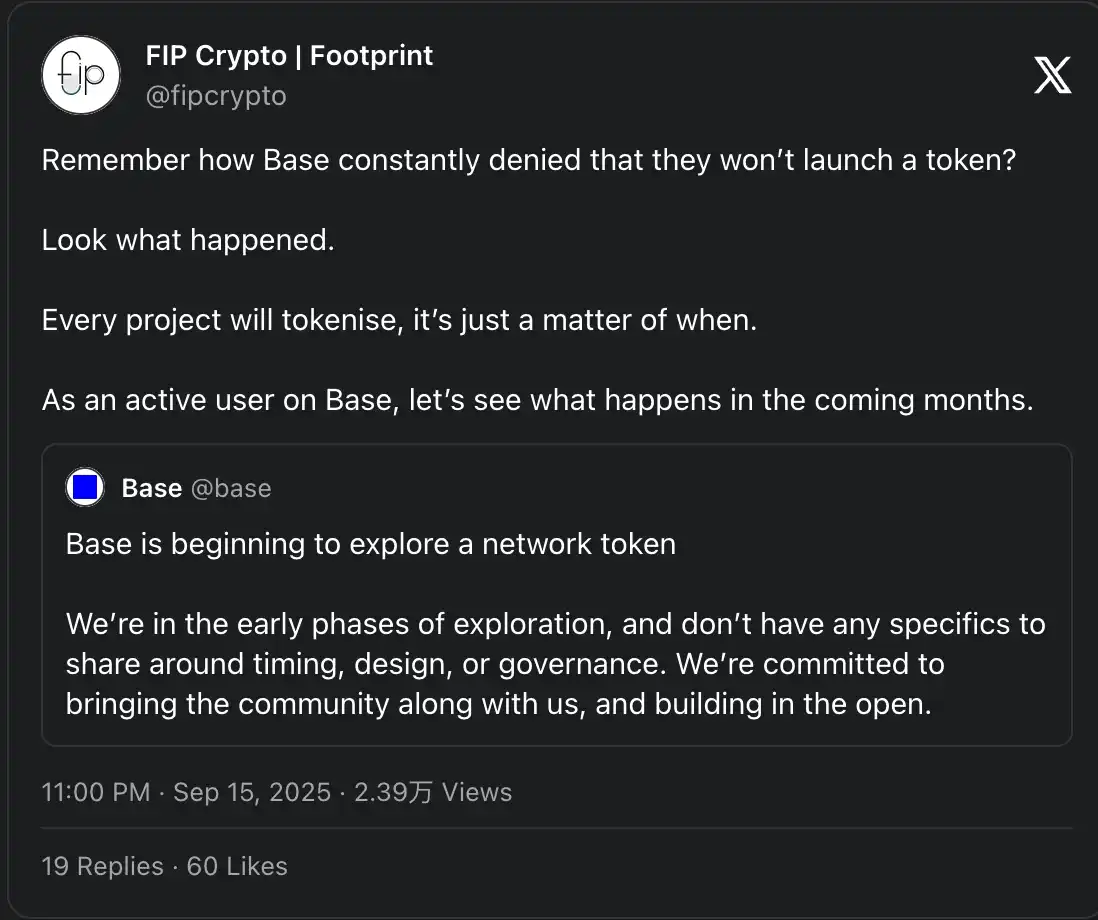
Therefore, fewer wallets actively participate because those solely chasing incentives won't join.

Or they might drop out halfway, as it doesn't make sense from a Return on Investment (ROI) perspective to farm this project.

Optimism's 5th airdrop was a huge surprise for me; it turned out only 54,723 wallets were eligible.
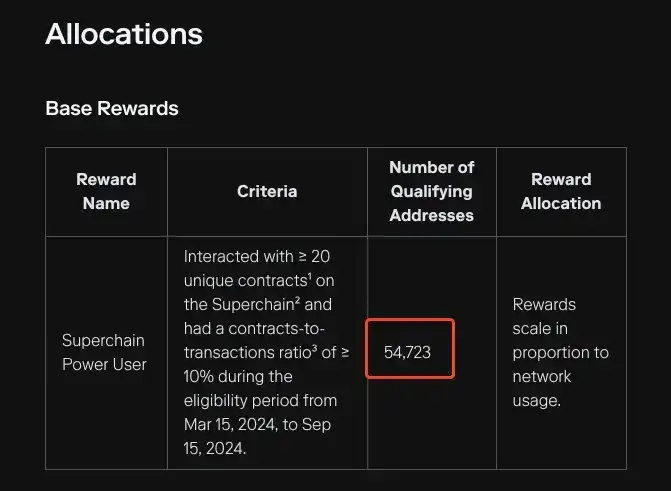
Many will adopt a wait-and-see attitude, questioning if it's worth interacting without guarantees.

But the real reward comes from uncertainty:

We risk our time and capital based on our convictions, which could be a failure or a highly rewarding investment.

Even if we fail, it helps us further optimize our strategy and understand what to avoid in the future.

We Don't Get Burned Out

I've been asked countless times which are the best projects to farm.

We are always looking for the next farm, and after the token dump, the next one.

But sometimes, the best way to play airdrops is to use products you enjoy.

Who would have thought that staying active on Aave or Uniswap would make us eligible for a Monad airdrop?
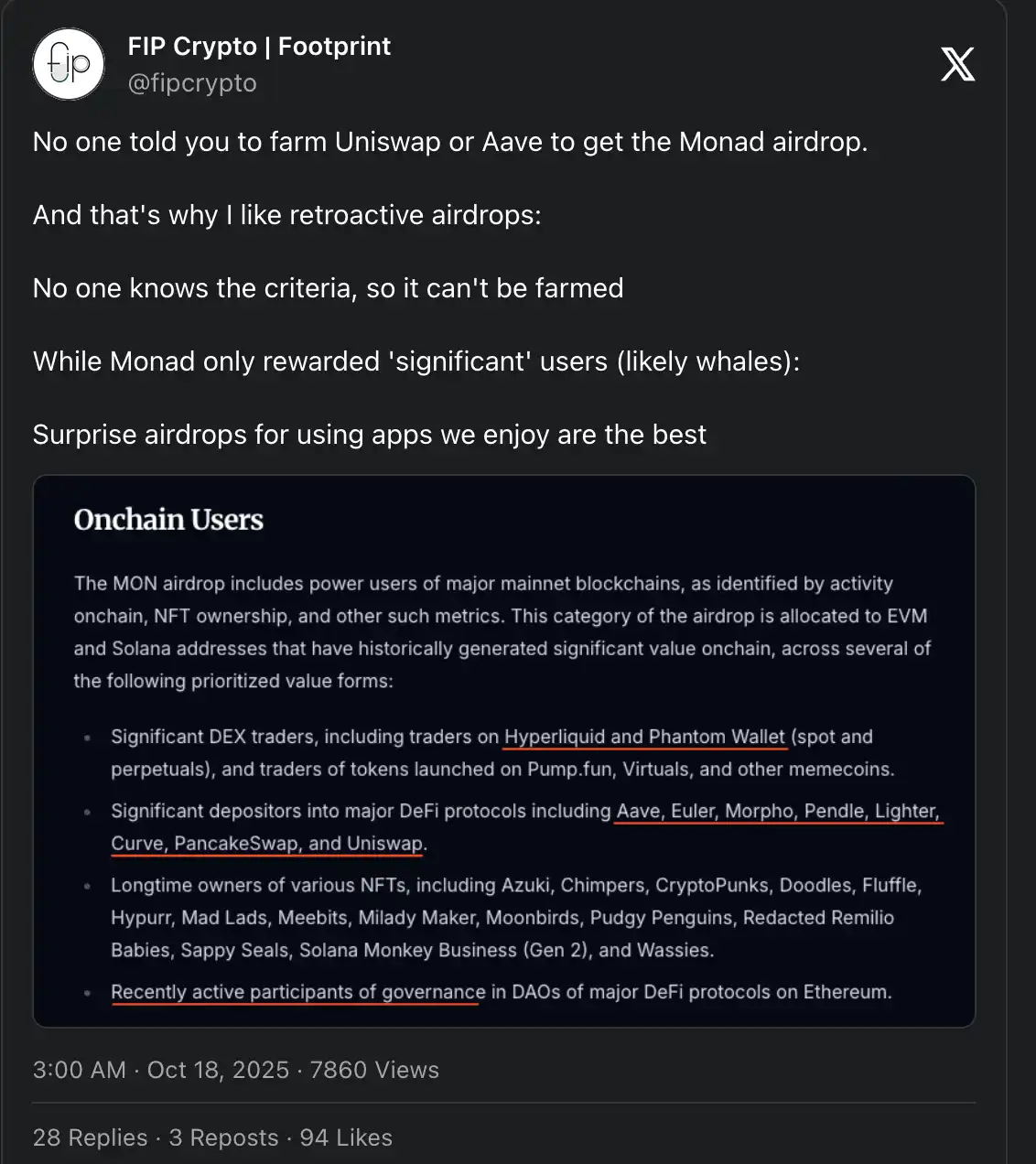
I've been burned out multiple times from constantly searching for the next Alpha.

But if we can get rewarded based on our on-chain footprint:

The real Alpha is interacting with protocols we enjoy using and profiting from in the process.
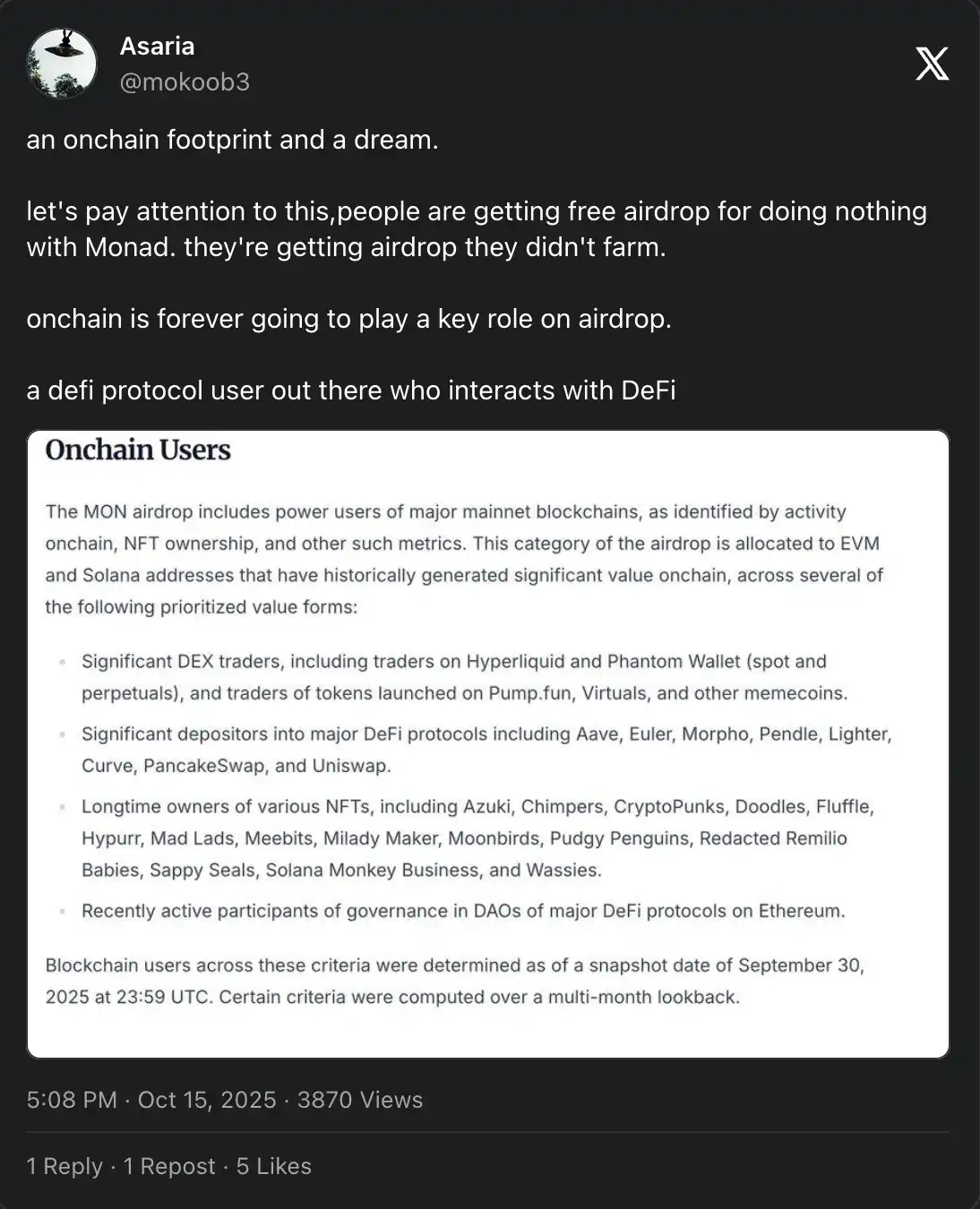
Focusing too much on the end result leads to disappointment.

Receiving surprise airdrops keeps us motivated to continue exploring on-chain.

Sybil Attacks Can't Game the System

Sybil farms mimic real users by performing the most basic operations to gain eligibility.

There will always be Sybils trying to extract value from projects.

But projects using retrospective criteria can adjust rules to filter out Sybils.

Of course, these are never perfect:

  • Real users get falsely filtered out.
  • Some Sybils get allocations.

It's hard to balance between the two; someone always gets left out.

On our end, we can try our best not to be filtered out as Sybils.

It all starts with this principle:

Value is the Primary Criterion

Retrospective airdrops are distributed based on the value your wallet provides.

Monad described it as "addresses that have historically generated significant value on-chain across different forms of value."

If we do the same low-value tasks as Sybils:

We get flagged and lose eligibility.

Project teams don't want to reward farmers who repeatedly make the same low-value swaps.

Instead, they reward high-value contributions.

But there are no strict rules for this; project teams decide which behaviors they want to reward.

So, to be eligible, we just need to find applications we like and use them consistently.

Our footprint will be recognized by other projects, and we'll get rewarded for using applications we enjoy.

Building a Strong On-Chain Social Footprint

The on-chain footprint has been declared dead by many, but I still believe it plays a key role in future airdrops.

Even though airdrops now heavily lean towards social distributions:

The on-chain footprint still forms the foundation of trust for your social reputation.

Others can easily tell if you're faking it or genuinely participating, so there's no point in trying to lie.

You just need to talk about what you've done on-chain to increase your "surface area for luck."

İlgili Sorular

QWhat is the core argument of the article regarding the best strategy to receive airdrops?

AThe article argues that the best airdrops are not obtained through deliberate, repetitive 'farming' but are instead 'unexpectedly' received through genuine, valuable on-chain activity and interaction with protocols one genuinely likes and uses.

QAccording to the author, what is a key advantage of public points programs for airdrops?

AA key disadvantage of public points programs is that they are heavily manipulated by Sybil attacks, which dilutes the rewards for genuine users, and the projects can change the rules at any time with no guarantee of a token distribution.

QHow do retrospective airdrops, like the one from Monad, differ from public points programs?

ARetrospective airdrops do not publicly share their criteria beforehand. They are distributed based on the value a wallet's historical on-chain activity provided, rewarding genuine users rather than low-value, repetitive actions common in Sybil farming.

QWhy does the author suggest that having less competition is beneficial for receiving airdrops?

ALess competition arises when a project's token distribution is uncertain (e.g., Base, Arbitrum initially denying a token). This discourages users who are only motivated by guaranteed incentives, leaving more rewards for those who interact with the protocol based on genuine belief.

QWhat is the recommended way to build a strong on-chain reputation to qualify for future airdrops?

AThe recommended way is to establish a genuine on-chain footprint by actively exploring and consistently using new protocols and applications that you genuinely like, as this valuable activity is what project teams look to reward.

İlgili Okumalar

Apple's Desired On-Device AI Sees a Dark Horse Emerge: The First Cognitive Model is Born, 4B Matches GPT-5.4

A Chinese company, Tomorrow's Journey (Nextie), has introduced what it is calling the industry's first "cognitive model" for edge devices. Named New Journey Alpha, this 4-billion-parameter model reportedly matches the performance of trillion-parameter giants like GPT-5.4 in group intelligence tasks such as debate and collective decision-making. The development follows Andrej Karpathy's vision of stripping vast factual knowledge from large language models to retain only a smaller "cognitive core" capable of reasoning, planning, and knowing its own limits. This approach directly addresses the soaring computational costs and token expenses hindering AI's widespread deployment, as highlighted by incidents like Amazon shutting down an internal AI tool due to prohibitive costs. Trained via reinforcement learning on a corpus of academic papers from 1800-2020 to enhance generalization, the model enables three key advancements: 1) Improved decision quality in multi-agent systems, 2) Drastically reduced compute costs, allowing for cost-effective cloud or on-device (e.g., MacBook) deployment, and 3) The feasibility of "proactive" AI agents that act autonomously without user prompts, unlocking new commercial possibilities beyond today's reactive models. Built by the former Microsoft Xiaoice team—known for creating a 3.6B model that outperformed a 65B Llama model—the company is now focusing on the multi-agent systems sector, a field gaining significant investor interest. The model's economic impact is profound; by achieving high-level performance with minimal parameters, it fundamentally alters the cost structure of AI services, challenging the prevailing model of ever-larger parameter counts.

marsbit1 saat önce

Apple's Desired On-Device AI Sees a Dark Horse Emerge: The First Cognitive Model is Born, 4B Matches GPT-5.4

marsbit1 saat önce

OpenAI's 'Blueprint for the Future': Making AI Beneficial for Every Person on the Planet

A new transformative technology emerges every few generations. OpenAI draws a parallel with the advent of electricity in the 1920s, which initially brought convenience but ultimately enabled unprecedented progress in medicine, engineering, and living standards by empowering people to create new possibilities. AI is poised to recreate this phenomenon. Its true significance lies not in the technology itself, but in what people can achieve with it—from understanding a medical bill or starting a business to aiding scientific discovery. OpenAI believes AI should be universally accessible, allowing everyone to use it according to their own needs. This future, however, is not guaranteed. While transformative tech can centralize power, OpenAI's philosophy is that AI must serve humanity, augmenting human capabilities and broadly distributing its benefits. The company's first commitment is to build AI for human service, aiming to empower the many rather than concentrate power in a few. Safety, alignment with human intent, and oversight are paramount. OpenAI is optimistic about AI's potential to expand human welfare but remains clear-eyed about risks. The goal is to help people achieve more, not to replace them. Full automation is not the desired future; human judgment, values, and direction will become even more critical. OpenAI outlines three core goals: 1. Build automated AI researchers to accelerate and increasingly automate the research process itself, maintaining close human collaboration. The internal projection is that by March 2028, a significant portion of their research will be conducted by AI systems working alongside human researchers. 2. Accelerate economic development by advancing science, boosting productivity, and fostering growth, while ensuring the fruits are widely shared. 3. Provide a personal AGI for everyone on Earth, allowing individuals to benefit from this transformative technology in their own way. The company is entering its third phase, moving from foundational AGI research (Phase 1) to product deployment and learning from real-world use (Phase 2). The current challenge is making advanced AI abundant, affordable, safe, practical, and usable for all individuals and organizations. OpenAI concludes that a widely distributed power structure leads to a more resilient, adaptable, and free society. A positive AI future should not be controlled by a handful of entities but built, benefited from, and owned by many. If realized correctly, AI can become a cornerstone for enhancing global productivity, creativity, scientific advancement, and economic opportunity, fulfilling the mission to ensure AGI benefits all of humanity.

marsbit2 saat önce

OpenAI's 'Blueprint for the Future': Making AI Beneficial for Every Person on the Planet

marsbit2 saat önce

Arthur Hayes' New Article: AI Bubble Nears Bursting, Crypto Market Faces Short-Term Pressure

In a new essay, Arthur Hayes argues that the AI market bubble is approaching a rupture, which will place significant short-term pressure on crypto assets. He identifies rising oil prices, a trio of massive tech IPOs (SpaceX, Anthropic, OpenAI), and potential anti-AI political rhetoric from Trump as the three key catalysts for a correction. Hayes posits that the prolonged blockage of the Strait of Hormuz will drive energy prices higher, increasing operational costs for data centers and squeezing AI company profits. Simultaneously, the market may struggle to absorb the upcoming wave of multi-trillion dollar tech IPOs. Furthermore, with high inflation hurting his election chances, Trump could pivot to attacking the AI sector with proposals for heavy taxation and regulation to win over voters, spooking the market. Hayes notes that nearly all new dollar liquidity since 2022 has flowed into the AI sector, leaving little for Bitcoin, explaining its recent underperformance. He believes an AI stock crash would trigger a broad risk-off sentiment and credit contraction, dragging down crypto in the near term. Consequently, his fund, Maelstrom, has sold all AI-related stocks and non-core cryptocurrencies, retaining only Bitcoin and Ethereum while building positions in traditional energy stocks. He anticipates Bitcoin will bottom and resume its bull run only after the AI bubble pops and a new monetary easing cycle begins.

marsbit2 saat önce

Arthur Hayes' New Article: AI Bubble Nears Bursting, Crypto Market Faces Short-Term Pressure

marsbit2 saat önce

İşlemler

Spot
Futures
活动图片