Stop Focusing Only on Bitcoin—We Are Already in a Bear Market

marsbit2025-12-18 tarihinde yayınlandı2025-12-18 tarihinde güncellendi

Özet

The author argues that the crypto market has been in a bear market for about a year, despite many investors' reluctance to accept it. The peak of market euphoria occurred around November 2024, with the launch of $TRUMP marking the final exuberance. Two key misconceptions are highlighted: First, the meme coin frenzy was not a precursor to an "altseason"—it *was* the altseason itself. Unlike previous cycles with distinct new narratives and liquidity splits between "dumb money" and "hot money," this cycle lacked differentiation, keeping both groups in the same arena. Second, Bitcoin is no longer driven primarily by crypto-native cycles but by institutional and macro factors, meaning its price resilience doesn’t indicate an ongoing bull market. The bear market began after the $TRUMP peak, and the market has since gone through phases of anxiety, denial, panic, and now anger and depression. The author writes to encourage debate, correct flawed mental models, and signal a intention to begin accumulating near what they believe is the bottom.

Author: XY

Compiled by: Tim, PANews

One Year into the Bear Market

It took me some time to convince myself: we are in a bear market, and it has been going on for about a year.

November 2024 was a period of market excitement, and the launch of $TRUMP pushed the market into extreme euphoria—it was the final frenzy that no one wanted to believe was the end.

Below, I will explain my perspective.

It all starts with that old cliché: "History doesn't repeat itself, but it often rhymes."

This foolish saying has been hugely misleading for market analysis—it's downright harmful.

It has made us overly reliant on historical patterns and, at the same time, eroded our ability to question.

Yes, this reliance on historical patterns for prediction is like viewing the world through a prism carved with old designs. It inevitably misinterprets new realities and ultimately causes us to overlook the latest driving factors in the market. This is precisely where the danger lies.

More specifically, we misread two fundamental changes.

Change One

We thought Meme mania was the spark that would ignite altseason, but in reality, Meme mania was altseason itself.

When Meme coins surged one after another, we thought it was just the beginning.

Some talked about altseason, and a few bold ones even mentioned a raging bull market.

We were all wrong.

Keep in mind that previous cycles always featured bubble叠加-bubble phenomena, typically driven by new narratives. These new narratives gave rise to new markets, which often led to differentiation.

This differentiation was important because it split liquidity into two distinct groups.

The first group is dumb money.

This type of capital prefers simple operations, market depth, and low barriers to entry, staying within highly liquid tokens.

The second group is hot money.

This capital actively pursues returns and is willing to overcome complexity to find opportunities.

The subsequent short-term rotation of hot money fueled bullish trends, which eventually evolved into what people called altseason.

This cycle never produced that trend. There was no new narrative to explore this time.

From start to finish, both groups remained in the same arena.

Dumb money could participate effortlessly, and hot money could still profit by getting in early.

Our mistake was expecting an "altseason" to occur.

But it never happened.

The only path the market had was: from Bitcoin to a new narrative, then to altseason.

That used to be the script you wanted.

But the reality is that Meme mania became the altseason people anticipated.

November 2024 marked the peak profitability for most traders, and TRUMP was the climax of the market狂欢.

Change Two

Bitcoin is no longer driven internally by the crypto market but is instead dominated by institutions and macro markets.

And the macro environment follows a different timeline and reacts differently to changes.

After the TRUMP surge, many interpreted Bitcoin's resilience as the market still being in a consolidation or bull market correction phase.

This interpretation stemmed from an anchoring bias based on past experiences: people are accustomed to the idea that Bitcoin must crash sharply to confirm a bear market, applying this to a market structure now dominated by institutions.

This cognitive framework is outdated.

Bitcoin has actually decoupled from the native cryptocurrency market cycle.

Once you recognize this, the subsequent developments make perfect sense.

The bear market began after the MEME coin TRUMP, regardless of Bitcoin's price performance.

So, stop focusing only on Bitcoin.

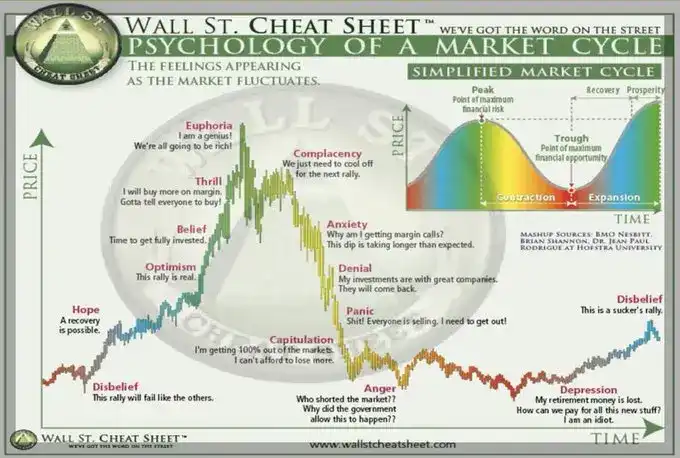
From January 2025 to the present, the market has fully gone through the three stages of anxiety, denial, and panic. If you've made profits, you can clearly see these stages in the people around you; if you've suffered losses, you've experienced these emotions firsthand.

We are now in the stage of anger and depression.

So, why am I writing this post?

Two reasons.

First, one of the reasons the crypto market has been profitable for me is the ability to buy near the bottom. If you misjudge the market phase, this advantage disappears.

If you think the bear market isn't over yet, you'll keep waiting for the bottom to arrive, unaware that you're already in it.

Second, I hope this perspective sparks fierce debate or helps people become alert and break free from the wrong cognitive framework.

I have extremely high confidence in this judgment.

That's why I will soon start acting to prove my judgment.
Trend Kriptolar

İlgili Sorular

QAccording to the author, when did the bear market in cryptocurrency actually begin?

AThe author states that the bear market began around the time of the $TRUMP meme coin frenzy, which was in November 2024, and has been going on for about a year.

QWhat were the two fundamental changes that the author believes most people misread about the market cycle?

AThe two changes were: 1) Meme frenzy was the altcoin season itself, not a precursor to it, and 2) Bitcoin is now dominated by institutional and macro markets, not the internal crypto market cycle.

QWhy does the author argue that there was no traditional 'altcoin season' in this cycle?

AThe author argues there was no traditional altcoin season because no new narrative emerged to create a differentiation between 'dumb money' and 'hot money.' Both groups operated in the same arena of meme coins, so the expected rotation of hot money into other altcoins never occurred.

QWhat is the danger of relying on the saying 'history doesn't repeat itself, but it often rhymes' for market analysis?

AThe author calls this saying misleading and pernicious because it creates a path dependency and reduces our ability to question new realities, causing us to misread new market factors and ignore the latest driving forces.

QWhat is the author's main purpose for writing this article?

AThe author's main purposes are: 1) To help people recognize they are already in a bear market so they can take advantage of buying near the bottom, and 2) To spark debate and help people break free from incorrect cognitive frameworks about the market.

İlgili Okumalar

Qualcomm: AI Hype Subsides, When Will Smartphones Emerge from the Gloom?

Qualcomm reported its Q3 FY2026 results (ending June 2026), with revenue of $9.95B, down 4% YoY but above expectations. Gross margin declined to 53.1%, pressured by rising costs across manufacturing and memory. Key business segments showed mixed performance: Handset revenue fell 19.6% YoY to $5.09B, dragged by an 11% decline in non-Apple Android shipments and weaker high-end mix. Conversely, Automotive revenue surged 61% to $1.59B, and IoT grew 9% to $1.83B. Core operating profit dropped 41% YoY due to margin compression and higher expenses. Management's Q4 FY2026 guidance projects revenue of $9.7B-$10.5B, in line with consensus, but Non-GAAP EPS guidance of $2.05-$2.25 fell short of expectations. Amidst persistent weakness in its core handset market, Qualcomm is pursuing growth in AI, focusing on Edge AI (smartphones, PCs, automotive) and Data Center AI. Its data center strategy includes four pillars: AI accelerators (e.g., AI200), commercial CPUs (Dragonfly C1000), custom silicon, and connectivity solutions. While these initiatives initially boosted its stock, concerns over AI capital expenditure sustainability have since erased those gains. The company targets $5B in data center revenue for FY2027 and $15B for FY2029. The report concludes that with the traditional handset business still under pressure, the data center opportunity is currently viewed as a longer-term option, and a more conservative valuation based on core operations may be warranted until AI contributions materialize.

marsbit5 dk önce

Qualcomm: AI Hype Subsides, When Will Smartphones Emerge from the Gloom?

marsbit5 dk önce

From TPU to Self-Evolving Agents: How Jeff Dean Predicts the Next Step in AI

At the 2026 YC Startup School, Jeff Dean outlined his vision for AI's next phase, shifting focus from simply scaling models to building intelligent, autonomous systems. He believes AI's progress is no longer just about creating smarter models, but about integrating them into systems capable of long-term, iterative work, automated experimentation, and continuous learning. This evolution moves the competition from "who has the bigger model" to "who can best organize intelligence." Dean suggests AI capabilities are now comparable to a junior engineer, enabling the automation of complex workflows. However, the true challenge and opportunity lie in managing these AI "workers" at scale. He emphasizes the importance of **context engineering**—structuring tools, memory, and feedback loops—over raw model power. For startups, this means building deep expertise in niche domains where general models currently fail (near 0-1% success rates), leveraging proprietary data, specialized tools, and domain-specific evaluators. A recurring theme is re-examining fundamental constraints. Dean's past work, like moving Google's search index to memory or creating the TPU, stemmed from questioning outdated assumptions about hardware and cost. He sees similar inflection points today, particularly in **specialized inference hardware** to drastically reduce latency and energy consumption for real-time Agent operation. Notably, he points out that in modern AI systems, the dominant cost is often not computation but **data movement**. Reliable, long-running Agents require robust system design, borrowing concepts from distributed computing like checkpointing, state management, and parallel exploration to handle failures and maintain progress over days or weeks. As AI automates execution, the scarcest human skills will shift to **defining clear specifications**, **judging what problems are worth solving** (taste), and designing effective feedback loops. Ultimately, Dean's framework prioritizes understanding the problem deeply, identifying the true bottlenecks, and systematically building closed-loop systems where AI can not only perform tasks but also improve AI itself.

marsbit5 dk önce

From TPU to Self-Evolving Agents: How Jeff Dean Predicts the Next Step in AI

marsbit5 dk önce

İşlemler

Spot

Popüler Makaleler

O Nasıl Satın Alınır

HTX.com’a hoş geldiniz! O1 exchange (O) satın alma işlemlerini basit ve kullanışlı bir hâle getirdik. Adım adım açıkladığımız rehberimizi takip ederek kripto yolculuğunuza başlayın. 1. Adım: HTX Hesabınızı OluşturunHTX'te ücretsiz bir hesap açmak için e-posta adresinizi veya telefon numaranızı kullanın. Sorunsuzca kaydolun ve tüm özelliklerin kilidini açın. Hesabımı Aç2. Adım: Kripto Satın Al Bölümüne Gidin ve Ödeme Yönteminizi SeçinKredi/Banka Kartı: Visa veya Mastercard'ınızı kullanarak anında O1 exchange (O) satın alın.Bakiye: Sorunsuz bir şekilde işlem yapmak için HTX hesap bakiyenizdeki fonları kullanın.Üçüncü Taraflar: Kullanımı kolaylaştırmak için Google Pay ve Apple Pay gibi popüler ödeme yöntemlerini ekledik.P2P: HTX'teki diğer kullanıcılarla doğrudan işlem yapın.Borsa Dışı (OTC): Yatırımcılar için kişiye özel hizmetler ve rekabetçi döviz kurları sunuyoruz.3. Adım: O1 exchange (O) Varlıklarınızı SaklayınO1 exchange (O) satın aldıktan sonra HTX hesabınızda saklayın. Alternatif olarak, blok zinciri transferi yoluyla başka bir yere gönderebilir veya diğer kripto para birimlerini takas etmek için kullanabilirsiniz.4. Adım: O1 exchange (O) Varlıklarınızla İşlem YapınHTX'in spot piyasasında O1 exchange (O) ile kolayca işlemler yapın.Hesabınıza erişin, işlem çiftinizi seçin, işlemlerinizi gerçekleştirin ve gerçek zamanlı olarak izleyin. Hem yeni başlayanlar hem de deneyimli yatırımcılar için kullanıcı dostu bir deneyim sunuyoruz.

429 Toplam GörüntülenmeYayınlanma 2026.06.19Güncellenme 2026.06.29

O Nasıl Satın Alınır

PROS Nasıl Satın Alınır

HTX.com’a hoş geldiniz! Pharos (PROS) satın alma işlemlerini basit ve kullanışlı bir hâle getirdik. Adım adım açıkladığımız rehberimizi takip ederek kripto yolculuğunuza başlayın. 1. Adım: HTX Hesabınızı OluşturunHTX'te ücretsiz bir hesap açmak için e-posta adresinizi veya telefon numaranızı kullanın. Sorunsuzca kaydolun ve tüm özelliklerin kilidini açın. Hesabımı Aç2. Adım: Kripto Satın Al Bölümüne Gidin ve Ödeme Yönteminizi SeçinKredi/Banka Kartı: Visa veya Mastercard'ınızı kullanarak anında Pharos (PROS) satın alın.Bakiye: Sorunsuz bir şekilde işlem yapmak için HTX hesap bakiyenizdeki fonları kullanın.Üçüncü Taraflar: Kullanımı kolaylaştırmak için Google Pay ve Apple Pay gibi popüler ödeme yöntemlerini ekledik.P2P: HTX'teki diğer kullanıcılarla doğrudan işlem yapın.Borsa Dışı (OTC): Yatırımcılar için kişiye özel hizmetler ve rekabetçi döviz kurları sunuyoruz.3. Adım: Pharos (PROS) Varlıklarınızı SaklayınPharos (PROS) satın aldıktan sonra HTX hesabınızda saklayın. Alternatif olarak, blok zinciri transferi yoluyla başka bir yere gönderebilir veya diğer kripto para birimlerini takas etmek için kullanabilirsiniz.4. Adım: Pharos (PROS) Varlıklarınızla İşlem YapınHTX'in spot piyasasında Pharos (PROS) ile kolayca işlemler yapın.Hesabınıza erişin, işlem çiftinizi seçin, işlemlerinizi gerçekleştirin ve gerçek zamanlı olarak izleyin. Hem yeni başlayanlar hem de deneyimli yatırımcılar için kullanıcı dostu bir deneyim sunuyoruz.

423 Toplam GörüntülenmeYayınlanma 2026.06.22Güncellenme 2026.06.29

PROS Nasıl Satın Alınır

VERONA Nedir

I. Proje Tanıtımı VERONA, zincir soyutlaması aracılığıyla herkes için, her yerde inşa edilmiş bir blok zinciridir. Genel Soyutlama katmanını kullanarak, VERONA, hesaplar, imzalar ve birlikte çalışabilirlik gibi karmaşık blok zinciri işlevlerini doğrudan protokol seviyesinde entegre ederek kendini ayırt eder. Bu yaklaşım, temel teknolojileri anlamaya gerek kalmadan blok zinciri uygulamalarıyla etkileşimde bulunmayı sağlar.1) Temel Bilgiler İsim: VERONA (VERONA)III. İlgili Bağlantılar Resmi web sitesi bağlantısı: https://xion.burnt.com/ Whitepaper: https://xion.burnt.com/whitepaper.pdf Keşif Araçları: https://explorer.burnt.com/ Sosyal Medya: https://x.com/burnt_xion Not: Proje tanıtımı, resmi proje ekibi tarafından yayımlanan veya sağlanan materyallerden alınmıştır, yalnızca referans içindir ve yatırım tavsiyesi teşkil etmez. HTX, ortaya çıkan doğrudan veya dolaylı kayıplardan sorumluluk kabul etmez.

380 Toplam GörüntülenmeYayınlanma 2026.06.22Güncellenme 2026.06.22

VERONA Nedir

Tartışmalar

HTX Topluluğuna hoş geldiniz. Burada, en son platform gelişmeleri hakkında bilgi sahibi olabilir ve profesyonel piyasa görüşlerine erişebilirsiniz. Kullanıcıların A (A) fiyatı hakkındaki görüşleri aşağıda sunulmaktadır.

活动图片














