Starting from 9.9 RMB, Three Major Carriers Enter the Token Business. Will Using AI Be Like Paying a Phone Bill in the Future?

marsbit2026-05-19 tarihinde yayınlandı2026-05-19 tarihinde güncellendi

Özet

China's three major telecom operators—China Telecom, China Mobile, and China Unicom—have officially entered the AI token business, launching low-cost token packages for individuals and businesses. China Telecom introduced six trial commercial token plans. For individuals and families, prices start at 9.9 yuan/month for 10 million tokens. For developers and SMEs, plans range from 39.9 yuan/month for 15 million tokens to 299.9 yuan/month for 150 million tokens. Shanghai Mobile launched a token service offering 400,000 tokens for 1 yuan, payable via phone bill. It also started an "AI Hui Shen Huo" upgrade plan for smart home products. China Unicom's cloud division released personal and team token plans. Personal plans start at 15 yuan/month for 6 million tokens, while team plans begin at 198 yuan/month (approximately 200 million tokens). Local branches in Sichuan and Shanghai have also rolled out their own token packages and AI strategies. This move marks a shift for operators, repackaging AI model usage (tokens) into familiar, subscription-based services like data plans. By leveraging their vast user base, billing systems, and distribution channels, they aim to make AI access as simple and widespread as paying a phone bill, potentially establishing tokens as a new fundamental utility.

ZHIDONGSHE, May 18 — In recent days, China Telecom, China Mobile, and China Unicom have successively launched Token packages and related AI services, selling large model call volume to users such as individuals, families, developers, and small and medium-sized enterprises.

This marks the first formal entry of the three major carriers into the Token business, which was previously dominated by large model manufacturers, internet giants, and cloud service providers.

Yesterday, China Telecom launched a series of trial commercial Token packages. Personal and family customers can obtain 10 million Tokens for as low as 9.9 RMB/month; on the same day, Shanghai Mobile launched a Token general service, where 1 RMB can buy 400,000 Tokens, supporting payment via phone bill; Unicom Cloud recently collaborated with Unicom Yuanjing to launch Token Plan Personal Edition and Team Edition dual-track products. China Unicom's Sichuan and Shanghai branches also released local Token packages and AI strategy upgrades.
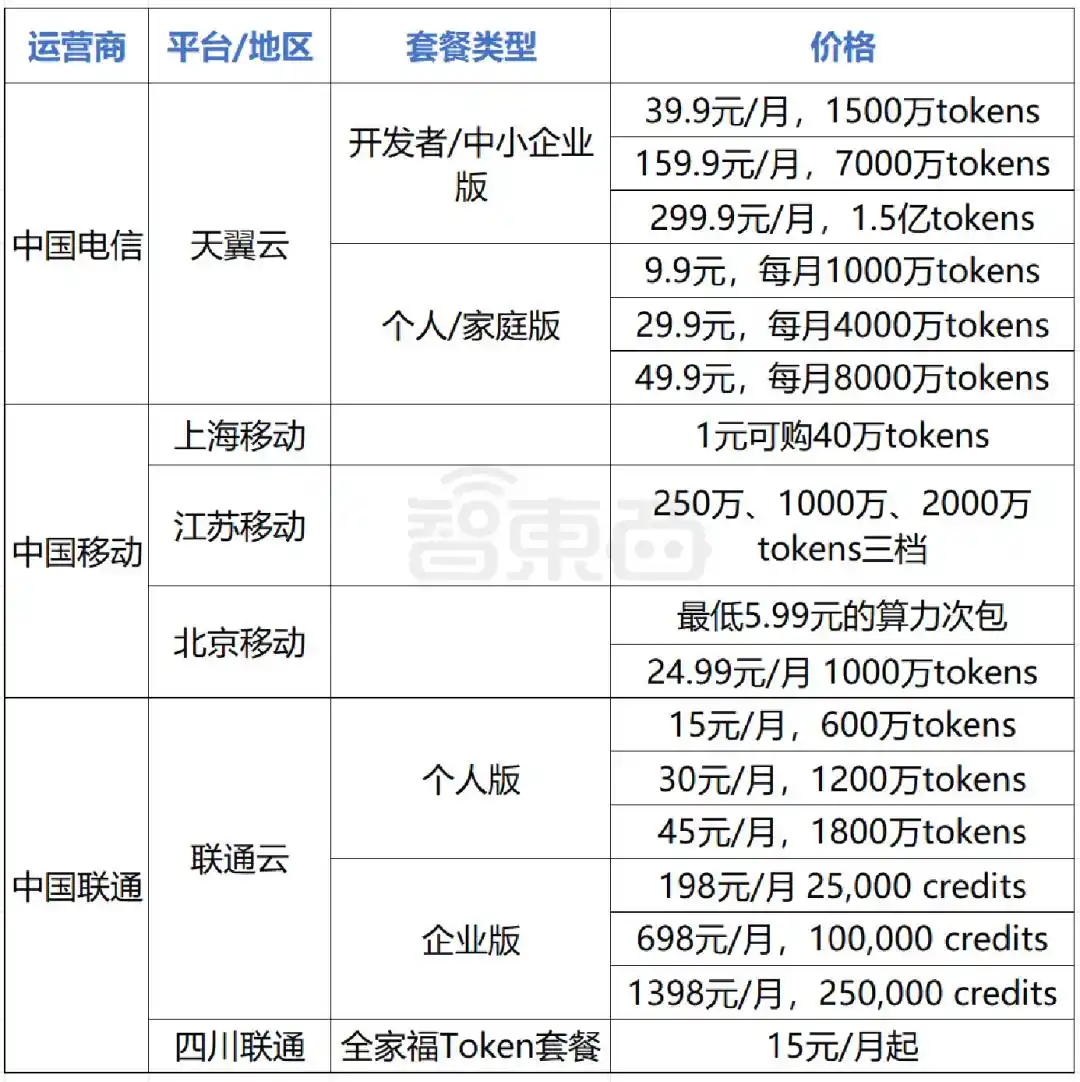
Comparison of Token Packages from the Three Major Carriers (Chart by ZHIDONGSHE)

The Token packages from the three major carriers have lowered the price threshold to tens of RMB or even single-digit RMB. China Telecom and China Mobile adopt tiered sales for individuals and enterprise teams, while China Mobile and China Unicom introduce special policies for different provinces.

It can be seen that all three major carriers are packaging large model call volume from a backend cloud platform capability into a basic service similar to data packages or broadband packages. In the past, data traffic was one of the core businesses for carriers. Now, in the AI era, the three major carriers launching Token packages are, to some extent, attempting to get a share in the Token consumption track, and may even become new primary operators leveraging their massive customer base.

01. China Telecom Launches Six-Tier Token Packages, Starting from 9.9 RMB/Month

Yesterday, China Telecom launched a series of trial commercial Token packages, offering six tiers of Token Plans for developers and SME customers, as well as personal and family customers, along with uplink speed boost packages for broadband and security protection packages.

For developers and SME customers, China Telecom provides an integrated service of "Token + Connectivity + Security", introducing three tiers of Token Plans: Basic, Professional, and Premium, with monthly fees of 39.9 RMB, 159.9 RMB, and 299.9 RMB, corresponding to 15 million Tokens, 70 million Tokens, and 150 million Tokens per month, respectively. This package integrates China Telecom's Xingchen Large Model and GLM-5 and other mainstream domestic large models, suitable for scenarios like AI programming and creation, code development and debugging, and intelligent agent setup and operation.

For personal and family customers, China Telecom launched three tiers of Token Plans: Light, Standard, and Premium, with monthly fees of 9.9 RMB, 29.9 RMB, and 49.9 RMB, corresponding to 10 million Tokens, 40 million Tokens, and 80 million Tokens per month, respectively. This package integrates China Telecom's Xingchen Large Model and DeepSeekV3.2 and other ecosystem large models, suitable for scenarios like daily office assistance, learning and creation, and copywriting.
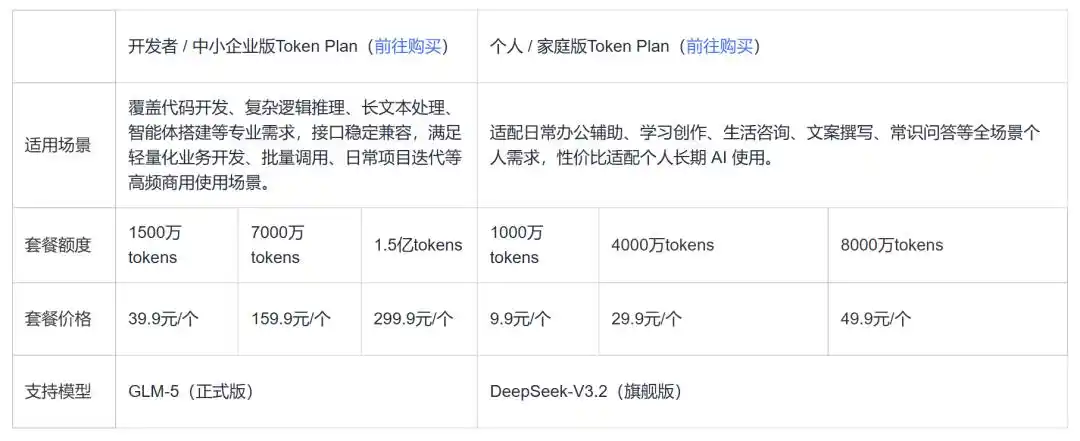
China Telecom Launches 6-Tier Token Plan (Image Source: Tianyi Cloud)

Users can subscribe through channels like the Tianyi Cloud official website and the China Telecom App. Customers who already have local hardware terminals (e.g., Mac Mini) can set their own API keys for applications like China Telecom's TeleClaw, third-party OpenClaw, and Hermes; customers without local hardware terminals can directly use them by purchasing Tianyi AI Cloud Computers with built-in intelligent agents like TeleClaw, OpenClaw, and Hermes.

Additionally, China Telecom will launch Tianyi Token Coins and Token Benefits for Token ecosystem partners. Customers can use points to exchange Token volume packages and AI applications. China Telecom will also collaborate with more AI ecosystem application partners to operate Token benefits.

02. Shanghai Mobile Launches Token General Service, 1 RMB Buys 400,000 Tokens

According to a report from the Shanghai Municipal Commission of Economy and Informatization, on May 17, China Mobile Shanghai Company launched a Token general service at the World Telecommunication Day press conference and jointly launched the co-branded WorkBuddy Intelligent Agent Workbench with Tencent. 1 RMB can buy 400,000 Tokens, supporting phone bill payment and multi-model universality.

Shanghai Mobile also simultaneously launched the "AI Hui Shen Huo" upgrade plan, introducing products like Super Portable Wi-Fi, Dual Vivid Jingcai Audio-Visual, AI Smart Viewing, and Love Home Lingxi Screen for citizens, accelerating the entry of embodied intelligence and Token inclusive services into home scenarios.
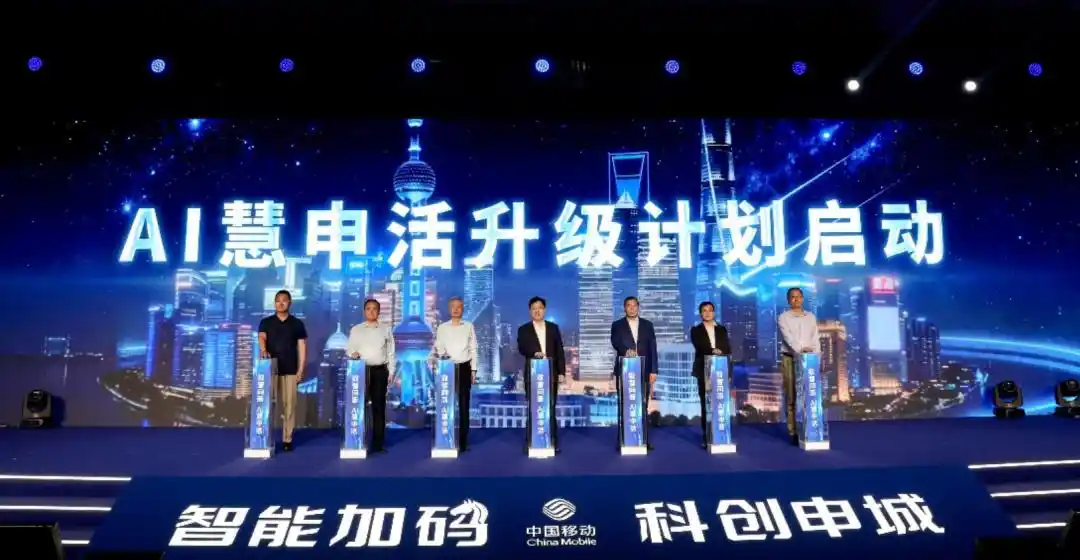
Shanghai Mobile Launches "AI Hui Shen Huo" Upgrade Plan (Image Source: Shanghai Securities News)

Previously, some local branches of China Mobile had conducted pilot AI Token packages. Jiangsu Mobile launched three packages of 2.5 million, 10 million, and 20 million Tokens, each valid for 1 month; Beijing Mobile launched a 5.99 RMB computing power sub-package and a 24.99 RMB/10 million Token monthly package for cloud computer users. Overall, China Mobile is accelerating the launch of AI computing power services through pilot projects by local branches and the group's Token operation ecosystem.

03. China Unicom Advances with Cloud Products and Local Packages, Personal Edition Starting from 15 RMB/Month

Recently, Unicom Cloud, in collaboration with Unicom Yuanjing, officially launched the Token Plan Personal Edition and Team Edition. This Token Plan relies on the Yuanjing MaaS platform, self-developed intelligent agent toolkit, and AI-selected Unicom Cloud computing power, covering scenarios from personal light office work, content creation, and student learning to enterprise R&D, government and enterprise office work, and industry digitization.

The Token Plan is divided into Personal Edition and Team Edition, with a total of 6 tiers. The Personal Edition targets users like independent creators, professionals, students, and self-media bloggers, offering three packages: Lite, Pro, and Max, priced at 15 RMB/month (including 6 million tokens), 30 RMB/month (including 12 million tokens), and 45 RMB/month (including 18 million tokens) respectively.

The Team Edition targets enterprise R&D teams, government and enterprise office teams, and industry solution teams, offering three packages: Team Lite, Team Pro, and Team Max, priced at 198 RMB/month (including 25,000 credits), 698 RMB/month (including 100,000 credits), and 1398 RMB/month (including 250,000 credits) respectively.

The Credits consumed per instance are dynamically determined by factors such as model type, token usage (input/output/cache), thinking mode, and tool calls. Taking DeepSeek-V4-Pro as an example: 25,000 credits are approximately 200 million tokens; 100,000 credits are approximately 800 million tokens; 250,000 credits are approximately 2 billion tokens.
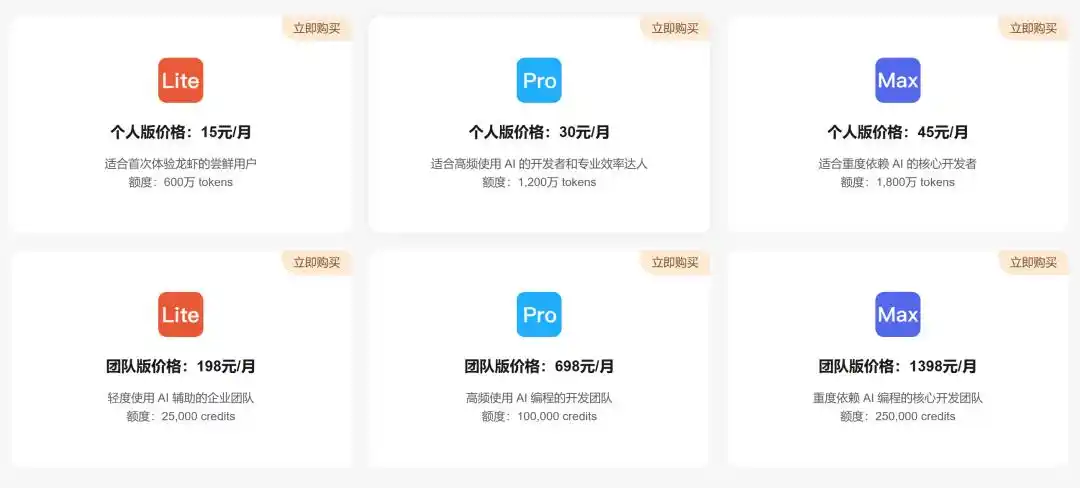
Unicom Cloud Launches Personal and Team Edition Token Plans (Image Source: Unicom Cloud)

In terms of models, the Personal Edition supports DeepSeek V4-Flash and MiniMax-M2.5, while the Team Edition unlocks DeepSeek V4 and provides models such as DeepSeek V4-Flash, DeepSeek V4-Pro, and MiniMax-M2.5.

Additionally, Unicom's self-developed office assistant UniClaw can handle tasks like file processing, document generation, data analysis, deep research, and multimodal content processing, and supports local private deployment.

Besides the unified products from Unicom Cloud, local branches of China Unicom are also simultaneously promoting the landing of Token packages. Yesterday, China Unicom Sichuan Branch released the "Family Token Package", with a fixed monthly fee starting as low as 15 RMB. Combined with Unicom Cloud Desktop and the WorkBuddy intelligent agent application, it allows users to process files and generate reports in the cloud without complex technical deployment.
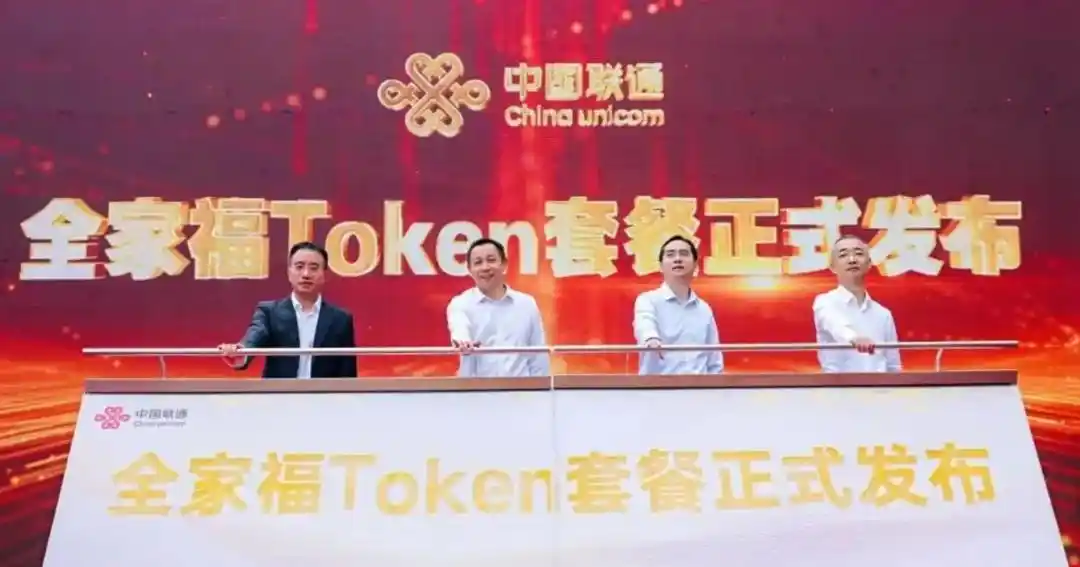
Sichuan Unicom Releases Family Token Package

On May 16, China Unicom Shanghai Branch comprehensively upgraded the "UniAI·Zhi Lian Shen Cheng" artificial intelligence strategy, building a "National Chip, National Model, National Cloud" security foundation. Simultaneously, relying on ten-thousand-card domestic computing power and self-developed scheduling platforms, it launched three types of computing power services, released multiple Token products and integrated packages, and initiated the "Computing Power Inclusive Season".

04. Conclusion: Carriers Collectively Launch Token Packages, AI Computing Power Enters the Mass Market

The consecutive launch of Token packages by the three major carriers signifies, to some extent, that AI computing power is gradually transforming into a basic service for the masses. Compared to the traditional API calling model, carriers' advantages lie in user accounts, phone bill payment, broadband and mobile network access, and service channels targeting families and SMEs.

As Tokens are packaged into monthly packages, instance packages, benefit packages, and integrated packages, ordinary users no longer need to understand model platforms and API calls to use AI. For carriers, Tokens may also become a new category of basic billing unit following voice calls, data traffic, and broadband.

This article is from the WeChat public account "Zhixidongshe" (ID: zhidxcom), author: Yang Jingli, editor: Li Shuiqing


İlgili Sorular

QWhat are the price ranges and token allowances for China Telecom's token plans?

AChina Telecom offers six trial commercial token plans. For developers and SMEs, the Basic, Professional, and Premium plans cost 39.9, 159.9, and 299.9 yuan per month, providing 15 million, 70 million, and 150 million tokens respectively. For individual and family users, the Lite, Enjoy, and Premium plans cost 9.9, 29.9, and 49.9 yuan per month, offering 10 million, 40 million, and 80 million tokens respectively.

QHow is Shanghai Mobile promoting AI token services?

AShanghai Mobile has launched a token service where 1 yuan can purchase 400,000 tokens, and this supports payment via phone bill. They have also partnered with Tencent to launch a co-branded WorkBuddy smart agent workbench. Furthermore, they initiated the 'AI for a Better Shanghai Life' upgrade plan, introducing products like Super Portable Wi-Fi and AI Smart Viewing to bring embodied intelligence and token services into household scenarios.

QWhat are the main differences between China Unicom's 'Personal Edition' and 'Team Edition' token plans?

AChina Unicom's 'Personal Edition' is aimed at individual users like creators and students, with three tiers: Lite (15 yuan/month, 6 million tokens), Pro (30 yuan/month, 12 million tokens), and Max (45 yuan/month, 18 million tokens). The 'Team Edition' targets business teams, with tiers offering Credits: Team Lite (198 yuan/month, 25,000 credits), Team Pro (698 yuan/month, 100,000 credits), and Team Max (1398 yuan/month, 250,000 credits). Credits dynamically translate to tokens based on model usage; for example, 25,000 credits roughly equals 200 million tokens for the DeepSeek-V4-Pro model.

QWhat strategic advantage do telecom operators have in the AI token market?

ATelecom operators like China Telecom, China Mobile, and China Unicom possess significant strategic advantages for the AI token market. These include their massive existing customer bases, established billing and payment systems (like phone bill integration), extensive service channels for households and SMEs, and their core infrastructure in broadband and mobile networks. This allows them to package AI token usage as simple, accessible monthly plans, similar to data or voice packages, lowering the technical barrier for mainstream adoption.

QWhat does the article suggest about the future of AI compute power consumption?

AThe article suggests that the entry of major telecom operators into the token business signals a shift where AI compute power is becoming a mainstream, consumer-facing utility service. By packaging tokens into monthly bundles, pay-per-use packs, and integrated service plans, operators are making AI model usage as straightforward as paying for mobile data or a phone plan. This trend indicates that tokens could evolve into a new fundamental billing unit for operators, alongside traditional services like voice, data, and broadband.

İlgili Okumalar

Understanding the New Economic Model of Tokenization

Understanding the New Token Economics Model The commercialization of AI applications is evolving from selling software and subscriptions to selling token call capacity. Tokens, the fundamental unit of information processing for large language models (LLMs), have become the basis for API billing and consumption. With call volumes exploding, tokens themselves are now being traded—procured, routed, split, and resold—forming a new intermediary market. This layer connects upstream LLM providers with downstream developers and enterprises, acting as a global wholesale-to-retail liquidity network. The rise of this business is fueled by a massive surge in China's daily token call volume—growing over a thousandfold from 100 billion in early 2024 to over 140 trillion by March 2026—and significant improvements in domestic LLM capabilities, which are now competitive globally. The core value of token distribution platforms extends beyond simple arbitrage. Key functions include aggregating multiple models (like GPT, Claude, and domestic models such as Kimi and DeepSeek) under a unified API, lowering network and payment barriers, and providing enterprise services like model selection, prompt engineering, and system integration. Profit models are diversifying: (1) resale margins; (2) technical premiums from proprietary inference acceleration (e.g., reducing costs to 1/10 of the industry standard); and (3) enterprise value-added services. High-consumption scenarios like marketing, short-form video, gaming, and e-commerce are primary drivers. Investment opportunities are seen in both companies with strong model capabilities (e.g., Alibaba, Tencent, MiniMax) and those with high-consumption client scenarios (e.g., marketing agencies with overseas reach). However, risks are significant: low entry barriers leading to intense competition, capital requirements and bad debt risks from advance payments, and dependency on policy changes from upstream LLM providers who control API pricing and access.

marsbit5 dk önce

Understanding the New Economic Model of Tokenization

marsbit5 dk önce

Farewell to the Copper Era: Understanding the Logic of the AI Silicon Photonics Industry Chain and Key US Stock Players

**Summary: The Era of Silicon Photonics and Key AI Infrastructure Stocks** The article delves into the transition from copper-based interconnects to silicon photonics (SiPh) as a critical enabler for next-generation AI data centers. It explains that copper faces fundamental physical limits—the bandwidth wall, density wall, and power wall—at high data rates (1.6T+), making a material shift essential. Silicon photonics, which integrates components like lasers, modulators, and detectors onto a silicon chip, offers a solution by leveraging mature CMOS manufacturing for cost-effective, high-volume production. A key challenge is that silicon itself is not an efficient light source, making Indium Phosphide (InP) lasers a critical and supply-constrained component. A major industry catalyst was NVIDIA's 2025 GTC announcement, declaring optical interconnects a "standard" from its Rubin platform onward, followed by strategic investments to secure the supply chain. The industry is structured in four key layers: 1. **Foundries:** TSMC leads with its COUPE platform, while Tower Semiconductor (specialized SiPh foundry) and GlobalFoundries are major players. 2. **Core Component Suppliers:** Lumentum is highlighted as the sole volume manufacturer of the crucial 200G/lane EML laser, with orders locked by NVIDIA through 2027. 3. **Module & System Manufacturers:** Coherent holds significant market share, with Chinese manufacturers like InnoLight also noted for scale. 4. **System Integrators:** NVIDIA, Broadcom, and Marvell dominate this layer, setting standards and integrating technology. The article identifies core public investment targets: **NVIDIA (NVDA)** as the ecosystem driver; **Broadcom (AVGO)** and **Marvell (MRVL)** in networking/switching chips; **Lumentum (LITE)** and **Coherent (COHR)** for critical components; and foundries **TSMC (TSM)** and **Tower Semiconductor (TSEM)**. Private companies Lightmatter and Ayar Labs are noted as key IPO candidates. The silicon photonics shift is driving a re-rating of company valuations, moving them from traditional telecom/industrial metrics to premium AI infrastructure multiples. The industry features high barriers to entry (e.g., multi-year lead times for InP laser capacity, complex 3D integration/thermal management, and lengthy customer qualification cycles), suggesting a "winner-takes-most" dynamic. Risks include dependence on hyperscaler capex cycles, potential technology disruption among competing optical approaches (LPO, CPO, OCS, Optical I/O), and a timeline where widespread CPO deployment may not occur until ~2028, with LPO serving as a transitional technology. The conclusion advises that betting on the overall industry trend may be safer than betting on any single company.

marsbit44 dk önce

Farewell to the Copper Era: Understanding the Logic of the AI Silicon Photonics Industry Chain and Key US Stock Players

marsbit44 dk önce

POLY's Appearance Hints Are Getting Denser, How Far Away Is the Polymarket Airdrop?

**POLY Debut Hints Grow More Frequent: How Far is the Polymarket Airdrop?** Recent continuous hints from Polymarket team members regarding the POLY token have sparked widespread analysis within airdrop communities about its launch timeline and potential scale. According to predict.fun data, the probability of "Polymarket launching its official token before year-end 2025" currently stands at 56%. Hints about POLY began in October 2024. CEO Shayne Coplan's social media post mentioning $POLY alongside major cryptocurrencies first fueled speculation. This was followed by Growth Lead William LeGate discussing "prospective airdrop farmers," and CMO Matthew Modabber explicitly confirming that "Polymarket will have a token, and there will be an airdrop." The momentum continued into 2025. In April, major crypto data platforms CoinGecko and CoinMarketCap created placeholder pages for POLY, further solidifying expectations. May saw discussions shift towards token utility and airdrop criteria. A team member's "Soon" reply to a question about staking POLY for fee reductions, and a leaked internal screenshot showing an "Airdrop" tab, significantly increased anticipation. LeGate also outlined potential airdrop qualifiers, mentioning badges for employees, high-volume/high-profit traders, and ecosystem builders. He suggested that linking a Polymarket account to X (Twitter), sharing trades and market insights, and actively engaging with the community might constitute part of the eligibility criteria, leading to a surge in related social media activity. Despite the growing hype, the article's author expresses a personal view that Polymarket might prioritize platform stability and infrastructure upgrades—especially with the upcoming World Cup—over an immediate token launch, opting for a post-event release. Their current strategy involves hedging positions across prediction markets, actively trading on Polymarket, and engaging on social media to potentially qualify for a future airdrop.

Odaily星球日报1 saat önce

POLY's Appearance Hints Are Getting Denser, How Far Away Is the Polymarket Airdrop?

Odaily星球日报1 saat önce

İşlemler

Spot
Futures

Popüler Makaleler

BILL Nasıl Satın Alınır

HTX.com’a hoş geldiniz! Billions Network (BILL) satın alma işlemlerini basit ve kullanışlı bir hâle getirdik. Adım adım açıkladığımız rehberimizi takip ederek kripto yolculuğunuza başlayın. 1. Adım: HTX Hesabınızı OluşturunHTX'te ücretsiz bir hesap açmak için e-posta adresinizi veya telefon numaranızı kullanın. Sorunsuzca kaydolun ve tüm özelliklerin kilidini açın. Hesabımı Aç2. Adım: Kripto Satın Al Bölümüne Gidin ve Ödeme Yönteminizi SeçinKredi/Banka Kartı: Visa veya Mastercard'ınızı kullanarak anında Billions Network (BILL) satın alın.Bakiye: Sorunsuz bir şekilde işlem yapmak için HTX hesap bakiyenizdeki fonları kullanın.Üçüncü Taraflar: Kullanımı kolaylaştırmak için Google Pay ve Apple Pay gibi popüler ödeme yöntemlerini ekledik.P2P: HTX'teki diğer kullanıcılarla doğrudan işlem yapın.Borsa Dışı (OTC): Yatırımcılar için kişiye özel hizmetler ve rekabetçi döviz kurları sunuyoruz.3. Adım: Billions Network (BILL) Varlıklarınızı SaklayınBillions Network (BILL) satın aldıktan sonra HTX hesabınızda saklayın. Alternatif olarak, blok zinciri transferi yoluyla başka bir yere gönderebilir veya diğer kripto para birimlerini takas etmek için kullanabilirsiniz.4. Adım: Billions Network (BILL) Varlıklarınızla İşlem YapınHTX'in spot piyasasında Billions Network (BILL) ile kolayca işlemler yapın.Hesabınıza erişin, işlem çiftinizi seçin, işlemlerinizi gerçekleştirin ve gerçek zamanlı olarak izleyin. Hem yeni başlayanlar hem de deneyimli yatırımcılar için kullanıcı dostu bir deneyim sunuyoruz.

53 Toplam GörüntülenmeYayınlanma 2026.05.07Güncellenme 2026.05.12

BILL Nasıl Satın Alınır

Tartışmalar

HTX Topluluğuna hoş geldiniz. Burada, en son platform gelişmeleri hakkında bilgi sahibi olabilir ve profesyonel piyasa görüşlerine erişebilirsiniz. Kullanıcıların BILL (BILL) fiyatı hakkındaki görüşleri aşağıda sunulmaktadır.

活动图片